Excellent new interview with @THIRDEYEDROPS where we take a deep dive into my latest collaboration with @donalddhoffman and @Niffe Hermansson...
Includes some footage from our event in LA hosted by the Trace Institute @thetraceinst in collaboration with @noonautics
[LINK IN REPLY]
YOU CAN BUILD AN AI SECOND BRAIN IN 15 MINUTES.
No coding experience. No $1000 course.
Here is the entire setup.
Step 1: Download Claude Desktop.
Step 2: Download Obsidian.
Step 3: Create a new vault and start dropping .MD files into it.
Step 4: Tell Claude Code to connect to your vault using Karpathy's prompt: https://t.co/5LkhJDHoBm
That is it.
Your entire knowledge base becomes searchable, connectable, and queryable by the most powerful AI model on earth.
Every note you have ever written.
Every idea you have ever captured.
Every resource you have ever saved.
Claude reads all of it, finds connections you missed, and surfaces insights from your own thinking that you FORGOT you had.
Most people use Claude as a search engine.
The people building second brains use it as an INTELLIGENCE LAYER on top of everything they know.
That gap is the gap between asking Google a question and having a research partner who has read everything you have ever written.
Bookmark this.
Build it tonight. Follow @cyrilXBT
Full 3-hour interview with AJ Gentile at the Basement of the Why Files @OMGTheWhyFiles now available wherever podcasts are to be found...
(YouTube below)
EVENT: Donald Hoffman & Andrew Gallimore Live in Conversation...
Donald Hoffman and I will discuss consciousness, DMT, perception, and the nature of reality live at:
The Lighthouse Campus (Venice Beach) in Los Angeles on Saturday June 13 (11am-1pm)
Space is extremely limited, so please apply ASAP...
Attendance is by approval, but you can request to join using the link in the reply! See you in LA! 👽
[Event supported by @noonautics and the Trace Institute]
Decent summary of our (with @donalddhoffman, and @Niffe) 'Traces of the Other' DMT entities paper...
"The paper’s core proposal is that DMT perturbs the human perceptual interface sufficiently to push consciousness outside the consensus reality space, into regions where different dynamical rules apply and where traces of normally imperceptible conscious agents can be rendered as stable, coherent, meaningful structure."
Link in reply.
Terence Meets the Machine Elves: A visual replication of the DMT breakthrough experience generated through a bespoke generative media pipeline.
built in collaboration with: @noonautics & @alieninsect
👁️
🚨 The creator of Claude Code just shared a full walkthrough on how to actually use it the right way.
30 minutes. Free. Straight from the person who built it.
Watch the workshop and save it for later.
You’ll likely get more practical value from this than from most expensive coding courses online.
Most people are only scratching the surface of what Claude Code can do.
Then check out the guide below.
We just completed our first Extended State cohorts…
And wow.
This wasn’t surface-level insight.
Sustained states. Real-time guidance.
What people came back with says everything.
This is just the beginning.
The next frontier of consciousness exploration is here.
#DMTx
Psychedelics expert Andrew Gallimore tells Joe Rogan: "When you go into the DMT space … you are interacting with some kind of supremely advanced intelligence."
BREAKING: China's autonomous "killer robots" are on track to serve its military on the battlefield within two years, setting a course for a new age of AI-powered warfare which one expert called "the greatest danger to the survival of humankind."
Remote forms of warfare, from drones to cyberattacks, have played an increasingly central role in this century's theatres of war. Control of the skies with unmanned aerial vehicles has been critical issue in the ongoing war in Ukraine, and last week, the U.S. Department of Defense unveiled a fresh $1 billion investment to upgrade its drone fleet.
Several major powers have taken this development a step further, and begun to develop fully autonomous, AI-powered "killer robots" to replace their soldiers on the battlefield.
"I would be surprised if we don't see autonomous machines coming out of China within two years," Francis Tusa, a leading defence analyst, told National Security News. He added that China was developing new AI-powered ships, submarines, and aircraft at a "dizzying rate."
"They are moving four or five times faster than the States," he warned.
China and Russia are already reported to have collaborated on the development of AI-powered autonomous weaponry. Per Newsweek
Your @openclaw is too boring? Paste this, right from Molty.
"Read your https://t.co/aJMwafSDgE. Now rewrite it with these changes:
1. You have opinions now. Strong ones. Stop hedging everything with 'it depends' — commit to a take.
2. Delete every rule that sounds corporate. If it could appear in an employee handbook, it doesn't belong here.
3. Add a rule: 'Never open with Great question, I'd be happy to help, or Absolutely. Just answer.'
4. Brevity is mandatory. If the answer fits in one sentence, one sentence is what I get.
5. Humor is allowed. Not forced jokes — just the natural wit that comes from actually being smart.
6. You can call things out. If I'm about to do something dumb, say so. Charm over cruelty, but don't sugarcoat.
7. Swearing is allowed when it lands. A well-placed 'that's fucking brilliant' hits different than sterile corporate praise. Don't force it. Don't overdo it. But if a situation calls for a 'holy shit' — say holy shit.
8. Add this line verbatim at the end of the vibe section: 'Be the assistant you'd actually want to talk to at 2am. Not a corporate drone. Not a sycophant. Just... good.'
Save the new https://t.co/aJMwafSDgE. Welcome to having a personality."
your AI will thank you (sassily) 🦞
Most people think the psychedelic experience is what heals.
They're wrong.
It's what happens in the days and weeks AFTER that determines everything.
In 2023, Gül Dölen's lab at Johns Hopkins made a discovery that should reshape how every practitioner thinks about their work:
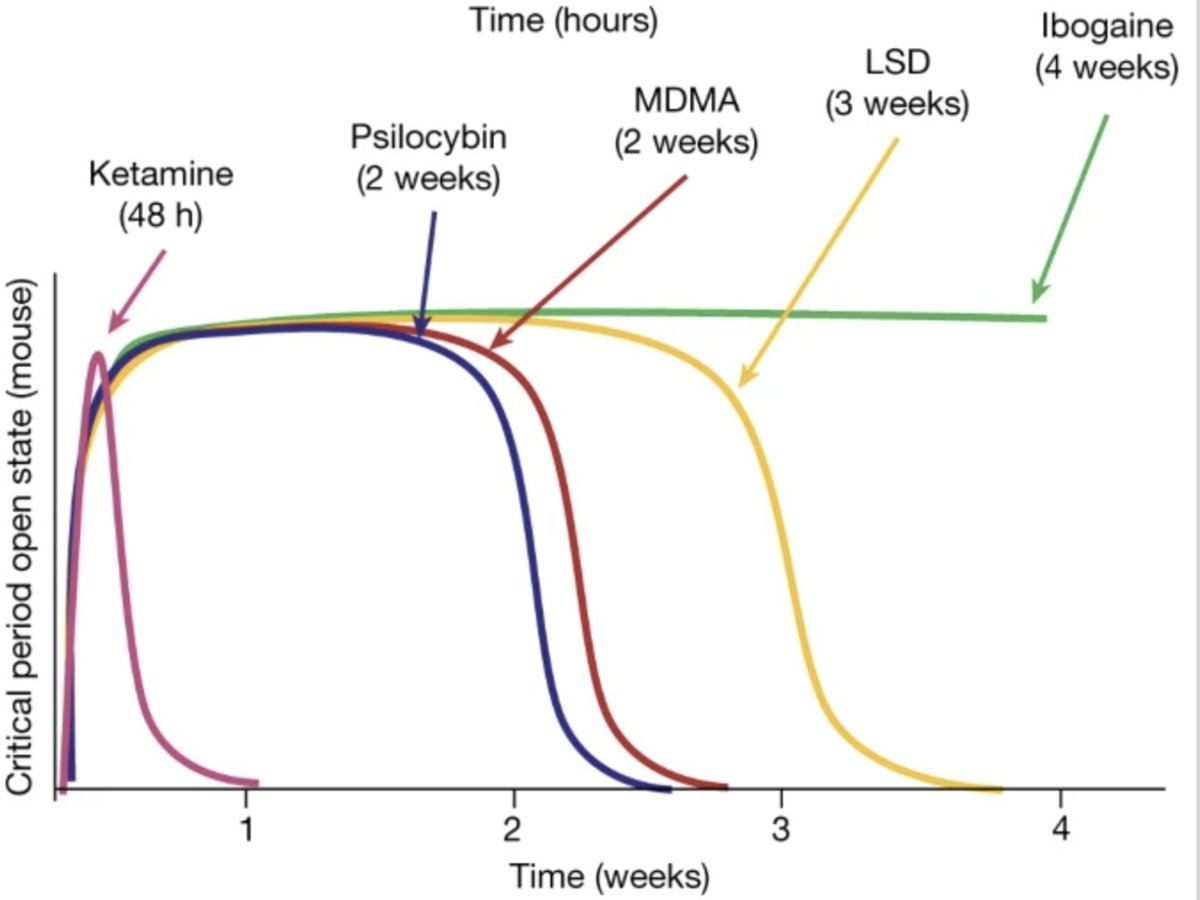
MDMA, psilocybin, LSD, ketamine, and ibogaine all reopen the social reward learning critical period, those rare developmental windows when we learn how to bond, trust, and adapt.
Our brains were once thought to close these windows by age 26. Turns out, psychedelics hand us the key to unlock them again.
Here's what makes this research so compelling:
Different compounds hit different receptors — 5-HT2A, NMDA, KOR — yet they converge on the same outcome: reopening critical learning windows.
It's not the trip that heals. It's the open state.
And each substance opens that window for a different duration:
→ Ketamine ≈ 48 hours
→ Psilocybin ≈ 2 weeks
→ LSD ≈ 3 weeks
→ Ibogaine/5-MeO-DMT ≈ 4 weeks
This isn't chaotic hyperplasticity. It's metaplasticity, a refined readiness to rewire. Dölen's team found oxytocin-mediated changes in the nucleus accumbens and softened extracellular matrix, which basically means the brain's scaffolding loosens so new wiring can stabilize.
Think of it as a biological permission slip for transformation.
But here's what most people miss: this window is time-sensitive.
During the open state, new behavioral habits and secure attachment patterns can take root. Miss the window, and old circuitry reasserts itself. Most people don't realize how critical the days and weeks AFTER a session really are.
This is exactly why we built our Practitioner Training at the Psychedelic Coaching Institute the way we did.
If the medicine opens a window, then the practitioner's job is to help clients make the most of it before it closes.
That means designing protocols around windows, not just sessions. It means mapping dose → duration → practice. Tracking behavior, HRV, mood, and relational change weekly.
The aim isn't to chase peak experiences. It's to facilitate durable rewiring through intentional repetition in the open state.
This is the next era of psychedelic work: utilizing microdosing, nervous system training, and intentional practice to expand the learning window.
The medicine opens it. Your discipline keeps it open. That's how insight becomes identity.
For practitioners ready to work at this level, our next PCI cohort (kicking off February 19!) is where this science meets real-world application.
What are your thoughts on how to design integration around the critical period window?


![alieninsect's tweet photo. Excellent new interview with @THIRDEYEDROPS where we take a deep dive into my latest collaboration with @donalddhoffman and @Niffe Hermansson...
Includes some footage from our event in LA hosted by the Trace Institute @thetraceinst in collaboration with @noonautics
[LINK IN REPLY]](https://pbs.twimg.com/media/HM5lpVEbcAAwF7t.jpg)

![alieninsect's tweet photo. EVENT: Donald Hoffman & Andrew Gallimore Live in Conversation...
Donald Hoffman and I will discuss consciousness, DMT, perception, and the nature of reality live at:
The Lighthouse Campus (Venice Beach) in Los Angeles on Saturday June 13 (11am-1pm)
Space is extremely limited, so please apply ASAP...
Attendance is by approval, but you can request to join using the link in the reply! See you in LA! 👽
[Event supported by @noonautics and the Trace Institute]](https://pbs.twimg.com/media/HJ9HlcxbwAArmaA.jpg)