My suggestion that we follow a structured cycle for each tier of government, in this brief article. Illustratively, in year 1, national elections; in year 3 all states, in year 4, all local bodies
https://t.co/rkbwVxNMDv
@ppchaudharybjp
VIDEO | Lucknow: Chairman of the Joint Parliamentary Committee on One Nation, One Election, P.P. Chaudhary (@ppchaudharybjp) says, "See for One Nation, One Election, the committee has come to Lucknow, we have already visited nine states, we are discussing with the stakeholders, because it is a big election reform... Everybody's suggestion would be considered, then the report will be presented."
#OneNationOneElection
Why progs to support MSMEs fail?
Wrong sequencing
Evidence from Africa shows finance given before capability building yields defaults, not growth. Market access first, then sellable products, branding, management skills, infrastructure — finance last
@minmsme@dcmsmeoffice
MSME Productivity: Lessons from Africa — EGROW Webinar
The Presentation
MSMEs are large employers across the developing world — accounting for 60 to 65 per cent of total employment in India — yet most are informal, low-wage micro enterprises that prioritise stability over growth. Improving their productivity is nonetheless essential, as it enables this vast employment base to generate higher incomes and sustainable jobs.
Productivity improvement is difficult for two reasons. Politically, many MSMEs seek protection from competition rather than growth. Analytically, with so many potential drivers — finance, technology, infrastructure, markets, management — there is no consensus on where to start.
Africa, where MSME development is at an earlier stage, offers a clearer view of the fundamental first steps. Thriving African MSMEs cluster in and around marketplaces, confirming that market access comes first. Next comes product improvement — a sellable product must precede efficiency. Then branding and new sales channels, followed by management capability as firms grow beyond the owner's direct oversight.
Randomised trials show management training improves productivity, though employment effects are limited. Infrastructure — power, water, space to expand — must accompany capability building. Finance comes last: credit extended before capability, as African experience shows, produces bankruptcies rather than growth.
Discussion: The European Transition Experience
Drawing on Bulgaria's post-hyperinflation transition, the discussion confirmed that most micro enterprises are survival-oriented rather than growth-oriented — research showed 85 per cent simply do not wish to grow.
Productivity is a complex function requiring internal effort by firms to absorb technology and organise better, with the search for high value-added products as the starting point. In Africa's development stage, however, greater responsibility rests with governments: facilitating technology transfer, opening access to large markets in Europe, Asia and North America, and investing in education.
A caution was noted — rising productivity in transition economies often meant shedding workers as automation replaced jobs.
Discussion: The African Development Perspective
African enterprises are smaller on average than anywhere else, with the highest share of micro enterprises — partly explaining low productivity. Exporting firms are more productive, and linkages with large enterprises and FDI offer channels for learning.
Africa's specific constraint is energy: it is the least electrified continent, and closing the power gap would itself raise productivity. Mentoring proves more effective than one-time training but must be sustained.
Inclusion matters — women, youth, seniors and persons with disability as entrepreneurs. Africa's 54 countries vary enormously, and small firms' staying small is often by design, not inability.
Conclusion
Three lessons emerge:
1. Sequencing matters. MSME support programmes fail when finance comes before capability. The right order is market access, sellable products, branding, management skills, infrastructure — and finance last.
2. Small is rational, not unambitious. Micro enterprises stay small not from lack of ambition but rational caution — unreliable power, weak infrastructure, informality and risk make expansion dangerous. Fix the environment and growth follows.
3. Productivity and jobs together. More MSMEs is not the goal — more productive MSMEs is. Yet since productivity gains can reduce employment, the true policy challenge is achieving both.
New research on political pressure on Fed Res finds a clear pattern: pressure to ease policy ahead of elections raises inflation persistently, with inflation expectations most affected — but real output & jobs barely move, costly step
#MonetaryPolicy#CentralBankIndependence
Join us today in an informative and enlightening webinar on "Political Pressure on the Fed" by Prof. Thomas Drechsel at 4:30 pm IST
Link: https://t.co/JfmdYlbPIW
Brazil's growth has followed boom-bust cycles rather than sustained rise, shaped by debt, hyperinflation, and deep inequality
Fiscal reform now compete with powerful lobbies
Key lesson: growth without equitable distribution is unsustainable—India must pursue both together.
Informative discussion: Crop insurance enrollment is rising, yet claim-to-premium ratios are falling—payouts averaged across regions miss individual losses, claims settle slowly, and many farmers remain unaware they're even enrolled
Imp lessons from from China, USA, Kenya.
The US–Iran dear remains fragile & unsigned
For India, exposure runs thru Hormuz-dependent oil, LNG & LPG, latent inflation & constrained strategic space
Recommend: diversify energy sources, accelerate renewables, secure Chabahar, institutionalise resilience to global shocks
@Indiastory91 ✈️Noida International Airport (DXN) has announced that flight operations from 15th June 2026. Indigo will be the first operator, followed by Akasa and Air india Express
#Noidaairport#Jewar@jewar_airport
Fantastic article. Thank you @Sachin_Chat for flagging this important strategy to achieve viksit Bharat@2047
It is the ground up - district level - approach that can help local government and community to innovate and participate in this revolutionary progressive
@nalanda_univ
📖 Professor Sachin Chaturvedi in The Indian Express | Measuring the Economy, from the Ground Up
Nalanda University is pleased to share an insightful opinion piece by our Hon’ble Vice Chancellor and noted Economist, Professor @Sachin_Chat Ji, published in @IndianExpress today.
In this thought-provoking piece, Prof. Chaturvedi makes a compelling case for district-level GDP measurement as a critical step towards more effective policymaking, stronger cooperative federalism, and truly inclusive development. He emphasizes that understanding economic realities at the district level is essential for ensuring that growth is accurately measured, better targeted, and more responsive to local aspirations.
“What gets measured gets tracked.” By bringing districts into the centre of economic measurement, India can build a more transparent, people-centric, and globally competitive development framework.
📰 Read the full article: https://t.co/Ef3LTw4nRf
@PMOIndia | @MEAIndia | @IndianDiplomacy | @FinMinIndia | @EACtoPM
@PravinSawhney India’s strength will be measured by brute force which we are building steadily under Modi .. after long periods of indecision by congress and mixed govts .. nothing changed when US added indo to its pacific command name and nothing changed now when it dropped it
It rewards those who imagine — and then build - our Viksit Bharat@2047 is an illustration
New EGROW Working Paper by Satish Chandra Mishra: The Age of Discontinuity stresses the need to think out of box & not just extrapolate on the basis of past trend
🔗 https://t.co/6fYnjwLfwG
From Viksit Bharat 2047 to Indonesia Emas 2045, this EGROW Working Paper highlights why Asia must move beyond old models and prepare for bold, discontinuous change.
Link: https://t.co/3lt4j1FCgP
Thank you @ShamikaRavi for analytical interview
Our research had similar concl -https://t.co/euHUtcpc4v
Despite flagging issue, there is no care center for new born child, even in Lutyen Delhi or NITI. Maternity leave is not of long duration so sadly young mothers quit
@PMOIndia
Superb, why only pilots, even economists, especially monetary, also need to learn @ashwani_mahajan
Take-off; flight height, speed; landing: all important
For Viksit Bharat@2047, should IT be 4% or can go upto 6% without policy interjection, to encourage growth & emp?
@PMOIndia
Excellent discussion on how India cannot afford jobless growth, given that 1 crore youth enter work force annually
Manufacturing’s share sliping & workers rushing back to agriculture
Need
*Labor intensive industrial policy
*MSMEs
*Women’s work
*Skill dev
@PMOIndia@minmsme
Egrow-Assocham Shadow MPC, combining economists, professional experts & industrialists, recognised massive uncertainty prevailing globally
Currency Stabilisation is important for trade & investment
To augment FER, NRI/FCNR bonds can be an option
@PMOIndia@FinMinIndia@RBI
Forty-Sixth EGROW Shadow Monetary Policy Committee Meeting on June 1, 2026
Key Takeaways :
1. The global situation is extremely uncertain regarding the direction of oil prices.
2. Global economy can take 2-3 years to recover from damage caused by the conflict in Middle East.
3. Currency stabilization is important for trade and investment.
4. The Rapid depreciation of Indian Rupee needs to be addressed.
5. The Current Account Deficit needs to be carefully managed.
6. Instrument like FCNR- NRI bonds can be considered, as in 2013.
7. Climate including Monsoon can be more inflationary.
8. To correct the CD ratio banks are raising rates for deposits.
9. In view of globally driven shocks, monetary policy requires careful calibration.
10. Avoid abrupt monetary tightening despite concerns for higher inflation.
Recommendations of EGROW Shadow MPC :
Members of EGROW — 5
Repo Rate – No change
Stance – Neutral
Guests — 4
Repo Rate – No change
Stance – Neutral
Read more :
https://t.co/1nkkQHlgHE
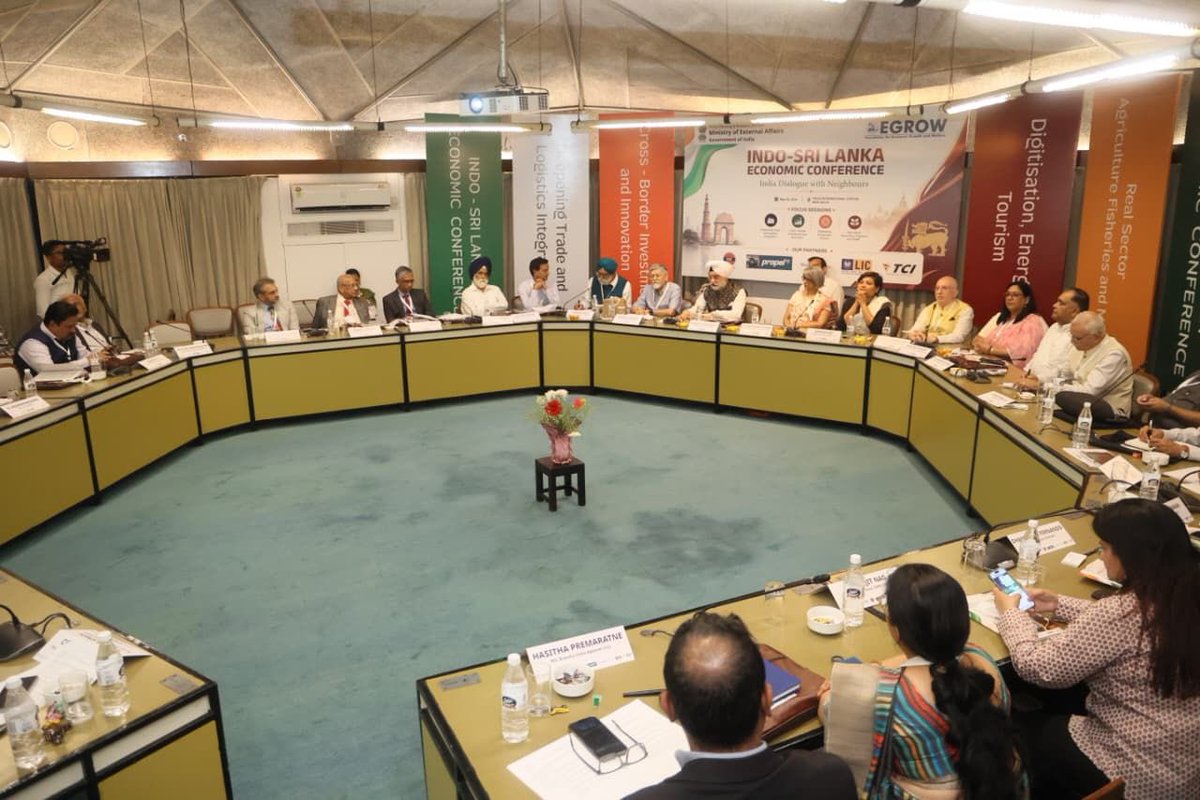
In an extensive day-long discussion on Indo-Sri Lanka Economic Relations, Hon LG, stressed immense potential of enhancing trade relations, investment, renewable energy, digital economy and infra development. Delhi drives innovation & provides policy leadership
@LtGovDelhi
Made keynote remarks at the Indo-Sri Lanka Economic Conference today at IIC Delhi. Underlined the deep bond rooted in history, culture, and commerce, which has today evolved into a strong strategic partnership.
Sri Lanka remains an indispensable partner in the Indian Ocean region. Guided by Hon’ble PM Shri @narendramodi Ji’s ‘Neighbourhood First’ vision, 🇮🇳 and 🇱🇰 are together unlocking immense opportunities in renewable energy, the digital economy, and infrastructure development, with cities like Delhi driving innovation and policy leadership behind these transformative initiatives.
Our shared commitment to deeper trade, enhanced connectivity, and mutual trust will help build a resilient economic corridor that advances inclusive growth and strengthens prosperity for the people of both nations.
Had an excellent discussion on Way Forward on Hon PM @narendramodi 7 apeals-
https://t.co/E33orW1hIr
These 7 should become integral part of Viksit Bharat@2047 as these are imp for nation & citizens, environment
Some rich citizens can afford but can India afford? NO
@PMOIndia
India continues to scale new heights of progress but at the same time there are several challenges we have to overcome.
Here is my appeal to my fellow Indians.
Rigorous analysis on Global Imbalances (GI) by Dr Patnam
Tariffs simply cant fix as there are fundamental problems in domestic economies of major countries. Consequently, EMEs & small countries suffer
Challenge for Multilateral inst: Correction of GI, & with equity
@IMFNews
Hon PM @narendramodi is correctly ensuring adequate Foreign Exchange (FE)
Sugg for constructing Wedding Parks (WP) across India to curtail wedding related international Travel
With 50 lakh marriages expected annually, developing WPs nationwide will also boost economy
@PMOIndia
India continues to scale new heights of progress but at the same time there are several challenges we have to overcome.
Here is my appeal to my fellow Indians.
Hon PM @narendramodi is correctly guiding us to preserve Foreign Exchange (FE) for difficult times
Sugg
In apparently prosperous India, can we reduce free rations to BPL or only needy 40 cr instead of 80 cr? The saved foodgrains can be sold in global market to earn FE
@PMOIndia
India continues to scale new heights of progress but at the same time there are several challenges we have to overcome.
Here is my appeal to my fellow Indians.
Excellent nudge by Hon PM @narendramodi to save Foreign Exchange Reserves
Sugg
Incentivise use of public transport?
Eg: In cities with metro, car parking can be made expensive & use of monthly pass of more than 20 days should be rewarded with double reimbusement
@PMOIndia
India continues to scale new heights of progress but at the same time there are several challenges we have to overcome.
Here is my appeal to my fellow Indians.