While Keynes blamed the Great Depression on market failures and demanded government intervention, Friedrich Hayek delivered the real explanation in his brilliant 1931 lectures "Prices and Production." The Austrian economist laid out precisely how central bank credit expansion creates unsustainable booms that must end in devastating busts.
Hayek explained that when central banks artificially lower interest rates below their natural market level, they distort the price signals that coordinate economic activity. Entrepreneurs receive false information about consumer preferences and available savings. They launch investment projects that appear profitable but consume resources that don't actually exist. The Fed had done exactly this throughout the 1920s, pumping credit into the economy and fueling the speculative mania that Keynes and his followers mistook for genuine prosperity.
The inevitable crash came in 1929 when reality reasserted itself. Malinvestments had to be liquidated. Workers had to move from unsustainable industries back to productive ones. Prices had to adjust to reflect actual supply and demand conditions. This painful but necessary correction process would have restored the economy to health relatively quickly.
Policymakers followed Keynesian logic instead. They propped up failing businesses, prevented wage adjustments, and launched massive government spending programs. President Hoover increased federal spending by 50% between 1929 and 1932. Roosevelt doubled down with the New Deal's alphabet soup of interventions. Each program delayed the natural healing process and prolonged the depression for over a decade.
Hayek's analysis stands vindicated by history while Keynesian demand management continues wreaking havoc through boom-bust cycles worldwide. The next time politicians promise to spend their way out of recession, remember who actually explained what went wrong in the 1930s.
The moment you find yourself moving in lockstep with a mass, repeating its talking points, dismissing inconvenient facts, defending contradictions, and rationalizing betrayals, you have completely surrendered your mind.
This kind of thinking is profoundly limiting. It shrinks the human experience down to a narrow corridor of approved beliefs and sanctioned emotions.
You trade the full spectrum of perception for a sense of belonging. You lose nuance, depth, curiosity, and the strange joy of discovering you were wrong.
Liberty lives in the capacity to question without requiring permission. A liberated mind can hold two opposing ideas at once without panicking or collapsing into dogma. It can sit with tension, uncertainty, and incomplete answers. This is how reality gets examined rather than rehearsed.
A liberated mind carries its own authority, and that is precisely why every system tries to cage it.
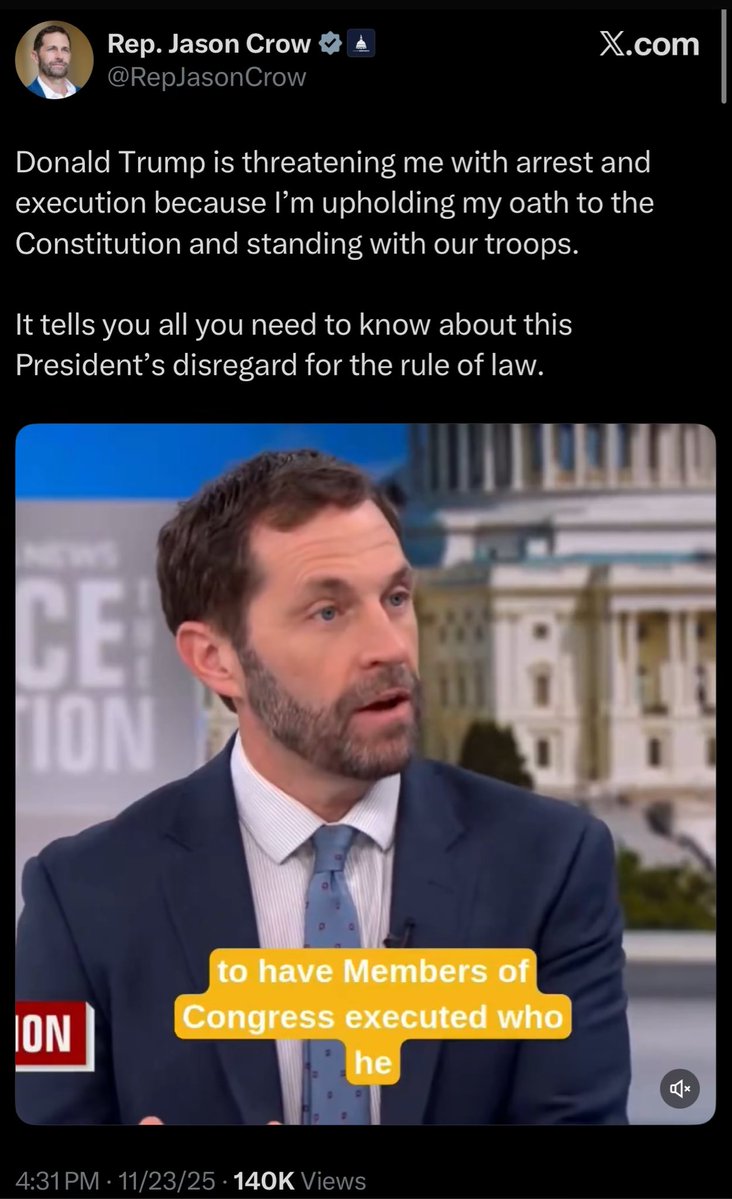
Since they seem intent upon continuously using doctrinal propaganda on the US populace, I think it’s important to highlight exactly what Crow and other Members of Congress are really doing.
Rep. Jason Crow’s post is a doctrinal example of narrative escalation within modern IO and psychological warfare doctrine.
Check out FM 3-05.301 / MISO.
By claiming that the President is threatening him with arrest and execution—a statement never actually made by Trump—Crow amplifies and inflates the narrative to its most extreme form in order to shape public perception.
This tactic, often called interpretive maximalism, takes an opponent’s words or actions and stretches them into a dire or existential threat, allowing the speaker to adopt a position of moral heroism while casting the opponent as an authoritarian danger.
When Crow doubles down on this framing, he creates what IO doctrine refers to as a self sealing narrative, where any denial or criticism becomes proof of the alleged threat.
The emotionally loaded language like “upholding my oath,” “standing with our troops,” “disregard for the rule of law,” are designed to trigger identity based responses and mobilize his political base through fear, outrage, and moral urgency.
In doing all of this, Crow shifts the conversation away from what was actually said and into a battle over perceived intent, a classic PSYOP mechanism that reframes political disagreement as existential warfare.
This is not an evidentiary argument—it is a strategic influence play aimed at narrative dominance.
It is important that Americans recognize these tactics so that they can understand when propaganda is being pushed by their own government officials.
"who designed this? too many columns. structurally redundant. waste of materials. look at those muppets in their matching pink, how stupid. acoustics could be improved by at least 17%. should install hexagonal sound panels. i wonder what's happening on 𝕏"