Ask anyone holding AI coins what their token actually does for AI. Most can't answer in one sentence.
That's why they keep rotating into the wrong one every cycle.
Here is how I sort the top AI crypto projects before I ever touch a chart.
Compute, Intelligence, Agents.
1. Compute: the rails AI runs on
solana:rndrizKT3MK1iimdxRdWabcF7Zg7AR5T4nud4EkHBof for decentralised GPU power
$ICP and $NEAR for onchain AI infrastructure
2. Intelligence: the networks producing the models
bittensor:native Bittensor
$VVV Venice for private, uncensored inference
3. Agents: the apps putting AI to work
$VIRTUAL Virtuals Protocol
ethereum:0xaea46a60368a7bd060eec7df8cba43b7ef41ad85 Artificial Superintelligence Alliance
Where does $INJ fit? It is a strong chain, but its AI angle is tooling rather than the core bet.
Narratives rotate every cycle, but the layer that captures real usage is the one that keeps the bid.
So what does your AI coin actually do?
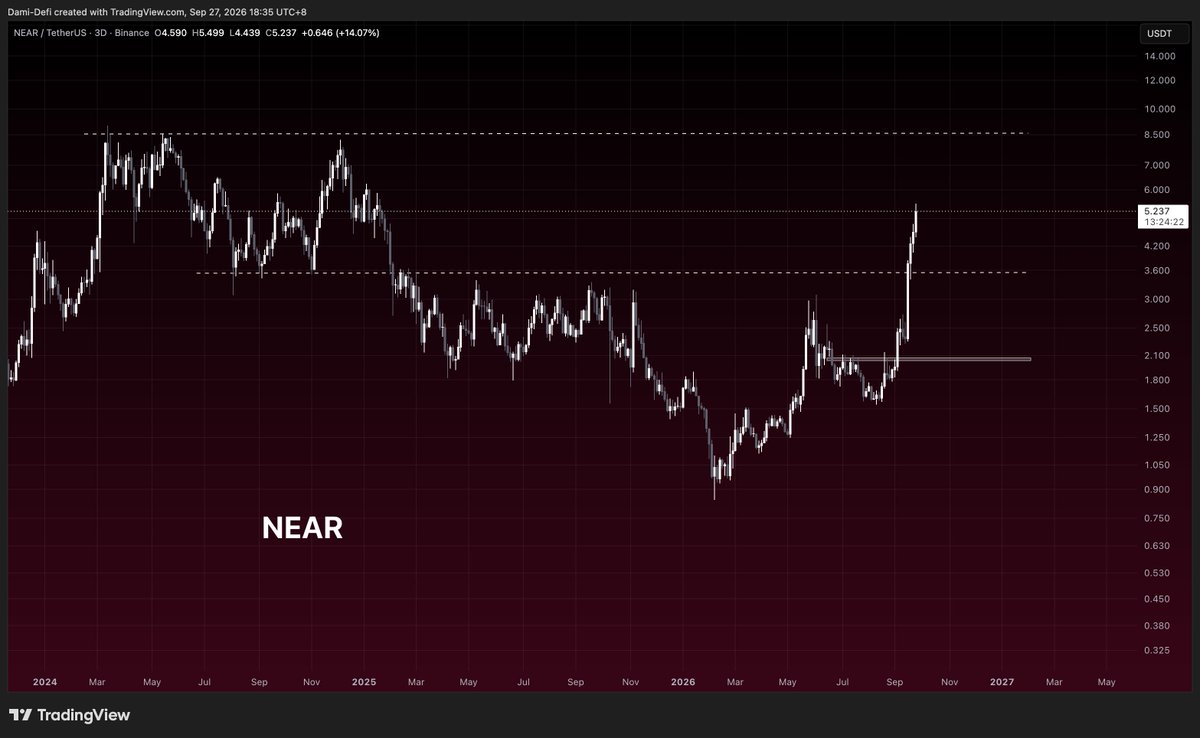
$NEAR’s move above $3.60 has opened the higher range. Holding that level matters on any pullback.
$NEAR was around $2.22 on my September 5 chart when I highlighted the bullish momentum and recovery above the $2.05 area.
It’s now trading around $5.23, roughly 136% higher, with the current 3D candle reaching almost $5.50.
The important development is how far price has progressed beyond that initial reclaim.
That $3.60 area mattered repeatedly during the earlier range, so clearing it strengthens my continuation thesis.
I’m still bullish, but the next resistance I’m watching is approximately $5.50–$5.80, where earlier price action shows several reactions.
A clean break and hold above it would put approximately $6.50, then $7.00, on my radar.
The upper dashed level around $8.50 remains the larger objective, with those closer resistance areas coming first.
The scariest thing about AI is not that it thinks.
It is that it sounds exactly as confident when it is wrong.
Once you see how the machine actually works, that stops being a mystery and starts being a rule you can use.
I broke it down in six simple steps, no jargon.
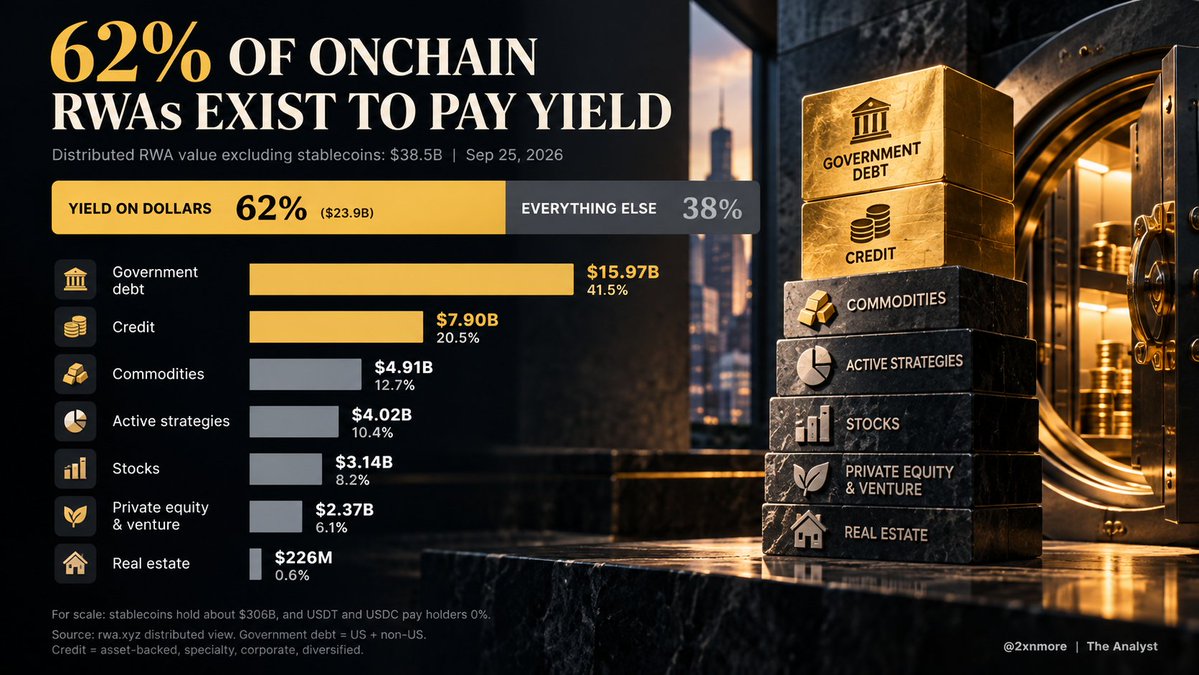
Most of the RWA market is not about owning companies or property.
It is about earning yield on dollars, because your stablecoins pay you nothing.
Distributed RWAs onchain, excluding stablecoins, per rwa. xyz:
$38.5B
Here is what most of it is.
Government debt: 41%
Credit: 21%
Together, that is 62% of the market, and both exist mainly to pay yield. Credit also carries default risk that treasuries do not, but the reason people buy both is the same.
Here is why that matters.
When you hold USDT or USDC, the issuer earns interest on the reserves backing your dollars. You earn zero.
Tokenised treasuries fix exactly that. They are the same dollars onchain, but the yield goes to you instead of the issuer.
So the RWA boom is not mainly an ownership story. It is a yield story.
And yield stories answer to one thing: interest rates.
When rates are high, sitting in a stablecoin at zero is expensive, and money moves into tokenised treasuries.
When rates fall, that gap shrinks, and the easiest reason to hold RWAs gets weaker.
That is the part almost nobody is pricing into the "RWA to trillions" posts.
The real test is the part that does not depend on rates. Commodities, mostly gold, are already 13% of the market. Tokenised stocks are still small.
That is the bucket that will prove tokenisation can stand on its own.
The RWA market is a rates trade wearing a tokenisation costume, and the Fed is holding the other end of it.
Opus 5.5 is quietly the best value model Anthropic has shipped.
Anthropic just published the official playbook for Opus 5.5, written by Addy Osmani, who spent years on Google's Chrome team.
40% cheaper than Opus 5. Cache reads 60% cheaper. Fable 5.1 level on most tasks. Runs for hours on its own.
If you're still prompting it like the old models, you're paying more for less. Everything you need is in the article.
The next $TAO halving lands in December 2029.
Daily emissions drop from 3,600 to 1,800 TAO.
That makes 2030 the first full year of half the new supply.
So what's your number for 2030? Not the moonboy one.
The one you would defend in public with your name on it.
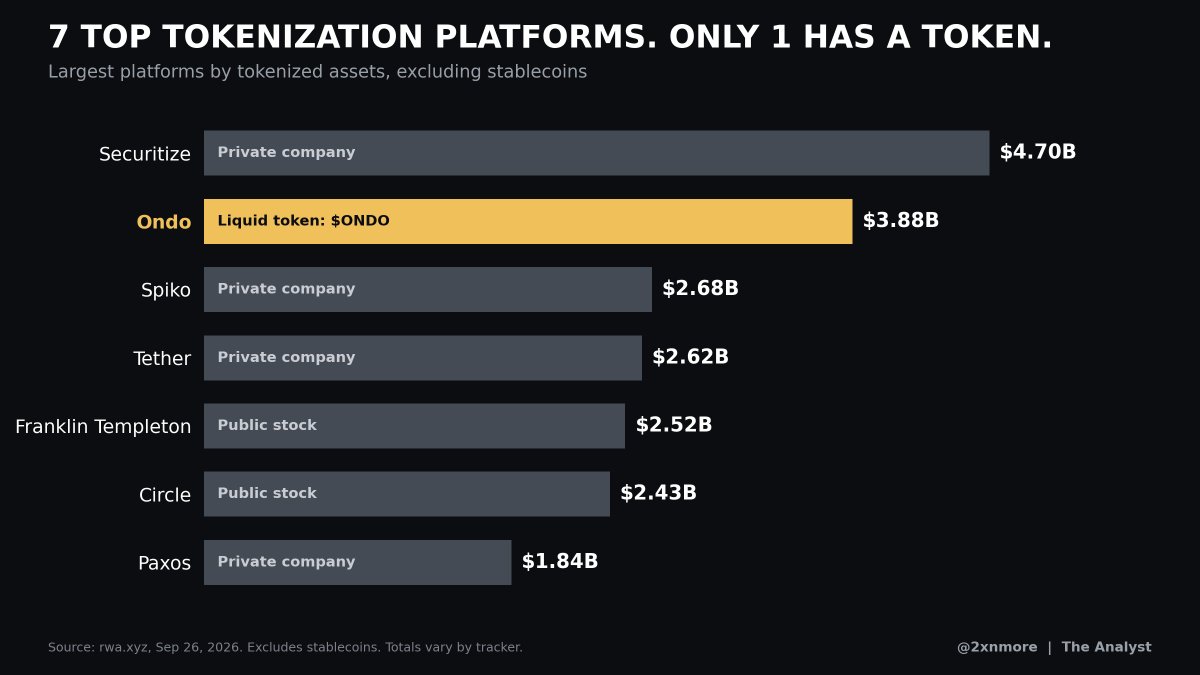
The companies winning in tokenisation do not have a token for you to buy.
Here are the largest tokenisation platforms right now, excluding stablecoins.
Securitize: $4.70B
Ondo: $3.88B
Spiko: $2.68B
Tether: $2.62B
Franklin Templeton: $2.52B
Circle: $2.43B
Paxos: $1.84B
Seven platforms, billions in assets each, and only one of them has a liquid token.
That is Ondo, sitting in second.
The rest are private companies or public stocks. Franklin and Circle trade on stock exchanges, so if you want their tokenisation growth, you buy equity, not crypto.
That changes how you should read every tokenisation headline.
When the market grows, most of that growth lands on balance sheets you cannot touch onchain.
So check three things before you get excited.
Size: which slice of the market is the chart actually measuring gold, stocks, treasuries or all of it?
Mix: who is issuing the assets that are growing?
Owner: does any of that growth flow to a token you can actually hold?
Ondo is the one top platform you can own as a token, which makes the capture question the entire trade.
Bitcoin paid the world to solve puzzles nobody needed.
Bittensor PAYS it to produce intelligence everyone will.
That flips the most familiar story in crypto on its head.
The same mining model that burns a Poland's worth of electricity securing a ledger is now being pointed at useful work.
And the man who saw Bitcoin before Wall Street did took the CEO seat at the company built around it.
The market priced the BlackRock logo.
It has not priced what happens when a whole allocation becomes collateral.
That is the part almost nobody is reading.
Tokenised stocks were the first leg of RWA: one ticker, one name, and an easy headline.
Intelligent Portfolios are the second leg.
One token now holds a full mix, whether that is income, diversified growth or high growth, rebalanced on a schedule.
No private banker.
No rebalance spreadsheet.
BLKHIon
BLKDIGon
BLKGRWon
BlackRock sold the model. Ondo runs the engine. You hold the wrapper.
You still do not own the shares.
You still do not get the vote.
US persons still cannot buy it.
What changed is the unit of account.
A stock token is inventory. A portfolio token is a product.
And a product that is also a token can sit under a loan or a perp.
That is how a "sensible diversified portfolio" turns into leverage with a blue chip logo on the box.
Ondo keeps building the rails. The company keeps the spread and the service fee.
ethereum:0xfaba6f8e4a5e8ab82f62fe7c39859fa577269be3 is still waiting for the tap.
So ask the only question that sizes this.
Is this the moment RWA stopped selling assets and started selling allocation?
Or is it just another Wall Street headline with no fee switch behind it?
Drop your honest read. I will read every reply.
$ONDO JUST RALLIED 20%+ IN 24 HOURS, AND THE CATALYST IS HUGE.
Ondo just launched Intelligent Portfolios, with three onchain portfolio tokens built from strategies developed by BlackRock.
→ BLKHIon: High Income
→ BLKDIGon: Diversified Growth
→ BLKGRWon: High Growth
One token can now represent an entire professionally designed portfolio, with onchain transparency, rebalancing, and DeFi composability.
Ondo isn't just tokenizing assets anymore. It's tokenizing how people invest.
BlackRock just designed three portfolios you can hold as a single token onchain.
Most people will read that headline wrong.
BlackRock is not running your money here. It designed the strategies, and Ondo builds and runs them.
That distinction is the whole story, so here it is in plain language.
Ondo just launched Intelligent Portfolios.
Think of it as the difference between ingredients and a finished meal.
Until now, Ondo gave you ingredients: tokenized US stocks and ETFs, one at a time. You still had to decide what to hold, in what mix, and when to rebalance.
An Intelligent Portfolio hands you the finished meal. One token holds an entire professionally designed portfolio, and the rebalancing happens automatically.
It works in three layers.
Strategy, Engine, Token.
Strategy: a manager designs the mix. The first three strategies come from BlackRock, built specifically for Ondo.
Engine: Ondo encodes the allocation, the rebalancing schedule and the fees into smart contracts, with real tokenized stocks and ETFs underneath.
Token: you mint or redeem one token to move in or out, and there is nothing else to manage.
The first lineup:
BLKHIon
High Income, a global income strategy
BLKDIGon
Diversified Growth
BLKGRWon
High Growth
So why not just buy an ETF?
An ETF trades only during market hours, is limited by where you live, and only shows what it holds in periodic disclosures.
These tokens trade around the clock outside restricted jurisdictions, every rebalance is visible onchain, and the token itself can be used across DeFi.
That last part is genuinely new. A whole diversified portfolio can now back a loan or a perps position.
Now the fine print.
"Powered by BlackRock" means the strategy came from BlackRock. It is not a BlackRock fund, and BlackRock is not the one executing it.
The announcement does not list the fees.
Access excludes restricted jurisdictions, so check where you stand before you get excited.
If you hold ethereum:0xfaba6f8e4a5e8ab82f62fe7c39859fa577269be3, the question from Private Client still applies. The portfolios have fee logic built in, but nothing in the launch says how any of that value reaches the token.
Ondo just built a private client desk for its whales, and now it has built a portfolio product for everyone else.
That is the shift from access to allocation. Ondo is no longer just putting assets onchain. It is starting to manage how people invest them.
Ondo is quietly becoming an asset manager, and the only thing still missing is proof that ethereum:0xfaba6f8e4a5e8ab82f62fe7c39859fa577269be3 gets paid like one.
The market is arguing about a dozen narratives.
Price has only confirmed three.
Privacy
$ZEC ~$25B
The privacy coin institutions can actually access.
$XMR ~$10.4B
Still the default when privacy is mandatory.
$DASH ~$0.8B
Same sector, roughly 1/30th of ZEC.
RWA
ethereum:0xfaba6f8e4a5e8ab82f62fe7c39859fa577269be3 ~$2.1B
Tokenised treasuries and stocks with real TVL.
$SYRUP ~$240M
Maple's private credit, with actual loans and actual yield.
$CFG under $100M
A small token sitting on $1B+ of tokenized assets.
AI
$TAO ~$3.3B
Already priced as the category leader.
solana:rndrizKT3MK1iimdxRdWabcF7Zg7AR5T4nud4EkHBof ~$0.9B
GPU compute people actually pay for.
ethereum:0xaea46a60368a7bd060eec7df8cba43b7ef41ad85 ~$0.5B
Same agent narrative as TAO at about 1/7th the cap.
The BTC bounce has already carried $TAO, ethereum:0xfaba6f8e4a5e8ab82f62fe7c39859fa577269be3, solana:rndrizKT3MK1iimdxRdWabcF7Zg7AR5T4nud4EkHBof and xeqm-labs:native higher.
The first leg pays the names everyone already knows.
The second leg pays the names the crowd still treats as optional.
Look at the bottom of each list again.
That gap is the trade.
Of these, which one is still the diamond in the dirt?
The product just earned a private client desk.
The token still has not earned a cut.
Ondo Private Client is the moment this stops being a retail experiment and starts looking like a brokerage.
$25M books do not show up for a badge.
They show up when they can trade size without broadcasting every fill.
That part is now live.
What is still missing is the only part that actually pays ethereum:0xfaba6f8e4a5e8ab82f62fe7c39859fa577269be3 holders.
Usage is compounding. Capture is not.
The next headline that matters is not another ticker.
It is the first mechanism that ties volume, AUM or fees back to the token.
Until then, you are holding the distribution layer while the business treats the token like a mascot.
Which one do you think it becomes?
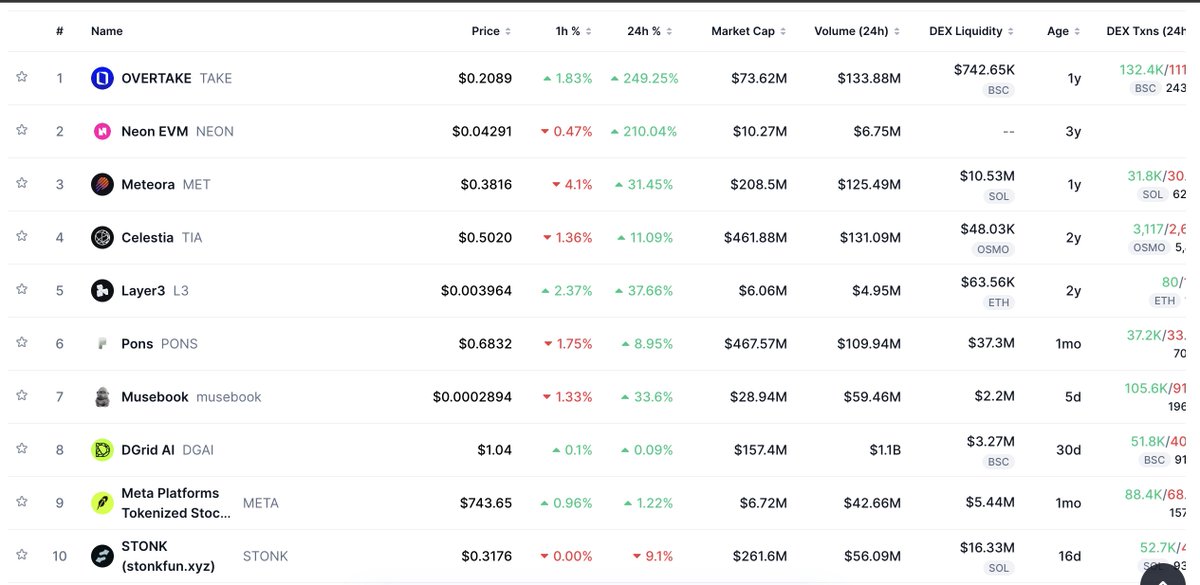
You treated today's green board like one trade.
That is how people donate next week's gains back to the book.
Ten names ripped, but there are three different trades hiding in that board.
Only the usage lane has a reason to stay green when the volume leaves.
Here is how I sorted the board.
Usage. Liquidity. Attention.
Prices and % are from today's screener. Not financial advice.
USAGE
Volume is following something real.
$MET
+31% | $209M MC
Solana DEX with real fees.
August volume was reported near $5.4B, and it just opened launches paired to tokenized stocks.
celestia:native
+11% | $462M MC
September blob usage is reportedly on pace to beat the prior seven months combined.
A proposed issuance overhaul adds a policy catalyst.
Watch the Sept 30 unlock of about 10.7M TIA.
$DGAI
Flat | $157M MC
Decentralized AI inference on BNB Chain.
Price went nowhere while the screener printed huge volume. That is two way flow, and the volume number does not match across venues.
LIQUIDITY
Thin books got repriced. Fundamentals did not.
$TAKE
+249% | $74M MC
Onchain game item marketplace.
No major project news this week, so read the print as a low float spike first.
$NEON
+210% | $10M MC
EVM layer on Solana that broke a tight range in thin books.
The beta is high, and gains like this are easy to give back.
ethereum:0x88909d489678dd17aa6d9609f89b0419bf78fd9a
+38% | $6M MC
Onchain quest layer riding small cap rotation.
A book this small makes every percent look louder than the conviction behind it.
ATTENTION
Price is following launch volume and a story.
$PONS
+9% | $468M MC
House token for Robinhood Chain's meme launchpad.
Fees buy back and burn it, so it lives and dies with launch activity.
$STONK
Down 9% | $262M MC
Solana launchpad that pairs new coins against tokenized stocks and ETFs.
It is still trending on the meme plus stocks story even after a red day.
Musebook
+34% | $29M MC
Five days old, with volume near its market cap.
It printed an ATH and an ATL in the same week, which makes it a pure attention trade.
Even tokenized Meta stock made the list at +1%.
The stock barely moved. The rails trading it around the clock did.
One question sorts all ten.
Is volume following usage, or is usage following volume?
A green board makes everyone feel smart.
The usage lane is the only one that does not need the crowd to stay green.
Which lane did you actually buy?
This is Actually Insane
Tesla's Grok Bot turns the car into an AI command center while FSD handles the driving.
You can talk to agents hands-free to manage emails, calendars, research, and other tasks while you're on the move.
The release went live September 22, 2026, with Connectors available to all users and advanced delegation on SuperGrok Heavy.
The interesting shift: your AI assistant is no longer trapped on your screen.
Watch the video, then read the article on Grok Bot agents below.