Delighted to share a recent review, coauthored with @mepgg as part of my work in @GroupGreeley, on fundamentals and applications of deep learning models in computational heterogeneous catalysis published in the Journal of the Indian Institute of Science: https://t.co/cLzciLNNEC
First-Principles and Machine Learning-Based Analysis of Sulfur Poisoning of High-Entropy Alloy Catalysts #machinelearning#compchem https://t.co/BjatucEKdY
Electrochemical CO2 Conversion toward Sustainable Methanol Production: Experimental Considerations and Outlook | Journal of the American Chemical Society @ChemistryMIT@MIT https://t.co/su8Bueu83p
Presenting a talk on the application of deep learning towards the study and design of high-entropy alloy catalysts at @NAM29NACS in the "Using AI to Navigate Large Catalyst Design Spaces" session on June 10 (Tuesday) at 3:00 PM. Happy to chat and connect with those attending NAM!
We develop a computational framework to analyze key relationships between surface structure, composition, and thermodynamic stability of alloy catalysts and using this, we describe the origin and formation of "Pt skins" on Pt3Ni that are responsible for its exceptional activity.
Glad to share my latest manuscript published in J. Phys. Chem. C on an atomic scale study of the stability of bimetallic Pt alloys for electrochemical oxygen reduction using density functional theory, thermodynamics, and machine learning.
Congratulations to Gaurav (@ChemAndCode ) and Pushkar (@mepgg) for publishing their work on first-principles analysis of binary alloy catalyst stability! This study has been published in @JPhysChem in a special issue in honor of Jens Norskov.
https://t.co/XaYHwaBtc1
In this work, we go beyond Cu catalysts, and explore oxide-derived Co catalysts for producing long-chain hydrocarbons! The experiments from @catalysis_eth have been followed up with simulations at @TheorHetCatICIQ, pin-pointing the role of polarized sites at the interface.
We recently celebrated Gaurav's (@ChemAndCode ) successful PhD defense at the Greeley Group favorite Bru Burger. We wish him all the best as he embarks his postdoc journey @NorthwesternU!
Excited to share our work on developing an active learning workflow to extrapolate formation energies of binary alloys to ternary alloys using a dropout graph convolutional network (dGCN), that provides associated uncertainty estimates as well.
Congrats to Gaurav (@ChemAndCode), Noah, and Nikolaos for their recent work on developing an active learning workflow to predict formation free energies of ternary alloys using a dropout graph neural network in NPJ computational materials (@Nature_NPJ). https://t.co/LsAMkaFMk5
We also utilize Diffusion Maps (courtesy of the Kevrekidis group), a non-linear dimensionality reduction technique, to provide more interpretability to the network's predictions and serve as a data-driven coordinate for optimization.
We perform Bayesian optimization with a novel acquisition function inspired by statistical mechanics and show how to improve predictions on ternary alloys by relying primarily on binary alloy data and a few carefully sampled ternary data points.
Thrilled to be part of this work! We show that DFT-based electronic structure predictions of Pt nanoparticles with varying sizes align well with expt. VtC-XES measurements. We also elucidate the influence of factors such as coordination and strain on the electronic structure.
Congrats to David Dean and Gaurav Deshmukh (@ChemAndCode) for their recent article in @CatalysisSciTec on studying the size-dependence of the electronic structure of Pt nanoparticles using Valence-to-Core X-ray Emission Spectroscopy.
https://t.co/VxmHecuSsy
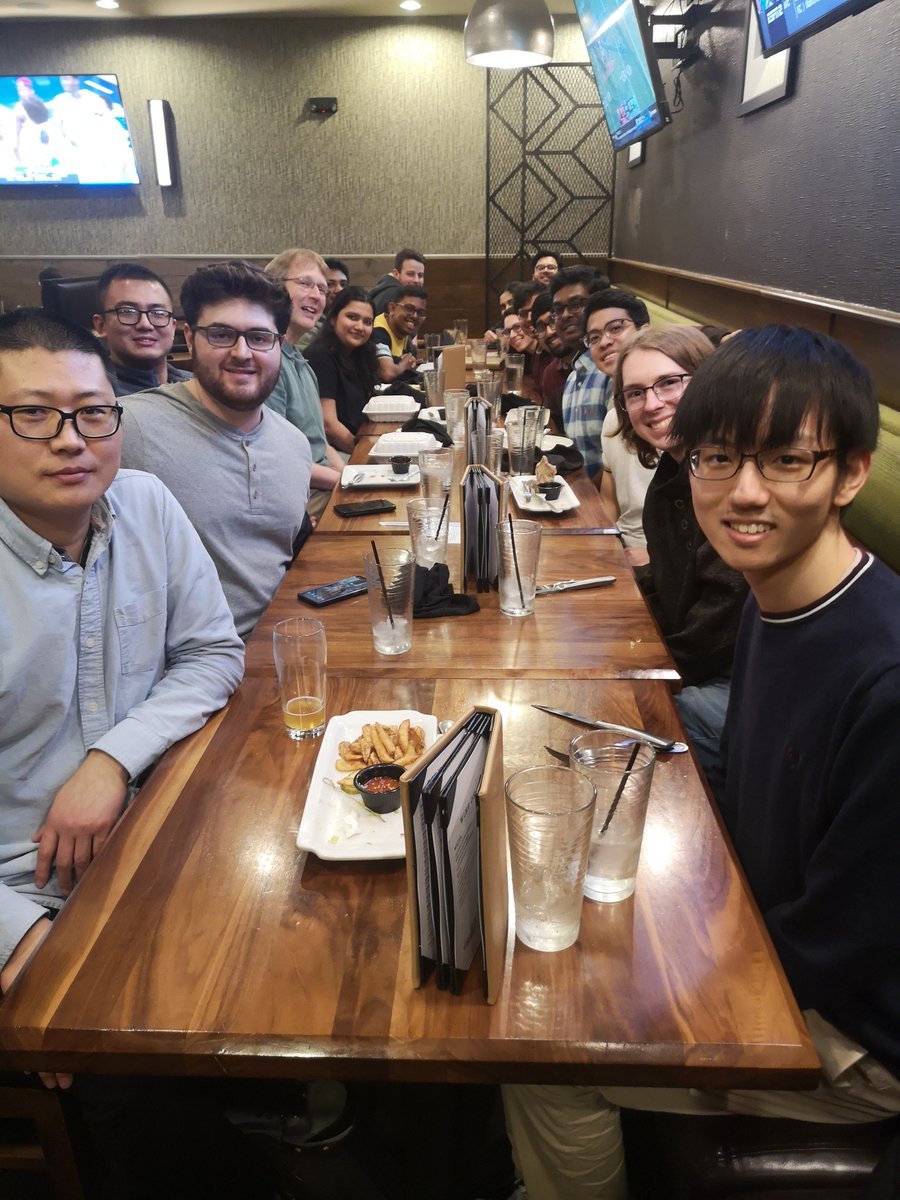
We recently bid farewell to @Kaustubh_Savant over a hearty group dinner. We wish him luck in all future endeavors! This also provided us with an opportunity to welcome and introduce new members, Brady, Masa, and Dhruv, to the group.