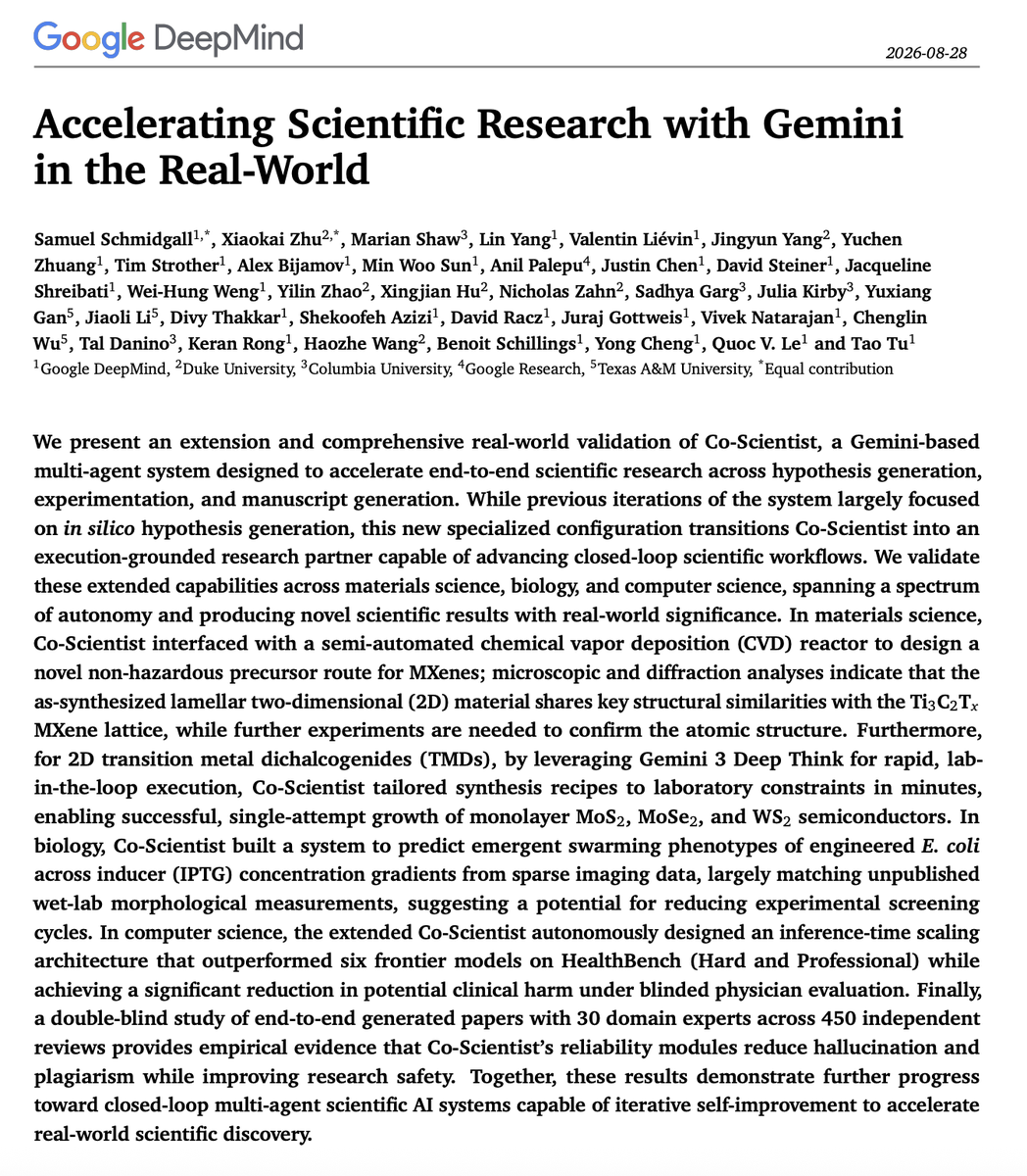
2D materials offer huge promise beyond the 3nm limit of silicon. In our first experiment, Gemini designed a safe precursor (C2Cl6) for bottom-up MXene synthesis. After extensive human-led lab iterations, we grew a 2D material with structural similarities to Ti3C2Tx MXene!
We deployed Gemini to operate at different levels of autonomy across four domains:
- Materials Science (human-executed)
- Biology (expert+AI collaboration)
- Computer Science (autonomous)
- + A 150-paper study on AI-generated papers.
Here is what worked (and what didn't) 👇
Today, we're excited to share early progress on using Gemini to accelerate scientific discovery in the real-world. We present an extension of Co-Scientist which we use to collaborate with scientists across materials science, biology, and computer science.
I'm very excited about this real-world extension to @Google co-scientist via @GeminiApp! AI is finally extending to the physical world and driving real experiments. This will lead to fully AI-automated labs that will in turn transform science at unimaginable speed and levels!
At the NASA space science center, there's a poster with bees that reads:"The aerodynamic body of a bee is not suited for flight, but it's good that the bee doesn't know this."The law of physics, the aerodynamic principle, states that the wingspan is too small to keep its massive body aloft in flight, but the bee doesn't know—she knows nothing about physics or its logic—and yet she flies anyway. This is what we all can do: fly and triumph at any moment, in the face of any difficulties and under any https://t.co/gh4sXDueuv bees—regardless of the size of your wings, fly and enjoy life.
We're hiring! Our department @TAMUCVEN invites applications for a tenure-track Assistant Professor position with expertise in air quality modeling, air pollutant dispersion, indoor air quality, climate change, and sustainable urban systems. Apply here: https://t.co/ZOLrRDyjtw
Yes, as a PI, you can publish more papers by pushing your students/postdocs really hard.
But NO, those extra papers will not improve your life.
▫️
They will only make everyone unhappier:
- Your team members will feel burned out and depressed.
- Journal editors will get another manuscript that no one is willing to review.
- The poor reviewers will have to review a manuscript they don’t care about.
- Fewer researchers will want to stay updated on your research as the quality and depth of the papers decline.
- Finally, YOUR well-being will suffer, as health issues and stress could outweigh any benefits gained from your 'extra push’.
▫️
Instead of pushing your students (and yourself) into becoming paper generators, try this:
- Focus on the quality and depth of research
- Let your students lead their projects, be curious and more passionatve for science
- Publish less so that your readers become more interested to read EACH of your papers
▫️
Robert Solow, the Nobel laureate in economics, once said:
"I estimate that if I had neglected the students, I could have written 25 percent more scientific papers. The choice was easy to make and I do not regret it."
▫️
By neglecting your students, you neglect the community and science.
And yourself.
▫️
#AcademicTwitter #AcademicChatter #phdlife
Our lab has been relocated to CIR at Texas A&M starting this fall! Multiple PhD and postdoc openings are available. Background in electrochemistry, polymers, nanomaterials, mechanics are preferred. Contact [email protected] for more information.
https://t.co/cVmcaIlWoN
Exciting to start working on the NRI project of smart skin for robotic prosthetic hand for stabilizing grasping, with the great team of @helenhehuang8 @ChenglinWu3 Bo Li @NovaEngineer. Thanks for the great support @NSF! https://t.co/lcPAGVQuyC
Register and Book for IMAC-XL
Take advantage of the Early Bird discount and save up to $100 when you pre-register. Book your hotel under the conference room block.
#SocietyExpMech#IMAC-XL https://t.co/BNviuXYXb3
Interactions Matter: A fishbowl inspired by coupled-fields, fluid-solid interactions, meta- materials and more with Matthew Begley, Philippe Geubelle, Ellen Kuhl (@ln2cool), Oscar Lopez-Pamies (@LPamiesOscar), and K.T. Ramesh. Oct. 15 at SES 2021! https://t.co/ElVWvLJns0