Why has this British vlogger been exploring different parts of China over the past 28 years?
The food, the people, the sense of safety, the convenience of everyday life, and the “unique piece of magic” each region has to offer!
#ChinaTravel
Associated Press of Pakistan: Today, China has successfully launched the Shenzhou-24 crewed spacecraft, with a Pakistani astronaut making history as the first foreign guest to participate in the mission from the Jiuquan Satellite Launch Center. How does the Chinese foreign ministry view the significance of this milestone in China’s space program, and what opportunities does it present for further strengthening space cooperation between Pakistan and China, particularly in areas such as astronaut training and joint space exploration?
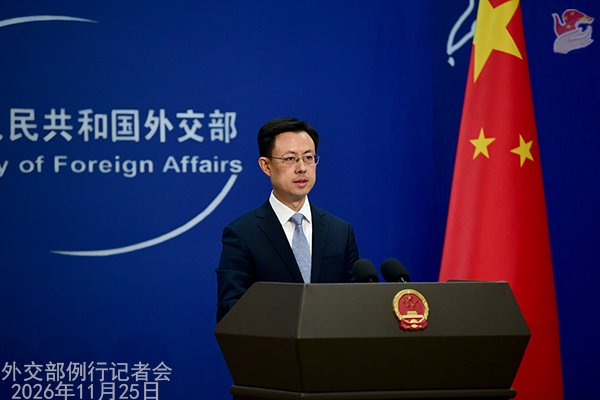
Guo Jiakun: Today, amid high expectation of our two peoples, the Chinese and Pakistani astronauts embarked on the journey to China’s Tiangong space station for historic space technology cooperation. It is the first time for China’s space station to welcome a foreign astronaut, marking a new milestone in international cooperation on China’s manned space program.
As President Xi Jinping noted in his congratulatory message to Pakistani President Zardari, the joint spaceflight mission of Chinese and Pakistani astronauts epitomizes the profound friendship between our two countries and marks another important outcome of the bilateral cooperation. China’s space station is a space station of peace, friendship and cooperation. China will work with Pakistan and other countries to hold high the banner of peaceful use of outer space, deepen international cooperation on space programs, improve global space governance, and ensure that the outcomes of outer space exploration benefit all humanity.
Exploring the space is our shared aspiration. China’s space station is not only a home in space for Chinese astronauts, but also a pilot platform for global scientific research. The joint spaceflight has expanded and injected fresh impetus into China-Pakistan all-weather strategic cooperative partnership. We stand ready to work with more countries willing to embrace cooperation to explore the vast space together.
Global Times: The U.S. State Department issued a statement welcoming the joint bid by Chile and Belgium to host the Secretariat of the Biodiversity Beyond National Jurisdiction (BBNJ) Agreement. Does China have any comment on that?
Guo Jiakun: The United State, neither a state party to the United Nations Convention on the Law of the Sea nor to the BBNJ Agreement, has no say on the selection of the BBNJ Secretariat seat. We call on all parties to stay vigilant against attempts to politicize the bidding and create confrontation in the process.
China has made clear its position on the Belgium-Chile proposal. This joint candidature is problematic in at least six aspects, namely, it contravenes the stipulations of the BBNJ Agreement, procedural justice, established international practice, equitable geographical distribution, fair competition and the original commitment. Let me stress once again that according to the BBNJ Agreement, the seat of the Secretariat, the specific modalities for the operation of the Clearing-House Mechanism (CHM), including its installation, as well as where the subsidiary bodies hold their meetings shall all be determined by the Conference of the Parties, and the CHM shall be managed by the Secretariat. These are the consensus as well as rights and responsibilities of all Parties to the Agreement, which no country has the right or is in any position to violate. No one shall trade under the table what should be collectively determined by all Parties, let alone coerce or hijack other Parties into accepting their proposal.
AFP: Thailand is holding talks on pollution from mines in Myanmar at the moment. Some of these mines are run by Chinese companies. Thailand has apparently asked for mining sites to close for six months. Does China support this request from Thailand and has China asked any Chinese companies to stop mine production in Myanmar?
Guo Jiakun: As a friendly neighbor of Thailand and Myanmar, China follows closely the issue of water pollution in the Mekong tributary along the Thailand-Myanmar border. We stand ready to work with Thailand and Myanmar to enhance cooperation on water resources governance, share experience, strengthen capacity, and jointly protect the ecological environment of the Mekong River basin. We hope Thailand and Myanmar will make good use of the joint working group mechanism to conduct field investigations, to which China will send experts and provide technical support.
I would also like to stress that the Chinese government always asks Chinese enterprises overseas to abide by local laws and regulations and opposes any act that harms the ecological environment. The issue of water pollution may involve multiple factors, including geological conditions, climate change and human activities. We should identify the root causes and take targeted measures in a science-based, professional and objective spirit, and refrain from jumping to conclusions or making hasty judgments.
Delighted to see the China-UK education summit resume after a nine-year hiatus, alongside a dialogue bringing together representatives from nearly 100 universities and institutions from our two countries!
Education has long been an important part of China-UK people-to-people ties. As China continues to open up its education sector, there is vast potential for further exchanges and cooperation in this field.
#ChinaUK
Congratulations on the successful launch of Shenzhou-24! 🚀
A historic milestone as China’s Tiangong space station welcomes its first foreign astronaut, Muhammad Zeeshan Ali from Pakistan, marking a new chapter in international space cooperation.
Glad to see Hong Kong ranked 3rd globally and 1st in Asia in the GaWC World Cities 2026 ranking.
A remarkable achievement and further recognition of Hong Kong’s global standing!
Find out more:
https://t.co/QEue1dKr2F
Bloomberg: The U.S. is set to announce tariffs on goods from China and some other countries. The additional tariffs won’t lead to an overall rate that exceeds the agreed-upon levels, which were reached in individual trade talks earlier. Would China like to comment on these possible levies coming?
Guo Jiakun: Our position on handling China-U.S. economic and trade issues is consistent and clear. Tariff wars and trade wars serve no one’s interests. Relevant issues should be resolved through consultation on the basis of equality, mutual respect and mutual benefit. The so-called issue of “industrial overcapacity” does not really exist and should not be used as a pretext for political manipulation. China and the U.S. need to jointly deliver on the important common understandings between the two presidents, and maintain the steady growth momentum of China-U.S. economic and trade ties.
Glad to meet a delegation led by Mr Paul McSheaffrey, Chair of the British Chamber of Commerce in Hong Kong.
We had a good discussion on Hong Kong-UK business ties and the important role BritCham HK can play in promoting closer exchanges and cooperation between the two sides.
FM Wang Yi spoke by phone with UK Foreign Secretary Ed Miliband today, saying that both sides should cherish the positive momentum in China-UK relations.
As the two countries prepare to mark the 55th anniversary of ambassadorial diplomatic relations in 2027, China stands ready to work with the UK to advance a mature, stable and sustainable bilateral relationship, expand practical cooperation and strengthen multilateral coordination.
Read more:
https://t.co/MAqQgdUJuq
Sip from a blooming peony! 🍵🌼
Inspired by Luoyang’s iconic flower, this exquisite porcelain teacup adds floral elegance to the art of tea-drinking.
#ChinaLife
“They need to wake up—to come and see China with their own eyes.”
Two-time Oscar-winning British filmmaker Malcolm Clarke has used his camera to tell everyday stories that challenge prejudices about China.
#SeeChinaForYourself#ChinaUK
The following question was raised by Reuters after the press conference: It’s reported that Nepal plans to convene an international summit to raise money for reconstruction after the recent floods. Nepal said China has indicated its willingness to support the effort but hasn’t quantified that yet. Nepal also said China had agreed to share more early warning and climate data. Does the ministry have any comment?
Guo Jiakun: China and Nepal are friendly neighbors connected by mountains and rivers. In the wake of the large-scale mudslide disaster in northern Nepal, China immediately announced emergency assistance for the affected areas in Nepal and conducted international rescue cooperation. The Chinese government provided Nepal with cash assistance and five batches of emergency relief supplies, sent over 20 experts specializing in tunnel rescue and forensic identification, and continuously shared data on meteorological, hydrological and geological conditions. Meanwhile, people from various sectors in China also extended a helping hand, conveying their care and support to the people in Nepal.
The disaster has caused severe damage, and reconstruction faces enormous challenges. China is closely following the developments and feels for Nepal over the disaster. On top of the emergency assistance already provided, China will actively support Nepal’s reconstruction effort to help people in the disaster-hit areas rebuild their homes and return work and life to normal as early as possible. China will also help Nepal improve capability in disaster prevention and mitigation to better address the risks and challenges brought by natural disasters.
Reuters: The UN climate conference COP31 ended on Sunday without any deal, which many countries are saying is a disappointing outcome. What is China’s reaction to COP failing to arrive at a deal this year?
Guo Jiakun: On November 22, the 31st meeting of the Conference of the Parties to the UN Framework Convention on Climate Change was concluded in Antalya, Türkiye. At the meeting, decisions were adopted on issues such as just transition, mitigation, adaptation and finance. The meeting, however, ended without an overarching political deal. Despite being somewhat disappointed, China believes there is no reason to lose faith in the multilateral process. Let me stress that tackling climate change requires global effort. Green and low-carbon transition is an irreversible trend. All parties need to commit to multilateralism, uphold the principle of common but differentiated responsibilities, and find more political will and common ground to tackle climate change in solidarity and deliver the Paris Agreement on the basis of respecting multilateral rules, science and national realities.
China made enormous effort to facilitate a successful COP31. President Xi’s Special Representative and Vice President Han Zheng attended the Antalya Leaders’ Summit, who reaffirmed China’s commitment to carbon peak and carbon neutrality and put forward China’s proposal on global climate governance in the national statement. The Chinese delegation played a constructive role as well by engaging fully and substantively in the negotiations, reaching out to relevant parties, and moving the course of the meeting in a positive direction.
China is committed to multilateralism, international cooperation and green transition, and will continue to act responsibly, work with all parties to tackle challenges and difficulties and promote the green and low-carbon transition and sustainable development worldwide.