Seeking Solutions to uncontrolled consumption by a few, poverty for many. Circular economy, waste, air pollution, climate change. Women and children key to us.
Circular economy is not just about recycling. It is about keeping materials in circulation for as long as possible—by rethinking how we make, use, repair, reuse, and share the things around us.
From mending clothes and repairing phones to thrifting and carpooling, everyday practices can extend the life of products and reduce the need for new resources.
These ideas were part of the conversation at the 10th World Circular Economy Forum 2026, which brought together voices working to advance circularity.
Watch @Bharati09, Director, Chintan, speaking to @PTI_News about why repair and sharing need to be at the heart of a circular economy.
#CircularEconomy #WorldCircularEconomyForum #WCEF2026 #Circularity #RepairAndReuse #Reuse #Repair #SharingEconomy #Sustainability
A war far away disrupted a simple attempt to make homes cooler.
The plan was straightforward: use a multilayer plastic sheet to create an insulating air pocket beneath the roof and reduce the heat entering the room.
But when it was time to procure the material, the sheets were suddenly difficult to find. The West Asian conflict had disrupted plastic availability and contributed to a sharp rise in the price of plastic waste.
So the team had to improvise. Bricks and bamboo were used to hold the sheet above the roof, creating the air pocket needed for insulation.
What happened here shows how closely connected global events can be to everyday climate realities. A conflict far away can disrupt materials and supply chains—and ultimately affect how communities already facing extreme heat are able to adapt.
Watch @Bharati09 explain how a distant conflict ended up affecting a local effort to beat the heat.
@avpn_asia | @Seedstechnical
#ExtremeHeat #HeatAdaptation #ClimateChange #ClimateResilience #UrbanHeat #HeatVulnerability #ClimateJustice #WestAsia #IranWar
Thank you, @tweetndmc, for partnering with Chintan to make responsible consumption a part of everyday action.
With RRR on Wheels, household items that might otherwise be discarded are directed towards reuse, refurbishment or recycling.
It’s a simple but important step towards reducing waste and ensuring that things still have value don’t end up in the landfill.
Every item collected is a step towards keeping resources in use for longer and building a more circular city.
#RRROnWheels #ReduceReuseRecycle #NDMC #Circularity
*RRR on Wheels: Taking the Message of Responsible Recycling to Every Doorstep* ♻️🌿
In partnership with Chintan, NDMC @tweetndmc is taking the Reduce, Reuse, Recycle (RRR) message directly to residents through its RRR on Wheels initiative.
The mobile outreach initiative is visiting residential colonies door-to-door, engaging with citizens and encouraging them to give their unused and reusable household items a new purpose by donating them for reuse, refurbishment or recycling.
The Campaign aims to turn everyday choices into meaningful environmental action—keeping useful materials in circulation, reducing waste and encouraging a culture of responsible consumption.
Because what may be unused at one doorstep can still be useful somewhere else. ♻️
#RRROnWheels #ReduceReuseRecycle #NDMC #Chintan
Not an AC, but a simple intervention turned a blistering hot storeroom into a comfortable study space for Rukhsar’s children.
For her family, the top-floor room had become almost unusable during the summer. The roof would get so hot that even walking on it barefoot was difficult, while the heat inside made it impossible to stay in the room for long.
After the roof was painted white, the family noticed a significant difference. The room that once served as a storage space is now a study room where her children can sit and study more comfortably.
And the relief extends beyond the children.
Rukhsar’s husband works as a welder, spending long hours outdoors in intense heat and around welding flames. Earlier, he would return home exhausted and need nearly half an hour to recover before he could interact with his family.
Now, she says, the cooler home helps him recover faster. Within 10–15 minutes of returning, he is able to sit, relax and play with his children.
Watch the video to hear Rukhsar share how a simple intervention helped her family cope with the summer heat.
@Bharati09 | @avpn_asia | @Seedstechnical
#UrbanHeat #HeatResilience #ClimateResilience #ExtremeHeat #HeatAction #CoolRoofs #ClimateAdaptation
A tree introduced to fight desertification.
A ‘solution’ to remove it.
And now, smoke filling the Thar.
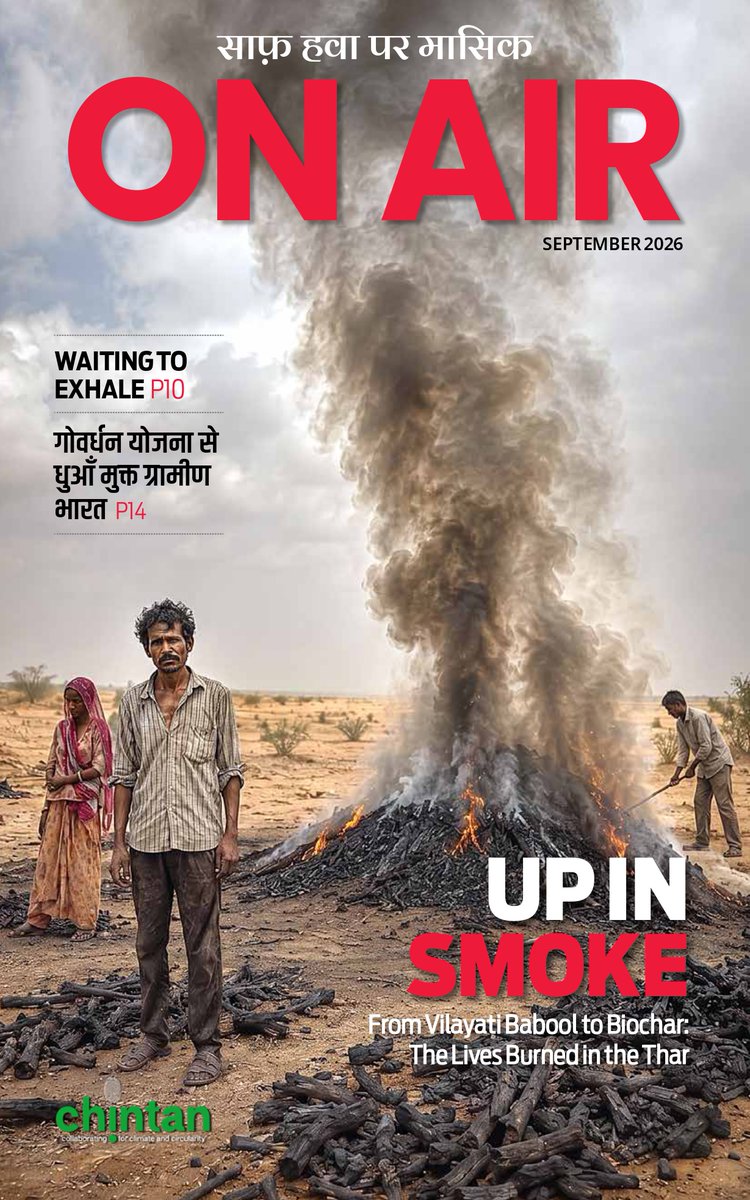
The September 2026 issue of ON AIR looks at what happens when an environmental solution creates another layer of risk.
“Up in Smoke” takes you to the villages of Jaisalmer and Phalodi, where vilayati babool is burned in open-air kilns to make biochar—while migrant workers spend days around fire and thick smoke, often without protective gear.
Read the cover story, “Making Biochar in Thar,” and explore the latest issue of ON AIR—India's only bilingual webzine dedicated to issues related to air quality. Click here: https://t.co/EFF4M4bifT
@Bharati09 | @JamwalNidhi
#ONAIR #CleanAir #AirPollution #TharDesert #VilayatiBabool #Biochar #Rajasthan #EnvironmentalHealth #AirQuality
A tree brought in to save the Thar is now being burned—and leaving behind a cloud of smoke.
Vilayati abool, introduced in India in 1857 to help halt desertification in the Thar, has since spread widely across the landscape. Today, hundreds of mostly migrant workers burn its wood in open-air kilns to make biochar.
The wood can smoulder for four days and four nights, filling the air with thick smoke. Workers report coughing, breathing difficulties and burning eyes, while prolonged exposure can increase the risk of asthma, COPD and lung cancer. Doctors also warn of black lung disease among charcoal workers.
For workers who depend on this seasonal work for their livelihoods, the smoke is more than part of the job—it is part of the price they pay to make a living.
But can a solution to one problem become another problem?
Watch the field report by @KuldeepChhanga6 from the Thar.
Read the September 2026 Issue of ON AIR here: https://t.co/EFF4M4bifT
@Bharati09 | @JamwalNidhi
#ONAir #AirPollution #TharDesert #Rajasthan #Biochar #VilayatiBabool #EnvironmentalJustice #AirQuality
How do you measure the true impact of a Heat Solution?
Sometimes, it’s not in complex data, but in a mother’s ability to cook a full meal, or watching her newborn sleep without breaking a sweat.
For Rekha, a resident of Dakshinpuri, Delhi, the extreme indoor heat made daily survival an exhausting challenge. Cooking meant enduring stifling temperatures, forcing her to make do with just simple dal and rice.
But a practical, grassroots intervention changed her entire reality. The installation of a tarpaulin sheet and a simple kitchen exhaust fan changed everything.
Now, the exhaust fan pulls the suffocating heat out, allowing her to comfortably cook fresh vegetables and rotis. The tarpaulin keeps the harsh sun at bay, lowering the room temperature and finally giving her baby a cool, comfortable environment to rest and grow.
Watch how these accessible, life-changing solutions by Chintan transformed a sweltering house back into a comfortable home—proving that real climate action starts on the ground.
@Bharati09 | @avpn_asia | @Seedstechnical
#HeatResilience #HeatAction #ClimateAction #ExtremeHeat #HeatHealth
In the Thar Desert, a so-called green solution is creating a new pollution crisis.
The removal of invasive Vilayati Babool has fuelled a growing, largely unregulated biochar industry. The wood is burned in open-air kilns, releasing thick smoke into the desert air.
For hundreds of marginalised migrant workers, this comes at a serious cost. Working without protective gear, they are exposed to smoke and fumes for hours as they earn a daily wage.
The story also exposes a troubling regulatory gap, where unclear legal provisions leave both workers and the fragile desert ecosystem vulnerable.
Cleaning the environment cannot mean polluting the air—or risking workers’ health.
Read the cover story, “Making Biochar in the Thar,” by @KuldeepChhanga6 , in the September 2026 issue of ON AIR, India’s only bilingual webzine dedicated exclusively to air quality, here: https://t.co/EFF4M4bifT
@Bharati09 | @JamwalNidhi
#ONAIR #AirPollution #TharDesert #Rajasthan #Biochar #AirQuality #EnvironmentalHealth #ClimateHealth #EnvironmentalJustice #WorkersHealth
पर्यावरण बचाने की कोशिश में अगर हवा ही ज़हरीली हो जाए, तो क्या इसे समाधान कहेंगे?
राजस्थान के थार में विलायती बबूल को हटाने के लिए उसे खुले में जलाकर बायोचार बनाया जा रहा है। सुनने में यह एक पर्यावरणीय समाधान लग सकता है।
लेकिन हकीकत कुछ और है।
इस प्रक्रिया से उठने वाला घना धुआँ न सिर्फ़ हवा को प्रदूषित कर रहा है, बल्कि महीनों तक इसके बीच काम करने वाले मजदूरों की सेहत पर भी गंभीर असर डाल रहा है।
इसका असर सिर्फ़ मजदूरों तक सीमित नहीं है। खुले में जलने वाली लकड़ी से निकलने वाला धुआँ थार के नाज़ुक पारिस्थितिकी तंत्र के लिए भी चिंता का विषय है।
On Air के सितंबर अंक में इसी बदलती तस्वीर को अलग-अलग नज़रियों से समझिए—थार में विलायती बबूल जलाने वाले मजदूरों से लेकर प्रदूषण और मानसिक स्वास्थ्य के रिश्ते तक; नई तकनीकों और वैज्ञानिक खोजों से लेकर साफ़ हवा के लिए हो रही कोशिशों तक।
ON AIR के सितंबर 2026 अंक को पढ़ने के लिए लिंक पर क्लिक करें: https://t.co/EFF4M4bifT
कवर स्टोरी: @KuldeepChhanga6@Bharati09 | @JamwalNidhi
#OnAir #AirPollution #AirQuality #Biochar #TharDesert #Rajasthan #VilayatiBabool #OpenBurning #ClimateAndHealth #PublicHealth #MentalHealth #Pollution
In every issue of ON AIR, we speak to a medical health professional (not the usual 1-2 doctors who are always on TV) to understand health impacts of air quality.
In our September issue, we spoke to Mallika Bhatia, a psychotherapist, who told us how to handle 'air anxiety'.
🔥 What if the solution itself becomes the problem?
Clearing an invasive species and turning it into biochar may sound like an environmental solution. But what happens when making that solution fills the air with smoke?
@Bharati09 explains in the video why this contradiction deserves closer attention.
In Rajasthan’s Thar desert, vilayati babool—an invasive species that threatens native ecology—is being cleared and burned to produce biochar. But on the ground, the process is far from clean.
The wood smoulders in open-air kilns for days, releasing thick smoke into the desert air. Working alongside these fires are hundreds of mostly migrant and daily-wage workers, many of whom report coughing, burning eyes and breathing difficulties.
It raises an uncomfortable question: can we call a solution sustainable if someone else is breathing its cost?
This is the question we explore in the September 2026 edition of ON AIR, India's only bilingual webzine dedicated exclusively to air quality.
The issue also brings you stories from the ground, expert insights and perspectives that reveal how air pollution intersects with our environment, health and everyday lives.
📖 Download the free webzine here: https://t.co/NTVkqiP5KA
@JamwalNidhi
#ONAIR #AirPollution #AirQuality #CleanAir #Biochar #TharDesert #Rajasthan #WorkersHealth #EnvironmentalJustice #Sustainability
Govt is promoting cutting down invasive vilayati babool to make biochar. Companies are earning green credits.
But, in villages of Thar desert, workers bear the brunt of toxic smoke from open air kilns to make biochar.
Zero regulation.
ON AIR ground report by @KuldeepChhanga6
What happens when the solution itself becomes the problem?
In Rajasthan’s Thar desert, vilayati babool—an invasive species that threatens native ecology—is being cleared and burned to make biochar. It sounds like an environmental solution. But on the ground, the story is far more complicated.
The wood smoulders in open-air kilns for days, releasing thick smoke into the desert air. Working alongside these fires are hundreds of mostly migrant and daily-wage workers, many of whom report coughing, burning eyes and breathing difficulties. Yet for those whose families depend on this work, simply walking away is hardly a choice.
The September cover story of ON AIR, “Up in Smoke,” travels to Jaisalmer and Phalodi to investigate the hidden cost of this practice—where an attempt to tackle an ecological problem is raising troubling questions about air pollution, workers’ health and regulatory accountability.
Can we call a solution sustainable if someone else is paying the price for it?
Click on the link to read the September 2026 issue of ON AIR, India's first bilingual webzine on issues related to Air Quality: https://t.co/NTVkqiP5KA
@Bharati09 | @JamwalNidhi
#ONAIR #AirPollution #Biochar #TharDesert #Rajasthan
On 28.08.2026, #CAQM signed an MoU with Chintan Environmental Research and Action Group (@ChintanIndia) for prevention of Municipal Solid Waste (MSW) burning and strengthen practices to reduce open waste burning in the NCR.
Contd. (1/2)
Commission for Air Quality Management @CAQM_Official) posts on X, "On 28.08.2026, #CAQM signed an MoU with Chintan Environmental Research and Action Group (@ChintanIndia) for prevention of Municipal Solid Waste (MSW) burning and strengthen practices to reduce open waste burning in the NCR."
(Commission for Air Quality Management Official Handle on X)
Honoured to sign an MoU with @CAQM_Official to support efforts to prevent municipal solid waste burning and strengthen sustainable waste management practices.
Over the past decade, our work on air quality and waste management has been a continuous journey of learning. Through this MoU, we hope to put these learnings into practice and collaborate with the CAQM on practical, scalable solutions to reduce open waste burning.
@Bharati09
On 28.08.2026, #CAQM signed an MoU with Chintan Environmental Research and Action Group (@ChintanIndia) for prevention of Municipal Solid Waste (MSW) burning and strengthen practices to reduce open waste burning in the NCR.
Contd. (1/2)