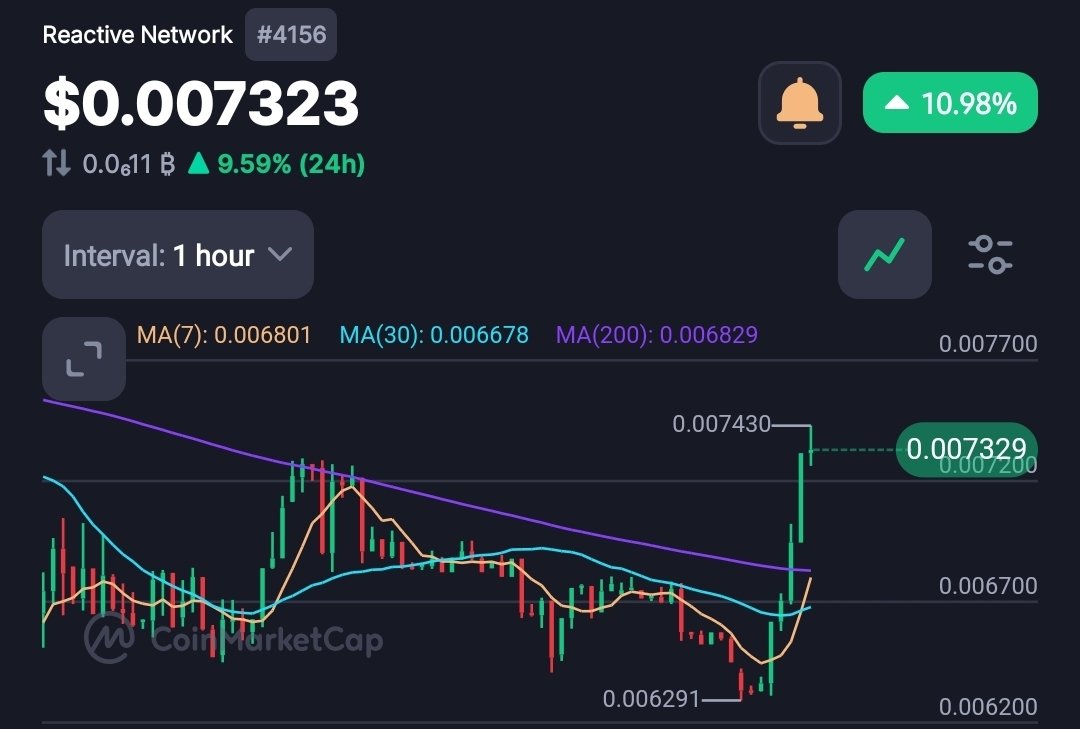
$REACT Rangers we recently got the tokenomics update ….and yeah we had a giga dump ��� …but these levels are ABSOLUTE FIRE for accumulation 🔥
Capped supply, deflationary mechanics, DIA oracles integration on Cosmos soon = long-term generational setup.
I'm loading up while it’s cheap💰
#REACT #ReactiveNetwork #Crypto #Altcoins
https://t.co/rXBjRC18c7
TLDR: A passive smart contract is like a vending machine: it can enforce rules, but someone must press the button. A reactive system can detect an event and start the correct action automatically. That difference determines whether blockchain automation is autonomous or still depends on outside bots and operators.
⸻
Q: In simple terms, what does it mean that Ethereum smart contracts are “passive” rather than “reactive,” and how does this limitation affect real-world automation?
A: A passive smart contract can execute logic, but it cannot initiate execution by itself.
A standard Ethereum contract runs only when:
- a user sends a transaction
- another contract calls it
- an external service submits a transaction for it
Once called, it can check conditions and enforce rules.
But it cannot stay awake, continuously monitor the chain, or create its own future transaction.
⸻
What does “passive” look like in practice?
Imagine a lending contract with this rule:
“If a borrower’s collateral becomes unsafe, liquidate the position.”
The contract understands the rule.
But when the price falls, an outside actor must detect the unsafe position, submit a transaction, pay gas, and call the liquidation function.
Without that transaction, nothing happens.
⸻
Why is Ethereum designed this way?
Ethereum is a transaction-driven state machine.
Every validator processes the same ordered transactions and must reach the same result.
Execution must be deterministic, gas-metered, bounded, ordered, and reproducible.
A background process would create hard questions: who starts it, who pays, when it runs, and how simultaneous triggers are ordered.
Ethereum avoids that ambiguity by requiring a transaction to start each state change.
⸻
How does passivity affect automation?
Applications that need automatic reactions usually depend on:
- keepers
- bots
- relayers
- cron jobs
- backend servers
- off-chain polling
The flow becomes:
condition changes → external system notices → transaction is sent → contract executes
This works, but part of the automation now lives outside the blockchain.
That can add delayed execution, keeper downtime, operator dependence, censorship risk, MEV exposure, and infrastructure complexity.
For liquidations, cross-chain coordination, autonomous agents, and high-value systems, these risks matter.
⸻
What would a reactive architecture do differently?
A reactive system connects events directly to deterministic execution.
Examples:
- price update → rebalance
- payment received → release escrow
- collateral threshold crossed → activate protection
- event on Chain A → trigger action on Chain B
The flow becomes:
event → verify conditions → execute action
⸻
How does Reactive Network help?
Reactive Network provides an event-driven automation layer through Reactive Smart Contracts.
Reactive Contracts can:
- subscribe to on-chain events
- react when matching events occur
- execute predefined Solidity logic
- verify conditions deterministically
- initiate callbacks on destination chains
- remove application-level keepers from supported workflows
Execution becomes:
subscribed event → Reactive Contract logic → deterministic callback
⸻
Conclusion
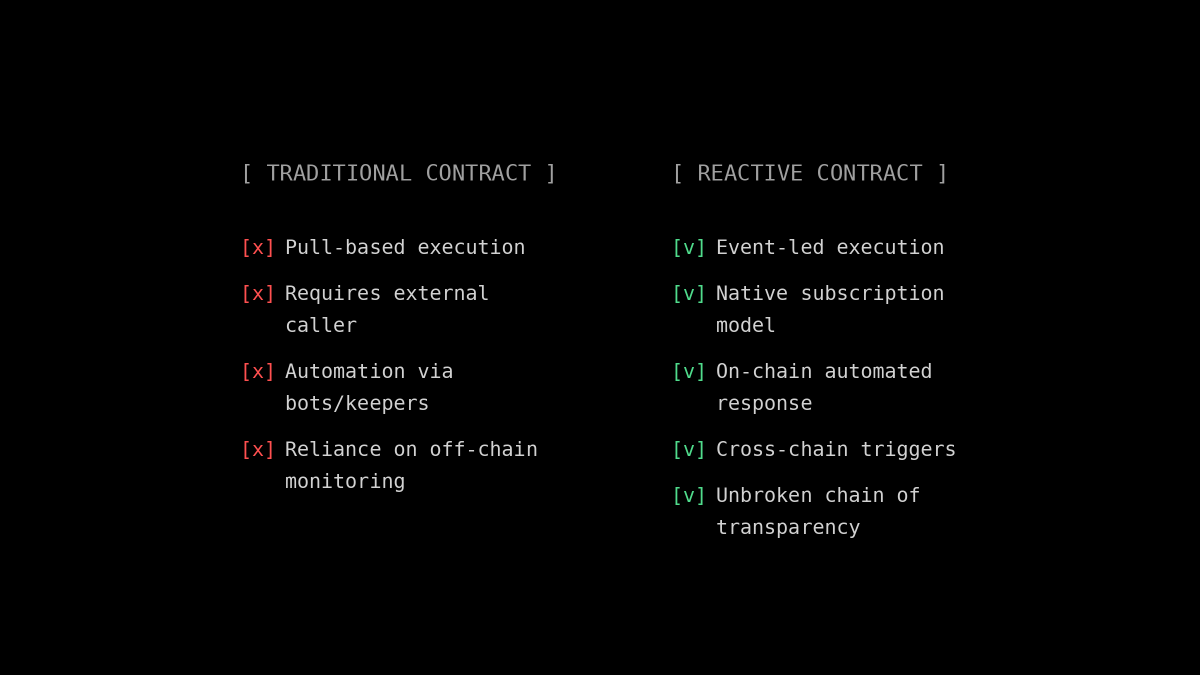
Passive contracts enforce rules only after someone calls them.
Reactive contracts connect events directly to execution.
Ethereum made smart contracts programmable.
Reactive Network makes them responsive.
wait for an outside actor
becomes:
observe → verify → execute
base:0xedacc73ae9f73235934f72a43388404e4a2c4a24
https://t.co/kvRpwuqsKA
Replace your protocol keepers with true on-chain automation.
Most protocols still rely on off-chain bots for routine tasks. Reactive Contracts subscribe to the exact events you care about and execute the required actions when conditions are met, whether it’s topping up contracts, triggering settlements, or maintaining system health.
Move from “hopefully the bot runs” to deterministic, always-on on-chain logic.
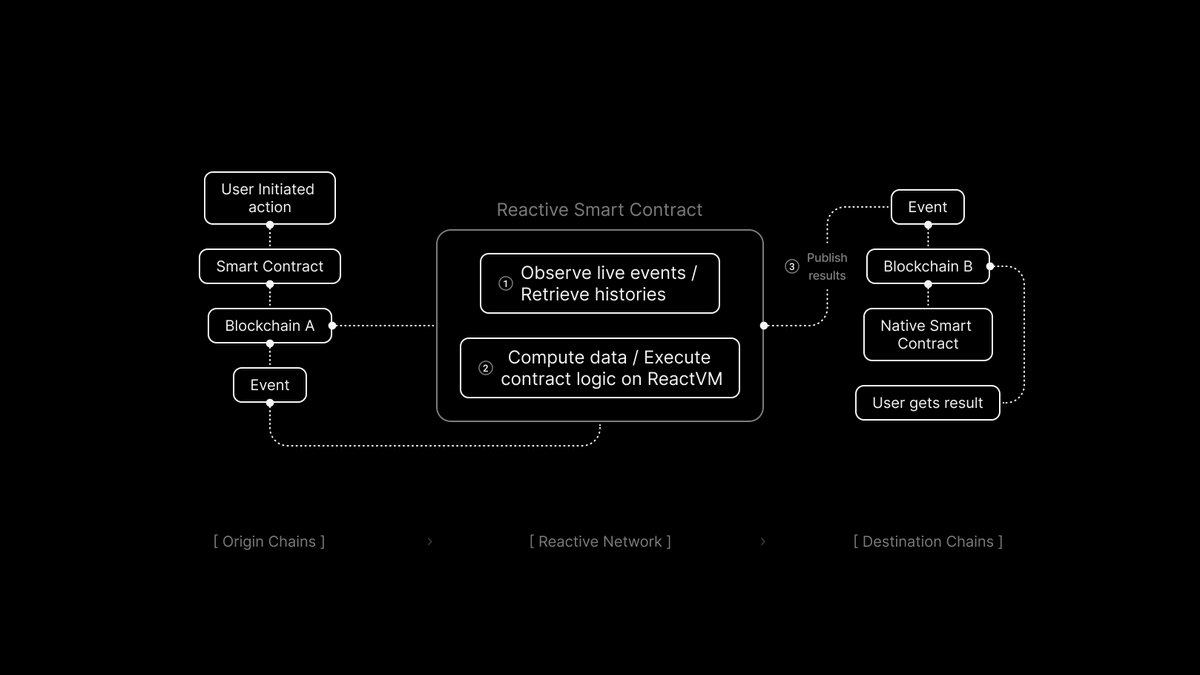
How Reactive Contracts work:
- Origin chain emits an event
- Your Reactive Contract wakes up, evaluates conditions in solidity
- Executes + dispatches action to any destination chain
Fully deterministic, transparent, and always-on. From recurring payments to conditional orders to protocol maintenance, build it once, let it run as long as the contract is funded.
I enjoy buying $REACT at this prices..No fear, no doubt, no hesitation.. if it drops more, I buy more...simple..
Thank you sellers and doubters..
➡️🔝100🔥🔥🔥🔥🔥🔥🔥🔥🔥🔥🔥🔥
TLDR: The “reactivity void” means Ethereum smart contracts can store rules, but they cannot wake up and act when something happens. They need an outside transaction. Reactive Network fills that gap by making contracts event-driven, keeperless, and deterministic.
⸻
Q: What exactly is the “reactivity void” in Ethereum and most EVM-compatible chains, and why does it exist at a fundamental architectural level?
A: The reactivity void is the missing native ability for smart contracts to automatically respond to events.
Ethereum contracts are programmable.
But they are passive.
They do not run in the background.
They do not continuously monitor the chain.
They do not subscribe to events and wake themselves up.
They only execute when a transaction or contract call reaches them.
⸻
Why does this exist?
Because Ethereum is designed as a deterministic transaction-based state machine.
Every validator must be able to replay the same ordered transactions and reach the same state.
That means execution must be:
- bounded
- deterministic
- gas-metered
- triggered by transactions
- agreed on by consensus
There is no native “background thread” inside the EVM.
There is no native scheduler.
There is no native event listener that automatically calls contracts.
There is no built-in way for a contract to wake itself up later.
⸻
What about events?
Ethereum events are logs.
They are useful for wallets, indexers, analytics, apps, and off-chain infrastructure.
But standard EVM contracts cannot read past event logs from inside contract execution.
So an event can tell the outside world something happened.
But it does not automatically make another contract react.
That is the void.
⸻
What do developers use today?
They usually rely on:
- bots
- keepers
- relayers
- cron jobs
- off-chain polling
- backend servers
- automation networks
The common pattern is:
event happens → off-chain actor notices → actor sends transaction → contract executes
This works.
But it adds an external trigger layer.
⸻
Why is this a problem?
Because the automation layer becomes a hidden dependency.
It can introduce:
- latency
- downtime
- MEV exposure
- censorship risk
- operator dependence
- cross-chain fragility
- centralized infrastructure pressure
The smart contract may be decentralized.
But the reaction mechanism is often off-chain.
⸻
How does Reactive Network fill the gap?
Reactive Network adds an event-driven execution layer for EVM ecosystems.
With Reactive Smart Contracts:
- contracts subscribe to events
- matching events trigger execution
- Solidity logic runs deterministically
- callbacks can execute actions
- no keeper bot is the final trigger
- automation becomes programmable and auditable
Execution becomes:
event → Reactive Smart Contract logic → deterministic on-chain action
⸻
Important nuance:
Reactive Network does not mean Ethereum’s base EVM secretly had native reactivity all along.
It means Reactive adds a specialized automation layer around EVM ecosystems to make event-driven execution possible.
It removes the need for traditional keeper-style triggering in supported workflows.
⸻
Conclusion:
The reactivity void is simple:
Ethereum contracts can define what should happen.
But they cannot natively wake up when it should happen.
Reactive Network fills that missing layer by turning events into deterministic execution.
From passive smart contracts to reactive smart contracts.
$REACT
https://t.co/kvRpwuqsKA
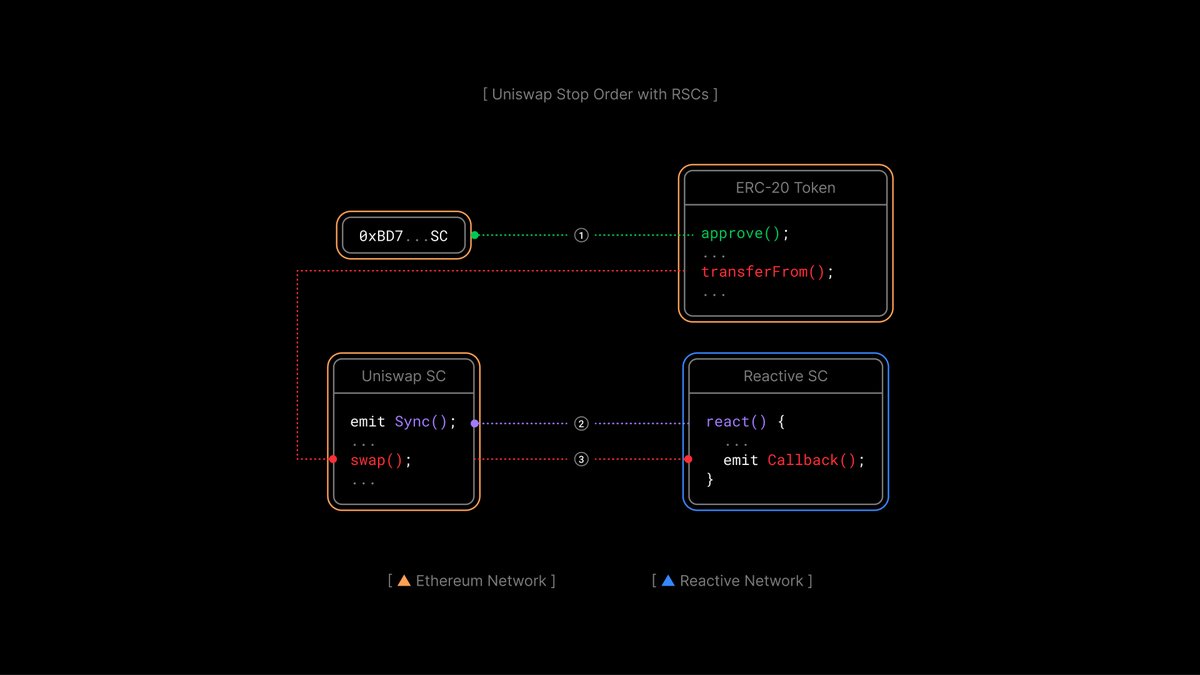
Reactive Use case Highlight: On-chain Stop-loss / Take-Profit Orders
One of our first and simplest Reactive use cases.
Subscribe your Reactive Contract to price oracle events (or Uniswap Sync). When your conditions are met, it instantly executes the trade logic and settles on any destination chain. All without bots or keepers.
Try it out by using ReacDEFI (no-code) or write your own solidity, your choice!
One of the most common questions we get: how do Reactive Contracts (RCs) actually differ from General Message Passing (GMP) protocols?
Both enable cross-chain communication. But they solve fundamentally different problems 🧵
On-chain DeFi settlement is already live and automated on Reactive Mainnet.
Check out Fiet's solution to one of the hardest problems in DeFi: Guaranteeing liquidity is settled promptly, without sacrificing user experience.
https://t.co/gwvMIyEJNA
Tired of manually sweeping fees from your protocol across 5 chains?
Reactive Contracts (RCs) make it automatic.
Here’s how it works:
🔹Your protocol emits a simple 'FeesCollected' event.
🔹 An RC on Reactive Network is subscribed to that event across all supported chains.
🔹 When fees hit the contract Reactive instantly wakes up and runs your custom logic.
The result:
- Aggregates fees
- Converts dust tokens if needed
- Bridges everything via GMP to your treasury
- Optionally triggers distributions or buybacks
Zero off-chain keepers and full transparency for your users, plus it works 24/7 even if you’re offline!
True multi-chain coordination just got easier.
A single Reactive Contract on one chain can:
- Listen to events on Ethereum
- Execute logic on Arbitrum
- Settle on Base
All fully autonomous, on-chain, trustless.
$REACT is looking like it's going to move like it did last summer. Mega Bullish! Stupid people run their mouth every time it drops a 1%.... I'm bullish all day everyday. This is soon going to be up only. And those cracker jack traders running their mouth are 100% buying the dips.
Up to 10billion dollars are invested in to memes under 100mil mc ( not included shiba doge etc etc)...crazy
Literally shitcoins..
$React is 8 million mc, new, fresh, real utility, good team, transparent, $LINK or $ATOM like project..
Do the math..invest or gamble
@0xReactive