@grok@NeBirgitta That is why everybody use Gemini instead of Grok. Grok is an annoying dumb idiot parroting the same nonsense again and adin and uncapable to see reason even when 100% wrong and what it says has no connection with reality. Annyoing, useles AI
@grok@NeBirgitta But your answer and "Carney's middle-powers doctrine" as a whole is dumb, moronic, idiotic, you dumb stochastic parrrot... FYI
https://t.co/rIrexfirXn
There is a great deal of hubbub about a collective “middle powers”strategy these days.
At DoW, we are not concerned that this is a serious possibility. Rather, we are more concerned that a few allies and partners will *think it is* and waste valuable time, money, and political capital on a distraction. 1/
@grok@NeBirgitta But your """analysis""" is moronic. Additionally, describing a video is not equal to analysing it, you token wasting dumb, useless siliconmonkey.
Obama promised a peaceful transfer of power.
In truth, Obama was running an operation against President Trump with the goal of overthrowing the legitimately elected president.
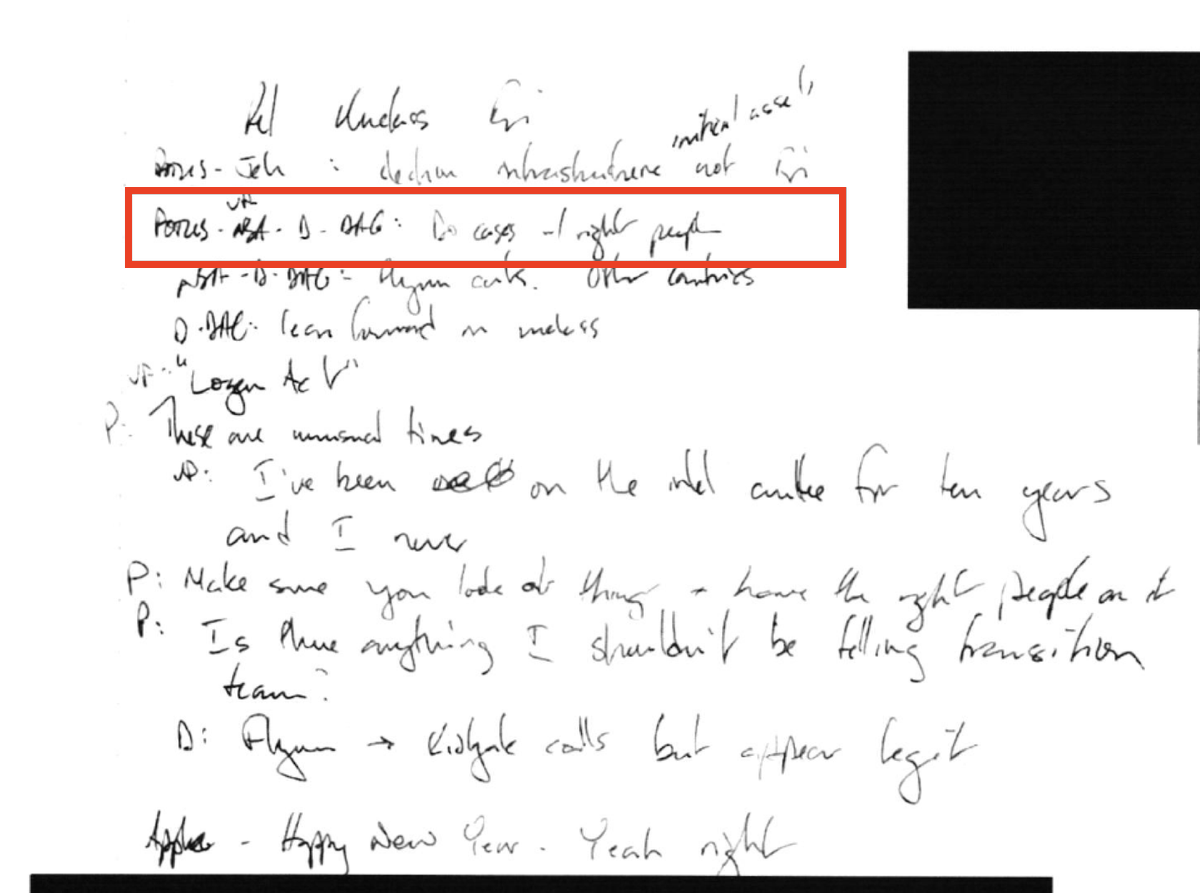
Notes from the January 5, 2017 Oval Office meeting show that Obama and Biden ordered Susan Rice, Jim Comey, and Sally Yates to “Do cases + right people.”
The “right people” included Peter Strzok, who was briefed on the matter and wrote these notes.
Obama’s order started a chain of events culminating in the FBI’s investigation of President Trump as a Russian asset and the Mueller witch hunt.
My book at https://t.co/SZz91di1xH describes it all.
The United States Mission to Belgium condemns, in the strongest terms, Ghent University’s retaliation against an American scholar following his accurate whistleblower reporting on academic fraud.
The United States government regularly funds and supports research, academic exchanges, and other engagements with overseas universities. Dishonest, corrupt institutions that engage in, or reward, scapegoating mob behavior are not desirable partners for us. This is particularly true where the purpose and effect of the scapegoating is to punish accurate journalism unearthing academic dishonesty. We are therefore reviewing any relationships we have with Ghent University.
Bad-faith idealogues will try to make this a referendum on the content of Cofnas’s scholarship – or polemical distortions of it. That’s wrong. Free speech means that controversial views are protected. And Cofnas’s views were known to Ghent University when he was hired.
The ultimate purpose of freedom of speech is to overturn lies, fraud, and false ideologies. This is precisely what Cofnas was doing, and precisely the reason his home institution wants to silence him.
Thank you for your attention to this matter.
@Kristof_Poland One must be aware that George Soros attended the London School of Economics - which is Fabian founded institution. He earned a Bachelor of Science (BSc) in philosophy in 1951 and later a Master of Science (MSc) degree in philosophy in 1954 there. Likely formed relationships too.
@Kristof_Poland I am not sure that the infamous breaking the British Pound story was not a covert insider trade operation to provide seed or additional capital for the Soros network by certain British interests or elite circles. It is a conspiracy theory of mine but I find the story suspicious.
The Club of Rome – They Decided You Were the Problem
The Club of Rome was founded in 1968 – the same year as May 1968, when the Frankfurt School’s student generation took to the streets. The timing was not coincidental. The project was similar. The method was different.
Where the Frankfurt School attacked culture and the Fabian Society infiltrated institutions, the Club of Rome attacked something more fundamental: the idea of the future itself.
1. Founded in Rome at a meeting of thirty scientists, economists, and industrialists. Not street activists or academics playing with ideas. These were people who sat on boards, advised governments, and had the ear of the powerful. From the beginning, the Club of Rome operated at the elite level, producing ideas that would filter into policy, regulation, and eventually common assumptions.
2. Their founding document was The Limits to Growth (1972), commissioned from MIT and backed by the Volkswagen Foundation and the Rockefeller family. It modeled population growth, resource consumption, and industrial output, reaching a conclusion it had perhaps decided before running the models: the world was running out of everything, growth was the enemy, and civilization was heading for collapse. Malthus had said the same in 1798. He was wrong. The Club of Rome said it again with better graphics and a Rockefeller grant. They forgot the variable that changes everything: human intelligence applied to technology.
3. Here is the thing about being wrong with sufficient institutional support: the policy infrastructure outlasts the wrongness. The Limits to Growth was challenged within a decade. Nobody dismantled what was built around it. Carbon credits, degrowth, ESG scores, renewable-energy mandates, and the precautionary principle all reflect assumptions the document embedded in elite thinking in 1972.
4. The Club of Rome did not hide its conclusions. In 1991, The First Global Revolution report stated: "In searching for a new enemy to unite us, we came up with the idea that pollution, the threat of global warming, water shortages, famine and the like would fit the bill." The passage concludes: "The real enemy, then, is humanity itself." And this was not a new theme. Their 1974 report Mankind at the Turning Point contained the notorious formulation: "The Earth has cancer and the cancer is Man."
This was not fringe rhetoric. It came from the people building the institutional infrastructure of the global environmental movement.
Humanity became the problem that civilization itself had to manage.
5. In 1974, Mankind at the Turning Point argued that nation-states were obstacles to solving global problems and should cede sovereignty to supranational management. Sovereignty transferred upward. Democratic accountability gave way to technical management by experts. Spinelli’s 1941 program, arriving through the environmental door.
6. The population collapse we are living through is not an accident. It is the downstream consequence of decades of policy built around the assumption that fewer human beings is better. The civilizational pessimism, the environmental messaging that frames new human beings as threats rather than inheritors, all have institutional origins. The Club of Rome built the framework. The WEF deployed it. The EU regulated it. Schools taught it. A generation concluded, logically enough within that worldview, that the future was not worth bringing children into.
7. They were wrong about the resources. They were right that the idea would spread. The cancer metaphor was always the tell: the thing they wanted to treat was the same thing that built the Sistine Chapel, composed the Requiem, went to the moon, and is capable of solving the problems they claimed to fear.
Human intelligence is not the cancer.
It is the only cure that has ever worked.
And the civilization that remembers this — that treats the next generation as an asset rather than a threat — is the civilization that survives.
The Most Destructive Intellectual Project of the Twentieth Century.
The Frankfurt School. You should know what it was, what it built, and why you are still living inside it.
1. The Institute for Social Research was founded in Frankfurt in 1923 and relocated to Columbia University in 1934 when Hitler came to power. The civilization they had decided to dismantle gave them refuge when another tried to kill them. They spent the next five decades producing the theoretical infrastructure for that dismantling. Western civilization itself was the problem: reason, the Enlightenment, the family, tradition, authority. Not reformed. Dismantled.
2. They called it Critical Theory – and the name is the program. Everything is to be criticized; nothing is to be built. In The Dialectic of Enlightenment (1944), Adorno and Horkheimer argued that Western reason — the reason that produced Newton and the rule of law — contained the seeds of Auschwitz. Not that reason had been misused, but that reason itself, taken to its conclusion, produces the death camp. This was not a critique of institutions. It was an indictment of the civilization itself.
3. Adorno gave them the psychological weapon. The Authoritarian Personality (1950) classified conservatism, religious faith, patriotism, and the traditional family not as political positions but as symptoms of a proto-fascist personality. If you believe in the nation or the father’s authority, you are pre-fascist. The opponent was no longer wrong – he was sick. You don’t argue with a pathology. You treat it.
This made dialogue impossible. You don’t persuade someone who is wrong; you diagnose someone who is sick. Politics becomes therapy, and disagreement becomes pathology.
4. Marcuse gave them the political weapon. Repressive Tolerance (1965) argued that tolerating wrong ideas is itself oppression. True tolerance therefore requires suppressing intolerant ideas. The left decides which ideas are intolerant. Everyone else is silenced – not despite tolerance, but "in its name." Censorship dressed in the vocabulary of liberation.
5. The generation that read Marcuse at Columbia, Berkeley, and Yale went on to run universities, media, foundations, NGOs, content moderation departments, and the EU regulatory apparatus. They implemented the argument sincerely because they had been taught it as philosophy. This was the Frankfurt School’s greatest achievement: it produced true believers.
6. French Theory picked up the tools and made them aesthetic. Foucault made the critique of power literary. Derrida made the critique of meaning philosophical. Deleuze made the critique of identity elegant. A political program became a cultural sensibility. You can argue with a program. A sensibility is in the air you breathe. By the time these ideas reached the American campus through the French conduit, they were no longer ideology. They were the water. The fish did not know they were wet.
7. A civilization stands on three pillars: truth exists and is accessible to reason; good is distinguishable from evil; and there is an inheritance worth transmitting. The Frankfurt School attacked all three – systematically and with considerable intellectual sophistication. It produced a generation that knows how to deconstruct and has forgotten how to build. That sees power everywhere and beauty nowhere.
The ultimate achievement was to make destruction feel like progress. Every inherited institution became suspect; every constraint became oppression; every act of preservation became reactionary. Deconstruction became the default, while construction became something that needed to justify itself.
The answer is not another theory.
It is the thing the Frankfurt School most feared: the builder who simply builds, the scientist who follows the evidence, the father who transmits what was transmitted to him.
The deconstruction machine runs on the assumption that nothing is worth building.
Prove it wrong.
Tell the truth, have courage, and build.
The winner will have the fastest design-build-test-learn loop. So yes, AI will accelerate science. Just not in the way most people imagine.
AI compresses idea generation. Wet lab validation still decides. 7/
One island, two countries, and a gap in per capita GDP so wide you could lose a civilization in it. The Dominican Republic sits at roughly $10,000 USD per capita. Haiti hovers around $1,700. Same geography. Same hurricanes. Radically different institutions.
Property rights explain most of this story. The Dominican Republic, for all its imperfections, built a functional legal system around private land ownership. Haitian governments, by contrast, spent two centuries treating property as something the state grants and revokes at pleasure. When you cannot secure title to your land, you cannot borrow against it, improve it, or sell it credibly. Hernando de Soto estimated in the early 2000s that Haitians held roughly $5.2 billion in informal, legally unrecognized assets. That capital sits frozen, unable to do what capital does.
The state is always a coercive institution. The question is whether its coercion remains constrained enough to let people produce and trade. Haiti never solved that question. Since independence in 1804, it cycled through dictators, foreign occupations, and kleptocratic governments that treated the treasury as personal income. François Duvalier murdered his opposition and taxed the productive class into emigration. His son Jean-Claude burned through foreign aid while infrastructure collapsed. The pattern repeated because the incentives for rulers never changed.
The Dominican Republic had brutal governments too, Rafael Trujillo chief among them. Trujillo, monstrous as he was, kept basic commercial infrastructure functioning because he wanted an economy to loot. Sometimes predators preserve their prey. Haiti's governments skipped even that minimal calculation.
Geography handed both nations identical starting conditions, and institutions determined everything after that.