Author of The Silver Meridian: historical thrillers set in the Roman Empire of AD 599. Roman, never "Byzantine". Vol I, The Smallest Coin, out 15 Jan 2027.
@Gregoresate I make a very similar argument in my recent YouTube video. I have also stopped referring to anything as "Byzantine", unless it is specifically to the pre-Constantine city.
https://t.co/nhGTbf5brI
Well one weakness of Frankopan's piece is that he makes no mention at all of the Greeks. Contemporary Armenian authors for example were clear: The empire is Roman; the language, people, culture are Greek. The culture was at the same time not hostile to Babylonian, Assyrian, & Hebrew letters. The Sasanids also had taken up the mantle of the Achaemenids. The men of late antiquity were interested in keeping tradition alive without affecting to be something else.
But Frankopan rightly suggests that the same pretenders had also invented a false Greek mythos, distinguishing Greece from (Latin) Rome and making Greek synonymous with "pagan philosophy," even though the ecumenical councils of the Church were all convened in Greek and the language of New Rome was Greek. Also these very Greeks (Romans/Byz) had in fact never lost touch with the pagan philosophers but had come to treat their works with circumspection (see, e.g., St. Basil's address to the youth on the uses of pagan literature).
Take by contrast academic classicists who hearken back to Ancient Greece but completely ignore ~1,000 years of Christian Rome, as though it were a byzantine vacuum of culture. One might be inclined to think that, without these academics, all this knowledge would've been completely lost to mankind. And wasn't it on this basis of hearkening back to the "pagan Greeks" that the humanists, with their "virtue (-signaling) politics" came to reject Christianity? Meanwhile, the Romans (Greeks) were still the real inheritors and custodians of that tradition, and could even anathematize certain of Plato's teachings when they had to.
As for Iran and Israel, it's much the same as the Roman affectation I think. These states hearkening back to ancient Iran and Israel look rather dubious, no?
On this day in 602, at Chalcedon, the emperor Maurice was made to watch five of his sons killed before he was killed himself.
The Silver Meridian begins three years earlier, in 599, while all of it could still be prevented.
Walk along Egnatia in Thessaloniki and you pass under the arch Galerius built about 300 for his Persian victory, with his great round Rotunda just above it.
In 599 both were already three centuries old. Andreas grew up with them. What he won't find in 599 is the White Tower.
@sirenrick@EngelsbergIdeas@peterfrankopan As discussed in the video, the point is where the Latin bitterness overflowed and they decided to crown their own Roman Emperor. It's not that the East ceased being Roman. It's that the West resented them for it.
The Byzantine Empire never existed. It was simply the Roman Empire in the east, and far more resilient than Western Europe has long claimed.
The rise and fall of the ‘Byzantine’ Empire | @peterfrankopan
https://t.co/D34z5qw3ON
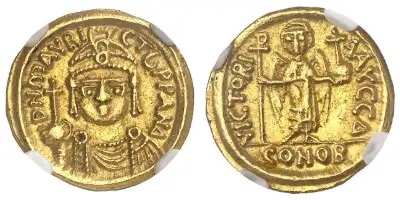
The emperor Maurice called himself Augustus. His coins say so. Nobody in his empire had ever heard the word "Byzantine".
So who invented it? A German scholar in 1557. 🏛️
Full episode on YouTube: https://t.co/fP84t67n39
The emperor Maurice called himself Augustus. His coins say so. Nobody in his empire had ever heard the word "Byzantine".
So who invented it? A German scholar in 1557. 🏛️
Full episode on YouTube: https://t.co/fP84t67n39
Why "Roman, never Byzantine"?
In 599 nobody had heard the word. The people of Constantinople called themselves Romans, and their state the empire of the Romans.
"Byzantine" is a scholars' label, first used for them in 1557 by Hieronymus Wolf, a century after the City fell.
It is now almost certain that Hagia Sophia in Istanbul was built on the site of a pagan building.
Restorers have cleared 420 metres of underground spaces beneath Hagia Sophia, removing nearly 3,000 tonnes of mud and rubble and uncovering six chambers.
The discoveries date back to around 500 years before Christianity emerged.
In 67 AD, a Roman emperor entered the Olympic Games.
The Games were due in 65 AD. Nero had them put off until he arrived in Greece.
At Olympia he raced a chariot pulled by ten horses.
He was thrown out of it. Cassius Dio says he came very near to being crushed to death.
They put him back in. He could not finish the race.
He was crowned champion anyway.
Suetonius and Cassius Dio, writing separately, both record the fall. And the crown.
Both also record that Nero paid the judges. Dio puts it at a million sesterces.
After Nero died, the next emperor, Galba, demanded the money back.
He ordered back nine-tenths of every gift Nero had ever given. 🏛️
The solidus, the gold coin of the Roman Empire: 72 to the Roman pound, about 4.5 grams each, and its weight barely moved for seven centuries.
This one is Maurice's, struck at Carthage around 585.
Photo: Janovsky, CC BY 4.0, via Numista