Fiat is so fragile and manipulated that some old dude can mutter 15 words and markets around the world whip-saw to the tune of trillions of dollars in a matter of minutes.
Humans have built their entire exchange of energy between each other on this scheme of a system. Decades later we will truly laughing at how primitive it all was.
@stacyherbert Transformative in the sense we're creating a dictator? I want to see my country prosper but using the military against civilians ain't it
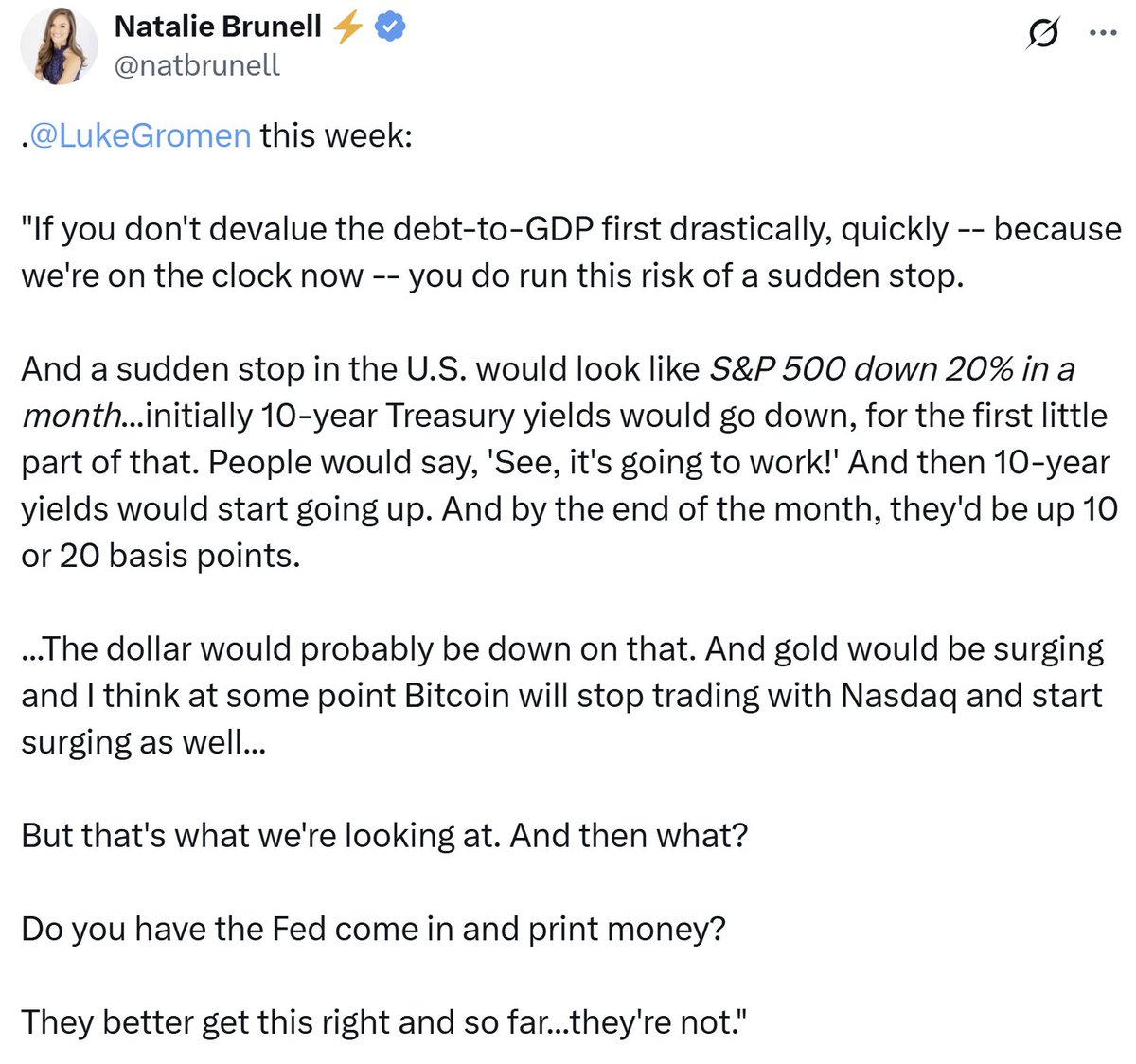
With DXY down, 10y UST yields up, stocks down, gold surging again, wanted to re-highlight this interview with @natbrunell from a week ago Monday (March 31, two days before Trump's tariff announcement), in which we said the following:
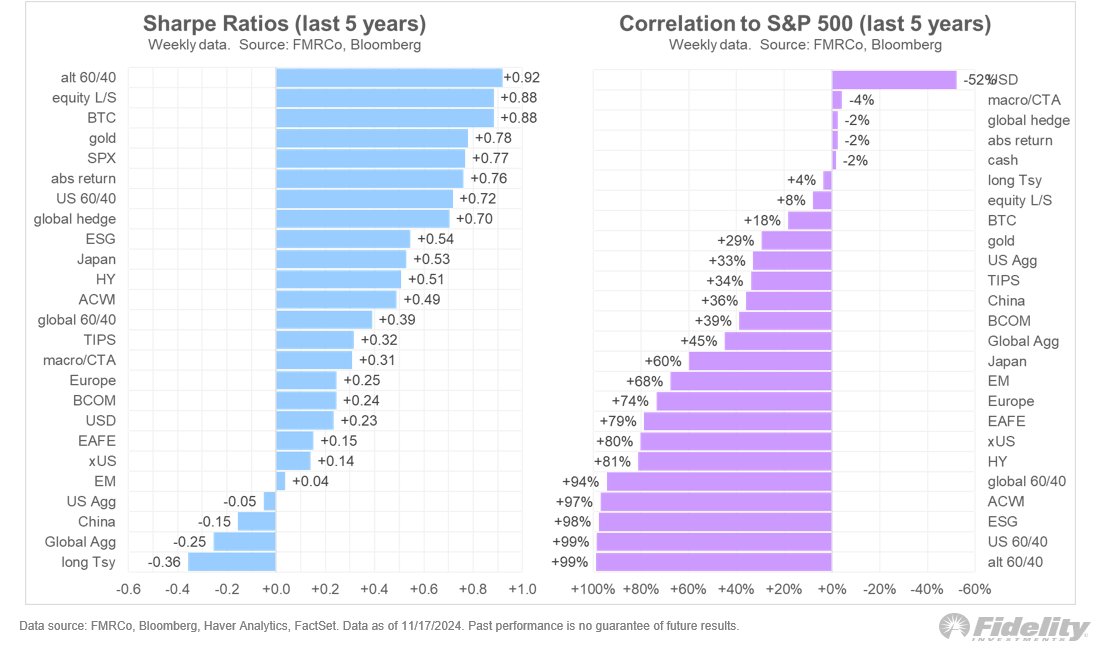
Despite its boom-bust cycles and high volatility, bitcoin remains quite competitive in terms of its 5-year Sharpe Ratio and limited correlation to the S&P 500.
What is going on?
Pure unadulterated reckless government spending and so an exponential rise in debt, requiring more units of debt to drive each unit of GDP. Madness.
@coryswan@LynAldenContact@Swan Let's take a victory lap and all congratulate you. You only had to lay off half of your work force (at least) a few months ago with absolutely 0 notice. Many of those employees with families and dependents. But hey look at how good you're doing
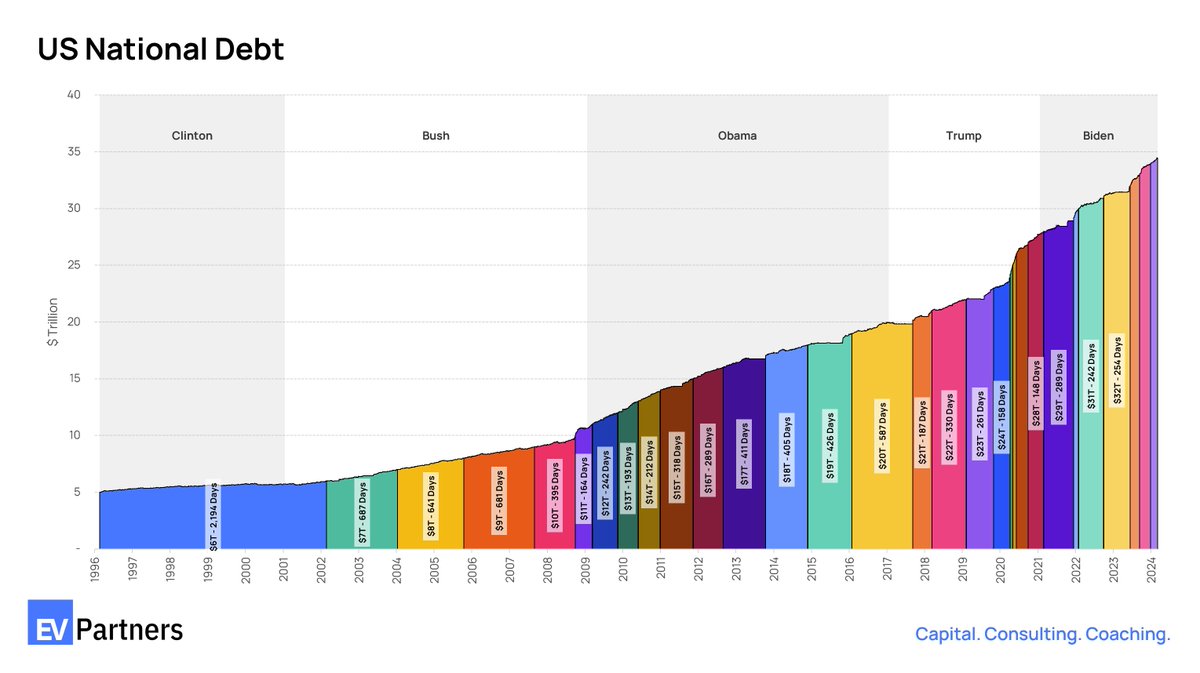
This is the scariest chart I’ve ever made. This is what it looks like when a country is heading toward a financial precipice.
Each color shows $1T getting added to the national debt.
Not that long ago, it took six years to add a bar.
We’re now adding one every 90-120 days.
The explosion of debt has been the only bipartisan phenomenon of my lifetime. For us conservatives, we can’t blame it on just Biden and Obama. For you Democrats, you can’t put this on just Trump. It’s both parties, all presidents, and every Congress.
The acceleration started under George W. Bush. Bush went into 2002 with less than $6T of debt. Thanks to GWOT military spending and tax cuts we probably couldn’t afford, $6T grew to $7T in 23 months, $8T in another 21 months, and $9T in 23 months.
Then the Great Recession hit. We added the next trillion in 13 months, crossing $10T for the first time in American history. And we haven’t looked back since.
During the second Obama term, with spending reined in by the Tea Party movement, annual deficits reduced to less than $1T, and growth in the debt slowed down. At the end of Obama’s tenure, it took nearly 20 months to go from $19T to $20T.
That would be the last time it took a full year to add a trillion dollars to the debt.
In 2017, a real-estate developer got inaugurated as president. And, if there’s one thing we all know—and love!—about real-estate investors, it’s that they understand the value of leverage.
Under Trump, even as the economy surged, deficits grew, and national debt once again spiraled. We ended 2019 with a little over $24T in debt.
Then Covid hit, along with consumer stimulus, PPP loans, massive government spending, and reduced tax receipts. Over just two months in 2020—April and May—we added $2T to the national debt. Ever since, we’ve been adding $1T every 160 or so days.
With Biden in the White House and a narrowly divided Congress, we’re now adding $1T to the debt every three to four months. It took just 91 days to go from $32T to $33T. 104 days to get to $34T.
And it’s not slowing down. Biden has another 300+ days in office this term. When he or Trump enters their second respective term in office in 2025, the debt will likely be above $37T.
Where does it end? As deficits continue to pile up and borrowing costs remain relatively high compared to where they were over the previous 20 years, how is any of this sustainable?