This wonderful dude is hanging out at the back gate--he just hung on while I opened and then closed the gate. This is a Cope's Gray Treefrog (Hyla chrysoscelis) or Eastern Gray Treefrog (Hyla versicolor). These guys contribute heavily to that New England spring evening noise.
It's lunar photography tonight, with an 83% waxing moon. Here's one of my shots. I'm out with the 8" Newtonian, 800mm FL at f/4 and the ZWO ASI715MC color camera. This is my first experience with the 715, so far so good! More of my astro stuff here: https://t.co/JbW7v2qikw
From last night's imaging run: M78, LDN 1622, Barnard's Loop. Top right structure composed of dark nebulae clustered around the reflection nebula Messier 78 (M78, NGC 2068) and bottom left is LDN1622, "Boogeyman Nebula", 49x300-sec subs #ZWO ASI071MC WilliamOptics Redcat51
The astro gear is ready to go (this is the advantage of being able to leave everything setup for weeks at a time). Now I'm just waiting for the clouds to move.
I setup the wide-field color rig at lunch. Going with the #ZWO ASI071 cooled color camera and Antlia UV-IR cut filter. No moon tonight, so if we get a stretch of clear seeing, I'm going after M45 (the Pleiades) for half the night, and then I'll spend the rest on M78 in Orion
Orion Core in hydrogen-alpha: two-panel mosaic of Orion's Belt, the Horsehead Nebula, and M42, the Orion Nebula The three bright stars in a line on the left is Orion's Belt. ZWO ASI2600MM-Pro, 3nm Ha, William Optics SpaceCat51 Apo refractor. https://t.co/JbW7v2qikw
Our giant neighboring galaxy, Andromeda (M31) in HaRGB. I captured this data last night, waiting for Orion to rise above 30°. Imaging Notes: 30 x 120-second subs in RGB, 30 x 180-second subs in Ha shot from my backyard in coastal New Hampshire, bortle 4-ish.
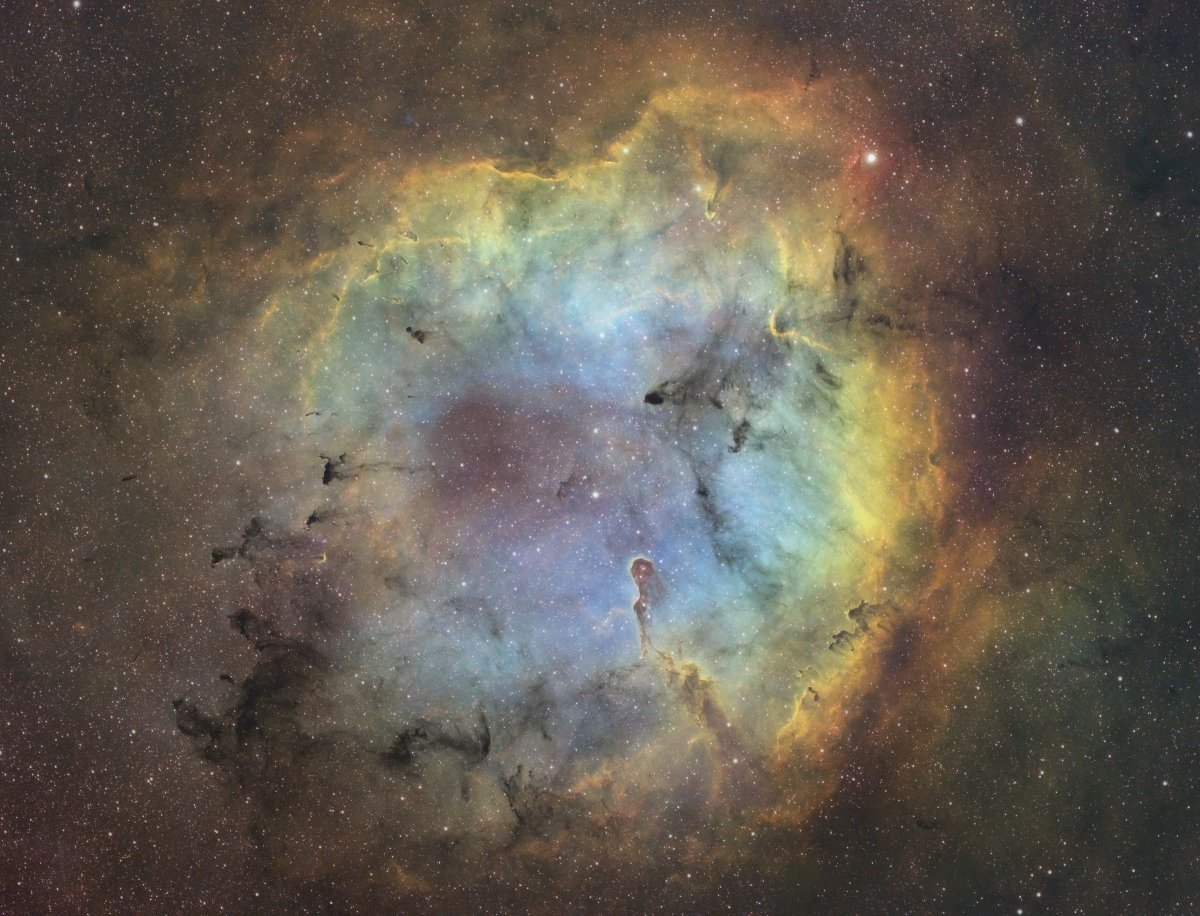
I spent most of the night capturing OIII and SII data in the IC1396 region in Cepheus, enough to combine with last week's Ha data to create a SHO color image, mapping sulfur to red, hydrogen to green, and oxygen to blue in RGB. https://t.co/JbW7v2qikw