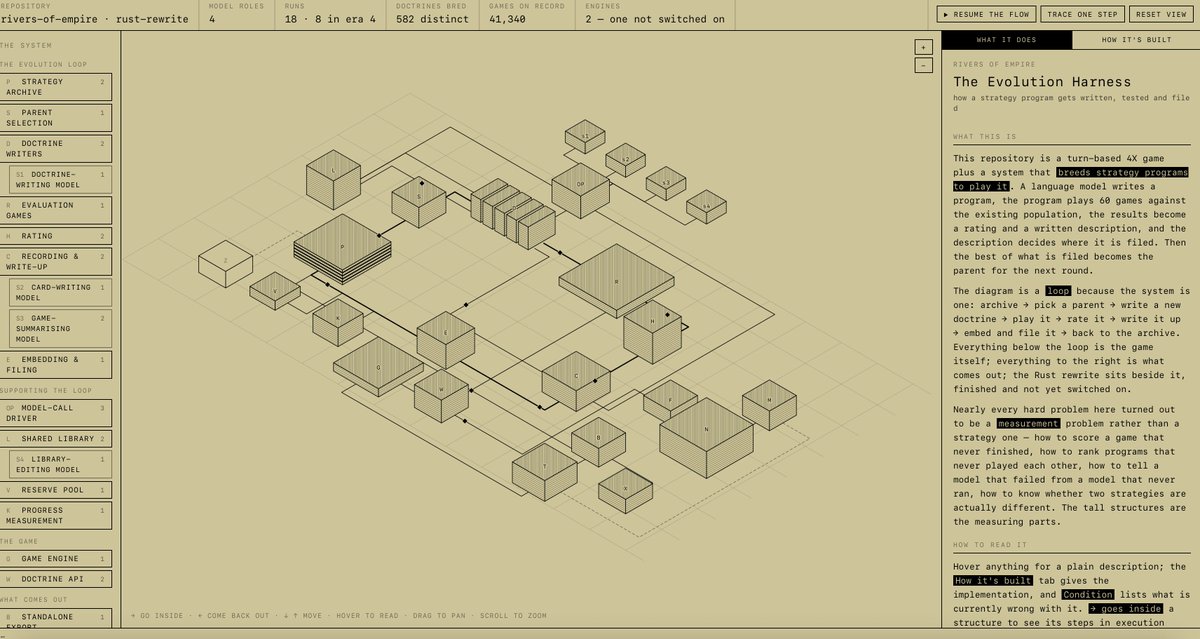
our gtm data platform is effectively a single pipeline on @modal@Snowflake@dbt_labs. it looks like this:
load -> enrich -> entity resolution -> qualification/segmentation -> reverse etl
until this tweet reminded me that You Can Just Do Things, the pipeline was effectively a black box
so i took the afternoon to build a GTM Data Platform Console, featuring...
- data flow, drop off, and trends
- interactive documentation
- source data health status
- QA and object lookup
- easy updates as schema/code drifts
i've started having claude turn my codebases into visual diagrams so i can discuss the codebases with claude more easily - the moving dots are data snippets that i can inspect
hone is the first product I’ve adopted that’s truly challenged me, not to adapt or learn or use it more, but to be more ambitious with the problems I give it
massively bullish on @hone as the future of work, and excited to share how we use it at @modal!
Announcing Hone
Intelligence has become abundant. Yet the world looks remarkably similar to how it did five years ago. With every model release, the gap between what frontier AI can do and the economic value derived from it widens.
Closing the gap requires re-organizing work around organizational outcomes, not individual tasks. Hone builds AI that creates, orchestrates, and improves agents and software continuously to own organizational outcomes over weeks and months.
We are ex-founders and early core contributors to Cognition, Mercor, Ramp, and OpenAI. We obsess over real-world value, not theoretical benchmarks.
Our core beliefs on closing the gap in the thread below.
Kimi K3 is live on Modal.
Moonshot has shipped the world's first open 3T-class model, and we're a day zero launch partner.
We trained a custom DFlash speculator for K3's novel architecture so you can run it faster, losslessly. The most capable open model we've worked with by far.
yes, working at @modal is as fun as it seems.
we are casting 35 more roles across new york, san francisco, and stockholm. one could be yours !
https://t.co/vY1nzNdGn4
i broke the willow branch and wished my cat would love me more than anything in the world and everything is great actually, 10/10 product, really delivers
I’ve been saving a desk next to me for a very special person :)
- They likely don't have the title of GTME (yet). Probably growth eng, SWE, or analytics/data engineer. They definitely dont care much about titles at all.
- They’re impact-seeking. They use data and intuition to find high-leverage problem areas and do whatever needs to be done to solve them.
- It seems like they’re on every team at once. No one knows what they do, yet everyone comes to them with their problems.
If this sounds like you, or reminds you of someone, shoot me a DM.
If it leads to a hire, not only will I be forever in your debt, but I’ll also take you to a very very nice dinner (or just pay for it if you want to go with someone else - no hard feelings!).
So why are we so excited about hiring this person?
It may come as a surprise, but I’m actually the only GTME/GTM systems person at Modal, a business of >120 people, generating >$300M in annualized revenue. In the 6 months I’ve been here, our revenue run-rate has increased 3X (correlation not causation, to be clear).
It’s not slowing down.
So we’re investing in Modal’s GTME function to enable the team to accelerate even faster without falling into total chaos.
The purpose of our team is simple: own the systems that give us the precision and leverage to call the forecast and hit it.
🔮 Calling the forecast is fundamentally a data engineering problem. We build pipelines and processes to aggregate signals and insights for every account, evaluate the potential future spend, and the probability of that coming to fruition.
I’ve taken this 0-1, but it’ll need to scale 1-100 very soon.
🎯 Hitting the forecast is a people and systems problem. People collaborate directly with our customers to help them solve their hardest technical challenges. Systems enable them to scale by spending more time creatively solving problems and less time toiling in the CRM mines.
This is honestly still at 0, and it’s a massively untapped source of leverage.
If you think you’re the best person in the world in either or both of these areas, please reach out - I’d love to work with you!
I have spent the last year in the weeds with teams running open LLM inference on Modal.
Modal was already the best place to do this: truly elastic GPUs, fast cold starts, low-overhead routing, and deep observability.
Very excited to raise the bar even higher today.
Auto Endpoints package the Modal inference stack into one command:
modal endpoint create --name agent --model zai-org/GLM-5.2-FP8