John provides a window into the mechanics of how Jesus’s death saves—his use of the OT. When we look through this window, our eyes are caused to see substitutionary atonement as essential to the inner mechanism of how Jesus’s death saves. @Themelios_TGC
https://t.co/wxXhmo34I6
"It is emblematic of the radical nature of orthodoxy in the last days: there is nothing quite so radically subversive today as sound doctrine and godly living" (@DrChrisWatkin, Biblical Critical Theory: How the Bible’s Unfolding Story Makes Sense of Modern Life and Culture, 482).
"Suspicion often creates what it suspects." - C.S. Lewis (Screwtape Letters)
Beware how easily we can develop false narratives about people based on assumptions or misinformation.
Now through November 30, my book, To Save Sinners, is available for 50% off if you order through the publisher's website. Just use the code CONFSHIP at checkout. Also, if you select Media Mail, shipping is free.
https://t.co/rm4WOsjLw7
Some things, Paul says, are not ἀνῆκεν.
They are not fitting (NASB, NRSV). They are not suitable (CSB). They are out of place (ESV, NIV).
For example:
❌ Filthiness
❌ Foolish talk
❌ Crude joking
What is always fitting and suitable and in place?
✅Thanksgiving.
"Let there be no filthiness nor foolish talk nor crude joking, which are out of place, but instead let there be thanksgiving" (Eph. 5:4, ESV)
"God gives us commands because he wants something _for_ us not just something _from_ us" (@pastorjgkell, Pure in Heart: Sexual Sin and the Promises of God, 51). Amen.
Okay, here's my effort at writing a hymn based on the Nicene Creed. It's set to the tune of "Praise to the Lord, the Almighty."
I'm calling it the Nicene Hymn. It's six verses. The first is about the Father, the second and third and fourth are about the Son, the fifth is about the Spirit, and the sixth is about the Church.
If you know the Nicene Creed well, you'll notice that the hymn tweaks wording here and there, in order to form stanzas, but the essence of the Creed's content is preserved.
"THE NICENE HYMN"
VERSE 1
Praise to the Father Almighty,
the King of creation,
He is the maker of all things
we see and do not see.
All by his word,
he formed the heavens and earth,
unto the praise of his glory.
VERSE 2
Praise to the Lord, who is Jesus
the only-begotten
Son of the Father and dwelling
before all creation.
He was not made,
for by him all things were made,
Light of Light, true God of true God.
VERSE 3
Praise to the Son, who came for us
and for our salvation,
who was incarnate as man by
the work of the Spirit.
For us he died,
by Pilate was crucified.
He suffered and he was buried.
VERSE 4
Praise to the Living One, who rose
again and ascended,
and at the Father’s right hand,
he is seated in heaven.
With glory, he
shall come again and will be
judge of the dead and the living.
VERSE 5
Praise to the Spirit, the Lord and
the Giver of all life,
who from the Father and Son
is proceeding for all time.
He too is praised,
and glorified for always,
he who spoke words by the prophets.
VERSE 6
Praise to our God for his people,
the Church, one and holy,
and for the sign of baptism
for sins washed by mercy.
Now we look for
when the dead rise like the Lord,
and dwell in glory eternal.
I wish English translations would keep the continuity between Luke 22:20 and 22:29 and translate διατίθεμαι and διέθετό as follows:
"I [Christ] covenant [διατίθεμαι] to you a kingdom, just as My Father covenanted [διέθετό] one to Me."
~Luke 22:29
It's a big deal that Luke records Christ's teaching and His usage of “covenant” language in 22:29 immediately after He institutes the Last Supper announcing the inauguration of the new covenant [διαθήκη] in His own blood (Luke 22:20).
Indeed, Luke 22:29 when properly exegeted/interpreted supports both the Reformed doctrine of the eternal Covenant of Redemption between the Father and Son [and Spirit] from before the foundation of the world;
and the Baptist distinctive that the Covenant of Grace (while promised in Genesis 3:15) is formally inaugurated/administered in and through Christ's new covenant work.
Excited to sing this with @RCBCRichmond.
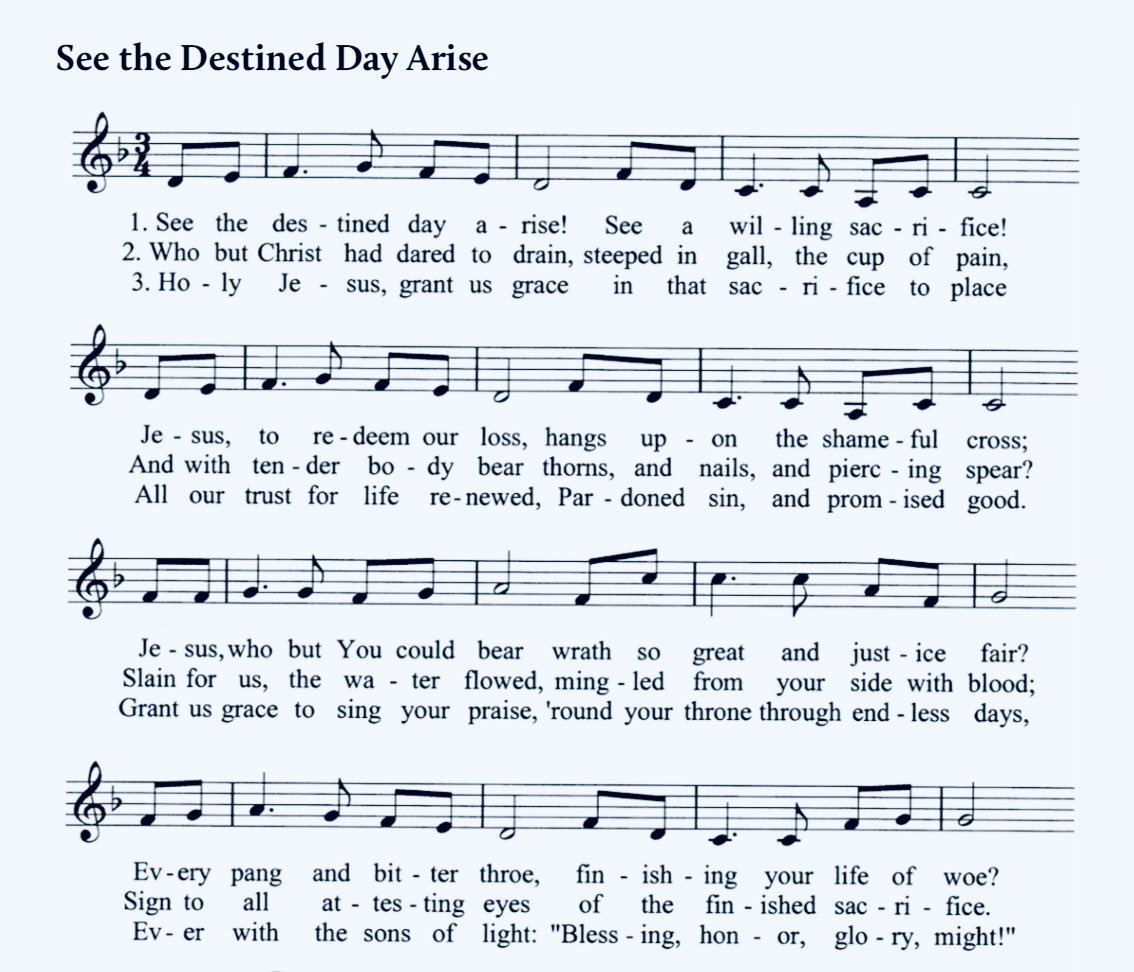
If you think penal substitutionary atonement is a modern invention, Venantius Fortunatus (AD 530–607) would beg to differ. These words predate the Reformation by a *thousand* years. And most significantly, they are thoroughly biblical.
What is the gospel? It's a surprisingly contested question.
I propose a way forward, through Christ’s threefold office—Prophet, Priest, and King.
🔹 Prophet: gospel as announcement
🔹 Priest: gospel as substitution
🔹 King: gospel as enthronement
https://t.co/Y5FC7NdZRt
"The very being of God is outwardly propulsive. God, in having glory, radiates; in having a Word, speaks; in having a Son, loves. It is his very nature to shine, communicate, and give himself in relationship" (@mike_reeves and @danhames, God Shines Forth, 37).
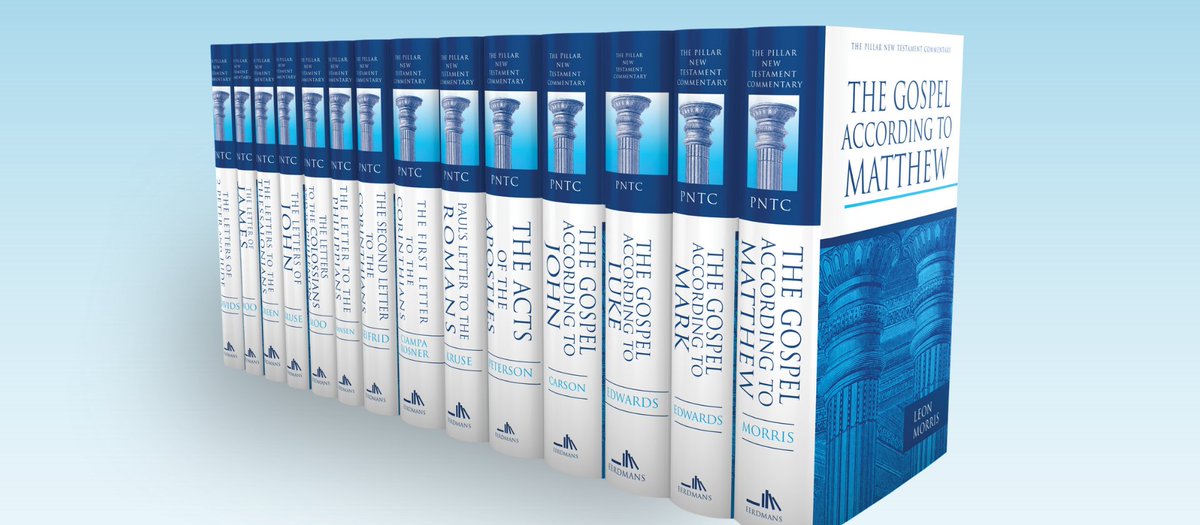
Exciting Pillar New Testament Commentary update. We've recently contracted the following:
🔹Mark: Alan Thompson
🔹John (2nd ed): Don Carson with Dan Brendsel
🔹Philippians: Tom Schreiner
🔹1-3 John: G. K. Beale
🔹Revelation: Ben Gladd
God continues to do great things with this series! 🙌🏻
To quote C. S. Lewis, “I have no intention of explaining how the correspondence which I now offer to the public fell into my hands.”
"Get Them to Call It Wisdom Literature: A Screwtape Letter"
https://t.co/Qn2e2eYw6j
On Monday, we kick-off an 8-week series on the biblical covenants. Here’s our guest lineup for July🔥: Peter Gentry @RichardJLucasJr@MichaelCarlino@jasonderouchie
Make sure you follow the show and share with your friends 🎧Anywhere 🔗👇🏽 https://t.co/IA0jY8F6IG
"Legalism is embedded in the human heart [from, virtually, creation], and it resides in us from conception.… [This confuses pastors' instincts.] For them, not only is the truth exchanged for the lie, but the lie is treated as though it were the truth" (Ferguson, Whole Christ).


![MichaelCarlino's tweet photo. I wish English translations would keep the continuity between Luke 22:20 and 22:29 and translate διατίθεμαι and διέθετό as follows:
"I [Christ] covenant [διατίθεμαι] to you a kingdom, just as My Father covenanted [διέθετό] one to Me."
~Luke 22:29
It's a big deal that Luke records Christ's teaching and His usage of “covenant” language in 22:29 immediately after He institutes the Last Supper announcing the inauguration of the new covenant [διαθήκη] in His own blood (Luke 22:20).
Indeed, Luke 22:29 when properly exegeted/interpreted supports both the Reformed doctrine of the eternal Covenant of Redemption between the Father and Son [and Spirit] from before the foundation of the world;
and the Baptist distinctive that the Covenant of Grace (while promised in Genesis 3:15) is formally inaugurated/administered in and through Christ's new covenant work.](https://pbs.twimg.com/media/Gyk6J8HXUAArCUC.jpg)





![MichaelCarlino's tweet photo. I wish English translations would keep the continuity between Luke 22:20 and 22:29 and translate διατίθεμαι and διέθετό as follows:
"I [Christ] covenant [διατίθεμαι] to you a kingdom, just as My Father covenanted [διέθετό] one to Me."
~Luke 22:29
It's a big deal that Luke records Christ's teaching and His usage of “covenant” language in 22:29 immediately after He institutes the Last Supper announcing the inauguration of the new covenant [διαθήκη] in His own blood (Luke 22:20).
Indeed, Luke 22:29 when properly exegeted/interpreted supports both the Reformed doctrine of the eternal Covenant of Redemption between the Father and Son [and Spirit] from before the foundation of the world;
and the Baptist distinctive that the Covenant of Grace (while promised in Genesis 3:15) is formally inaugurated/administered in and through Christ's new covenant work.](https://pbs.twimg.com/media/Gyk69dhXkAAErvQ.jpg)