Wohoo! Great work, @FahrenbergerM , on improving scRNA-seq analyses. Easy to use, implementation in Seurat workflow, better results across the board! Happy to have pitched in. Congratulations!
I m happy to present our latest preprint, and the main work of my PhD-project:
"GTestimate: Improving relative gene expression estimation in scRNA-seq using the Good-Turing estimator"
In this manuscript we introduce a new normalization method for scRNA-seq data.
I m happy to present our latest preprint, and the main work of my PhD-project:
"GTestimate: Improving relative gene expression estimation in scRNA-seq using the Good-Turing estimator"
In this manuscript we introduce a new normalization method for scRNA-seq data.
💫Two new papers and a joint News & Views article:
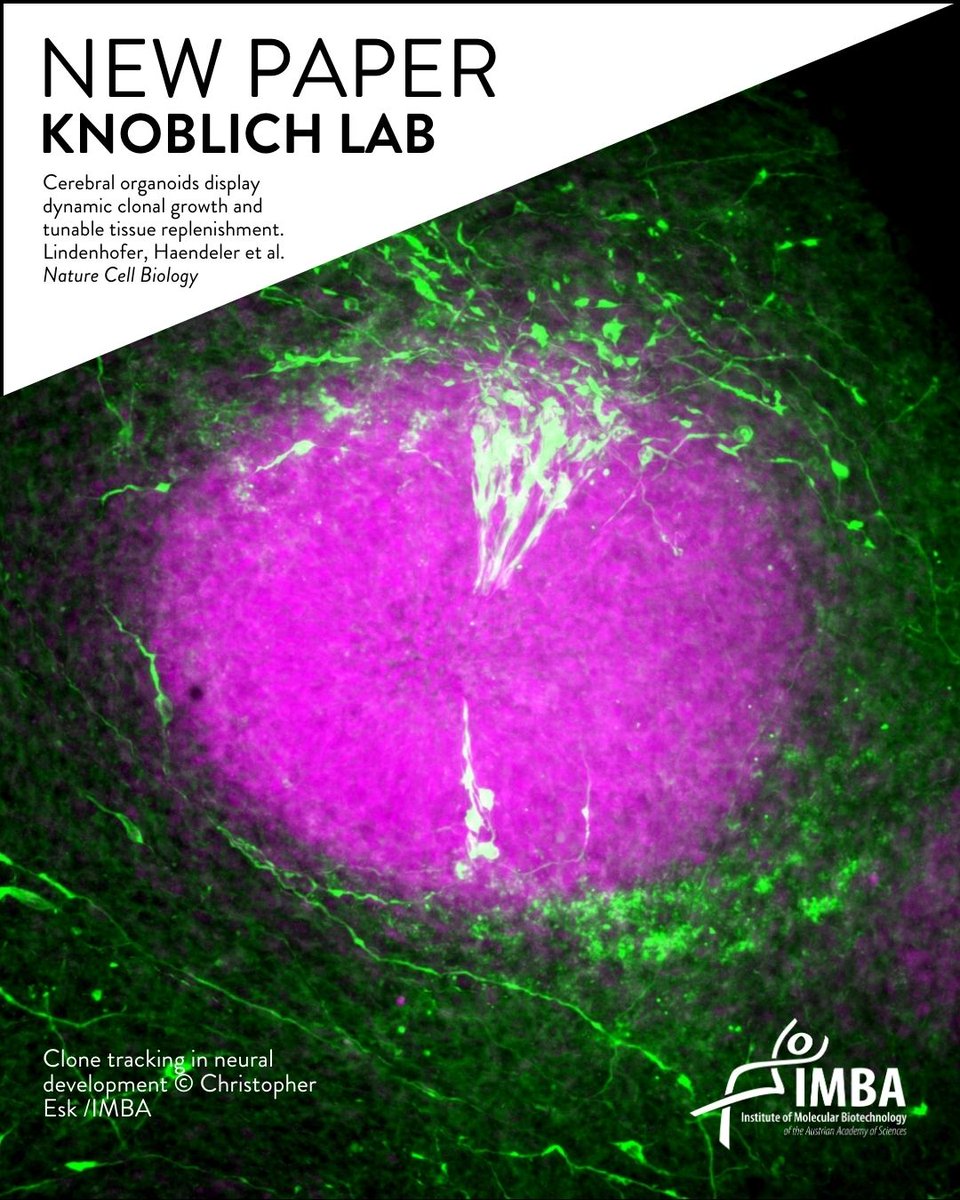
@Knoblich_lab & co perform whole-tissue #LineageTracing in human #CerebralOrganoids to reveal that a subpopulation of symmetrically dividing cells can adjust its lineage size depending on tissue demands.
https://t.co/RsABGzrRSm
📢 We’re excited to share another story published this week in @NatureCellBio! An effort led by @DLindenhofer, Simon Haendeler, @christopher_esk & @jamielittleboy1.
Cerebral organoids display dynamic clonal growth and tunable tissue replenishment
(https://t.co/xJNLOJspxN)
🧵1/9
New paper alert! Jürgen Knoblich and his team describe how so many more neurons are generated in the human brain than in the brains of other animals. Now out at Nature Cell Biology. Find out more: https://t.co/qB8CUZHIWZ
📢 Paper alert! Here's our latest @CellStemCell story, led by @catarinacsmc.
The corpus callosum safeguards interhemispheric communication in the human brain.
𝘈𝘙𝘐𝘋1𝘉 mutations cause agenesis/absence of the CC.
But by which mechanisms? ⤵
https://t.co/fmZbFCbLjo
🧵1/10
We are excited to share our latest work on developing a model of the human dopaminergic system with functional dopaminergic innervation, which we use to study Parkinson’s cell therapy as well as the reward system, published today in Nature Methods (https://t.co/2Xf6JyG3K2).
Frances Brodsky is a cell biologist at University College London. She is also the author of three mystery novels set in the world of bench science https://t.co/UuJ09thWzM
So excited to finally share our work on one of the two first construct-valid mouse models of gating-modifying CACNA1D (Cav1.3) variants implicated in neurodevelopmental and endocrine dysfunction in @JCI_insight. https://t.co/SGXpLAj58d
Thank you for the great meeting where this idea was crafted: Study Group Molecular Neurobiology of the @GBM_eV. And Biological Chemistry @degruyter_pub.
Congratulations to @ChongLi_cl and everyone in @Knoblich_lab and @TreutleinLab
on this very cool project finally being published alongside https://t.co/yx1VeZ8bIF. I am very happy to have pitched in a little bit.
We are thrilled to share our latest work, a collaborative effort with @TreutleinLab, in Nature (https://t.co/pChgPCFEOM). We introduce CHOOSE, a powerful screening system within cerebral organoids, through which we identified developmental defects associated with autism.
🧵1/7
📣 Preprint alert!
Check out our latest story, led by @catarinacsmc.
The corpus callosum safeguards interhemispheric communication in the human brain.
𝘈𝘙𝘐𝘋1𝘉 mutations cause agenesis/absence of the CC.
We wanted to know why. 🤓
🧵1/9
https://t.co/RwkEOBpf31
I am very honored to receive the Early Stage Funding from the University of Innsbruck, a research funding meant to support small projects of young scientists! I am looking forward to a fruitful year full of exciting new data! #iPSCs#stemcells@StemCellUibk@uniinnsbruck