📺🎓 Why Protecting Capital Matters More Than Making Money
Please ❤️like, 🔖bookmark, and 🔁share with fellow growth stock investors
In this educational Short, @1DannyStewart discusses one of the core principles behind @RevereAsset investment approach: protecting capital first.
Most investors focus on returns. The problem is that returns alone can be misleading if you ignore drawdowns.
*
Let's say, if you lose 50% during a bear market, your capital is cut in half. Even if your account gains 20% the following year, you're earning that return on a much smaller base.
Your statement may show a positive year, but the damage from the earlier loss is still affecting your long-term results.
This is why professional investors pay so much attention to risk management.
Every percentage point of capital preserved during a downturn allows more money to participate in the next recovery.
A portfolio that falls 10% or 15% has a much easier path forward than one that falls 35%, 50%, or more.
*
Dan also challenges one of the core assumptions behind traditional investing models.
Modern Portfolio Theory assumes returns follow a normal bell-curve distribution and that extreme market events are relatively rare.
In reality, markets experience far more large moves—both positive and negative—than these models predict.
These "fat-tail" events include major bear markets, financial crises, and sharp corrections that can erase years of gains in a short period of time.
Investors who underestimate these risks often discover that recovering from large losses is much harder than generating them.
*
The market may go up over the long run, but wealth is built through compounding. Compounding works best when capital stays intact.
So, the lesson is simple: you don't need to capture every upside opportunity, but you do need to avoid catastrophic losses.
Protecting capital isn't the opposite of growing wealth—it is the foundation of growing wealth.
*
We now also have a new dedicated page for educational content.
Check it out for more educational videos.
▶️https://t.co/3AUdKutiBU
Google and $NVDA are considering Intel $INTC as a backup chip manufacturer as TSMC capacity remains tight, per The Information.
Google has reportedly placed an order with Intel to manufacture more than 3M TPUs in 2028 after testing Intel’s advanced packaging technology.
Nvidia has not placed an order yet, but is testing Intel technology for a 2028 Feynman-series processor that combines four graphics chips into one unit.
Intel’s near-term opening appears to be advanced packaging, with SK Hynix also testing whether its HBM works reliably with Intel packaging.
After suffering its worst day of the year on Friday, the Nasdaq is rebounding sharply, up more than 1% in premarket trading.
As long as support holds, the bulls still remain in control.
Read the full note in today's Morning Print. 🌤️
https://t.co/Z8pmyhkAdL
$NVDA CEO Jensen on Stock selloff:
“We’re at the beginning of [AI Supercycle], and whatever happened to the stock market, you should be very happy because now you can buy at a discount... Everybody should be very excited
“It is a foregone conclusion that AI will be infrastructure for the world, just like the internet was infrastructure for the world.”
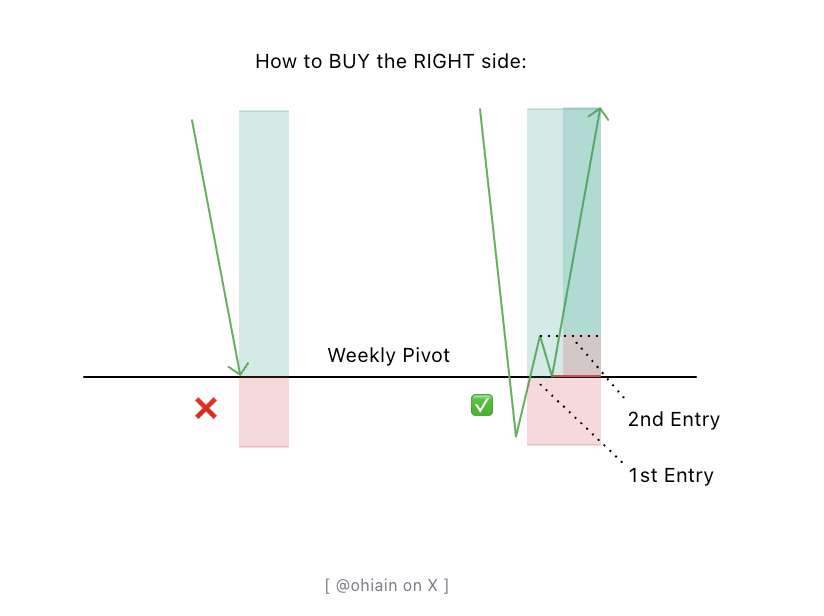
Trying to catch bottoms is probably costing you a lot of $$. The highest-probability entry comes AFTER the panic.
This is how I enter leadership on weakness instead:
1. Identify a leading RS stock.
2. Wait for sellers to flush it into a major weekly pivot (9EMA, 21EMA, prior breakout, weekly high/low, etc.).
3. Let the weak hands panic.
4. Watch for buyers to defend the level.
5. Enter on the 15/30min pivot reclaim.
6. Risk against LOD.
I'm not buying because I "hope" it bounces...
...I'm buying because buyers have already started proving they're willing to defend the area.
That's how I consistently buy the right side of the V with tight risk + asymmetric upside.
Save/bookmark this post!
Example:
Qullamaggie Inspired Screener 📈
25 Stocks
$TWLO $BB $HYLN $RXO $BRKR $ATEX $VSTS $MGM $VSXY $MRVL $STRL $GH $LQDA $DOCN $TXG $SEZL $ALNT $UMAC $TWST $UTI $CHRN $AXGN $BRUN $DK $SYRE
Criteria:
Relative Strength >= 97 (1W, 1M, 3M or 6M)
Price >= EMA10 >= SMA20 >= SMA50 >= SMA100 >= SMA200
ATR RS >= 50 (above average)
Price-to-20-Day Range >= 50%
The market cap has been limited to +$1B for liquidity purposes although Kristjan used a lower threshold
This screen is inspired by the streams of Qullamaggie following his well deserved inclusion in the next Market Wizard book.
Chris Camillo, the Market Wizard who turned $83K into $60M+ through informational arbitrage, is sitting on what he calls the trade of his life.
Three hundred and fifty hours of humanoid robotics research, with aggressive long positions in Tesla, Figure AI, and Apptronik. He frames it the same way he framed the Tesla EV trade ten years ago. One discovery, acted on early.
The full thesis is in his TraderLion interview.
Since most of my timeline is just predications and shit-posting...
I wanted to give you a valuable process you can use for days like Friday
Post Sell-Off Market Reset Plan:
A large down day often changes the market's character.
Breakouts fail, leadership rotates, support levels break, and many charts that looked attractive a few days ago are no longer actionable.
The goal after a large market sell-off is not to immediately find new trades.
The goal is to identify what held up best, remove what is no longer working, and rebuild a watchlist around the new leaders.
Step 1: Accept That the Market Has Changed
After a significant down day, assume that some of your previous watchlist is no longer relevant.
Many stocks will:
-Break key moving averages
-Lose momentum
-Trigger stops
-Require weeks to rebuild proper bases
Avoid forcing old ideas simply because they were on your watchlist before the sell-off.
The market does not care about yesterday's focus list.
Step 2: Clear Out Weak Charts
Review every stock on your watchlist and ask:
-Did it break key support?
-Did it lose the key moving averages?
-Did volume expand on the breakdown?
-Is the chart now damaged?
If the answer is yes, remove it.
A smaller list of quality setups is more valuable than a large list filled with broken charts.
Step 3: Scan for Relative Strength
The most important task after a large down day is finding stocks that resisted the decline.
Look for names that:
-Held up well relative to market weakness
-Closed near the middle of the candle range
-Held above key moving averages
-Refused to break support
These stocks often become future leaders once the market stabilizes.
When institutions continue buying during market weakness, that information matters.
Step 4: Re-Evaluate Themes and Sectors
Leadership often changes after corrections.
Ask:
-Which sectors held up best?
-Which themes continue attracting volume?
-Where is money flowing despite market weakness?
Focus on the strongest sectors first, then identify the strongest stocks within those sectors.
Strong themes produce strong leaders.
Step 5: Build a Fresh Watchlist
Create three categories:
Tier 1 – Relative Strength Leaders
Stocks that held up exceptionally well during the sell-off.
Tier 2 – High Quality Pullbacks
Strong trends that experienced healthy pullbacks into support.
Tier 3 – Rebuild Candidates
Stocks that were damaged but may become actionable again after forming new bases.
Prioritize Tier 1 names.
Step 6: Let the Market Prove Itself
Do not assume the first bounce is the bottom.
Allow:
-Support levels to hold
-Breakouts to follow through
-Volume to confirm
-Market indexes to stabilize
The best opportunities usually appear after the initial panic, not during it.
Step 7: Reduce Aggression Until Conditions Improve
After a large sell-off:
-Trade smaller
-Be more selective
-Demand stronger confirmation
-Focus on execution over P&L
Market conditions determine aggressiveness.
When conditions improve, exposure can increase naturally.
Key Question Every Night
Instead of asking:
"What can I buy tomorrow?"
Ask:
"What stocks are proving they deserve a spot on my watchlist?"
The stocks that continue showing relative strength during market weakness are often the same stocks that lead the next advance.







![wallstengine's tweet photo. $NVDA CEO Jensen on Stock selloff:
“We’re at the beginning of [AI Supercycle], and whatever happened to the stock market, you should be very happy because now you can buy at a discount... Everybody should be very excited
“It is a foregone conclusion that AI will be infrastructure for the world, just like the internet was infrastructure for the world.”](https://pbs.twimg.com/media/HKRoPbcaIAAvIXP.jpg)