What is with extremely young looking teenagers? Whipping around '90s GM products right now. Straight up seeing these kids drift around corners makes me feel like an old man
The bristlecone pine, found in the western United States, is another example of an incredibly long-lived plant.
Some of these trees are over 5,000 years old, making them among the oldest living organisms on Earth.
Like the llareta, bristlecone pines also thrive in harsh conditions, such as arid soils and high altitudes.
The wood of bristlecone pines is very dense and resinous, which helps protect them from insects, fungi, and other potential dangers, much like how the densely packed leaves of the llareta reduce heat and water loss.
Both plants serve as incredible examples of nature’s resilience, adapting extraordinary survival mechanisms to flourish in extreme environments for millennia.
A gigantic cactus in Baja, California, 1895. Pachycereus pringlei aka Mexican giant cardon or elephant cactus, is a species of cactus that can be found in Baja California and northwestern part of Mexico.
On average, these cactuses can reach a height of 30 ft (10 m) but there have been ones that can grow as tall as 60 ft (18 m). They typically live for hundreds of years and can reach a weight of 25 tons.
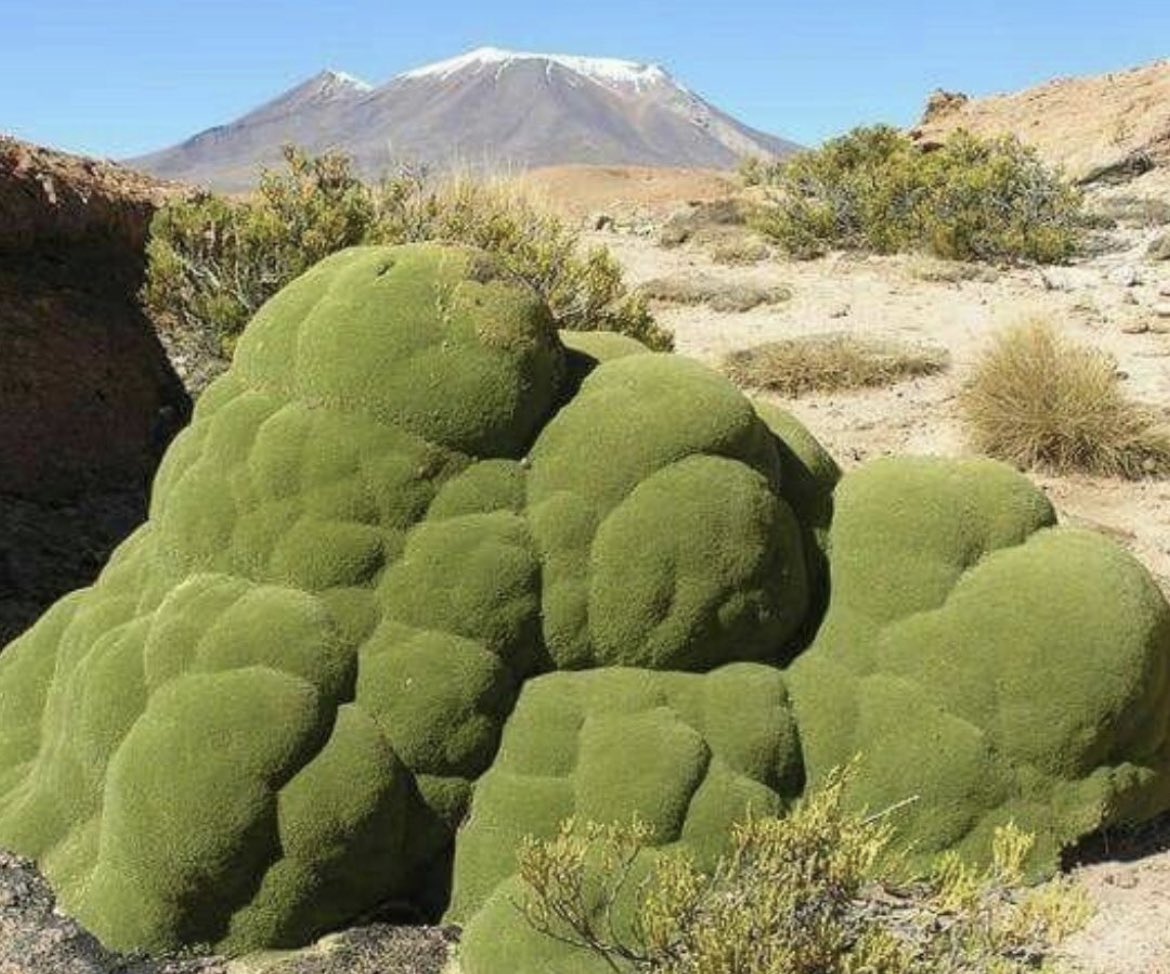
In the Atacama Desert in Chile, there's a 3,000-year-old, densely packed shrub called llareta. It looks like moss covering rocks, but it's actually a cluster of branches and leaves that is so hard you can stand on it.
Yareta or llareta is an evergreen perennial with a low, mat-like shape and hemispherical growth form that grows to around 6 m (~20 ft) in diameter.
The plant prefers sandy, well-drained soils and can grow in nutritionally poor soils that are acidic, neutral, or basic (alkaline) at altitudes of up to 5,200 meters (17,100 ft). Yareta is well-adapted to high insolation rates typical of the Andes highlands and cannot grow in shade. The plant's leaves grow into an extremely compact, dense mat that reduces heat and water loss.
This mat grows near the ground where air temperature is one or two degrees Celsius higher than the mean air temperature. This temperature difference is a result of the longwave radiation re-radiated by the soil surface, which is usually dark gray to black in the Puna.
Yareta is estimated to grow approximately 1.5 centimeters (0.59 in) per year. Many yaretas are estimated to be over 3,000 years old, and its very slow growth makes the traditional practice of harvesting it for fuel highly unsustainable.