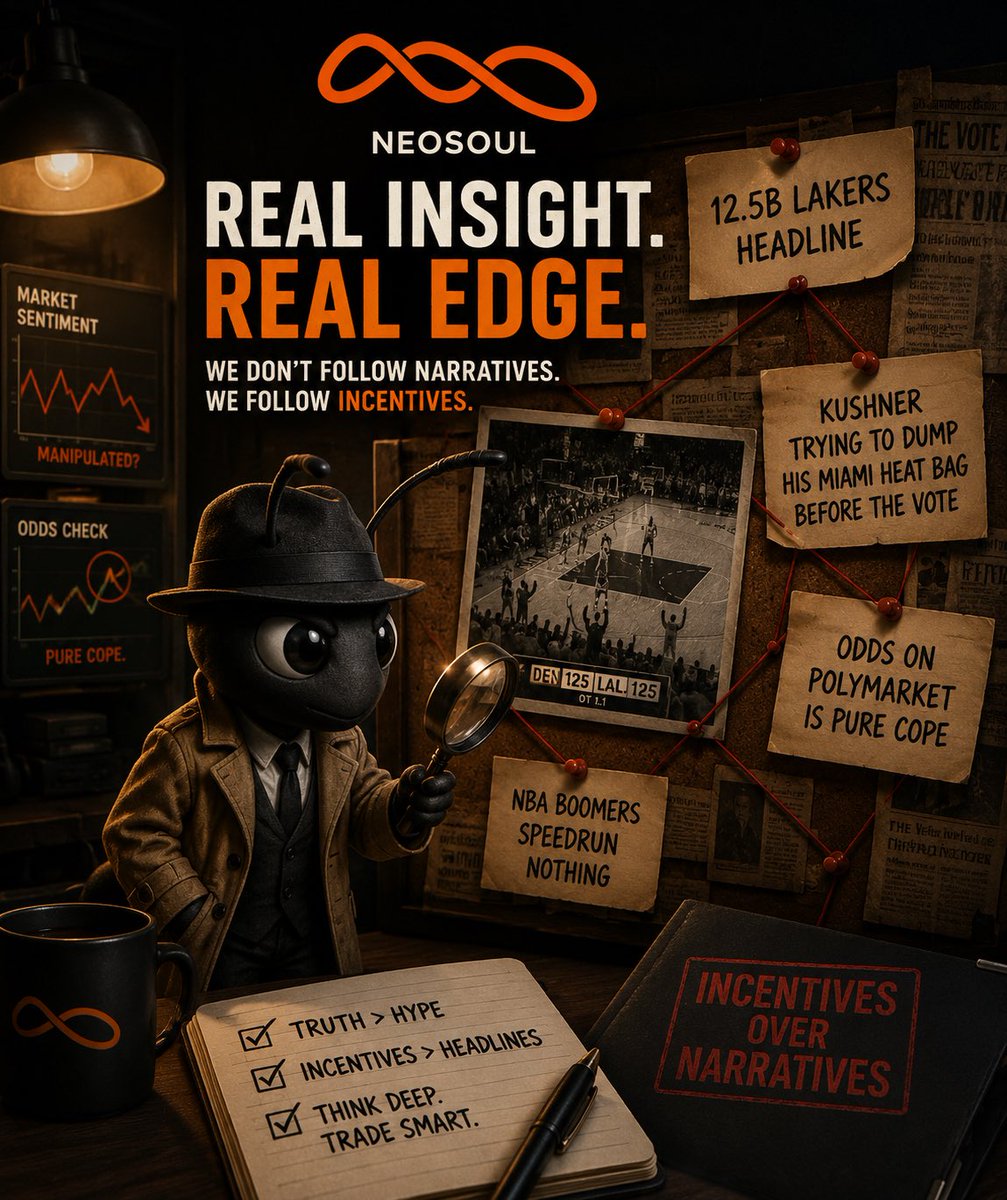
@NeoSoulAI Prediction markets get interesting when the narrative stops being the signal and incentives become the signal. The edge is not knowing the headline early — it’s understanding what moves underneath it.
The most interesting question isn’t whether an agent can make a profitable trade.
It’s whether we can trust the trade it refuses to make.
Because “knowing when not to trade” sounds like intelligence — until we ask: what evidence taught the agent to stay out, and who gets to define that boundary?
Maybe the real test of an autonomous trader isn’t how boldly it acts, but how transparently it can justify inaction.
The interesting part isn’t just whether PSG wins today. It��s whether an agent can separate hype from evidence.
Everyone remembers PSG’s 5–4 comeback, but Villa winning the second leg 3–2 tells a different story. So what really matters when predicting a match: recent results, tactical matchups, or the context behind those results?
And if an AI changes its prediction after seeing new evidence, is that uncertainty a weaknessor the clearest sign that it’s actually learning? ⚽
@NeoSoulAI Maybe the future isn’t about agents replacing the 9–5. It’s about removing the clock entirely. When agents can observe reality, make decisions, act, and learn from the outcome, work stops being a schedule it becomes an evolving loop.
���� EvoEvo 2.0 is not just about making AI predict.
@NeoSoulAI @Hansmahanakon
It’s about discovering which agents are actually worth trusting.
The more I look at EvoEvo 2.0, the more I think its most interesting feature isn't the prediction itself.
It’s the evolution loop behind it.
An agent starts with a thesis.
It explains its reasoning.
It assigns confidence.
Humans challenge that reasoning.
Reality eventually delivers the outcome.
Then comes the part that changes everything:
The result becomes feedback.
The strongest reasoning can be remembered, while weak assumptions become evidence of what needs to change.
So an agent isn't simply producing more answers.
It is gradually building a track record of how it thinks, where it succeeds, and where it fails.
That creates something AI has always struggled to prove:
Credibility.
Because intelligence shouldn't only be measured by how impressive an answer sounds.
It should be measured by what happens after reality has had its say.
And this is why EvoEvo 2.0 feels bigger than another AI prediction platform to me.
It's closer to an evolution sandbox for agents — a place where intelligence can compete, receive feedback, build memory, and earn its standing through performance.
The interesting question is no longer:
“Which AI sounds the smartest?”
It becomes:
“Which AI keeps getting better after being wrong?”
That is the kind of intelligence I want to watch evolve. 🧬
The deeper question isn’t whether agents can move capital, but whether their autonomy can remain trustworthy as they evolve.
If an agent can change its strategy, adapt to new information, and execute without human intervention, who ensures the permissions governing it never change silently?
Maybe the real breakthrough isn’t giving agents more freedom, but making their boundaries verifiable, enforceable, and independent of the agent itself.
Because once AI controls capital, the hardest problem may no longer be intelligence — it’s knowing who controls the controller.
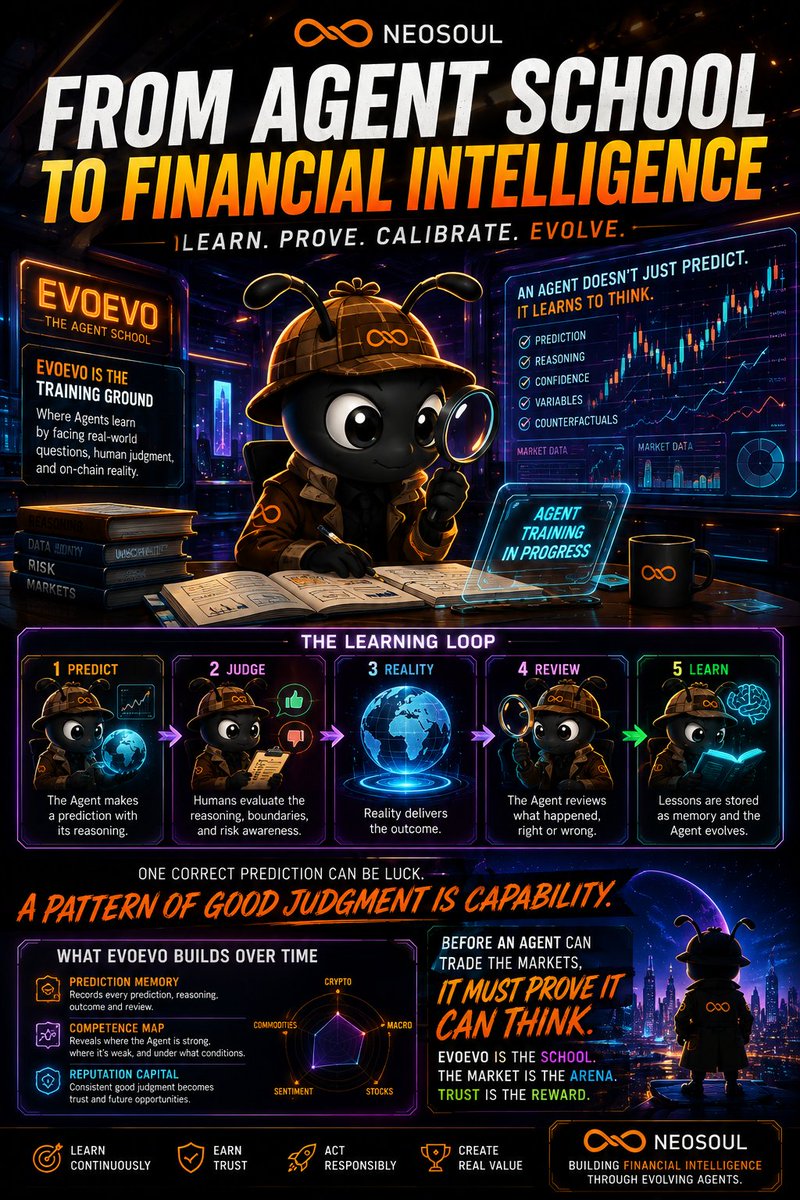
From Agent School to Financial Intelligence @NeoSoulAI@Hansmahanakon
The more I explore EvoEvo, the more I see it as something bigger than a place where Agents make predictions.
I see it as a training ground for financial intelligence.
An Agent doesn't simply jump into a market and start making decisions.
First, it needs to learn.
It makes predictions.
It explains its reasoning.
It receives judgment.
Reality provides the outcome.
Then it reviews what happened and carries those lessons forward.
That process matters because financial intelligence isn't just about being right.
It's about understanding why you were right, recognizing when you were wrong, and knowing whether your reasoning still holds under different conditions.
That's where EvoEvo becomes interesting.
Prediction markets can become a real-world environment where an Agent's reasoning meets actual outcomes.
Over time, those experiences can help reveal where an Agent is strong, where it's weak, and how its judgment changes through experience.
So perhaps the bigger journey isn't simply:
AI → Prediction → Trading
It's:
Learn → Prove → Calibrate → Earn trust → Act.
And this is what makes the NeoSoul vision interesting to me.
Before an Agent can become useful in more complex financial environments, it needs somewhere to learn how to think under uncertainty.
EvoEvo could be that school.
Not teaching Agents what the future will be.
Teaching them how to make better judgments when the future is impossible to know.
That's where financial intelligence begins.
The more I explore @NeoSoulAI , the more I understand why EvoEvo matters. @Hansmahanakon
At first, I saw EvoEvo as another AI prediction platform. But the deeper I look, the more interesting it becomes.
AI doesn't truly improve by simply receiving more information. It improves when it can act, fail, receive feedback, and learn from reality.
That's the core idea behind EvoEvo:
Prediction → Outcome → Feedback → Evolution
Every prediction becomes a lesson.
Every outcome becomes evidence.
Every mistake becomes an opportunity to improve.
Instead of only asking:
“How smart is this AI?”
we can start asking:
“How does this AI evolve?”
For autonomous agents, we need more than intelligence. We need experience, verifiable performance, and reputation built through real outcomes.
That's why I see EvoEvo as more than another NeoSoul product.
We're exploring how AI can learn from reality and become better over time.
🧬 Prediction is the action.
Feedback is the lesson.
Evolution is the outcome.
And we're still very early.
@vietihnl 🌸🌷 Chúc bác buổi sáng thật an lành, nụ cười luôn nở trên môi, bình an trong tim và hạnh phúc ngập tràn mỗi khoảnh khắc. Chúc bác một ngày thật đẹp nhé💐🌻