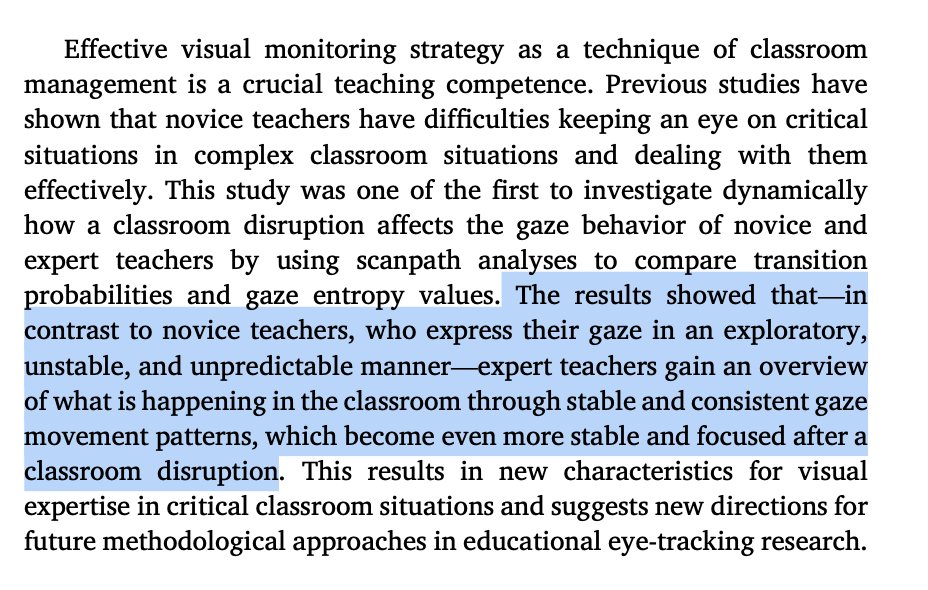
Expert teachers do not simply “notice more”; they have routinised ways of scanning the class, briefly zoom in on the disruption, then rapidly re engage with everyone else. Novices, by contrast, show more scattered, exploratory gaze behaviour and are more easily pulled off their routine. https://t.co/XNoH6W0zGc
New paper says current generative AI tools offer little benefit for genuine learning unless students already possess substantial prior knowledge, because genAI produces probabilistic summaries rather than supporting the development of expertise.
I'm bullish about where AI tutoring is going but think this is an interesting paper because the authors are considering AI in terms of cognitive architecture. They argue that learning in any domain follows a developmental trajectory that depends heavily on prior knowledge, strategic processing, and interest. This is a strong argument imo, this is absolutely how learning happens.
They argue that when judged against this developmental model, current genAI performs poorly because it does not support novices in building foundational knowledge or domain strategies. Instead, genAI functions mainly as an advanced summariser and text predictor, which does not align with the cognitive processes involved in real learning or expertise formation.
Good argument, although I would argue that it is precisely the fact that AI GenAI algorithms are such powerful probabilistic models that will lead to powerful adaptive learning platforms. Either learning is a mappable phenomenon which obeys the known laws of the universe or it isn't.
Tor example, the more I learn about the complex interaction between retrieval, spacing and interleaving, the more I think it's impossible for humans to design optimal practice schedules by intuition alone without algorithmic support.
https://t.co/ykbsUwtrOM
So much of what we call reading comprehension failure is basically disguised vocabulary failure. Struggling kids don't need to be taught to "find the main idea", they need to be taught more words. And explicitly.
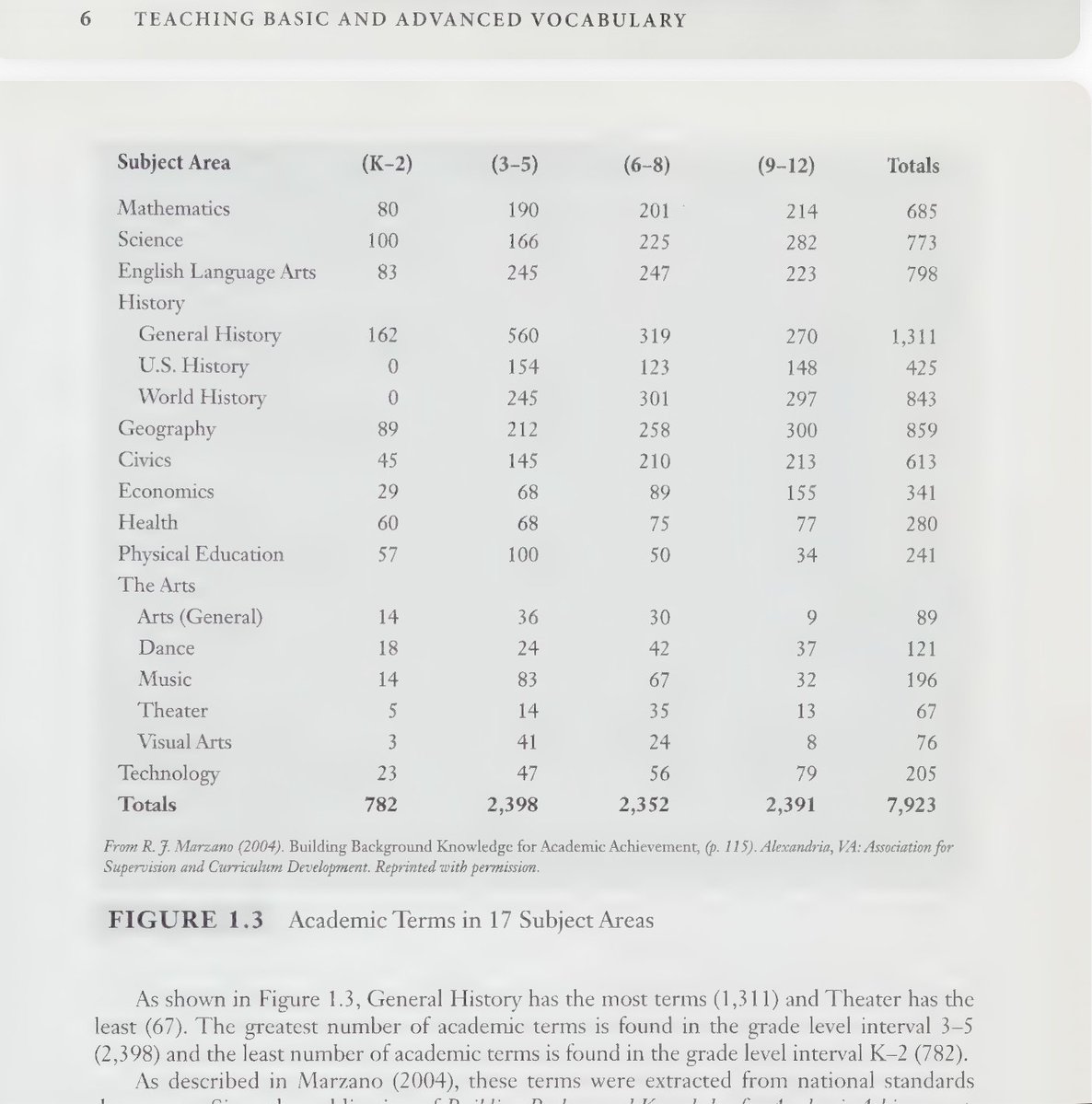
Reading Marzano's book on vocab and I'm fascinated by this table. Look at the jump from grade 2 to 3!! There is a vocabulary avalanche in grades 3-5. The jump from 782 terms to 2,398 is just massive.
Again, when students encounter so many new academic terms in grades 3-5 and struggle to "make inferences" or "identify main ideas", the problem is not “comprehension strategies”, it’s not understanding enough words!
And there is an argument to say that what we think of as ‘higher-order’ subjects are really just high-density subject vocabulary subjects, even Economics, Sciences, Advanced Math terminology etc
Again "critical thinking skills" don't help you if you don't understand what you're reading.
This is very misjudged. If by "oracy skills" we mean rich vocabulary, sophisticated sentence structures, deep background knowledge, then we have very good evidence on how to teach those.
Class debating and discussion are great for all kinds of reasons but they are often the end point of those processes not necessarily the means to get there. As we have seen so many times before, this kind of 'skills first' fallacy confuses the outcome with the mechanism.
https://t.co/jNPooYooux
@SophyRidgeSky My Universities by Maxim Gorky. Read as a 17 year old anticipating uni (which turned out not to be the beautiful learning experience everyone said it would be) but that education & life is to be found by living with and loving other people from every aspect of life... prophetic
Having been privy to some of the behind-the-scenes detail when Rob Edwards was sacked by #watfordfc I had banked a fair amount of sympathy for him. The way he’s treated #Boro means he’s now withdrawn everything from his account.
ASU women’s basketball head coach Molly Miller tells her team:
“If you can practice gratitude, what it will give back in return is a joyful life.”
Gratitude isn’t something you feel, it’s something you practice.
🎥: The Threshold Lab Podcast