And the ANC still thinks that the world is concerned enough about South Africa to continue to lend us money forever, when we are an insignificant speck in the global economy.
If my property is declared to be of nil value, then it would only be fair that I should be refunded every last cent of any and all rates and taxes paid based on a property value that was apparently a lie (adjusted for inflation and with interest).
The absurdity of political discourse in South Africa is illustrated by the fact that there is a court case right now in which parties are arguing that 'nil compensation' is in fact compensation and therefore not the same as 'without compensation'... and therefore constitutional.
This guy had to play an entire round of golf with strangers without using a golf ball and couldn't tell anyone why. It was his fantasy football last-place punishment.
A black South African fighting against Expropriation Without Compensation is labeled a sellout by ANC puppets.
Expropriation Without Compensation does not just hurt white people; it damages the entire South African economy and further impoverishes the black majority.
Similarly, cadre deployment did not merely impact white citizens, but instead destroyed once world class infrastructure and state owned enterprises.
It is embarrassing that in 2026, sections of the South African black community still prioritize race and are baited into supporting destructive laws without logically analyzing their long-term consequences and results.
The ANC's fixation on Expropriation Without Compensation is the ultimate, irreversible exposure of its complete ideological bankruptcy.
After 30 years in power, they have completely run out of ideas, solutions, and time.
When a liberation movement can no longer grow an economy, create jobs, or fix the infrastructure it broke, it always retreats to the lowest common denominator: raw, unadulterated populism.
Expropriation Without Compensation is the final refuge of a dying political party that has failed at everything else.
The ANC spent three decades claiming it wanted to build a modern, inclusive, constitutional democracy. Yet, in its desperate bid to survive politically, it has completely abandoned modern economics to embrace a 1970s Marxist-Leninist fantasy.
This isn't about historical justice or helping the poor. If the ANC actually cared about land reform, it would have handed over title deeds for state owned land years ago.
Instead, it wants the state to own everything. It wants citizens to be permanent tenants of the ruling party.
This is peak ideological decay, they are trying to out-populist the EFF by stealing its worst ideas.
Instead of competing on economic growth, innovation, or efficiency, the ANC is competing on who can destroy property rights fastest. It is a race to the bottom.
By choosing Mugabeism, the ANC has explicitly admitted it has no formula for the future.
https://t.co/27YreFG6IC
Passengers departing South Africa are waiting for more than 60 minutes in queues at Terminal A at @ortambo_int@TheBMA_SA says it is operating at just 25% capacity due to limited funding.
This is not the image we should be projecting to visitors or our own citizens.
Efficient border management is essential for tourism, business and national security.
This needs urgent attention.
@homeaffairsZA@Leon_Schreib
Penny Sparrow was convicted of crimen injuria and hate speech for posting a racist comment on Facebook comparing Black beachgoers in Durban to monkeys.
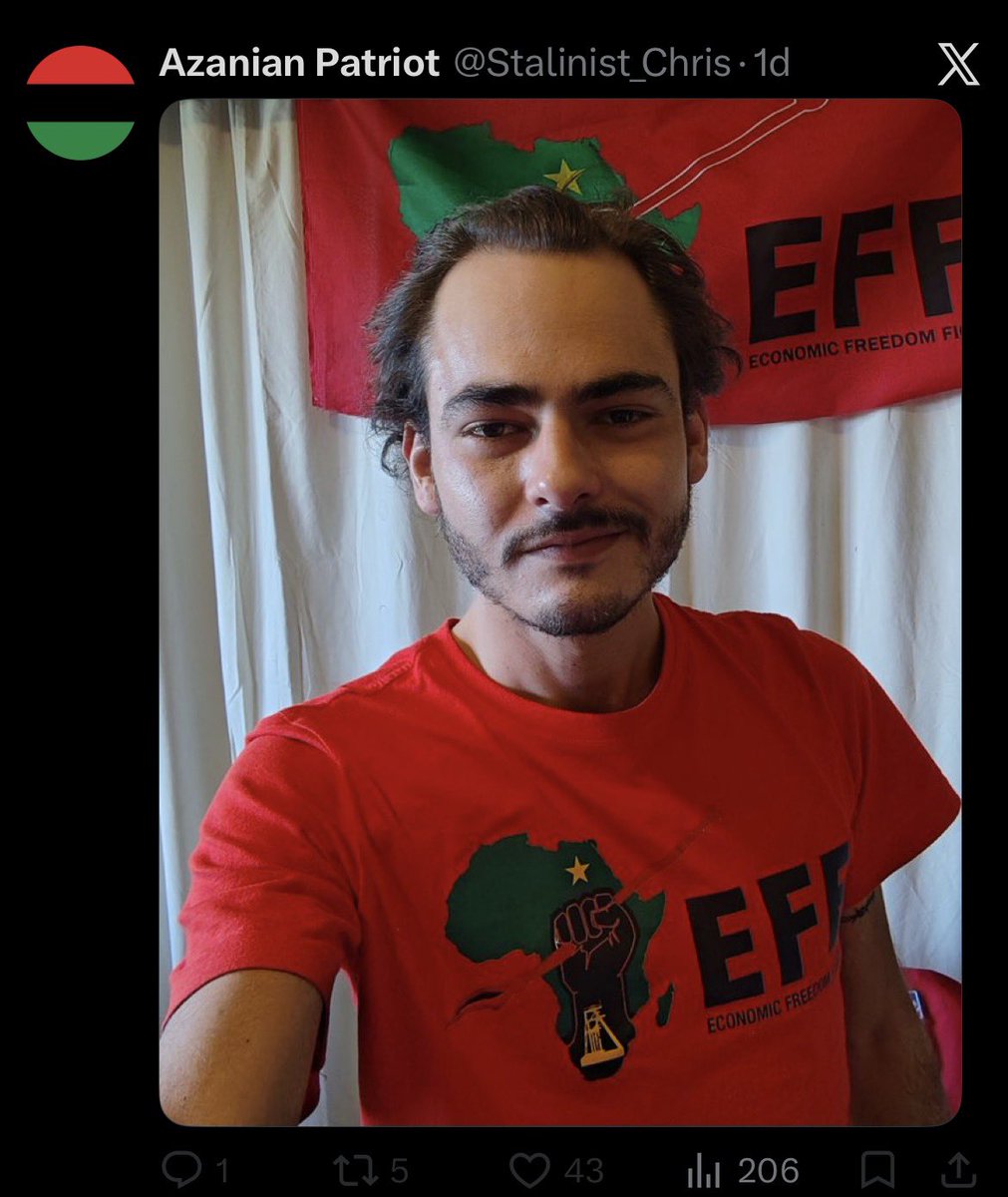
@EFFSouthAfrica member @Stalinist_Chris puts a racist post on X comparing white people in Orania to monkeys.
@SAHRCommission, how is this different from the Penny Sparrow case?
Why are you silent on this?
Cyril Ramaphosa and his ANC comrades are still fighting the ghosts of apartheid, guarding against an invasion that isn't coming.
No white South African is plotting to "take back" the country.
There's no reason for the cadres to hate, punish, or sabotage white business owners and farmers. Their actual job is simple: keep the economy running.
Instead, look at what's real. Five South African cities rank among the most dangerous in the world, with murder rates that rival active war zones.
Youth unemployment is rampant. The rand keeps buckling under inflation. Millions of South Africans still don't have clean water.
These are the emergencies. Punishing the white community isn't one of them, making South Africa work is.
I mentioned that my garage door was making a sound.
An American immediately said, "I got a guy."
He did not ask what the sound was. He did not ask what kind of door. He produced a guy on the basis of the word garage.
I asked who the guy was.
He said, "Just a guy."
He did not have a company name. He had a first name and a phone number in his phone saved as "Mike Garage."
That is the contact name. Mike Garage. As though Garage is his surname. As though there is a family.
I asked how he found this guy.
"My brother-in-law used him."
I asked if the brother-in-law was satisfied.
He thought about it. Then he said, "He's still standing."
The house is still standing. That is the entire review.
Inside I said: THEY DO NOT KEEP RECORDS. THEY KEEP LOYALTIES.
I called Mike Garage. He answered from inside a vehicle. There was wind. He said he could come Tuesday between eleven and four.
Between eleven and four. A window of five hours. In my country this would be a scandal. Here it is generous. He gave me a window at all. Some guys do not give you a window. Some guys say "Tuesday" and that is the whole appointment.
He came at 1:40.
He fixed it in twenty minutes. He charged me less than I expected and he did not take a card, only cash or an app I had never heard of.
Before leaving he looked at my water heater, which I had not mentioned, and said, "That's gonna go."
I asked when.
"Couple years."
I asked what I should do.
He said, "I'll give you a guy."
He gave me a guy. Mike Garage has a guy. The guy has a guy. There is a network beneath this country made entirely of men named after their function, and none of them advertise, and all of them are busy.
Inside I said: THERE IS A SECOND NATION HERE. IT HAS NO SIGNS. IT IS ENTERED ONLY BY INTRODUCTION.
I have been given four guys since.
I have a guy for trees.
I did not know I needed a guy for trees.
I have trees now, apparently. They are my responsibility. A man named Rick told me so and then left.
When 46 ANC-connected friends grab 60% of BEE mining deals, thats not transformation—it is elite capture. Policies meant to empower 49 million Black South Africans fails when 0.0001% of them take nearly two-thirds of the wealth. The broader community is mere political cover for enriching a tiny clique.
This is absolutely brilliant from Laurence Fox
It's a perfect moment to demonstrate not only how intolerant Islam is but also it proves the entire Oxford Union audience know as well despite pretending otherwise
Laurence is about to unveil an image of the Prophet Muhammad, the whole audience are in suspense, there are interruptions, they plead with him, they try to shut him down, the rules come out, there is an intake of breath
You can tell the room is completely on edge from this!
Because they know if he does, his life will be at risk and the Oxford Union may well be at risk too from the supposedly tolerant religion the other side are defending
Proving Laurence's point, that Islam is not compatible with our society at all
I won't ruin what happens you will have to watch for yourselves but Laurence's trick here is absolutely brilliant and well worth 3 minutes of your time
Enjoy
And @LozzaFox take a bow sir 👏
South Africa may be sitting on more oil than Norway.
But while Norway got rich from theirs, we are blocked from harvesting ours.
Namibia has drilled ~25 wells in the shared Orange Basin since 2022.
South Africa has drilled once — and court challenges keep stopping the rest.
Gas from Mozambique is about to run out.
70,000+ jobs and rising living costs are on the line.
This madness needs to change!
https://t.co/7UiOHawiFs
SARS takes up to 45% of what we earn, then we pay 15% VAT on almost everything we buy. Inflation eats whatever we manage to save, municipal rates & levies come for the property we already own, and fuel levies are waiting every time we fill up. At this point South Africans aren’t citizens, we’re shareholders with no dividends
Julius Malema is at it again.
This red beret terrorist stands at the University of Limpopo and tells black people in townships to stop living like sardines and go seize land belonging to White people. “They see land that looks like it’s owned by a White man and they will never go there. They should say, ‘We can’t live like this, let’s unite and go and take that thing.’”
Alexandra next to open land belonging to Wits. Kayamandi next to a Stellenbosch farm with one British colonial-style house on 3,000 hectares. “We must go and take that land. We must go and occupy that land.”
This is open racial incitement from a man who lives in a Sandton mansion while he radicalises the youth to steal from White farmers and institutions. He admits he prioritises “radicalising the youth” over winning votes. Because votes require results. Incitement only requires a microphone and a crowd that still believes the solution to failed governance is more violence and theft against White people.
Thirty-two years of ANC rule, billions in land reform budgets, and the answer is still “take the White man’s land.” Not fix the townships. Not create jobs. Not stop the corruption. Just seize what productive White people built.
The same mouth that sings “Kill the Boer” now tells people to walk onto White-owned land and claim it. And the media still platforms him like he’s a serious political leader instead of a professional race hustler who thrives on division.
South Africa is not failing because White people own land. It is failing because the people Malema pretends to lead keep electing thieves and then cheering when those thieves point at White farmers instead of their own empty hands.
https://t.co/ptMX1YWLbx
Black South Africans have been sold a lie: that they can't win in a free market. They can.
A truly open market doesn't care about your race, it rewards work, skill, and ambition. That's not something to fear. That's opportunity.
What Black South Africans should actually fear is the politics of victimhood, because it was never designed to help them. It was designed to help the politicians selling it.
Every "redistribution" scheme and regulatory carve-out is a mechanism, and the wealth moving through it lands with a connected few, not with the people it's marketed to.
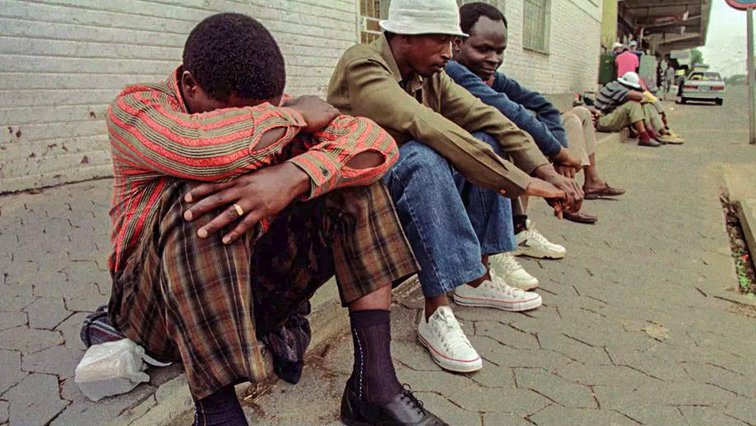
Meanwhile, an entire generation of able bodied, educated South African youth sits idle, talent that should be building, manufacturing, competing, locked out not by their own limitations, but by an economy built to protect political gatekeepers instead of open markets.
The tragedy isn't that Black South Africans can't compete. It's that they've been told they can't, by the very people profiting from keeping them out.
ANC cadres have said, on record:
"It's our time to eat."
"Without BEE, we're nothing."
"We didn't join the struggle to be poor."
That's not a slip of the tongue, it's an actual mentality. There's no patriotism in it, no discipline, no sense that governing a country comes with obligations attached.
Governance, for them, isn't a responsibility to be carried out. It's a resource to be extracted. And that's the doctrine in full, decades of struggle credentials converted into a permanent invoice against the state, payable indefinitely.
The institutions that were supposed to serve sixty million people instead get treated like a buffet reserved for those who showed up with the right membership card.
You don't fix a country by rationing that appetite. You fix it by removing it from power entirely.
🇿🇦SOUTH AFRICA’S R6.1 TRILLION DEBT BILL‼️
South Africa has borrowed another US$1.5 billion from the World Bank, approximately R24.7 billion, to support reforms involving electricity, freight transport, water and sanitation.
This is the fourth World Bank Development Policy Loan since 2022. It is not ring-fenced for a particular power station, railway line or water-treatment plant. It is general budget support released after government meets agreed reform conditions.
This latest loan did not create South Africa’s debt crisis. It merely adds another R24.7 billion to a debt story that has developed across every administration since 1994.
WHAT GOVERNMENT INHERITED
The democratic government did not inherit a debt-free country.
At the end of the 1993/94 financial year, gross national government debt stood at approximately R185 billion, equal to around 48% of GDP.
Most of that debt was domestic. The outgoing government had also agreed to repay the remaining US$4.5 billion covered by foreign-debt arrangements originating in the 1985 debt crisis.
That was the starting balance. What followed belongs to every administration that governed after it.
WHO ACCUMULATED THE DEBT?
• 1993/94 — Approximately R185 billion, or 48% of GDP. This was the debt inherited in 1994.
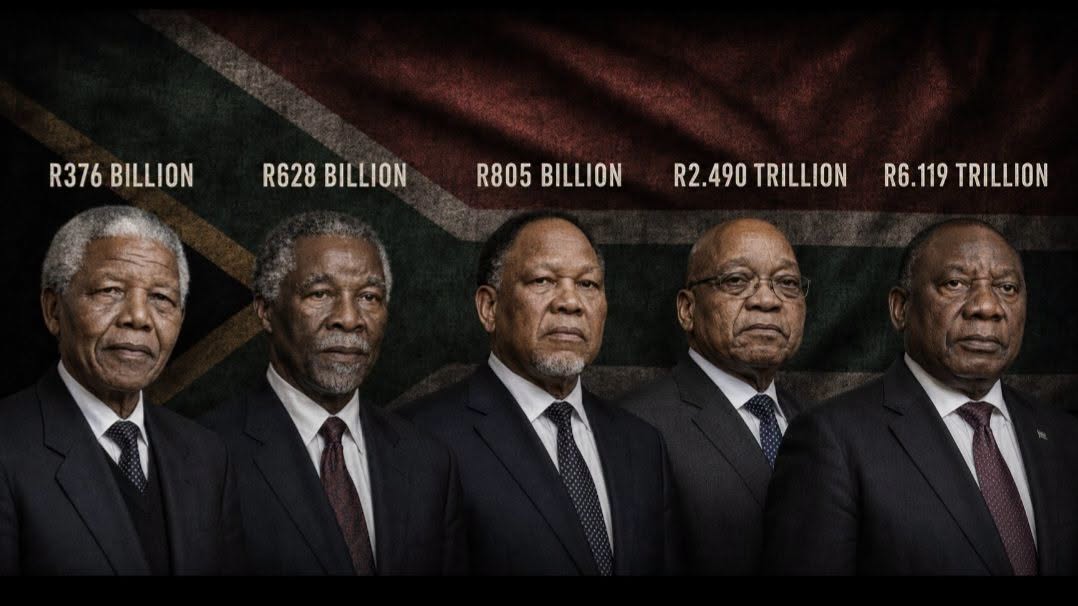
• 1998/99 — Approximately R376 billion, or 49% of GDP, under Mandela.
• 2003/04 — Approximately R510 billion, or 36% of GDP, under Mbeki.
• 2007/08 — Approximately R628 billion, or 27% of GDP, under Mbeki.
• 2008/09 — Approximately R805 billion, or 30% of GDP, during the Mbeki/Motlanthe transition.
• 2012/13 — Approximately R1.366 trillion, or 40% of GDP, under Zuma.
• 2014/15 — Approximately R1.799 trillion, or 41% of GDP, under Zuma.
• 2017/18 — Approximately R2.490 trillion, or 49% of GDP, during the Zuma/Ramaphosa transition.
• 2019/20 — Approximately R3.261 trillion, or 57.1% of GDP, under Ramaphosa.
• 2020/21 — Approximately R3.936 trillion, or 70.1% of GDP, under Ramaphosa during COVID-19.
• 2021/22 — Approximately R4.277 trillion, or 67.7% of GDP, under Ramaphosa.
• 2022/23 — Approximately R4.765 trillion, or 70.4% of GDP, under Ramaphosa.
• 2023/24 — Approximately R5.259 trillion, or 73.9% of GDP, under Ramaphosa.
• 2024/25 — Approximately R5.694 trillion, or 77% of GDP, during the Ramaphosa/GNU transition.
• 2025/26 — Approximately R6.119 trillion, or 78.9% of GDP, under Ramaphosa and the GNU.
• 2026/27 projection — Approximately R6.326 trillion, or 77.3% of GDP, under Ramaphosa and the GNU.
Under Mandela, debt almost doubled in rand terms, although it remained close to the same proportion of the growing economy.
Under Mbeki, debt continued increasing in rand terms, but stronger economic growth and improved revenue reduced the debt burden from around 49% of GDP to approximately 27%. This was the strongest period of debt consolidation after 1994.
The direction changed after the 2008 global financial crisis. Persistent budget deficits, weak growth, public-sector compensation, failing state-owned companies and rising interest costs drove debt steadily higher.
Under Zuma, gross debt increased from approximately R805 billion in 2008/09 to R2.490 trillion by 2017/18.
Under Ramaphosa, it increased from approximately R2.490 trillion to R6.119 trillion. COVID-19 caused the largest single-year increase, but the debt had already reached R3.261 trillion before the pandemic. Another R2.183 trillion was added after the worst COVID-19 financial year.
COVID-19 accelerated the crisis. It did not create it.
WHO LENT US THE MONEY?
South Africa did not borrow R6.1 trillion from one bank, one government or one country.
At March 2026:
• Domestic government debt: Approximately R5.490 trillion
• Foreign-currency government debt: Approximately R628 billion
• Total gross government debt: Approximately R6.119 trillion
Almost 90% was raised by selling domestic government bonds, Treasury bills and other financial instruments.
For every R100 invested in domestic government bonds during 2025:
• R25 was owed to foreign investors.
• R22.50 was owed to pension funds.
• R20.20 was owed to banks and similar monetary institutions.
• R23.70 was owed to investment funds and other financial institutions.
• R7.50 was owed to insurance companies.
• Approximately R1.10 was owed to other investors.
Foreign investors alone held approximately R1.065 trillion in rand-denominated government bonds. Describing these bonds as domestic debt does not mean every creditor is South African. It means the debt was issued inside South Africa, principally in rand.
Direct foreign lenders include the International Monetary Fund, World Bank, New Development Bank, African Development Bank, German KfW Development Bank, French Development Agency and the Government of Canada. International pension funds, banks, insurers, hedge funds and asset managers also hold South African government bonds.
Government therefore owes money not only to identifiable foreign institutions, but indirectly to millions of people through pensions, investments, insurance funds and bank deposits.
WHAT DO WE HAVE TO SHOW FOR IT?
Borrowing can be justified when it creates power stations, railways, ports, dams, roads and water systems that expand the economy and generate value for decades.
That is not what the national outcome shows.
South Africa extended electricity and water connections, delivered some housing, expanded social assistance and employed more public servants. Yet connections were expanded without adequately maintaining the systems behind them, housing demand still runs into millions, and social grants and government salaries remain recurring expenditure rather than productive assets capable of repaying debt.
After increasing gross national debt by approximately R5.934 trillion:
• Eskom required repeated bailouts and government debt relief.
• Freight rail and ports became obstacles to economic growth.
• Passenger rail infrastructure was allowed to collapse across large areas.
• Water interruptions, leaking networks, failing treatment works and sewage pollution became national problems.
• Municipalities developed enormous infrastructure and maintenance backlogs.
• Businesses and households increasingly pay privately for electricity backup, security, healthcare, education and transport after already paying taxes.
• Economic growth remained too weak to support the expanding debt.
Government can point to expenditure. What it cannot demonstrate is anything approaching R5.934 trillion in additional productive capacity, reliable infrastructure and economic growth.
We are now borrowing again to repair electricity, railways, ports, water and sanitation systems that previous taxation and previous borrowing were already supposed to build, operate and maintain.
THE INTEREST BILL
The R6.119 trillion is only the capital still outstanding.
Before government can spend money on policing, hospitals, schools, roads, water systems or infrastructure, it must service the debt accumulated by previous budgets.
Debt-service costs increased as follows:
• 2019/20 — R204.8 billion
• 2020/21 — R232.6 billion
• 2021/22 — R268.1 billion
• 2022/23 — R308.5 billion
• 2023/24 — R356.1 billion
• 2024/25 — R385.8 billion
• 2025/26 — Approximately R420.6 billion
• 2026/27 projection — Approximately R432.4 billion
During 2025/26, debt service cost taxpayers approximately:
• R35.1 billion every month
• R8.1 billion every week
• R1.15 billion every day
• R48 million every hour
• R800,000 every minute
That is principally interest and the cost of servicing the debt. It does not repay the entire R6.119 trillion capital balance.
When bonds and loans mature, government frequently borrows again to repay or refinance them. The old creditor is paid, a new creditor takes their place and the debt continues.
This is how a country can pay hundreds of billions every year without substantially reducing what it owes.
HOW LONG WILL WE BE PAYING?
South Africa’s debt has no single final repayment date.
The latest World Bank loan is approximately R24.7 billion and runs for 15 years. Government receives a three-year grace period on capital repayments, but “grace” does not mean free money. The debt exists immediately, interest is charged according to the agreement, and repayment of the capital has merely been postponed.
Government also has major foreign bonds extending decades into the future. Using approximately R16.50 to the dollar simply to illustrate their present rand value:
• Approximately R23.1 billion matures in 2032.
• Approximately R33 billion matures in 2036.
• Approximately R28.9 billion matures in 2037.
• Approximately R16.5 billion matures in 2046.
• Approximately R26.4 billion matures in 2052.
• Approximately R24.7 billion matures in 2054.
• Approximately R28.9 billion matures in 2055.
These bonds alone represent approximately R181.5 billion in capital at today’s illustrative exchange rate, before adding decades of interest. The eventual rand cost could be considerably higher if the currency weakens before repayment.
Even when those bonds mature, the national debt may not disappear. Government routinely issues new bonds and raises new loans to repay maturing obligations. The old creditor is settled, another creditor takes their place and the repayment date moves further into the future.
This is no longer temporary borrowing with a clear end. It has become a rolling national obligation, passed from one budget to the next and from one generation of taxpayers to another.
We are servicing debt accumulated by the governments before us. Our children will inherit the debt being created today, and their children may still be servicing the loans and replacement bonds used to postpone its final repayment.
The people authorising today’s borrowing may be long gone.
Generations of taxpayers will still be paying for it.
THE AUDIT FINDING
The ANC-led government inherited approximately R185 billion in gross national debt in 1994.
By March 2026, that had become approximately R6.119 trillion. By March 2027, Treasury expects it to reach approximately R6.326 trillion.
South Africa is now paying more than R1.15 billion every day largely in interest and debt-service costs, while the capital remains and government continues borrowing.
That money cannot simultaneously repair water systems, employ police officers, maintain roads, rebuild railways or improve hospitals. Taxpayers must first pay for yesterday’s expenditure before funding today’s needs.
The problem is not simply that government borrowed.
The problem is that borrowing repeatedly exceeded the productive capacity created with the money.
Economic growth remained weak, essential infrastructure deteriorated and the tax base did not expand sufficiently to carry the burden.
We are borrowing more than the country can comfortably support, while producing far too little evidence that the expenditure is building a stronger and more productive South Africa.
The debt remains.
The interest grows.
The infrastructure must still be repaired.
Our children will inherit the repayments, and their children may still be servicing bonds issued to cover money being spent today.
Written by Shaun Schutte
28 July 2026
One gigawatt of wind capacity requires about 2,900 tons of copper. At a standard ore grade of 0.6%, 99.4% of the ore is not copper.
Producing those 2,900 tons therefore requires processing roughly 480,000 tons of ore. That is about 1,200 full loads in a 400-ton-class mining truck.
And it excludes the waste rock, overburden and processing losses. Count those and the total material moved can exceed 1 to 2 million tons.
And that's before adding the steel, concrete, fiberglass and other materials required by the wind project.
The "green" turbine does not begin with the wind. It begins with a mountain being blasted, hauled and crushed.