Read more on AI shopping war in China here: https://t.co/44JTnvN5cD
Four platforms went live with AI commerce features in Q1-Q2 2026, converging on China’s second-largest shopping festival
Hands-on testing reveals two product philosophies: conversational discovery versus chat-wrapped shelf search
The decisive moat is content-to-commerce loop data, not model capability. Only Doubao has it
JD AI Gou recommended products with features they do not have. The accuracy problem nobody is pricing in
Xiaohongshu is the only credible challenger, if it can convert content depth into transaction gravity
Alibaba and ByteDance have closed China's AI shopping loop before 618.
Qwen can search, compare, and place Taobao orders inside one conversation.
Doubao can return a purchase page from a single question.
Both products hit the same wall immediately:
———
AI shopping recommendations depend on trust.
Users ask an assistant because they expect a better answer than keyword search — which has been shaped for years by sponsored placement and merchant bidding.
Paid ranking works in the opposite direction.
China's e-commerce ad systems are built on auction logic. Merchants pay for visibility. Platforms monetize that visibility.
Alibaba's customer management revenue — the core of its China e-commerce business — grew 8% like-for-like in FY2026.
Any serious shift toward AI-mediated recommendations pressures the most profitable engine Alibaba has.
Alibaba's China E-commerce adjusted EBITA fell 40% YoY to RMB24B in March 2026.
That weakened base is now funding Qwen user acquisition, quick commerce expansion, and the AI push simultaneously.
Alibaba is funding the AI layer from a weaker commerce core.
The AI layer, if it works as promised, reduces the value of the advertising revenue that core depends on.
———
The conflict may be resolved before users notice it.
Generative Engine Optimization (GEO) works by shaping the external content AI models retrieve before generating answers.
The goal: raise the probability a brand appears when an AI assistant is asked what to buy.
The important part is where the influence happens.
GEO does not require the platform to sell ad inventory.
It acts on the input layer, before the model produces a response.
China's GEO market grew 215% YoY in Q2 2025.
Service providers charge merchants RMB 2,980 to RMB 16,980 annually. Pricing scales with "compute intensity" of brand insertion.
The user does not see the transaction.
(iResearch via Jiemian, TMTPost)
China's regulatory framework covers algorithm recommendations, generative AI, and AI labelling.
One gap remains: paid inclusion inside AI-generated shopping recommendations has no disclosure regime yet.
That is the opening GEO is built to exploit.
Alibaba and ByteDance have closed China's AI shopping loop before 618.
Qwen can search, compare, and place Taobao orders inside one conversation.
Doubao can return a purchase page from a single question.
Both products hit the same wall immediately:
———
AI shopping recommendations depend on trust.
Users ask an assistant because they expect a better answer than keyword search — which has been shaped for years by sponsored placement and merchant bidding.
Paid ranking works in the opposite direction.
China's e-commerce ad systems are built on auction logic. Merchants pay for visibility. Platforms monetize that visibility.
Alibaba's customer management revenue — the core of its China e-commerce business — grew 8% like-for-like in FY2026.
Any serious shift toward AI-mediated recommendations pressures the most profitable engine Alibaba has.
Alibaba's China E-commerce adjusted EBITA fell 40% YoY to RMB24B in March 2026.
That weakened base is now funding Qwen user acquisition, quick commerce expansion, and the AI push simultaneously.
Alibaba is funding the AI layer from a weaker commerce core.
The AI layer, if it works as promised, reduces the value of the advertising revenue that core depends on.
———
The conflict may be resolved before users notice it.
Generative Engine Optimization (GEO) works by shaping the external content AI models retrieve before generating answers.
The goal: raise the probability a brand appears when an AI assistant is asked what to buy.
The important part is where the influence happens.
GEO does not require the platform to sell ad inventory.
It acts on the input layer, before the model produces a response.
China's GEO market grew 215% YoY in Q2 2025.
Service providers charge merchants RMB 2,980 to RMB 16,980 annually. Pricing scales with "compute intensity" of brand insertion.
The user does not see the transaction.
(iResearch via Jiemian, TMTPost)
China's regulatory framework covers algorithm recommendations, generative AI, and AI labelling.
One gap remains: paid inclusion inside AI-generated shopping recommendations has no disclosure regime yet.
That is the opening GEO is built to exploit.
12 months ago, Tencent was the AI also-ran.
Kimi, Qwen, and Ernie dominated coverage of China's LLM race.
Q1 2026 results just rewrote that narrative:
Hy3 preview accumulated 7.7 trillion tokens on OpenRouter between April 23 and May 12.
The next closest: Kimi K2.6 at 5.0 trillion.
Claude Sonnet 4.6: 4.0 trillion.
DeepSeek V3.2: 2.7 trillion.
Hy3's lead over Kimi is 54% by cumulative token count.
OpenRouter routes developer traffic across multiple providers — token usage is developer adoption, not a self-reported benchmark.
The model team was rebuilt from scratch over six months. Pre-training, reinforcement learning, and evaluation systems all rebuilt. Evaluation criteria shifted away from gamed benchmarks toward PhD qualifying exams from Tsinghua and Princeton.
Hy3 is already deployed across 131 internal Tencent products. No external provider can replicate that feedback loop at this scale within one company.
———
For the first time, Tencent carved out "new AI products" as a separate cost center. The margin arithmetic is now visible.
Operating profit excluding new AI products: RMB84.4B. Up 17% YoY. Margin: 43.0%.
Operating profit including new AI products: RMB75.6B. Up 9% YoY. Margin: 38.5%.
The gap: 4.5 percentage points. That is the quarterly cost of Tencent's AI build, expressed as forgone operating profit.
Free cash flow grew 20% YoY to RMB56.7B. Net cash rose 63% YoY to RMB146.9B.
The core business generates enough cash to fund the AI build and run share buybacks simultaneously.
The 4.5ppt drag is a floor, not a ceiling. The larger Hy model is in development. Agent monetization is early. Infrastructure investment is ongoing.
———
WorkBuddy leads China in productivity AI agents by DAU.
Among paying users: 80%+ retention.
80%+ at this stage of the adoption cycle means dependency formation is underway. Users who pay and stay are building workflows around the tool.
Marketing services grew 20% YoY to RMB38.2B. Accelerating from 17% in Q4 2025.
AIM+ powered approximately 30% of total advertiser spending in Q1 2026.
The self-funding loop is now active: better models improve ad targeting, ad revenue funds model development.
———
Three Chinese tech giants. Three distinct AI architectures.
Alibaba: cloud-infrastructure-first. Qwen drives enterprise cloud migration.
Baidu: vertical-first. Ernie embedded into search, autonomous driving, maps.
Tencent: distribution-layer-first. Agents run on Weixin, QQ, WeCom — surfaces 1.43B users already use.
Users don't learn a new interface. The AI comes to them.
The architecture that actually scales isn't the one building the best model.
It's the one distributing AI through 1.43B users who never have to change their behavior.
AIM+ already powers 30% of Tencent's ad spend. If that reaches 50% by Q4 2026, the self-funding loop accelerates beyond what investors currently model. Too aggressive or too conservative?
Visit CIW News and read complete update for free.
Top AI apps in China:
Doubao has 34.49M monthly active AI users in China.
Baidu's Wenxin has 0.48M.
Same country. Same market. 72x apart:
The top 3 are in a different league from everything below:
Doubao (ByteDance): 34.49M
Qianwen (Alibaba): 16.57M
DeepSeek: 12.72M
Then a cliff.
Yuanbao (Tencent): 5.73M
Everyone else: under 3M.
Two things stand out beyond the MAU rankings.
First, ByteDance has two apps in the top 6. Doubao at #1. Doubao Love Learning at #6. Combined: ~36M MAU.
No other company comes close across multiple products.
Second, the category breakdown tells a different story than Western AI charts.
AI Social Interaction appears three times (Lovekey, Miaomiao, Xingye).
AI Professional Consulting appears twice (Ant Aifei, Xiaohe AI Doctor).
China's AI native app market is not just an assistant race.
Baidu built its entire AI investment thesis around being China's leading AI company.
The consumer app data does not support that position.
ByteDance won China's AI assistant market. The question now is whether Alibaba or DeepSeek closes the gap or whether the top 3 is already locked in.
Find out more: https://t.co/ldNrHcPpFA
Duolingo grew 1,727.9% YoY in China's social networking rankings.
Read that again.
Everything else in this chart is normal. That number is not:
WeChat: 113.37M MAU. Up 3.6% YoY.
QQ: 62.12M MAU. Down 1.6%.
RedNote/Xiaohongshu: 24.53M MAU. Fastest-growing among the top 4 at +4.2%.
Below the top 4, the chart splits cleanly into winners and losers.
Declining:
OPPO Community: -19.7%.
Baidu Tieba: -13.6%.
MOMO: -12.4%.
Zhihu: -7.1%.
Growing:
Duolingo: +1,727.9%.
Qiandao: +36.9%.
Pengyou: +10.3%.
Forum-style and older community apps are losing users consistently.
A language learning app most analysts aren't tracking in China just posted the strongest growth number in the entire social networking category.
Click the link in the profile to find out more.
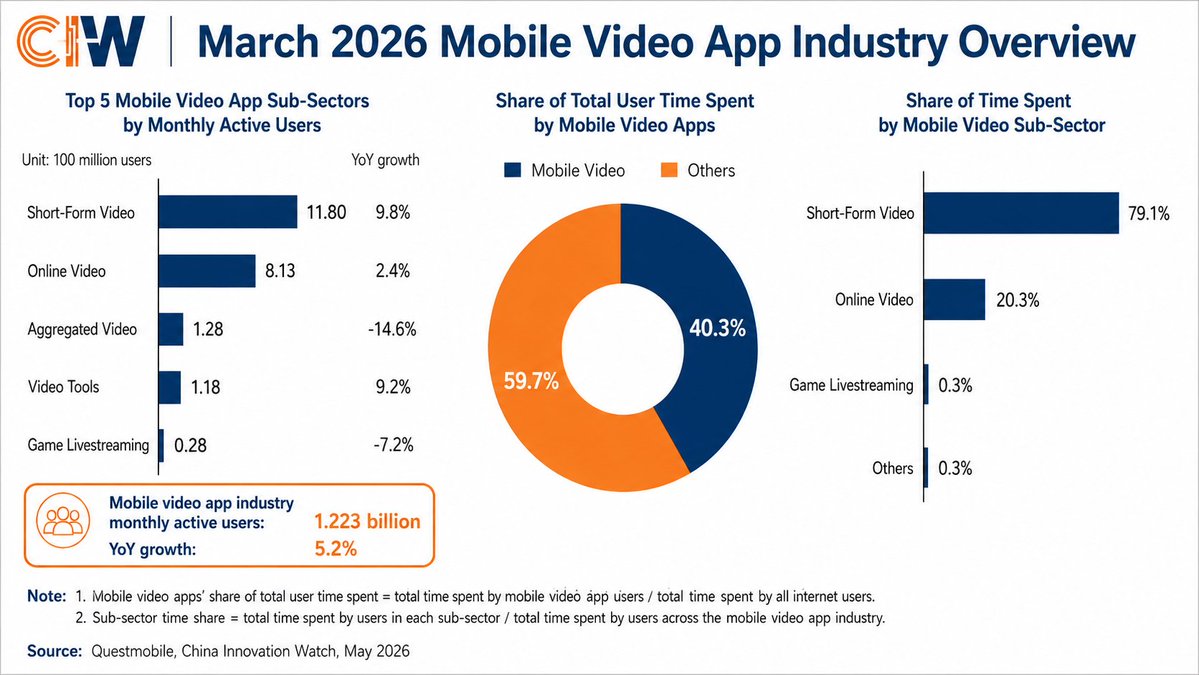
79.1% of China's mobile video time goes to short-form.
Nearly 4 in 5 minutes.
Douyin and Kuaishou aren't competing for the top spot anymore. They are the category.
The real signal is in what's declining:
aggregated video down 14.6% YoY.
These were the multi-platform hubs,
the catalogues.
Users chose the feed over the library,
consistently,
at scale.
Mobile video now takes 40.3% of all China internet time. Not video time. All of it.
What puts a dent in short-form's grip on attention? Genuinely asking. @ciwbrief
#chinatech
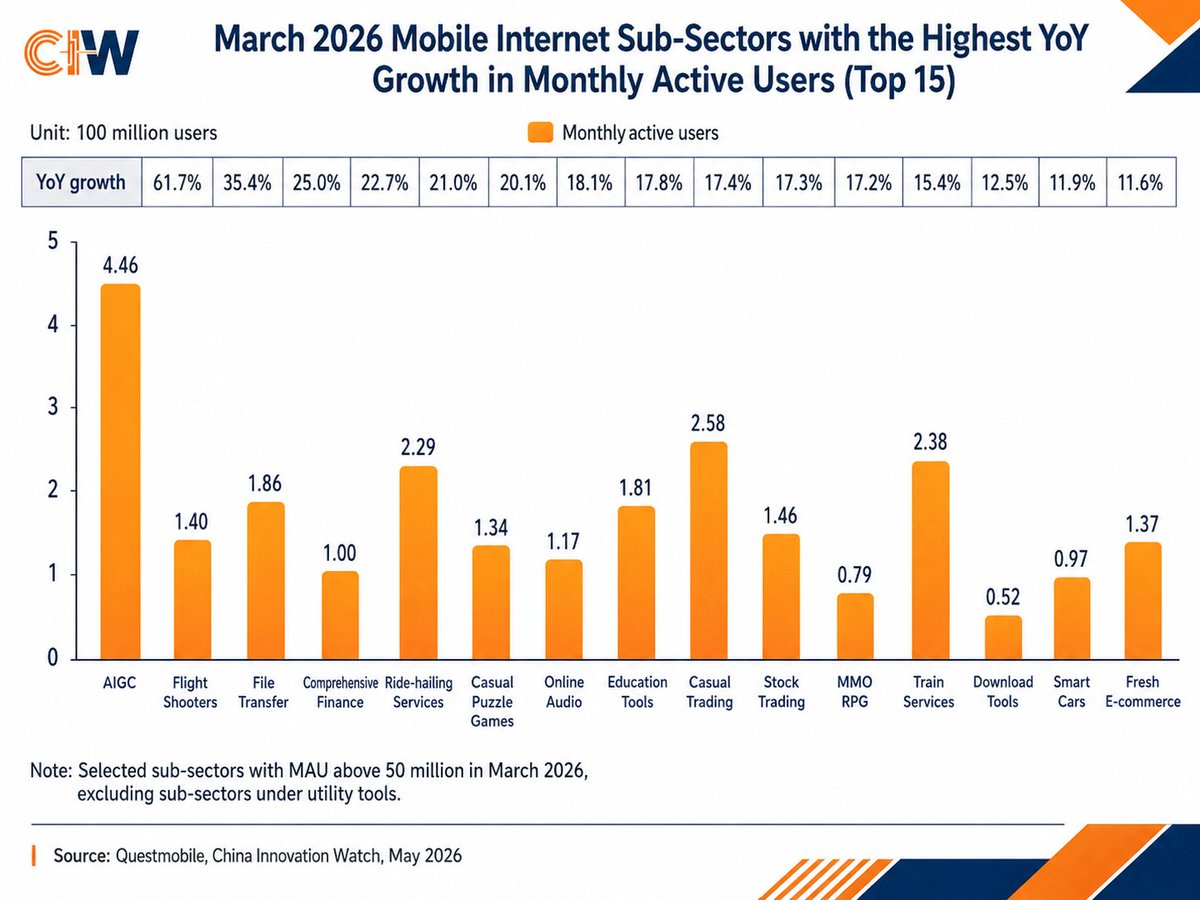
China’s fastest-growing mobile internet sub-sector in March 2026 was AIGC.
Monthly active users: 446 million
YoY growth: 61.7%
But the broader signal is more interesting: growth is spreading across AI, gaming, mobility, finance, audio, education, trading, and e-commerce.
Source: Questmobile, China Innovation Watch, May 2026
#ciwnews #chinatech #chinainternetusers
China's mobile internet user base: 1.28B.
YoY growth: 1.4%.
The user acquisition era is over. What follows is a fight for time:
———
AIGC apps grew 61.7% YoY in Q1 2026. The next fastest sector: flying shooter games at 35.4%.
The gap is not close.
Doubao (ByteDance), Yuanbao (Tencent), Qianwen (Alibaba) — AI assistants and video generation tools — are now the fastest-growing category in China's mobile internet. By a considerable distance.
And the demographic is broadening.
Users born in the 1960s grew their share of the AIGC base by 1.7 percentage points.
Tier 3 cities and below grew their share by 2.4 percentage points.
The early-adopter phase is over. AIGC is now reaching audiences with different content preferences, different purchasing behaviour, and different retention triggers.
The product strategies that drove initial growth may not sustain the expanded base.
(QuestMobile Q1 2026)
———
Monthly per-capita usage time hit 192.2 hours in March 2026. Up 9.3% YoY.
The sector breakdown is where the signal sits:
Comprehensive wealth management: +78.8% time-on-platform YoY.
AIGC: +41.4%.
Online video: +30.9%.
Audiobooks: +28.3%.
Wealth management's 78.8% surge reflects elevated trading and investor activity in early 2026. Users are not checking balances. They are monitoring positions, executing trades, consuming financial content. High-intent. High-frequency.
AIGC's 41.4% time growth signals the shift from episodic use to habitual use. That transition is happening across a broader demographic base than the apps were built for.
———
Two new surfaces are becoming structurally relevant.
Smart TV monthly active devices: 293M. Net YoY gain: over 10M.
NEV in-car active units: 42.12M. Net YoY gain: 11.21M vehicles.
Media planning built exclusively around smartphone inventory now misses a growing and measurable audience.
Platforms with presence on both smartphone and large-screen or in-vehicle surfaces hold a reach advantage that pure-mobile players cannot replicate.
———
Three structural dynamics define what China's mobile internet looks like from here.
The 46-plus cohort and lower-tier city users are growing their share of total internet participation. Products calibrated for them reach incremental users others cannot.
AIGC, wealth management, and content entertainment are capturing a disproportionate share of available user time. Sectors outside this cluster face a structurally tightening attention environment.
Smart TVs and NEV dashboards are real surfaces with real reach. Not emerging. Already material.
The competition for user time has replaced the competition for user count as the defining metric of China's mobile internet.
Which platforms own the 46-plus, lower-tier city user's daily hour? That cohort is where China's remaining growth concentrates.
Read the full report for free on CIW dot news.
Alibaba Cloud grew China IaaS revenue 34.4% last year.
The Chinese market grew 23.4%.
That 11-point gap is not noise. It is share capture at scale:
———
China IaaS share: 32.8% in 2025. Up from 30.1% in 2024.
A 2.7 percentage point gain in a market where Huawei Cloud, Tencent Cloud, and Baidu AI Cloud all compete at scale.
The advantage is not pricing. It is stack depth.
GPU clusters. Model serving capacity. AI-optimized networking. Tongyi model family. DAMO Academy research.
Pure-play infrastructure vendors cannot replicate that vertical integration.
(Gartner 2025 IaaS market share data)
———
Globally, Alibaba Cloud sits at #4. Behind AWS, Azure, and Google Cloud.
Worldwide share: 7.7%, up from 7.2%. Implied revenue: ~$17.1B.
The largest non-US cloud provider at the global level.
APAC share reached 22.5% in a $75.2B regional market.
Growing against heavy AWS, Google, and Azure investment in Southeast Asia.
US semiconductor export restrictions limit its ability to provision advanced AI compute for international customers.
It is gaining global share anyway.
———
Visit CIW News and read the full article.
DeepSeek V4 runs on Huawei chips. Not NVIDIA.
At near-frontier performance levels.
If you track US export controls on China AI, this changes the premise:
V4-Pro trails GPT-5.4 and Gemini 3.1 Pro by DeepSeek's own admission. Approximately 3-6 months behind.
It leads every open-source model currently available.
49.9% on Vibe Code Bench. First open-weight model to clear 40%.
80.6 on SWE Verified. Pre-integrated with Claude Code and OpenCode.
Pricing: V4-Pro at $1.74 per million input tokens vs. Claude Sonnet 4.6 at $3.00.
V4-Flash at $0.14. Cheaper than GPT-5.4 Nano at $0.20.
———
The benchmark scores are not the story.
At 1 million token context, V4-Pro uses 27% of the inference compute required by V3.2.
V4-Flash uses 10%.
DeepSeek was not optimizing for elegance. It was building for constrained hardware.
Fewer compute cycles. So make each one count more.
That architecture is now open-source under MIT license.
Every Chinese competitor can use it directly.
(DeepSeek V4 tech report)
Alibaba, ByteDance, and Tencent placed orders for hundreds of thousands of Huawei Ascend chips ahead of the V4 launch.
This is not one lab making an isolated infrastructure decision.
NVIDIA was shut out of the early access process entirely.
That reverses typical pre-launch optimization protocols where chip vendors work alongside labs to tune performance.
The gap between Huawei Ascend and NVIDIA used to be measured in years.
V4 measures it in months.
(Reuters, Yahoo Finance)
———
US export controls were designed around one assumption: frontier AI requires NVIDIA H100-class hardware.
V4 challenges that directly.
Read the full article for free on CIW (ciw news).
602M Chinese now use generative AI.
That is the wrong number to track.
If you cover China AI, the competitive question has already moved. From chatbots to factories:
———
Chinese industrial enterprise AI penetration reached 47.5% in 2025.
It was 9.6% in 2024.
A nearly fivefold increase in one year.
McKinsey's global benchmark: 88% of organizations use AI in at least one function. But only 23% are scaling agents. Just 6% attribute more than 5% of EBIT to AI.
Chinese industrial deployment is moving from pilot to production while Western enterprise AI stays stuck in the pilot loop.
(IDC enterprise research, cited by NDRC and CNNIC 57th report)
———
The reason this was possible in one year: inference costs collapsed.
DeepSeek V3.2: $0.28 per million input tokens. $0.42 per million output.
GPT-5.4: $2.50 input. $15.00 output.
A balanced 100M-token monthly workload costs $35 on DeepSeek V3.2.
The same workload on GPT-5.4: $875.
25x cheaper inference converts pilot economics into production economics.
The 9.6% to 47.5% jump happened in the same year DeepSeek's efficiency results reached Chinese enterprise users.
These are the same story.
———
Capital confirms the thesis.
Chinese AI venture investment in 2025: RMB 152.9B (~$21B). Up 66.7% YoY.
Robotics took 38.2% of capital and 41.5% of deals. The single largest category.
AI-native applications including chatbots: 16.8%.
Chinese capital is not betting on the chatbot war.
China now has more than 140 humanoid robot companies and 330+ product SKUs.
Competing on unit economics and supply chain integration.
US peers are not yet positioned to match either.
———
The 602M user number will keep generating headlines.
The figures worth watching are the ones that made it possible.
The names that benefit from China AI capability through 2026 are in factory automation, robotics integration, and vertical-domain SaaS.
Listed consumer internet companies dominate sell-side China AI coverage. They are not the translation channel.
Chinese humanoid robot unit economics reach commercial scale before Western industrial competitors can respond. Too early or too late to position?
Check out the full report on CIW website.
Nvidia’s AI chip monopoly in China is rapidly cracking. 🚨
New 2025 data from IDC reveals that domestic Chinese firms have now captured a massive 41% of the local AI accelerator market.
US export controls were meant to choke China's AI growth. Instead, they accelerated homegrown self-reliance.
Here is exactly what the market looks like today:
📊 Total 2025 China Market: ~4 Million AI chips
🇺🇸 The US Incumbents:
• Nvidia: 2.2M chips (55% share — still #1, but a steep drop from its past near-monopoly)
• AMD: 160K chips (4%)
🇨🇳 The Domestic Breakout (1.65M chips total):
🥇 Huawei: 812K (Accounting for ~50% of all local chips)
🥈 Alibaba (T-Head): 265K
🥉 Baidu & Cambricon: 116K each
(Startups like Hygon, MetaX, and Iluvatar CoreX make up the rest)
The Takeaway:
The US sanctions forced a massive pivot. While Nvidia is still holding on to the lead, a multi-billion dollar domestic supply chain has been born out of necessity—with Huawei firmly at the helm.
Will Nvidia’s market share in China drop below 50% this year?
MiniMax recently released M2.7. It matches GPT-5.3 on software engineering benchmarks.
API cost: roughly 1/50th of Claude Opus 4.6.
And it helped build itself.
Two months after IPO, MiniMax closed its model weights for the first time.
M2 shipped open-source. Ranked first globally among open-source systems.
M2.5 shipped open-source.
M2.7 is proprietary. API-only. No download. No self-hosting.
MiniMax is not alone. Zhipu AI released GLM-5 Turbo as proprietary. Alibaba's Qwen team reportedly moving the same direction.
DeepSeek is the holdout.
Open-source was the acquisition strategy. It worked.
Proprietary is the monetization strategy. Shareholders demand it.
The shorthand "Chinese labs are open, US labs are closed" no longer holds.
———
M2.7's most important claim is not a benchmark score.
The model ran 100+ autonomous improvement loops on its own training process.
Analyzed its own failures. Planned code changes. Modified infrastructure. Evaluated results. Kept or reverted.
No human intervention.
MiniMax says it handled 30-50% of operational work that normally requires human ML engineers.
The question for AI strategy is no longer who builds the best model.
It's who builds the model that builds the next model.
———
M2.7 input tokens: $0.30 per million.
Claude Opus 4.6: roughly 50x more expensive.
An agent workflow that costs $100 on Opus costs roughly $2 on M2.7.
With cache optimization, blended cost drops to about $0.06 per million tokens.
SWE-Pro: M2.7 scored 56.22%. Matches GPT-5.3 Codex.
SWE-bench Verified: 78%. Outperforms Opus at 55%.
(MiniMax, WaveSpeed AI)
Integrates with Cursor and Claude Code. Point your existing environment at the MiniMax API endpoint.
Switching cost is low.
———
MiniMax market cap: roughly $38B.
Trailing 12-month revenue: $79M.
480x revenue multiple.
Revenue grew 170% YoY. Gross margins at 69.4%.
Net losses: $512M in the first 9 months of 2025.
90% of IPO proceeds allocated to R&D.
Over 70% of revenue comes from outside China. The US alone is roughly 20%.
M2.7 is proprietary and API-only. No self-hosting option.
If US export controls expand to cover Chinese model API access, MiniMax's fastest-growing revenue stream faces direct regulatory risk.
———
MiniMax shipped M2 in October 2025. M2.5 in February 2026. M2.7 in March 2026.
The gap between releases is shrinking.
If self-evolving training loops hold, release cadence accelerates further.
R&D cost per model generation drops.
The moat shifts from model quality to iteration speed.
A plateau would mean the gains are front-loaded.
A sustained acceleration changes the economics of the entire sector.
Which matters more for AI competitive advantage over the next 3 years: model quality, cost structure, or iteration speed?
Read the full article for free: https://t.co/z5PHjfpEsG
China has released the world’s first Quantum Computer Operating System for free public download.
While US firms like IBM and Google keep their quantum OS proprietary, China’s "Origin Pilot" is completely open to global developers.
The details:
• Backed by $17.5B in state regional funds
• Supports superconducting & neutral atom processors
• Already powering China’s 72-qubit Wukong computer
• Has processed 339,000+ global workloads since 2024
The strategy: China is replicating the "DeepSeek" open-source playbook to dominate the software layer of the global quantum race.
Read the full article: https://t.co/j9vohkhHie
1/6 Rural China has 249M digital consumers.
Online shopping penetration: 83.2%.
Urban: 88.4%.
A 5.2 point gap.
Narrowed by 4.9 points in six months.
The next demand wave in China is not in Beijing or Shanghai:
6/6 249M consumers. 83.2% already shopping online. Income growing faster than urban.
Rural consumers expect to increase spending on appliances, cars, and home goods more aggressively than urban peers over the next 3 years.
(CNNIC)
The infrastructure window that determined who won rural goods e-commerce is now open for services.
It won't stay open long.
The biggest untapped demand signal in China right now isn't a new technology. It's 249M rural consumers whose income is growing faster than the brands targeting them can adapt.