Breaking Free from Liquidity Constraints: The Transformative Impact of the iCKB Protocol on Nervos DAO
In the blockchain world, liquidity reigns supreme. Recently, the NervDAO staking tool for Nervos DAO integrated the iCKB protocol, marking a significant milestone. This advancement liberates Nervos DAO depositors from the minimum 30-day deposit cycle, effectively addressing liquidity challenges. Moreover, it opens the door to higher yields through “BTCFi Lego.”
This article delves into how the iCKB protocol works and its significance in the market.
CKB Economic Model, Nervos DAO, and NervDAO
Before exploring the iCKB protocol, let’s briefly review the basics of the CKB economic model, Nervos DAO, and its staking tool, NervDAO.
As of December 8, 2024, the total issuance of CKB reached 46.202 billion, with 8.133 billion locked in Nervos DAO. These CKB primarily originate from three sources:
Genesis Block: Of the 33.6 billion total, 8.4 billion were sent to a "black hole" address (essentially burned) at launch, while the remaining 25.2 billion were allocated to institutional investors, ecosystem funds, development teams, and public investors. These allocations were time-locked but have since fully unlocked.
Primary Issuance: A total of 33.6 billion is rewarded to miners, following a Bitcoin-like halving mechanism every four years until fully issued.
Secondary Issuance: A fixed annual issuance of 1.344 billion is proportionally distributed among miners, Nervos DAO depositors, and the treasury (currently burned).
For a detailed explanation of the CKB economic model, read “A Comprehensive Guide to the CKB Economic Model and Its Elegant Design ( https://t.co/WCg0N3QQ8u ).”
Nervos DAO is a smart contract embedded in the system layer, which automatically distributes CKB’s secondary issuance to depositors. Simply put, if holders lock their CKB in the Nervos DAO contract, sacrificing liquidity, they receive compensation to offset asset dilution caused by secondary issuance.
NervDAO simplifies staking and withdrawal for Nervos DAO users. Compared to other tools like Neuron Wallet and CKBull Wallet, NervDAO offers:
Lower Barriers to Entry: Operate directly on a web interface without downloading additional apps or syncing block data.
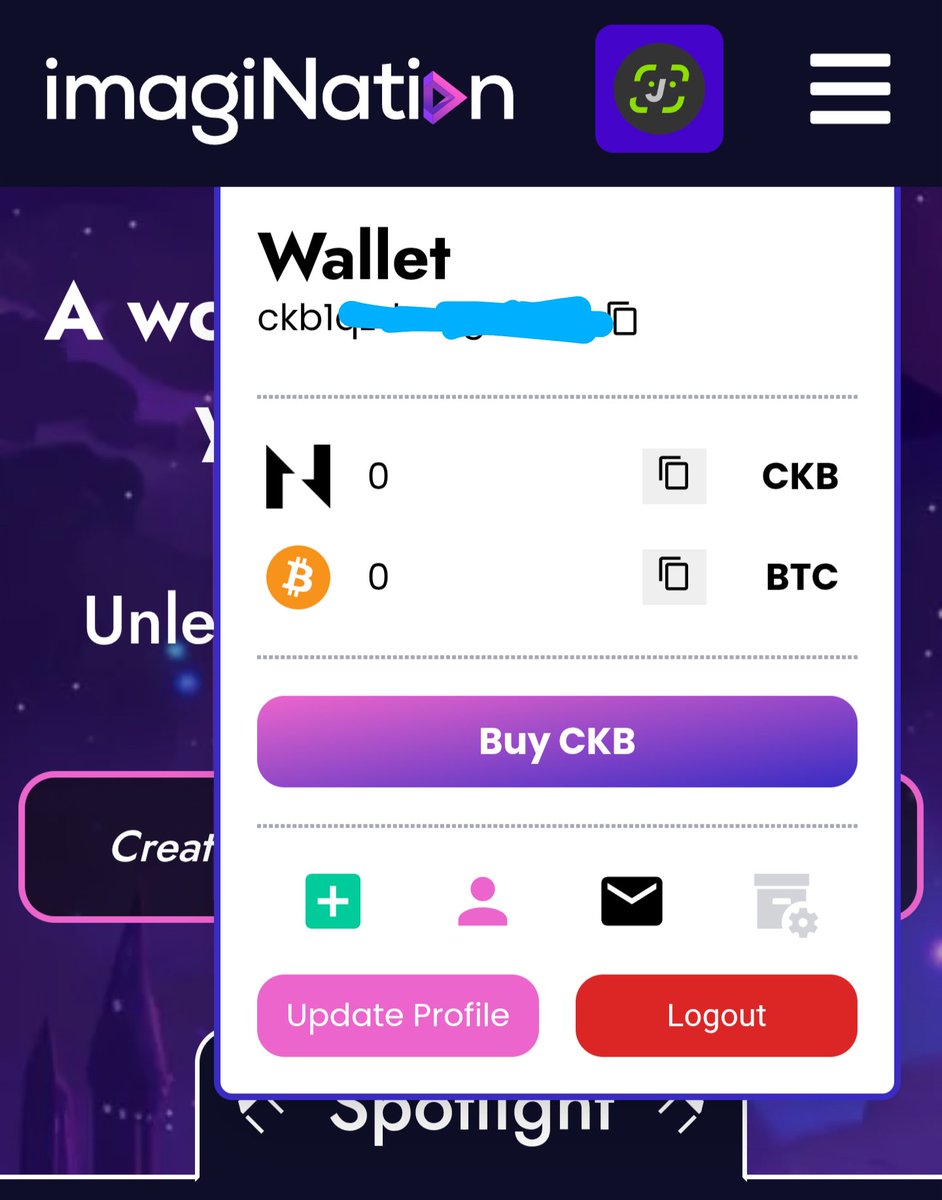
Multi-Chain Wallet Support: Currently compatible with JoyID, MetaMask, OKX Wallet, UniSat, and UTXO Global Wallet, with future support for ecosystems like SOL, DOGE, and Nostr.
With the integration of iCKB, NervDAO users now have two staking options: the "traditional" Nervos DAO staking or staking via the iCKB protocol.
iCKB Protocol Explained
Developed by community contributor Phroi, the iCKB protocol resolves Nervos DAO's liquidity limitations by allowing users to deposit or withdraw any amount of CKB at any time.
How It Works
For users, depositing CKB into Nervos DAO through the iCKB protocol is a one-step process: converting CKB into iCKB. Similarly, withdrawals only require converting iCKB back to CKB. iCKB acts as a deposit receipt for CKB locked in Nervos DAO.
Currently, 1 CKB ≈ 0.86287995 iCKB, and 1 iCKB ≈ 1.15890975 CKB. Deposited CKB accrues secondary issuance rewards (annualized return ~2.26%), causing iCKB to appreciate over time.
The protocol splits deposits into large and small portions, with every 100,000 iCKB-equivalent deposit forming a large deposit. A market maker mechanism ensures liquidity for smaller deposits.
Example
Alice deposits 300,000 CKB through the iCKB protocol, resulting in:
Two large deposits (125,000 CKB each), locked in Nervos DAO.
A small deposit (50,000 CKB), handled by the market maker.
Alice receives 240,000 iCKB, temporarily escrowed on-chain. An "Extract" operation is required to transfer these iCKB to her wallet, or they will automatically release upon future deposits or withdrawals.
Later, Alice withdraws 240,000 iCKB. The protocol burns the large deposit tokens, withdraws from Nervos DAO, and the market maker handles the remaining 40,000 iCKB. Alice receives 300,000 CKB, again in escrow.
This mechanism aggregates large deposits for efficient liquidity and uses market makers to handle smaller deposits, ensuring seamless operations.
Market Impact
The traditional Nervos DAO staking approach faces two limitations:
Minimum Deposit: At least 102 CKB (excluding miner fees).
Time Constraints: A minimum 30-day lockup and delayed withdrawals depending on reward cycles.
The iCKB protocol eliminates these barriers, enabling instant deposits and withdrawals of any amount, vastly improving liquidity.
Moreover, iCKB is an RGB++ asset, allowing holders to:
Earn Nervos DAO interest.
Participate in BTCFi applications for additional yields, such as becoming a liquidity provider (LP) on UTXOSwap.
Utilize iCKB across UTXO chains like DOGE via Leap’s bridgeless cross-chain technology.
Leverage CKB's Lightning Network (Fiber Network) for low-cost, private, and instant transactions.
Usage Guide
The NervDAO website offers two staking options: one is the "traditional" staking method available on the Deposit page, and the other is staking via iCKB on the iCKB page. These two methods operate independently.
As mentioned earlier, using the iCKB protocol to deposit CKB into Nervos DAO is a straightforward one-step process: convert CKB into iCKB. Similarly, to withdraw CKB, simply convert iCKB back to CKB. Here are the detailed steps:
Deposit
1. Open the NervDAO website and connect your wallet (currently supporting JoyID, MetaMask, OKX Wallet, UniSat, and UTXO Global Wallet).
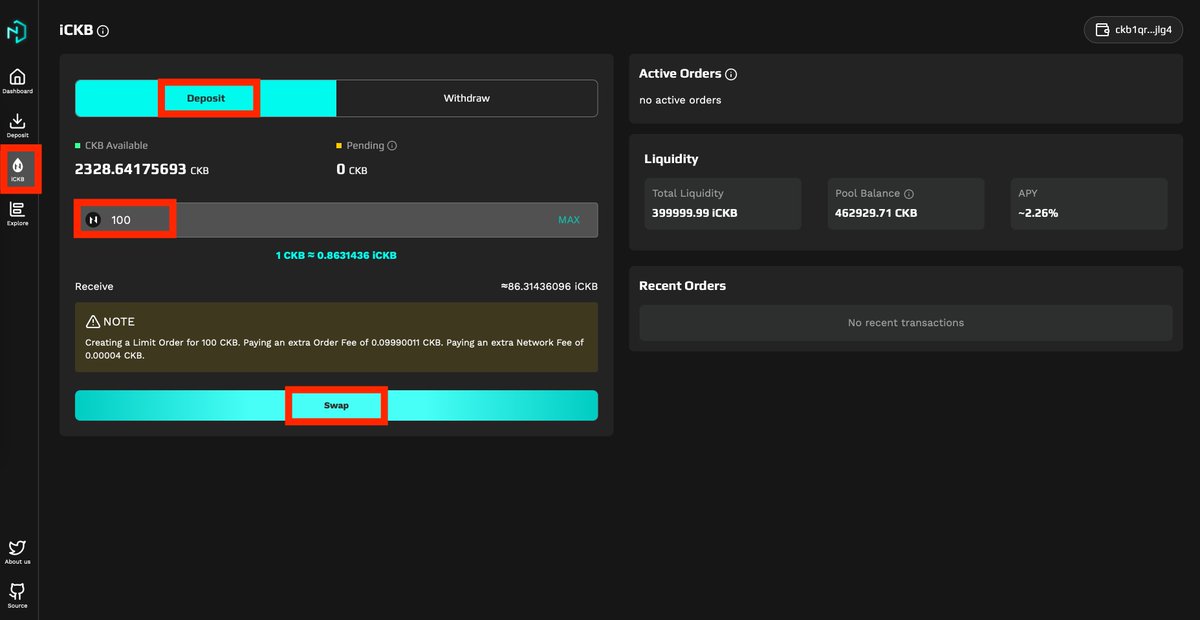
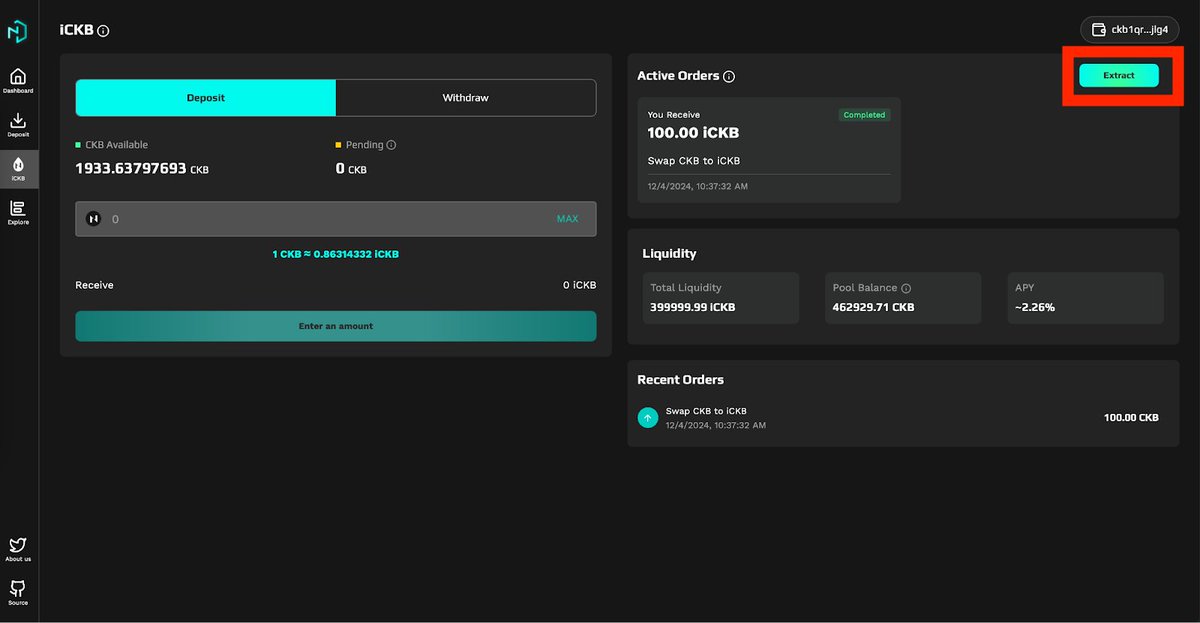
2. Click iCKB in the left navigation bar, select Deposit, enter the desired amount of CKB to deposit, then click the Swap button and confirm the transaction in your wallet.
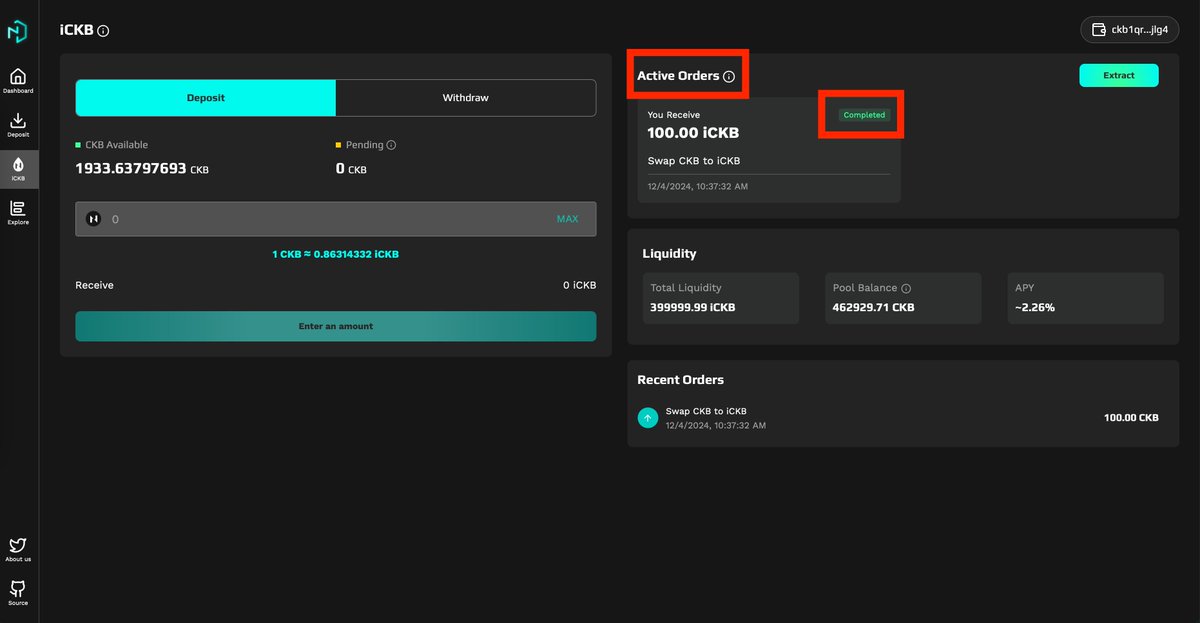
3. Wait approximately 90 seconds for confirmation. Once the order in the Active Orders section is marked as Completed, it indicates that the on-chain operation has been successfully completed.
4. At this point, your iCKB will be held in an on-chain contract escrow. If you wish to retrieve it, click Extract and confirm the action in your wallet. If you choose not to extract, the iCKB will automatically be released from escrow and returned to your wallet the next time you deposit CKB for iCKB or swap iCKB for CKB.
Whether or not you perform the Extract operation does not affect the interest earnings from Nervos DAO. The only difference is that iCKB in escrow cannot be directly swapped back to CKB, transferred to other wallets, or used in BTCFi applications.
Withdraw
1. Open the NervDAO website ( https://t.co/W2plzTWXi1 ) and connect your wallet.
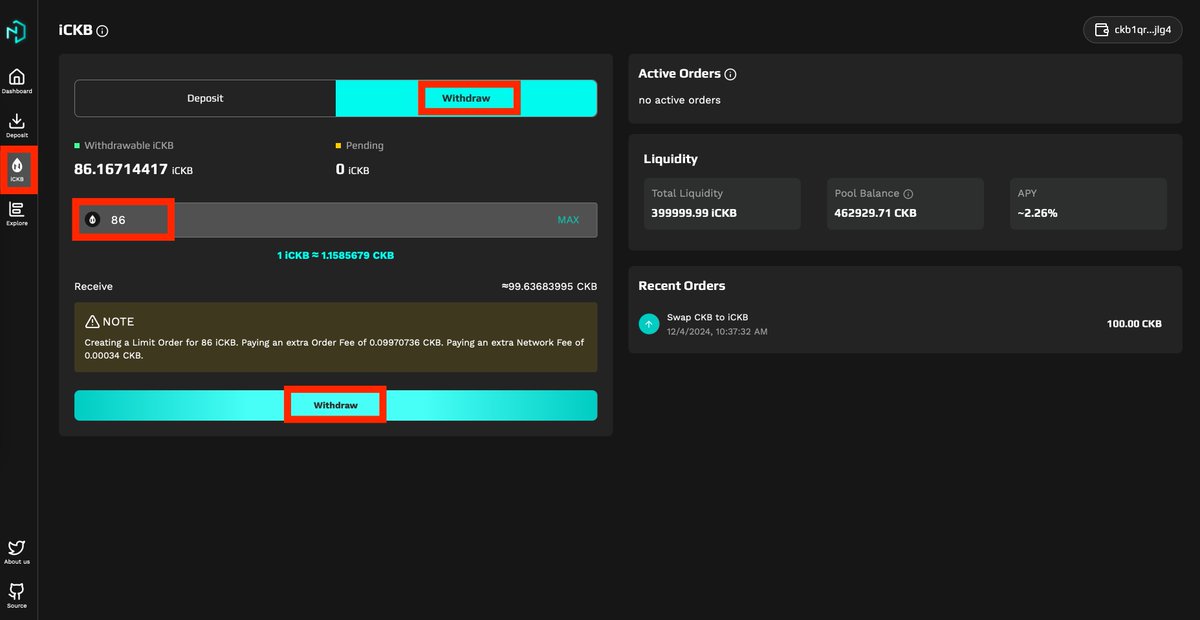
2. On the iCKB page, select Withdraw, enter the amount of iCKB you want to swap, then click the Withdraw button and confirm the transaction in your wallet.
(Note: If you wish to withdraw all iCKB and there are any iCKB held in on-chain contract escrow under Active Orders, you will need to perform an Extract operation to retrieve all iCKB first.)
3.Wait for the on-chain transaction to be confirmed. When the order in the Active Orders section shows as Completed, the on-chain operation is finished.
Similarly, the CKB will be held in an on-chain contract escrow. You can immediately retrieve it by performing an Extract operation, or it will automatically be released from escrow and returned to your wallet during your next swap or deposit transaction.
Conclusion
The iCKB protocol represents a significant leap forward for Nervos DAO staking tools. It not only resolves liquidity constraints but also offers users flexible investment options and enhanced earning opportunities within the BTCFi ecosystem. With iCKB, users can fully unlock the potential of Nervos DAO and the broader BTCFi landscape.
We just finished a round of work making the CCC SDK docs (https://t.co/bphoshFl1m) genuinely agent-friendly — not just "has an llms.txt," but actually tested against the AFDocs spec (https://t.co/H61Lu3T44h) and scoring 100/100 on Mintlify's Agent Score.
What that means in practice:
→ CCC now ships a full Skills library (fundamentals, wallet connect, transactions, UDT, Spore/DOB, playground, examples-finder). Install in your local AI coding tool:
npx skills add ckb-devrel/ccc --all
→ No local setup? Using a web-based AI app builder (https://t.co/IUxgM9Kxgk, Lovable, base44, v0...)? Just point it at:
https://t.co/osJbzZGrK7
and it'll follow CCC's own best practices instead of guessing.
We tested this ourselves — one-shot prompts building a working xUDT token issuance/transfer app and an on-chain message wall, wallet connection + transaction assembly included, both first-try:
🔗 https://t.co/ulH6yDiSXN
🔗 https://t.co/TeVgEgJUB9
Full write-up on what we built and why (AFDocs deep dive, Hub+Spoke skill architecture, before/after numbers):
https://t.co/ZkLQP9gb22
If you're building on CKB with Cursor / Claude Code / Devin / any AI app builder — try it and tell me where it breaks. Genuinely want the feedback. 🙏
This log will introduce the things I found interesting between 1.0.0 and 2.0.0. CCC is no longer just a novel experiment; it has gradually become a reliable foundation. Perhaps we have reached the time to build a Tower of Babel.
https://t.co/t0lBOT6Ypf
CKB Ecosystem Biweekly Update
Last week, CKCON25 convened in Chiang Mai, Thailand, where the community and core teams discussed the future development direction of the CKB ecosystem. Here is your biweekly round-up:
Infrastructure & Tooling 🛠
The new CKB explorer is live! Based on community feedback, @APP5Labs is releasing updates every 2 weeks. UDT display is now supported. Full migration by the end of January. https://t.co/wfFH7EPOFj https://t.co/TdJIkvtHEc, looking forward to your feedback: https://t.co/AZMeSdSgrR
@FiberDevs released Fiber Network v0.6.0 and deployed it to the testnet. The mainnet contract will be deployed in v0.6.1. The Dashboard has also been improved.
@CKBdev released OffCKB V 0.4.2. A minor CKB version is upcoming to enhance performance/security and reduce RPC DDoS risks.
@CKBDevrel: Reviewing PRs from SupeRise for the CCC library.
@rgbppfans: RGB++ Development Guide is under internal review.
Web5 & DAO 🌐
BBS successfully launched on mainnet! v0.2 is complete, and the team is now working on v0.3 (Admin dashboard & feedback optimizations), targeting a Jan 8th release.
The Web5 DID Toolbox is live, https://t.co/MakZGIJNsd, featuring functions like DID cell destruction.
DAO 1.1 repository is now public: https://t.co/K5f8d4BcMA. DAO MVP is complete, with a Mainnet launch target of mid-February.
Spark Program Updates ✨
We now have a dedicated GitHub to track and archive open-source content: https://t.co/LKDQQIyh1I
Blackbox: The team demoed prototypes on-site at CKCON25! 2 units delivered in person, 2 in customs, and 2 awaiting notification.
New Project: Welcome AirFi, a decentralized WiFi-sharing platform built on Nervos.
WarSpore-saga: Icon assets have been open-sourced.
Somo: Technical development completed. The project has now concluded.
Let's keep building! 🏗
CKB Ecosystem Biweekly #5
Hello CKB builders! It's time for our latest biweekly update. The ecosystem continues to grow with significant advancements across core infrastructure, developer tooling, and innovative Web5 applications.
Here’s a summary of the latest progress:
Infrastructure & Core Protocol ✨
- Updates include ACP Proxy (https://t.co/eaVeTSvx68) and ACP Auth migrating to Script Template (https://t.co/dJGq8dCfIV).
- A critical bug in CKB 0.203 affecting light client synchronization has been identified, and an RC2 version is currently being deployed to address it. CKB Crates will update to v1.0, and Molecule is moving to a new version with migration tools provided.
- @FiberDevs has successfully fixed the Fiber Network fund loss issue and is now conducting extensive large-scale testing to ensure stability and security.
Developer Tools & SDKs 🛠
- @CKBDevrel has released a Canary version of the DOB Render SDK within CCC (https://t.co/g3AUW51HIv)
- @rgbppfans has fixed redundant Paymaster fees in the RGB++ SDK (https://t.co/CJ2gTgBmuN).
- A new educational page for CKB wallet and address concepts from @CKBdev (https://t.co/QLqwQuRDNZ) has been launched.
Web5 & Ecosystem 🚀
- DAO 1.1: Login and proposal publishing are complete, with voting integration currently underway.
- BBS: The team is progressing on post and section management pages, and actively designing an ACP-based tipping solution for micropayments.
- Web5 Standards: Daily documentation updates are being made for Web5 WIP (Work-in-Progress) protocol standards, which will eventually be transferred to the web5fans repository. Efforts are also being made to define the scope of these standards and plan an official Web5 website.
- In a moment of profound validation, Michel Bauwens @mbauwens of the P2P Foundation has created a dedicated wiki page for Web5. This recognizes the vision for a decentralized web built on Bitcoin, as we are building with RGB++, Fiber Network, and USDI. Check out the page here: https://t.co/1xPVWgicLJ
- The Neuron iCKB mis-transfer issue for Neuron users has been successfully resolved.
Spark Program Updates 🌱
- Blackbox: We're excited to announce a new Spark grant for Blackbox (By @ckbsamurai
and Phillip), a hardware-based POS terminal by Neon and Phillip. This project aims to enable both fiat and crypto payments, focusing on CKB L2 / Fiber assets to bridge on-chain settlement with real-world merchant adoption.
- SoMo - Pixel Territory (By @tecmeup): The project now features multi-wallet support (JoyID, UTXO Global, Metamask), a live balance display, influence scoring, a real-time leaderboard, and extensive UI/UX enhancements, including responsive desktop design and social sharing. Pending tasks include Spore Protocol integration and database migration.
- Project Tracking Platform (By Emmanuel): The backend demo is live (https://t.co/UlOpp1q8dI). Next steps include UX/UI improvements, automated reminders, and integration with the Nervos Discord server.
The future is being built, piece by piece. Stay tuned for our next update!
⚠️ VM Security Update for Devs
As part of strengthening CKB, we regularly review older VMs and share issues we find.
One of CKB's strengths: you can always choose past VM versions. This design keeps asset ownership safe—even through hardforks. 🔐✅ But older VMs aren't without risks.
In our theoretical analysis, we found that v1 `exec` might display deterministic but non-standard behavior in certain edge cases, potentially leading to unexpected script execution results.
⚠️We recommend developers avoid `exec` in VM v1.
In cases like this, we may add protective measures (e.g., at the mempool) to filter risky txs.
These are NOT consensus changes—VM choice stays yours. The network adds safeguards, but you remain in control. 🛡️
More on Security Measures for VM Issues: https://t.co/ctrqX7VMjB
@CKBDevrel@NervosNetwork@CKBEcoFund
【⚠️ Patch Update: Infinite Loop Risk in *@ckb-ccc/core* Library】
Heads up, CKB developers. We have identified and fixed a critical bug in the *@ckb-ccc/core* library that could cause your application to freeze when building transactions.
The Issue: When using an affected version of *@ckb-ccc/core*, after successfully sending a transaction, any attempt to build and send a second transaction will trigger an infinite loop. This will cause the front-end or back-end service to become unresponsive.
Affected Versions: All versions of *@ckb-ccc/core* from 1.11.0 to 1.11.3 are affected.
Root Cause: The problem was traced to a faulty LRU cache implementation introduced in PR #244, which resulted in an infinite loop. For more technical details, please see the tracking issue: https://t.co/uDDQryPvzz
✅ Solution & Patched Version: This bug has been completely resolved in version v1.11.4. The update details are available in PR #297: https://t.co/VIHTd4AJ1i
We strongly urge all developers using the affected versions to immediately upgrade *@ckb-ccc/core* to the latest version (v1.11.4 or higher) to ensure the stability and security of your applications.
We apologize for any inconvenience this bug may have caused. Thank you for your understanding and support. #CKB #Blockchain #Bugfix
The CCC SDK has recently released a patch to improve compatibility with the latest JoyID scripts. 🩹 Developers using the CCC SDK are encouraged to update to maintain optimal compatibility.
🔗 GitHub PR: https://t.co/mETxN3kBoP
This is also a great opportunity to share an interesting aspect of CKB's smart contract design: How do contracts on CKB handle upgrades? 🤔
On CKB, every smart contract can have a permanent, unchanging identifier called a Type ID. Think of it like a house's street address 🏠. Even if you renovate entirely the inside of the house (i.e., update the contract code), the street address (the Type ID) remains the same.
This means when developers need to fix bugs or add new features, they can securely replace the old contract with a new version under the same "address." For users and other apps, this process is usually seamless. ✅ They just continue to interact with the original Type ID and automatically get the latest features.
Meanwhile, CKB's underlying rules ensure that only the contract's administrator can perform this upgrade, making the entire process secure and controlled. 🛡️
If you are interested in how the idea of Type ID relates to single-use seals, feel free to dive deeper with this article: 📖 https://t.co/4vqb29Y7eA
#CKB #Nervos #SmartContracts #Blockchain #Developer
@miner8811 There are many conceptual similarities between a Single-Use Seal and a Type ID. This article begins by explaining the concept of a Single-Use Seal and gradually introduces the thinking behind Type IDs.
Hello CKB community! Welcome to our Biweekly update. The ecosystem is consistently moving, with significant progress across core infrastructure, developer tools, and Web5 applications.
Web5 Apps & Community 🚀
- The first "Category A" Web5 application, BBS (Byte Builders Society), is now under development. An internal version of the BBS forum is ready for testing at https://t.co/IiZiseEJLU and is accepting new members via a whitelist.
- @RunningCKB is planning for CKCON 2025. Looking forward to seeing you, our excellent builders, there!
- The @CKBEcoFund Spark grant program continues to grow, with two new project applications currently being reviewed (https://t.co/8WNVZIHzha).
- @CKBEcoFund is preparing an optimizing proposal for the Community Fund DAO based on Web5 tech to meet growing governance needs.
Infra, Core Tech, & Developer Tools ⚙️
- @CKBdev is preparing a stable 1.0 release of CKB Rust Crate, which will reduce future development effort for the community (https://t.co/UlEAu6Huca). They are also updating developer documentation on the Exec syscall issue and providing new resources on script fuzzing (https://t.co/hlGY4HDnnP) and JS contract case (https://t.co/4n6IVmPdIT).
- @CKBDevrel has pushed several updates to CCC, enhancing developer experience, performance, and configurability (eg, https://t.co/zbaGVL5sOg).
- @rgbppfans has verified RGB++ Lock updates on the testnet, and a contract update is planned for this week. Work is also underway to support SPV services for Electrs TX Proofs (https://t.co/ExYYqQr7jF).
- @FiberDevs is preparing the Fiber Network 0.6 release, which will include WASM and security fixes.
- @APP5Labs finished maintenance for current CKB explorer and is addressing a high volume of transactions on the testnet by optimizing APIs.
- @joy_protocol is working on implementing instant convert (based on @xxuejie's open-sourced work https://t.co/plgCzAzl82). This will allow users to pay for transactions with USDI stablecoins, so they only need to focus on their USDI balance without worrying about holding CKB for fees.
The builders are hard at work! Stay tuned for more updates.
#CKB #Web5 #RGBpp #Developer #Nervos
🚴 Fiber Dev Log 12 🚴
Our recent work has centered on reliability — more end-to-end testing for funding tx verification, better shutdown handling, and perf improvements.
The Cross-Chain Hub (CCH) got a major update too: it now runs independently with persistent state storage.
And Fiber 0.6.0-RC 2 is ready: https://t.co/uC0g2HnNks
Looking forward, we're working on Atomic Multi-Path Payments (MPP) and continuing DAO discussions.
Dev log: https://t.co/PwONxpSssz
@NervosNetwork@CKBDevrel
An array stores many values of the same type in a continuous block of memory.
A union stores only one value at a time, but it can be one of several different types.
Both are fixed in size, but an array is for collections of one type, while a union is for a single value of a varying type.
In data structures, a "union" is like a magic box that lets you choose one item (data type) from several options. It's incredibly flexible, but it has a catch: if the items have different sizes, the "union"'s total size is variable.
This makes it incompatible with a "struct", which is like a precision container where every compartment must have a fixed, predefined size. This has limited how we can compose complex data on-chain.
💡 But here's a key insight: what if all possible members of a "union" just so happen to be the exact same size?
In that specific case, the "union" itself naturally becomes fixed-size! This isn't a new constraint we're adding; it's a powerful, inherent property we can now leverage in Molecule, CKB's serialization format.
This discovery unlocks the ability to embed these "unions" seamlessly into "structs", enabling more elegant and standardized definitions for complex data structures, like the Cell Data for UDTs.
🎉 A huge thank you to community contributor Phroi for their excellent work in formalizing this concept! It has been merged into the CCC - CCC is CKBer's Codebase.
Learn more and get involved:
➡️ The PR: https://t.co/ljt6ypePJ9
➡️ The CCC Repo: https://t.co/IL3HrJhZBW
We warmly invite everyone to contribute their insights and proposals to the CCC and help build a stronger #CKB ecosystem together!
#Nervos #Molecule #Blockchain #Tech #DataStructures
Nervos community developer “Tea” ( https://t.co/X0ZcqRoPuj)’s project Quantum Purse has completed the CKB Eco Fund Spark Program.
We spoke with Tea in a written interview, discussing the project’s origins, key technical decisions, and some behind-the-scenes stories only a developer could tell. The full conversation is below:
EN https://t.co/U9h6VF5sWv
CN https://t.co/TJsxcNHlaq
Enjoy the read and spark the ecosystem together!
@CKBDevrel@NervosNetwork
#web5 #BTC
It's fantastic to see the #CKB open-source spirit in action! We'd like to give a special thank you to Phroi (https://t.co/PfwruTo6Dm), a long-term community contributor and the brilliant mind behind the iCKB protocol.
For those who may not know, Phroi created iCKB to bring liquidity to assets staked in the Nervos DAO. Now, he's channeling that same expertise into improving CCC, our core toolkit for JS/TS developers. His recent contributions focus on optimizing performance and refining the codebase, making CCC faster and more robust for everyone.
When veteran builders like Phroi contribute to foundational tools, the entire ecosystem benefits. Thank you for your continued dedication, Phroi! ��
Inspired to contribute? Our GitHub is open to all: https://t.co/IL3HrJhZBW
CKB Ecosystem Biweekly #1
Hello CKB community! Welcome to our first Ecosystem Biweekly update, where we'll highlight the progress from our builders.
Here’s what’s been happening:
- A landmark moment for the Bitcoin and CKB ecosystem! The RGB++ Association (@rgbppfans) is now officially established with a brand new, developer-focused website: https://t.co/1v86kVJCsZ. This provides a rich portal of documentation, specifications, and tutorials to empower the next wave of RGB++ builders.
- Our developer tooling is getting stronger. @CKBDevrel's CCC has merged multiple community PRs (h/t phroi! https://t.co/cvF0wrOQH7), delivering significant performance improvements and enhanced configurability. This is what open-source collaboration looks like!
- Lightning infrastructure continues to advance. @FiberDevs is building a new dashboard to enhance user experience on the Fiber Network. Meanwhile, Fiber 0.6 RC-1 is under stress testing, with the upcoming release featuring crucial updates like WASM support and security fixes.
- The Web5 vision is no longer just a concept, it's a reality. The very first Web5 application, Xiangjian DAO, has been deployed and is live at https://t.co/L1BpgpIWDB! This is a pivotal step towards building truly user-centric applications, with many more in the pipeline.
- @OmigaHQ has completed the core development for its BTC Layer 1 DOB trading features. The module is now undergoing rigorous internal testing.
- @magickbase has successfully assisted @Ledger in adapting the new Multisig to support data2.
The ecosystem is building relentlessly. Stay tuned for our next update in two weeks!
#CKB #Web5 #RGBPP #BTC #DOB #Fiber #Dev
✅ Meepo Hardfork completed at epoch 12293.
Spawn syscall and CKB-VM v2 now live.
https://t.co/2qlvECS7fw
If your node isn’t syncing blocks, please upgrade to the latest version.
⚙️ Upgrade: https://t.co/7YvjqsJQ8C
@NervosNetwork@CKBEcoFund@CKBDevrel@NervosNation#nervos #ckb #meepohardfork #hardfork
An update has been long overdue, but we've got plenty of new features now live on https://t.co/uWiPQNT1Rf!
Where to begin? (1/5)
Let's start with multi-chain wallet (CCC)!
One wallet, unified multichain management - including #Bitcoin and $CKB - and greater convenience for you
#TeamCKB Dev updates
Last sprint, we wrapped up a multisig upgrade along with tooling updates. It’s all about improving compatibility between multisig scripts and NervosDAO withdrawals.
- If you’re using multisig, upgrade now to stay safe and compatible.
- If you're using NervosDAO with a single-signature address, you won’t be directly affected—but we still recommend upgrading for better stability.
Also, DID PLC Registry is now available on CKB. Originally developed by @bluesky, now bridging CKB with the web5 decentralized social network.
Full dev log: https://t.co/w11fLmQjYh
@CKBDevrel@NervosNetwork