12 HERBS YOUR BODY NEEDS AND NO ONE WOULD TELL YOU:
1. Milk thistle can regenerate up to 70% of damaged liver cells in just weeks.
2. Dandelion root makes your liver release 2x more bile, flushing toxins faster.
3. Cilantro binds to heavy metals like mercury and lead and drags them out naturally.
4. Burdock root purifies your blood and clears skin from deep within.
5. Nettle leaf cleanses over 10 liters of blood daily with its chlorophyll power.
6. Triphala removes gut toxins by up to 50%, boosting digestion and detox.
7. Turmeric raises glutathione levels, neutralizing up to 90% of free radicals.
8. Ginger speeds up lymphatic detox flow by 30–40% naturally.
9. Parsley flushes out excess uric acid and sodium, cleansing your kidneys.
10. Holy basil (Tulsi) enhances detox enzymes by up to 60% while calming stress.
11. Chlorella binds 8x its weight in heavy metals, detoxing cells deeply.
12. Garlic activates enzymes that eliminate over 20 harmful toxins from your body.
Joan Cusack has spent the last eleven years running a gift shop in Chicago. The red carpet she stepped onto this week for Toy Story 5 was a day pass to leave the shop and come back to Jessie for one afternoon.
The shop is called Judy Maxwell Home. She opened it in 2014 and named it after a character from What's Up, Doc?, the 1972 Barbra Streisand comedy. It sells curated home goods, small art, weird knickknacks she picks out herself. She works the floor. She picks the stock. She has been telling interviewers for over a decade that retail is the thing she actually wants to be doing.
In her words from this week: being a celebrity actress isn't that fun, over and over. Not that great of a world, except for being exposed to cool sets and talented, interesting people.
The Toy Story premiere was her first red carpet since September 2015. She did not attend Toy Story 4 in 2019, even though she was in the film. Her last on-screen acting role was a TV guest spot in 2020. The interviews where she talks about Hollywood with the most affection are the ones where she is also explaining why she left.
What I keep coming back to is the math of her career. Two Oscar nominations by 1997. School of Rock in 2003. Shameless from 2011 to 2018. She earned the right to keep working at the level she was working at, and she chose a gift shop in her hometown instead.
The line she gave reporters this week, about why the shop matters: if you're a woman now, it's so fun to have a shop of your own. You hone your instincts in the world, versus at home. This is a little lab of my own instincts about being in the world.
She made an exception for Jessie because Toy Story 5 finally makes the yodeling cowgirl the lead. Twenty-seven years after she first voiced the character. The carpet was for that, and only that.
The framing that she came back is the part worth correcting. She has been gone on purpose, doing the thing she actually likes, and a six-day press tour for a Pixar movie does not change that. The shop will still be there on Monday. She will be in it.
Farmers have figured out that the cheapest pesticide is a strip of flowers.
When you plant wildflowers through a crop field, not just around the edge but in strips running through the middle, you get ladybugs, lacewings, hoverflies, and parasitic wasps living in the field instead of visiting it.
They eat the aphids, the caterpillars, and the mites for free, all summer long.
In controlled trials, fields with tailored flower strips had leaf-beetle numbers 40 to 50% lower and crop damage cut by around 60%, enough to drop below the threshold where spraying was even considered worth it.
The flowers attract a standing army to our fields.
We spent decades engineering chemicals to kill the insects eating the crop, when the insects that eat those insects would have worked for the price of seed.
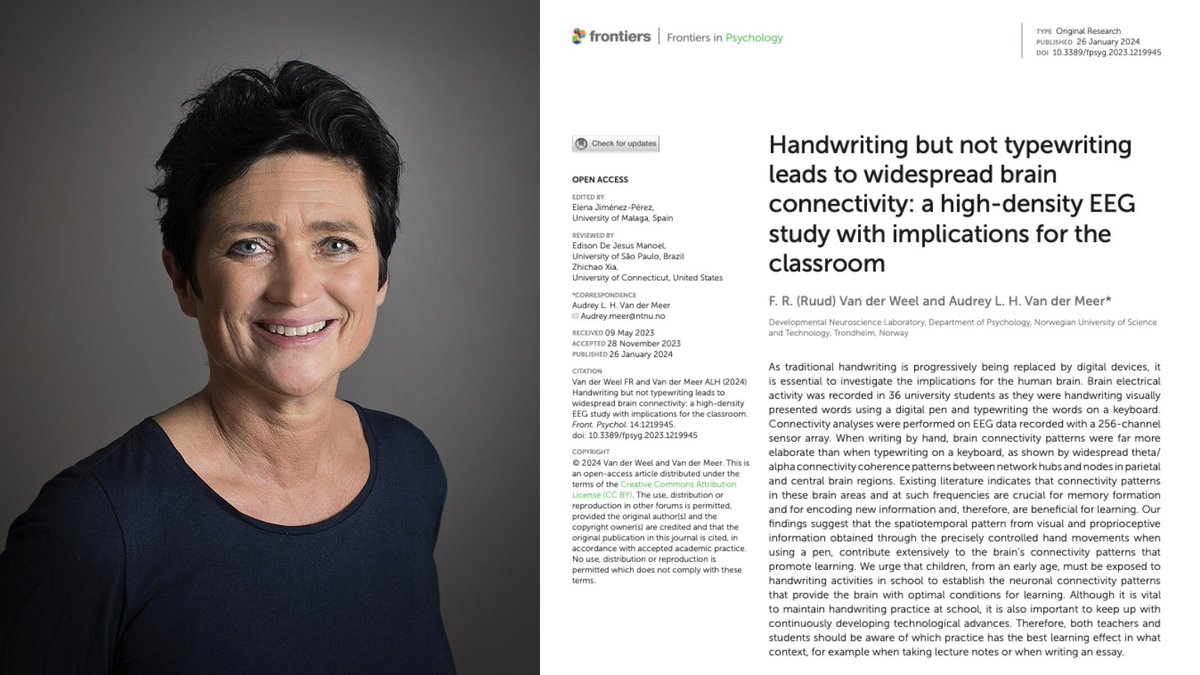
A Norwegian neuroscientist spent 20 years proving that the act of writing by hand changes the human brain in ways typing physically cannot, and almost nobody outside her field has read the paper.
Her name is Audrey van der Meer.
She runs a brain research lab in Trondheim, and the paper that closed the argument was published in 2024 in a journal called Frontiers in Psychology. The finding is brutal enough that it should have changed every classroom on Earth.
The experiment was simple. She recruited 36 university students and put each one in a cap with 256 sensors pressed against their scalp to record brain activity. Words flashed on a screen one at a time.
Sometimes the students wrote the word by hand on a touchscreen using a digital pen, and sometimes they typed the same word on a keyboard. Every neural response was recorded for the full five seconds the word stayed on screen.
Then her team looked at the part of the data most researchers had ignored for years, which is how different parts of the brain were communicating with each other during the task.
When the students wrote by hand, the brain lit up everywhere at once.
The regions responsible for memory, sensory integration, and the encoding of new information were all firing together in a coordinated pattern that spread across the entire cortex. The whole network was awake and connected.
When the same students typed the same word, that pattern collapsed almost completely.
Most of the brain went quiet, and the connections between regions that had been alive seconds earlier were nowhere to be found on the EEG.
Same word, same brain, same person, and two completely different neurological events.
The reason turned out to be something nobody had really paid attention to before her work. Writing by hand is not one motion but a sequence of thousands of tiny micro-movements coordinated with your eyes in real time, where each letter is a different shape that requires the brain to solve a slightly different spatial problem.
Your fingers, wrist, vision, and the parts of your brain that track position in space are all working together to produce one letter, then the next, then the next.
Typing throws all of that away. Every key on a keyboard requires the exact same finger motion regardless of which letter you are pressing, which means the brain has almost nothing to integrate and almost no problem to solve.
Van der Meer said it plainly in her interviews.
Pressing the same key with the same finger over and over does not stimulate the brain in any meaningful way, and she pointed out something that should scare every parent who handed their kid an iPad.
Children who learn to read and write on tablets often cannot tell letters like b and d apart, because they have never physically felt with their bodies what it takes to actually produce those letters on a page.
A decade before her, two researchers at Princeton ran the same fight using a completely different method and ended up at the same answer. Pam Mueller and Daniel Oppenheimer tested 327 students across three experiments, where half took notes on laptops with the internet disabled and half took notes by hand, before testing everyone on what they actually understood from the lectures they had watched.
The handwriting group won by a wide margin on every question that required real understanding rather than surface recall.
The reason was hiding in the transcripts of what the two groups had actually written down.
The laptop students typed almost word for word, capturing more total content but processing almost none of it as they went, while the handwriting students physically could not write fast enough to transcribe a lecture in real time, which forced them to listen carefully, decide what actually mattered, and put it in their own words on the page.
That single act of choosing what to keep was the learning itself, and the keyboard had quietly skipped the choosing and skipped the learning along with it.
Two studies. Two countries. Same answer.
Handwriting makes the brain work. Typing lets it coast.
Every note you have ever typed instead of written went into your brain through a thinner pipe. Every meeting, every book highlight, every idea you captured on your phone instead of on paper was processed at half depth.
You did not forget those things because your memory is bad. You forgot them because typing never woke the part of the brain that would have made them stick.
The fix is the thing your grandmother already knew.
Pick up a pen. Write the thing down. The slower road is the faster one.
Your body has shortcuts. Nobody taught you
- Nervous? Hold your breath for 5 seconds.
- Anxious? Put hand on chest + breathe slow.
- Low energy? Splash cold water on face.
- Stuffy nose? Rub an ice cube on mouth roof.
- Can't sleep? Blink fast for 60 seconds.
- Memory boost? Squeeze your fists tightly.
- Headache? Pinch between thumb & finger.
- Nauseous? Press inner wrist gently.
- Sleepy? Chew mint gum.
- Focus lost? Eat something crunchy.
Excited to announce I'm starting a new column at Bloomberg about the business of fashion. The first piece is about how to re-shore US apparel manufacturing. Instead of using mass deportations and tariffs, the government should move the industry upstream. 🧵