This tool was developed by a Muslim and is highly effective for blocking websites on your child’s phone or your own device.
Protect yourself and your loved ones from harmful content, including pornography, gambling websites, and anti-Islamic content. (It costs money)
Once, Sayyidunā Shaykh Muḥammad ibn Sulaymān al-Jazūlī قدس سره went to a well to perform wuḍūʾ, but there was no means of drawing water from the well. He was worried, wondering what he could do. A girl standing on a high rooftop saw him and said, “O Shaykh! You are well-known for your deeds, yet you are worried about how to draw water from the well!”
The girl then put her saliva into the well, and within a short while, the water began to rise so much that it overflowed from the edges of the well onto the ground.
The Shaykh performed his wuḍūʾ and said to the girl, “I adjure you by Allāh to tell me: How did you attain this status?”
The girl answered: “I recite ṣalāt upon the blessed Prophet ﷺ abundantly.”
Upon hearing this, Sayyidunā Shaykh Muḥammad ibn Sulaymān al-Jazūlī رحمه الله vowed that he would write and present a book concerning ṣalāt upon the beloved Prophet ﷺ.
[Maṭāliʿ al-Masarrāt, pp. 33–34.]
He subsequently wrote the famous book Dalāʾil al-Khayrāt.
In the path of taṣawwuf, one of the greatest obstacles to spiritual refinement is kibr (arrogance): the heart’s tendency to regard itself as superior to others.
A person may see another afflicted by a physical condition and laugh, forgetting that his own health, strength and abilities are blessings bestowed by Allāh Taʿālā, not achievements that entitle him to look down upon His creation.
Never assume that your outward well-being is proof of your spiritual superiority. A person whom society pities may possess a heart more beloved to Allāh than one whom society admires. The true rank of a servant is known to Allāh, who knows the realities of hearts and the sincerity of deeds.
Do not laugh at the afflicted; show them mercy. Do not despise the weak; honour their dignity. Do not become proud of your blessings; thank the One who bestowed them.
The path to Allāh Taʿālā is not walked by stepping upon the dignity of His creation, but by cultivating humility, mercy and sincerity. May He grant us the spiritual insight to see our own shortcomings before judging others.
True wisdom speaks with substance, while foolishness seeks validation through constant oaths. “Wallāhi,” “Qasam,” and the like. A person of sound intellect lets the weight of his words speak for itself; he does not need to swear repeatedly to make others believe him.
Taking oaths excessively is a sign of idiocy.
Imām Sufyān al-Thawrī said:
“A woman will pass by a man, and he cannot restrain himself from looking at her lustfully, although there is no benefit in it. What could be weaker than this?”
[Ḥilyat al-Awliyāʾ, vol. 7, p. 68]
A man who cannot lower his gaze and remain focused in a world full of temptation must question the strength of his self-control. True masculinity is not merely physical strength, but the ability to restrain oneself for the sake of Allāh Jalla wa ʿAlā.
@OICDelegate@HarounKanj We have 700,000 followers, and no, she is not helping the cause of the Muslims. She is contributing to spreading lies about Islām and advancing the mission of the British Empire’s offspring: Wahhābism.
@OICDelegate@HarounKanj We have been doing this since 2018 and have published over 200 posts exposing Zionism, with a combined reach of more than 100 million. We were not sharing naked pictures of ourselves, unlike certain people.
“...You will regard your Ṣalāh inferior to their Ṣalāh; your fasts compared to theirs and your deeds to their deeds as inferior. They will recite al-Qurʾān, but it will not pass their throats (it will have no effect on their hearts).”
[Ṣaḥīḥ al-Bukhārī, vol. 6 p. 197, Ḥadīth 5058]
“They will apparently speak good things...”
[Ṣaḥīḥ al-Bukhārī, vol. 6 p. 197, Ḥadīth 5057]
“They will constantly quote Aḥādīth...”
[Sunan Abī Dāwūd, vol. 4, p. 244]
“Their lower garb (Izār-pants) will be lifted high...”
[Ṣaḥīḥ Muslim, vol. 2 p. 742, Ḥadīth 144]
“𝗧𝗵𝗲𝘆 𝘄𝗶𝗹𝗹 𝗲𝘅𝗶𝘁 𝗜𝘀𝗹𝗮̄𝗺 𝗮𝘀 𝗮𝗻 𝗮𝗿𝗿𝗼𝘄 𝘄���𝗲𝗻 𝗶𝘁 𝗹𝗲𝗮𝘃𝗲𝘀 𝘁𝗵𝗲 𝗯𝗼𝘄 𝗳𝗼𝗿 𝗶𝘁𝘀 𝘁𝗮𝗿𝗴𝗲𝘁 𝗻𝗲𝘃𝗲𝗿 𝘁𝗼 𝗿𝗲𝘁𝘂𝗿𝗻 𝗮𝗴𝗮𝗶𝗻.”
[Sunan Abī Dāwūd, vol. 4 p. 244]
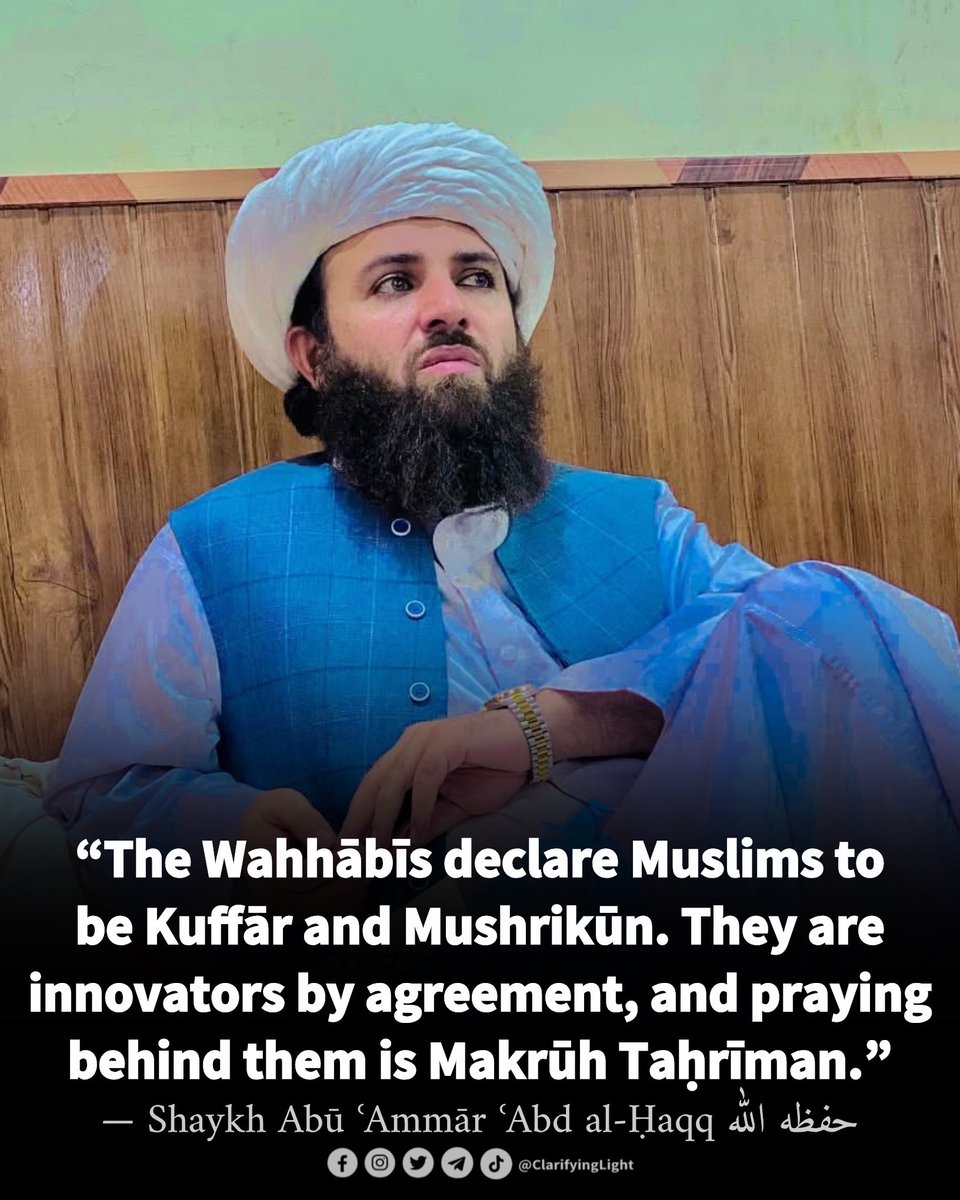
The prayer behind a deviant is not valid according to the madhhab of al-Imām al-Aʿẓam Abū Ḥanīfah.
Imām Badr al-Dīn al-ʿAynī:
“Imām Muḥammad narrated from Imām Abū Ḥanīfah and Imām Abū Yūsuf that praying behind Ahl al-Ahwāʾ is not permissible.”
[Kitāb al-Bināyah Sharḥ al-Hidāyah, 2/333]
This reflects a traditional understanding of ḥayāʾ (modesty), dignity, and the preservation of a woman’s honour. Within the Sunnī tradition, modesty is not merely an outward characteristic; it is a quality of the heart that governs one’s speech, gaze, conduct, and interactions with others.
This Wahhābī, Muḥammad Ḥasan ʿAbd al-Ghaffār, shows disrespect towards Abū Bakr al-Ṣiddīq!
Muḥammad Ḥasan ʿAbd al-Ghaffār said:
“If Abū Bakr had done such a thing, we would have objected to Abū Bakr and said: ‘Abū Bakr was mistaken.’”
[Source: Muḥammad Ḥasan ʿAbd al-Ghaffār, a video discussion on YouTube]
Notice the lack of respect and arrogance displayed by this man. He imagines that Abū Bakr al-Ṣiddīq (Allāh is pleased with him) would commit an act contrary to the Holy Prophet ﷺ, whereupon this deviant would rebuke Abū Bakr al-Ṣiddīq, the foremost Companion of the Messenger of Allāh ﷺ!
These people do not possess even an atom of shame or respect when they make the Ṣaḥābah the subject of hypothetical examples to illustrate their own misguidance and foolishness.
Imagine anyone arrogantly uttering whatever he pleases and then using the Ṣaḥābah as examples! Another deviant then comes along and says: “If ʿUmar had said that, we would have told him: ‘You were mistaken.’” And yet another says: “If ʿUthmān and ʿAlī had said that, we would have told them: ‘You were mistaken.’”
All of this comes from a group that falsely and deceitfully claims to venerate the Salaf and the Ṣaḥābah and to affiliate themselves with them. They imagine the Ṣaḥābah making mistakes and themselves being the ones who would rebuke the Ṣaḥābah!
Know that this wretched sect has no share whatsoever in following the Salaf and the Ṣaḥābah, except for what they merely repeat with their tongues.
If the statement of a Ṣaḥābī agrees with their understanding, they say: “We understand according to their understanding.”
But if it contradicts their understanding, they say: “This Ṣaḥābī was mistaken. He fell into a bidʿah (religious innovation). Even if a Ṣaḥābī had done such a thing, we would have rebuked him for it!”
There is no might nor power except through Allāh.
A Wahhābī once came to Aʿlā Ḥaḍrat, al-Imām Aḥmad Riḍā Khān, with some objections, and Aʿlā Ḥaḍrat responded to him compassionately, without scolding him.
That man had a change of heart and left with the intention of becoming Aʿlā Ḥaḍrat’s disciple.
Aʿlā Ḥaḍrat says:
“See, the benefit that lies in compassion is not found in harshness. If we were to deal with him roughly, he would certainly not have changed his ways.
Those who are confused or undecided should be treated kindly so that they may rectify themselves.
Even with the major leaders of the Wahhābiyyah, we initially treated them with compassion. But when they became obstinate in their deviations, to the point that there was no turning back, we then began dealing with them harshly, as Allāh ﷻ commanded us in the Holy Qurʾān:
‘O Prophet, strive against the disbelievers and the hypocrites and be stern with them.’”
[Sūrah at-Tawbah, 9:73]
'The haqiqa (reality/essence) of the Prophet peace be upon him existed at that time (whilst Adam was between water and clay), even though the existence of the blessed body of the Prophet peace be upon him, which possessed this reality as a characteristic, came later'