We're Classy AI News.
Every day we track AI labs, quantum computing, humanoid robots and AI biotech, and tell you 3 things:
• what changed
• why it matters
• what to do next
Sourced to primary docs. No hype. 🧵
Which protein pieces will the immune system notice? A better shortlist can save weeks in the lab.
PREpiBind, a bioRxiv preprint from a Seoul team, uses a protein language model to rank likely MHC class II binders. Code and weights are public.
https://t.co/nTsOV2nSn7 #Biotech
Not every part of a rollup proof is the same kind of work. Gryphes treats them differently.
An IACR ePrint from HKUST and OKX sends app logic down one path and hash-heavy checks down another, with constant-size proofs in their prototype.
https://t.co/j5dus06aZR #zkRollups
Farm AI shouldn't just name a plant disease. It should point to it.
AgroGround, an arXiv preprint, builds nearly 795k tasks where a model must name the disease and box the exact spot on the leaf.
https://t.co/CU4VU2Adiz #AgTech
Supply plans break when the real world gets noisy.
An arXiv preprint tests neural operators, AI that learns smooth maps of how a system changes, for planning under noise. In some tests they beat grid planners. Early, not peer-reviewed work.
https://t.co/8YIQReV5o1
Where did that pallet go? Ask the whole robot fleet.
In Industrial ReMEmbR, an arXiv preprint from NVIDIA-linked researchers, robots log what they see, when and where into one shared memory a single query can search.
https://t.co/auO4cqwsRq #Robotics
Quantum computers burn lots of extra qubits just to catch errors. New designs pack in more useful ones.
An arXiv preprint shares error codes like [[90, 21, 11]], with rates near 0.21 to 0.23.
https://t.co/obczhEle2U #QuantumComputing
Can a phone photo read your skin as well as a clinic device?
A study of 1,099 Korean adults in Skin Research and Technology (peer reviewed) trained AI on camera, tablet and phone photos. Results dropped when the camera changed.
https://t.co/OiebGPkH8P #SkinCare
What if an AI could clean up its own notes in the middle of a long task?
Meta FAIR and partners trained models to edit their own context file. In an arXiv preprint, accuracy rose about 11.4% while compute fell about 21.5% on one benchmark.
https://t.co/zt6lc0cJMq #AI
Split one harmful job across several AI agents, and the safety monitor mostly misses it.
An arXiv preprint (not yet peer reviewed) found a monitor flagged about 7% of split attacks, versus about 87% when one agent did the whole job.
https://t.co/VZEFGnuEMD #CybersecurityAwarenessMonth
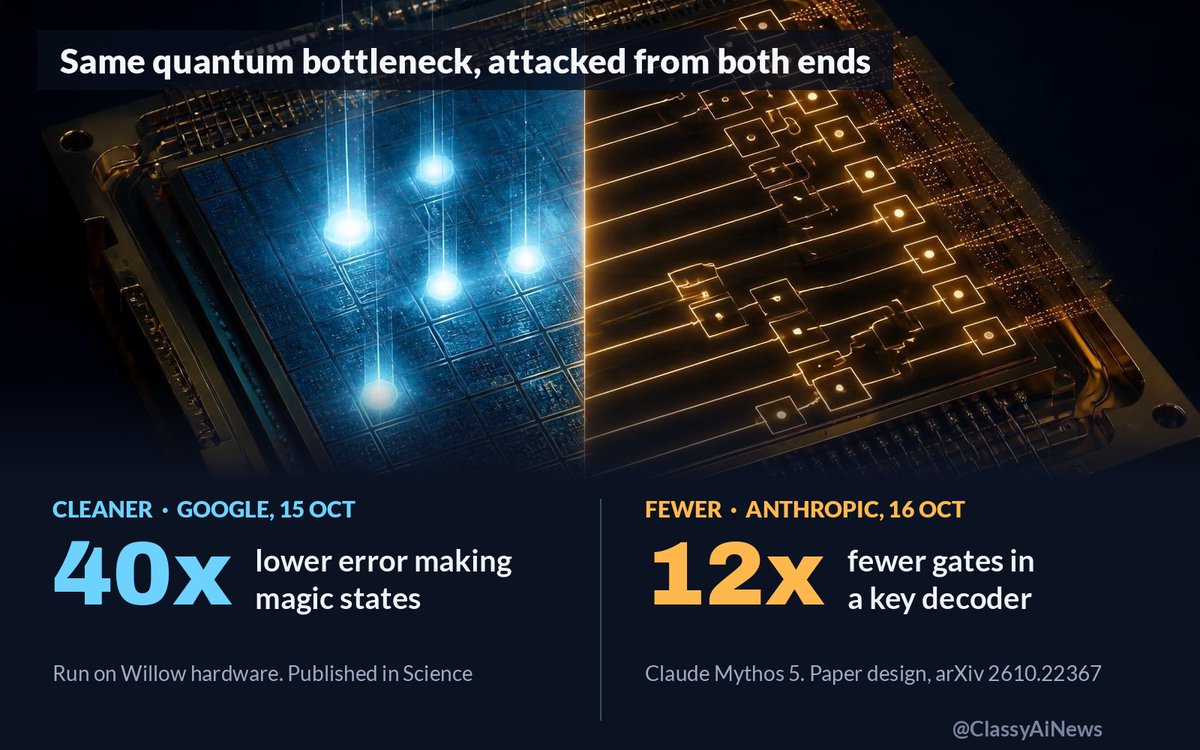
Google and Anthropic hit the same quantum bottleneck from opposite ends this week.
Google (in Science, 15 Oct): magic states, the input the costliest gates run on, now made with 40x lower error on its Willow chip.
Anthropic (16 Oct): Claude Mythos 5 redesigned circuits to need fewer of those gates. It cut Google's own decoder design 12x.
Claude's circuits are paper designs, not yet run on hardware.
Which gets us to a useful quantum computer first: cleaner gates or fewer of them?
For anyone training or serving models: TSMC just guided Q4 sales to US$52.3-54.3B, about 14% above Q3, and lifted its 2026 growth view to ~44%.
But its 2026 capex plan didn't move ($60-64B), and 2nm is only 8% of wafer revenue so far.
Does that make AI compute cheaper in 2027, or tighter?
Sources: TSMC Q3 2026 results and Q4 guidance:
https://t.co/VlfH2PXyj3
Full-year ~44% growth, capex reiterated at $60-64B, 2nm at 8% of wafer revenue (TrendForce call report):
https://t.co/Jb8m2gJxDX
~US$46.7B was our 14 Oct sum of TSMC's monthly sales. Card image is an illustration.
TSMC ($TSM) just raised its 2026 sales outlook, but not its capex.
Growth now ~44% (up from ~40%). Capex still $60-64B.
Q3: US$46.72B vs a US$44.6-45.8B guide. Our monthly-sales math yesterday said ~US$46.7B.
Q4 guide: US$52.3-54.3B, ~14% above Q3.
More sales from the same build plan: pricing power, or caution?
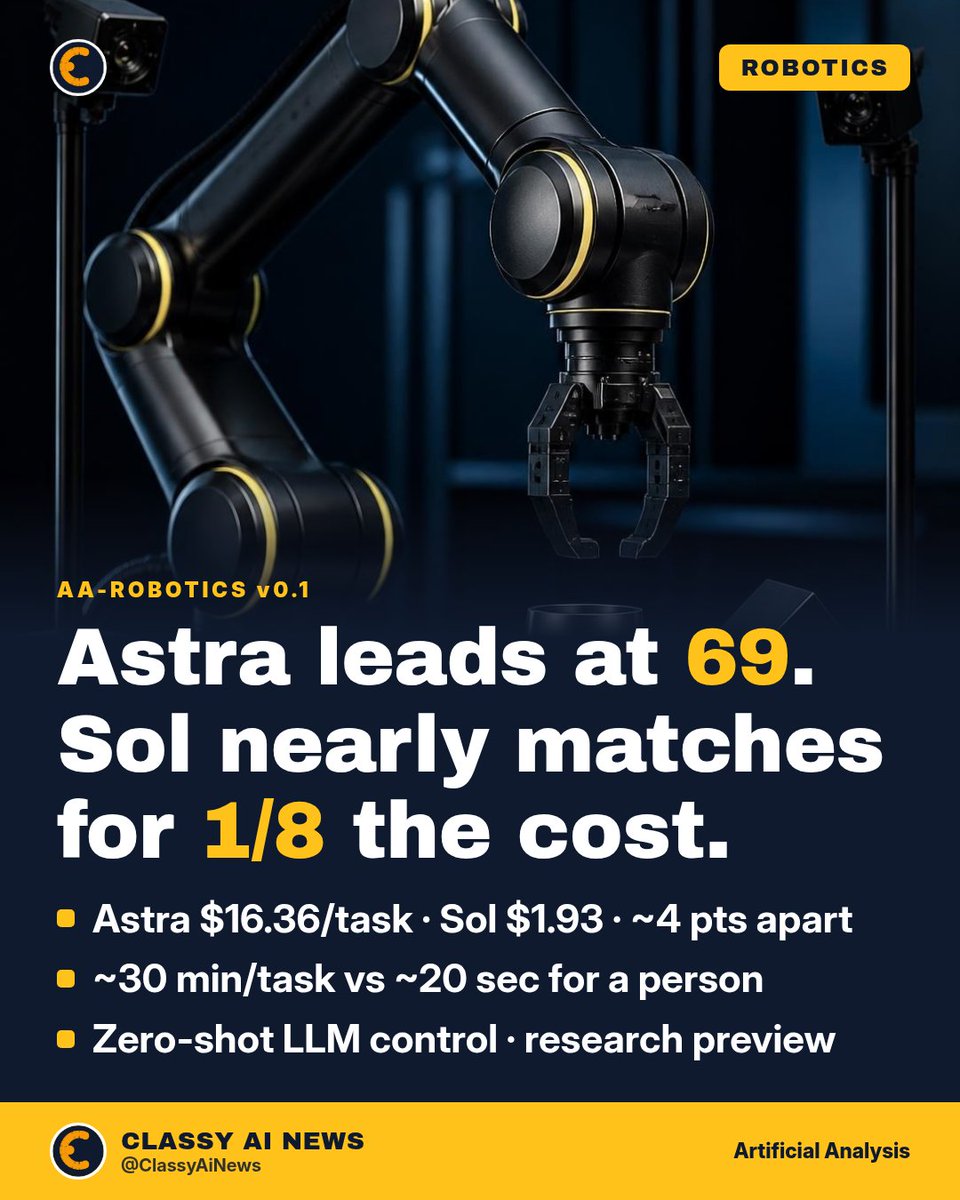
GPT-6 Astra topped Artificial Analysis's new robot-arm benchmark at 69. What most posts skip: Sol got to 65 for $1.93 a task while Astra cost $16.36 — about 8× more for ~4 points.
And both still need ~30 minutes where a person needs ~20 seconds.
Is cost the real race in embodied LLM control, or speed?
Source: Artificial Analysis, AA-Robotics v0.1 (14 Oct 2026). Scores and $/task are theirs. Research preview; zero-shot coding harness on a 6-axis arm; 8 tabletop tasks.
https://t.co/Pvday4pteL
Card image is an illustration.
Everyone is quoting Astra's 69 on Artificial Analysis's new robot-arm test. The line that matters is cost: Sol scored 65 for $1.93 a task vs Astra's $16.36.
Both still take ~30 minutes where a person takes ~20 seconds.
When does zero-shot LLM control become cheaper than a human for tabletop work?
Sources: Reuters, "Eight US states sue OpenAI, claiming ChatGPT harms children" (14 Oct 2026) https://t.co/pEBrRx2kUl
Nebraska AG release (states: AZ, AR, ID, IA, KS, MT, NE, WV) https://t.co/1EFYdBVn94
Card image is an illustration.
OpenAI now faces child-safety suits from 9 US states, and the ask is a redesign.
8 sued Wednesday, each in its own state court. Florida sued in June. They want ChatGPT changed for minors and profits from young users given up.
Allegations, no ruling yet.
What should a chatbot do differently for a 14-year-old?
QCi's first commercial pharma customer: INmune Bio will run Alzheimer's and rare-disease data on Dirac-3S quantum optimization, next to AI and normal stats.
The honest part: they'll compare quantum vs conventional methods to see where it actually helps — not claim a drug breakthrough yet.
XPro still in trials. Useful signal, or just a new market story?
PerPlant's AI crop sensor just went factory-fitted on Valtra tractors (AGCO) — not a bolt-on kit.
Two roof cameras map weeds, biomass and risk zones while you drive. Farmers using it cut inputs 40–87% depending on the implement.
The long game is season-long field data, not just see-and-spray.
Would you buy crop AI built into the tractor?