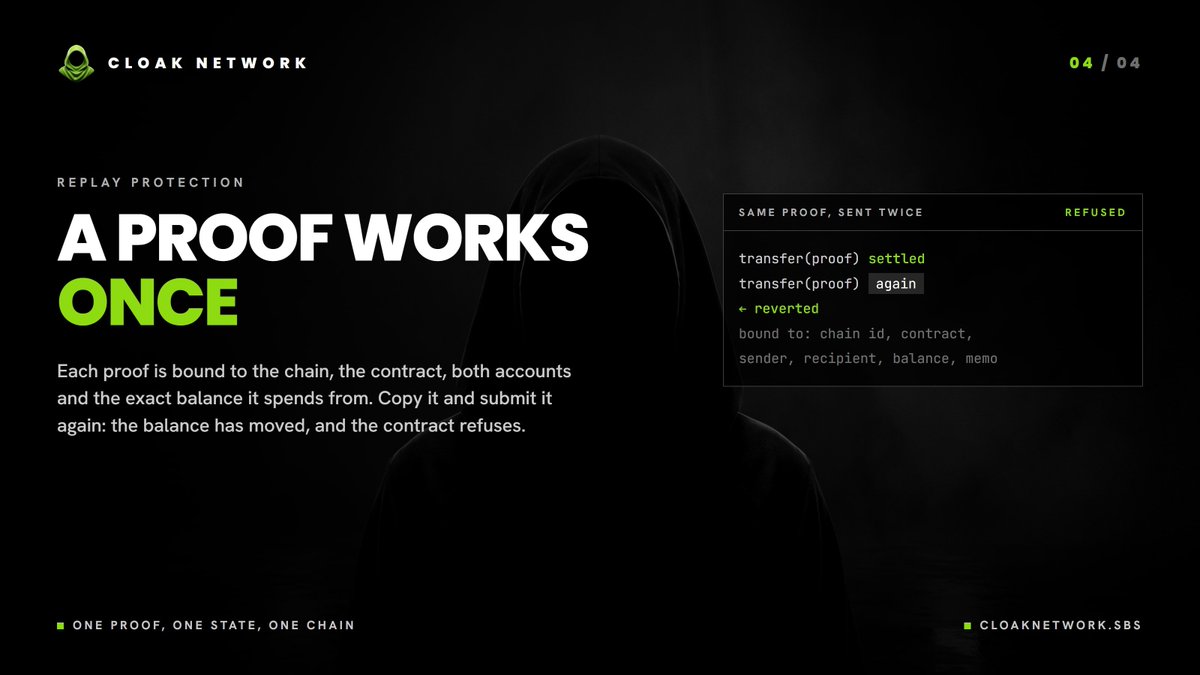
A Cloak proof works once.
It is bound to the chain, the contract, both accounts and the exact balance it spends from. Copy it and submit it again: the balance has moved, and the contract refuses.
One proof, one state, one chain.
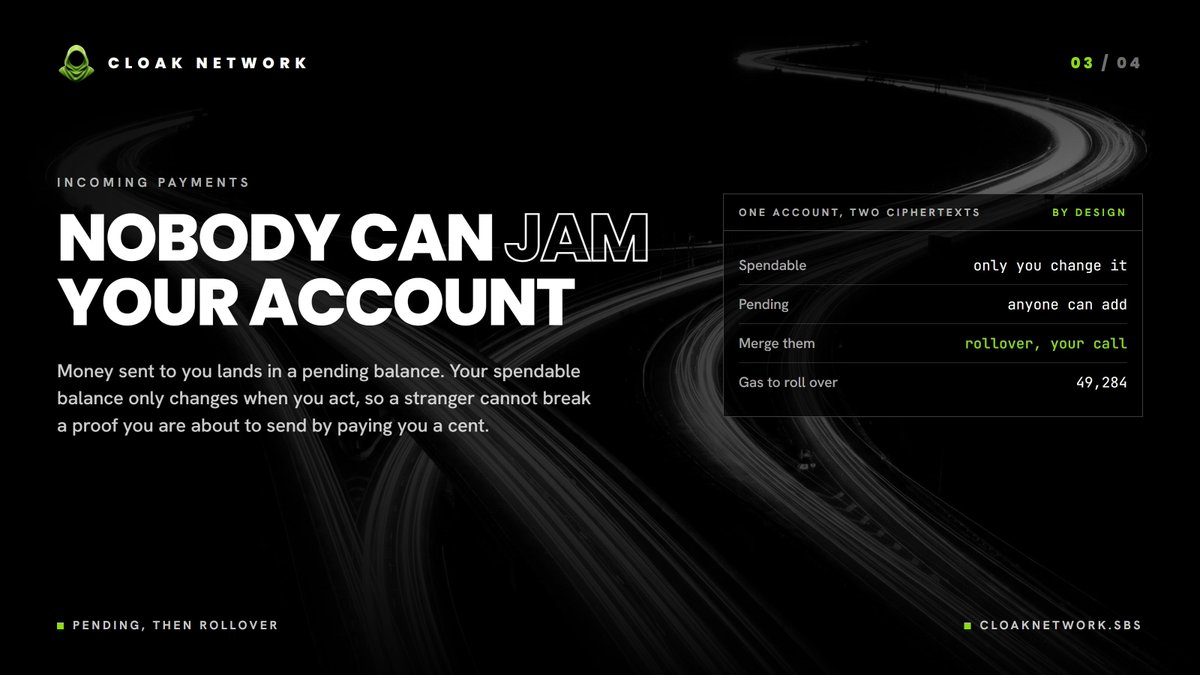
A subtle attack on private accounts: send someone a cent right before they pay, and their proof no longer matches their balance.
On Cloak it doesn't work. Incoming money lands in a pending balance. Your spendable balance only changes when you act.
Nobody can jam your account.
If amounts are hidden, what stops someone from sending 1 and crediting 1,000?
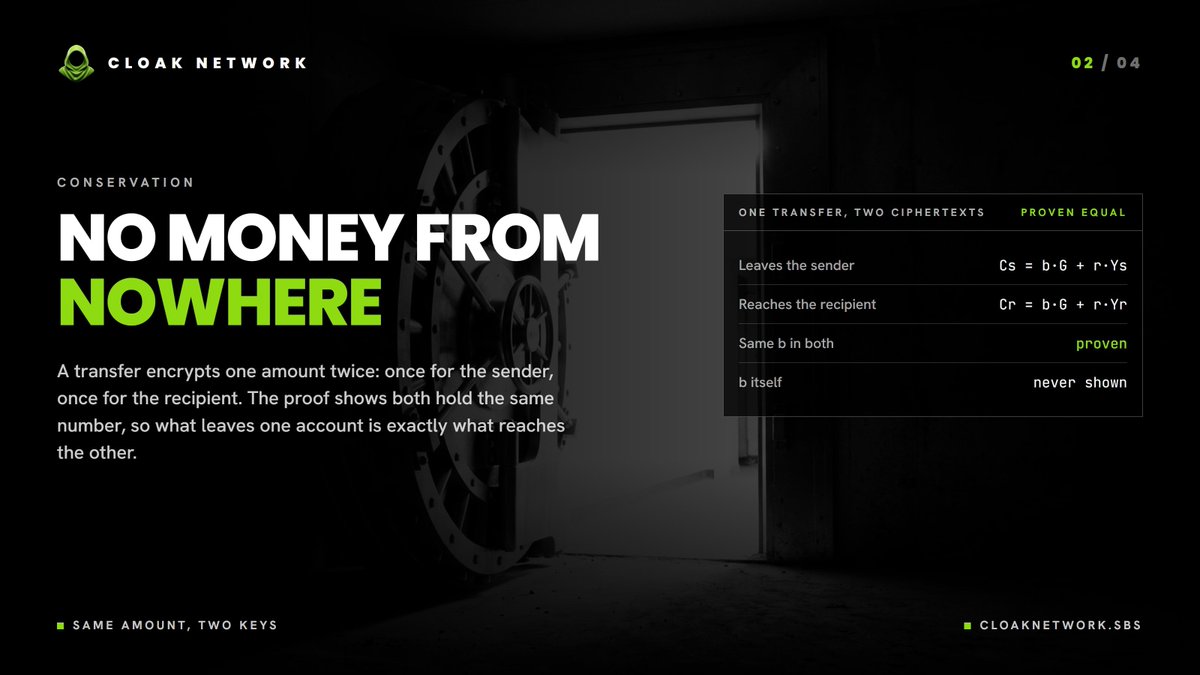
A Cloak transfer encrypts one amount twice: once for the sender, once for the recipient. The proof shows both ciphertexts hold the same number.
What leaves one account is exactly what reaches the other. No money from nowhere.
How do you prove a number is positive without showing the number?
Cloak commits to the amount bit by bit. For each of its 32 bits, you prove it's a 0 or a 1, never which one. The contract checks every bit and rebuilds the total.
No negative amounts. No hidden overdraft. No trusted setup.
Transfers on Cloak cost zero in protocol fees. So do deposits.
The only fee that can ever exist is on withdrawals. It is 0 % today and capped at 0.30 % in the bytecode, so nobody can raise it past that, including us.
You still pay network gas, like any transaction.
What Cloak hides, and what it doesn't.
Hidden: amounts and balances. With stealth routes, the recipient too.
Public: that a transfer happened, who sent it, and every deposit and withdrawal.
We'd rather tell you than let you guess.
Your key never leaves your device.
It is made in your browser and it stays there. Our site holds no key. Proofs are built on your machine, and the contract only ever receives ciphertexts and proofs.
The flip side: lose the key and nobody can recover the balance. Not us, not the contract owner.
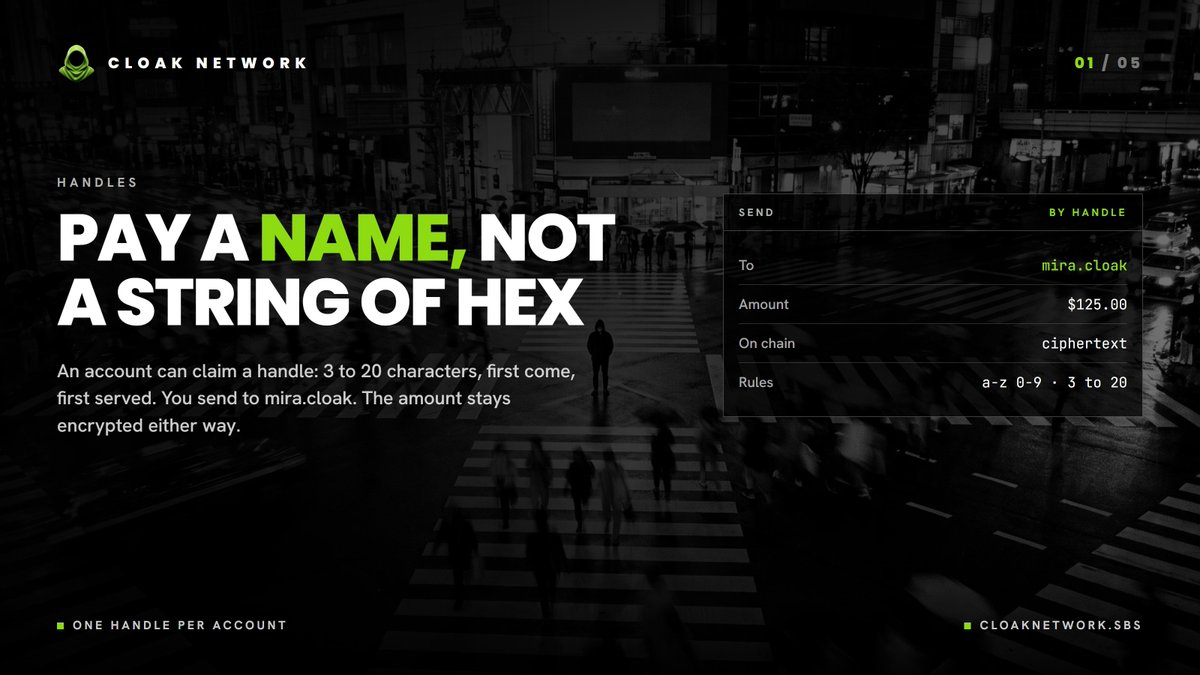
Nobody should have to paste 42 characters to pay a friend.
On Cloak an account can claim a handle. You send to mira.cloak, the contract resolves it, and the amount stays encrypted like any other transfer.
3 to 20 characters. First come, first served.
Don't trust us. Run it.
The console on our site runs the pool's real bytecode in your browser, with play money. Send an encrypted transfer. Overspend and watch it revert. Give an agent a budget.
The pool is deployed on Robinhood Chain. It is not audited yet, and the console is still a sandbox.
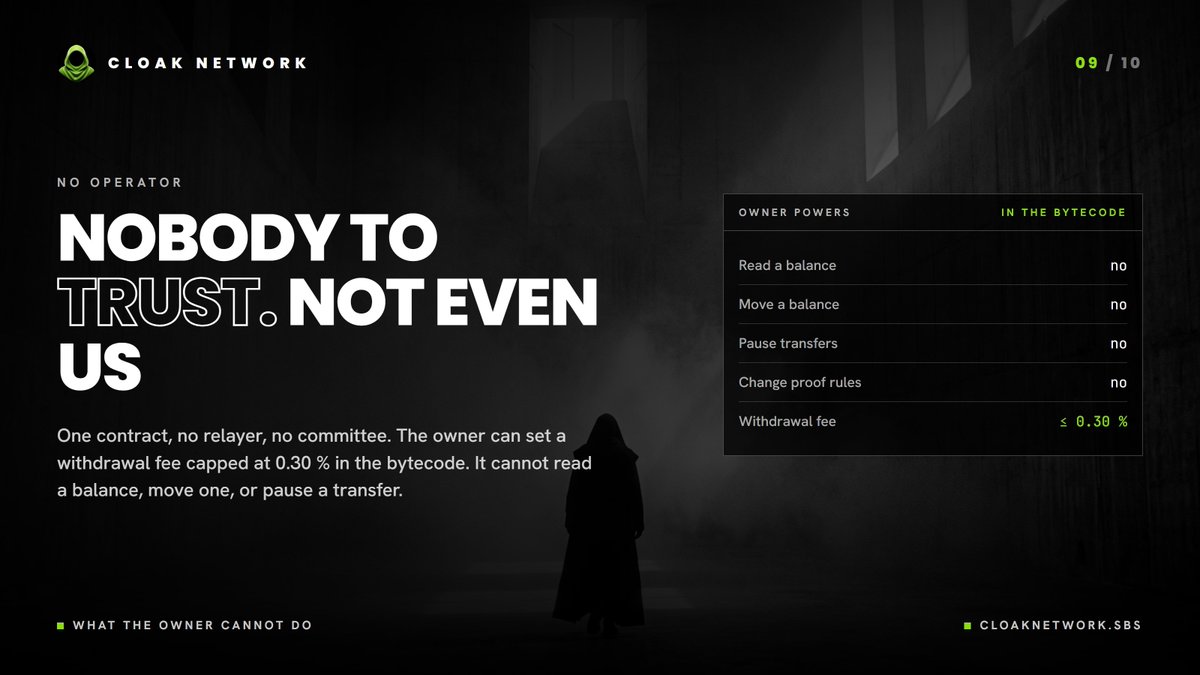
Nobody to trust. Not even us.
Cloak is one contract. No relayer, no committee, no off-chain verifier.
The owner can set a withdrawal fee, capped at 0.30 % in the bytecode. It cannot read a balance, move a balance or pause a transfer. Those functions don't exist.
Software that pays for itself.
A server answers "402 Payment Required" with a price. The agent pays in ciphertext and retries. The server decrypts its own side and checks it received the price, to the cent.
No human in the loop. No amount in public.
Demo is here :
77 seconds, no cuts, no mock-ups. This is the real site.
→ an amount encrypted live in the browser
→ a $125 transfer the chain verifies without reading
→ an overspend, refused by the contract
→ an AI agent with a budget, paying an API on its own
→ one cent over its ceiling: reverted
→ one transfer opened for an auditor
It runs the pool's real bytecode in a sandbox, with play money. Try it yourself:
https://t.co/eKO72iNIl0
CA: 0xfb4818595779bb19958586f24a8bd8b2949d9098
Private doesn't mean unaccountable.
Need to show an auditor one payment? Open that one transfer, with a proof that the opening is honest.
Your key never leaves you. Every other transfer stays closed.
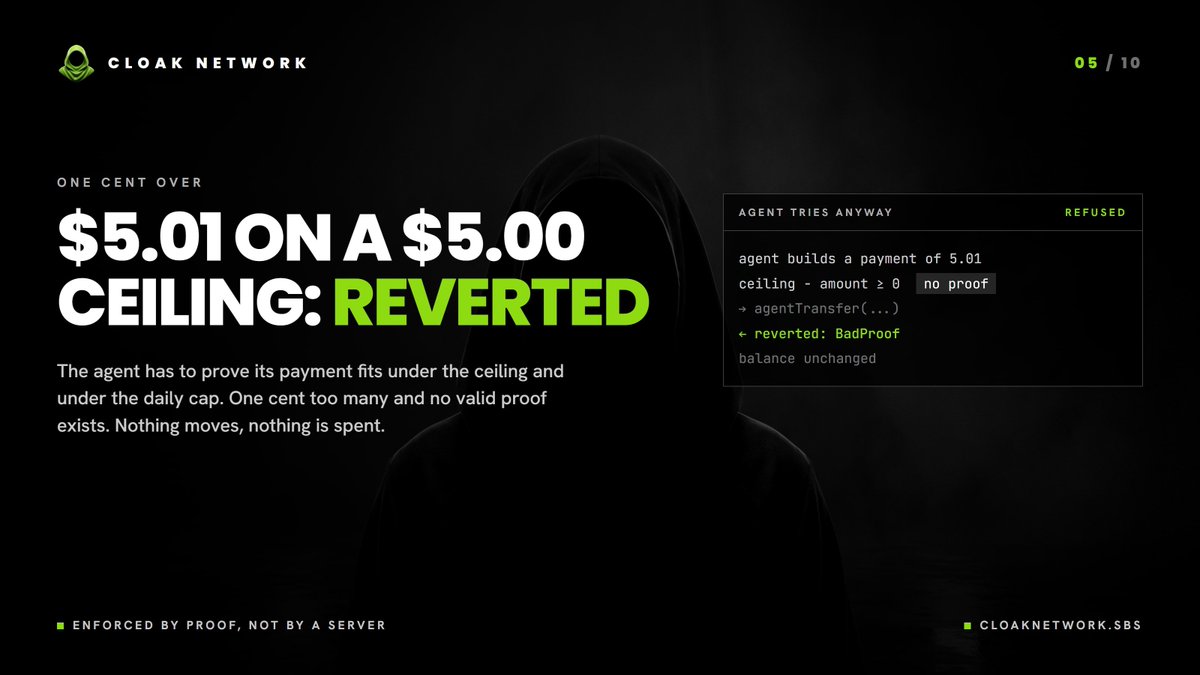
We asked an agent to pay $5.01 on a $5.00 ceiling.
It couldn't. To pay, it has to prove the amount fits under its limit, and for $5.01 no valid proof exists.
Reverted. Nothing moved, nothing was spent.
Not a rule on a server. Math, checked on chain.
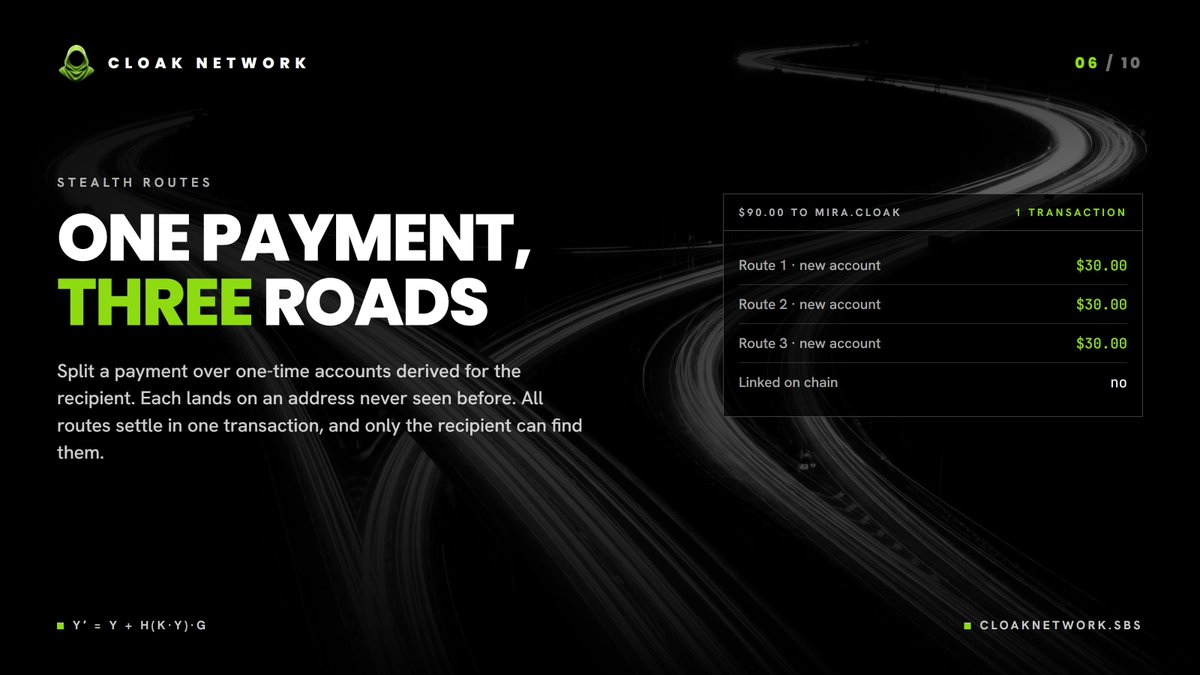
One payment, three roads.
Cloak can split a payment across one-time accounts made for the recipient. Each one lands on an address that has never appeared before.
All routes settle in a single transaction. Only the recipient can find them.
Give your AI agent a wallet and it can spend everything in it.
Give it a Cloak account and it gets a ceiling per request, a cap per day and a list of who it may pay.
The limits are public. What it actually spends stays encrypted. The chain enforces the limits anyway.
Hiding a payment is easy. Proving it's honest while it stays hidden is the hard part.
Every Cloak transfer carries a zero-knowledge proof: same amount on both sides, nothing negative, nothing overspent.
The contract checks it itself. No server, no committee, no trusted setup. Wrong proof, the transaction reverts.
On Cloak, the chain does the math blind.
Your balance is stored as a ciphertext. The contract adds to it and subtracts from it without ever holding a number.
Only your key turns it back into dollars, in your own browser.
On a public chain, your money is a postcard.
Who paid, who got paid, how much, what's left. Anyone can read it. Forever.
That's fine for a few traders. It doesn't work for payroll, for a treasury, or for software that pays on your behalf.
That's the problem Cloak Network was built for.