Want to learn a new skill in 2024?
Make it #SQL!
Oracle Dev Gym has a series of FREE classes to help you do this
Start with Databases for Developers: Foundations
Join at
https://t.co/k8dYUDTwwo
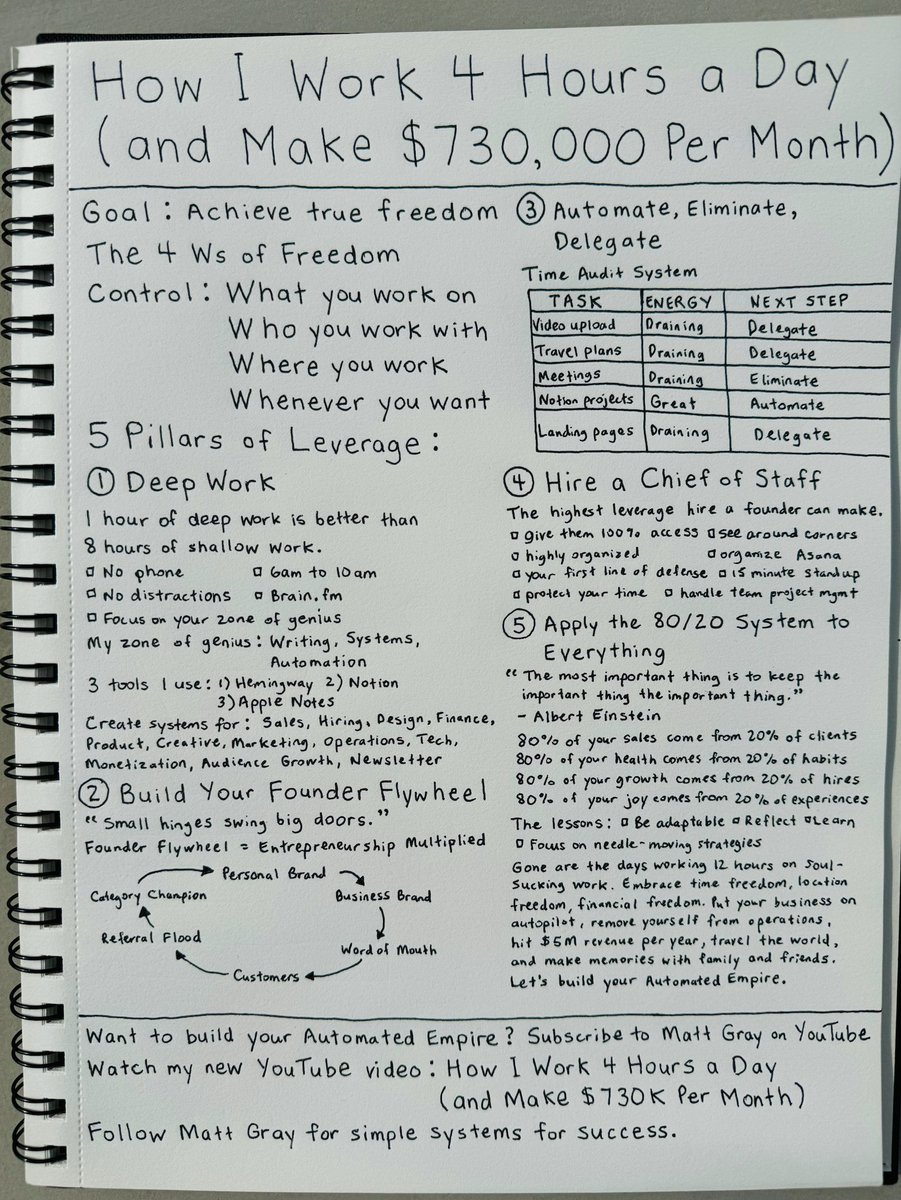
How I work 4 hours a day (and make $730,000 per month):
1. Deep Work
1 hour of deep work is better than 8 hours of shallow work.
Deep work is your time to work in your zone of genius - completely undistracted.
“The ability to perform deep work is becoming increasingly rare at exactly the same time it is becoming increasingly valuable in our economy. As a consequence, the few who cultivate this skill, and then make it the core of their working life, will thrive.”
― Cal Newport
2. Build Your Founder Flywheel
“Small hinges swing big doors.”
— W. Clement Stone
The Founder Flywheel is the self-propelling system I developed to 10x the results of my efforts and rapidly grow my brands.
3. Automate, Eliminate, Delegate
I’ve built an Automated Empire where all aspects of my business run without my involvement.
I travel the world, and in the last year alone have explored Japan, Hawaii, Sedona, Colombia, Dubai, California, and Mexico.
I’m able to live life on my terms and work with people I love, on work that fills my cup, in the most beautiful places in the world.
4. Hire a Chief of Staff
Being a CEO is hard.
You need reinforcements.
The highest leverage hire a founder can make is a Chief of Staff.
My Chief of Staffs are so important in all my businesses that they are literally the first hire I make when starting a new business.
They protect my time, organize my calendar, and remove any tasks that could interrupt my time - which is my most valuable asset.
5. Apply the 80/20 System to Everything
“The important thing is to keep the important thing the important thing.”
— Albert Einstein
• 80% of your sales come from 20% of your clients
• 80% of your health comes down to 20% of your habits
• 80% of your growth comes down to your top 20% of hires
Gone are the days of working 12 hours on soul sucking work.
Embrace time freedom, location freedom, and financial freedom.
You can put your business on autopilot, remove yourself from operations, hit $1M+ revenue a year, travel the world, and make memories with family and friends.
Let’s build your Automated Empire.
Time series analysis has been critical in my career. But it took me 3 years to get comfortable. In 3 minutes, I'll share 3 years of experience in time series:
1. Time Series Analysis: Time series analysis is a statistical technique that deals with time-ordered data points. It's commonly used to analyze and interpret trends, patterns, and relationships within data that is recorded over time (e.g. with timestamps).
2. Uses: Understanding and applying time series analysis concepts is critical for forecasting, detecting anomalies, and drawing insights on data that varies over time.
3. The 3 Core Concepts: There are 3 areas of time series that have been super helpful. Understanding 1. Autocorrelation, 2. Seasonal Decomposition, and 3. Calendar Effects. Let's break them down.
4. Autocorrelation: This refers to the correlation of a time series with its own past and future values. It measures the relationship (correlation) between a variable's current value and its past values.
5. Partial Autocorrelation: Autocorrelation has a problem. Some of the correlation is confounded by earlier lags. Enter Partial Autocorrelation. This removes the correlation effect of earlier lags.
6. Seasonal Decomposition (STL): Seasonal decomposition decomposes a time series into three components: trend, seasonal, and residual (irregular). STL stands for Seasonal-Trend-Loess. It uses a "LOESS" smoother to remove seasonal and trend effects. STL is flexible and can handle any type of seasonality, not just fixed seasonal effects. The residuals can be analyzed for outliers since they have been de-trended and de-seasonalized.
7. Calendar Effects: Calendar effects refer to variations in a time series that can be attributed to the calendar itself. This can include effects due to day of the week, month of the year, or holidays tied to the calendar.
Understanding and applying these concepts allows analysts to better forecast future values, detect anomalies, and draw insights from data that varies over time.
===
There’s a lot more to learning Data Science for Business. I’d like to help.
I put together a free on-demand workshop that covers the 10 skills that helped me make the transition to Data Scientist: https://t.co/LR39RJ5XKB
And if you'd like to speed it up, I have a live workshop where I'll share how to use ChatGPT for Data Science: https://t.co/EaMpKrJiqX
My High-Performance Time Series Course: This is an advanced course that shows you how to use my 2 R packages timetk and modeltime for high-performance forecasting. Not for complete beginners. https://t.co/O40JbCkPh1
If you like this post, please reshare ♻️ it so others can get value.
$LVMH's Q4 earnings report is sending positive shockwaves all over the world today, affecting both luxury and spirits companies.
As per tradition, we have gathered the most important Bernard Arnault quotes from the earnings call 🧵
1. 2023 ended on a high note for LVMH:
If you'd like an essay-formatted version of this thread to read or share, here's a link to it on https://t.co/iSBh8sqXw0, my surveillance-free, ad-free, tracker-free blog:
https://t.co/lpr6m8o9Y3
2/
Learn Machine Learning for FREE from top universities in 2024!
YouTube has many free ML courses, but finding good-quality ones is challenging.
This repo has you covered with all the best courses in ML, Deep Learning and NLP, which are 100% FREE and up to date.
Link 👇🧵
This is going to change Data Analytics!
A Dashboard UI inside the Jupyter Notebook which makes Visualizing Easy!
Using just one line of code and is easy to deploy as well!
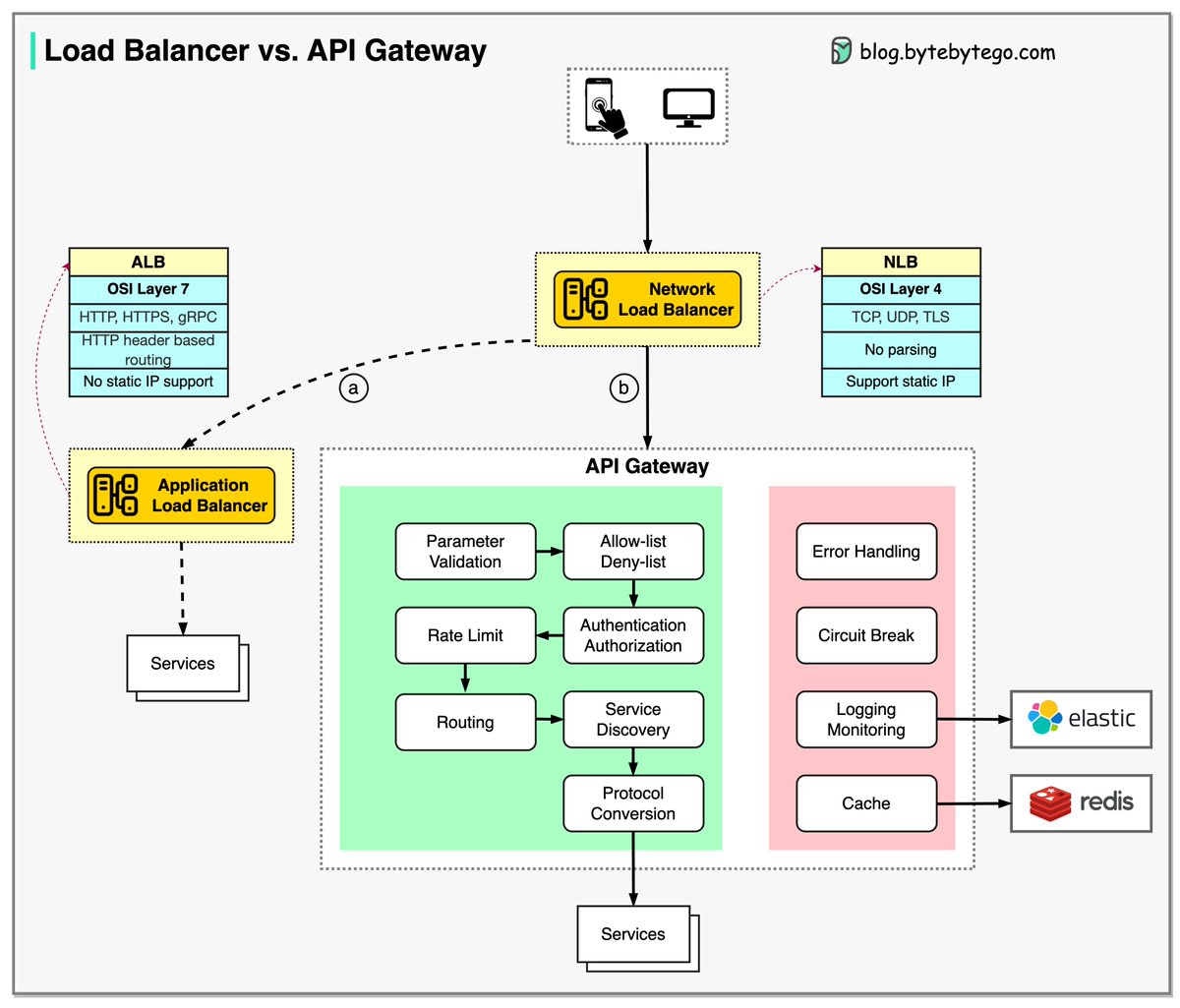
What are the differences between a load balancer and an API gateway?
First, let's clarify some concepts before discussing the differences.
1️. NLB (Network Load Balancer) is usually deployed before the API gateway, handling traffic routing based on IP. It does not parse the HTTP requests.
2️. ALB (Application Load Balancer) routes requests based on HTTP header or URL and thus can provide richer routing rules. We can choose the load balancer based on routing requirements. For simple services with a smaller scale, one load balancer is enough.
3️. The API gateway performs tasks more on the application level. So it has different responsibilities from the load balancer.
The diagram below shows the detail. Often, they are used in combination to provide a scalable and secure architecture for modern web apps.
Option a: ALB is used to distribute requests among different services. Due to the fact that the services implement their own rating limitation, authentication, etc., this approach is more flexible but requires more work at the service level.
Option b: An API gateway takes care of authentication, rate limiting, caching, etc., so there is less work at the service level. However, this option is less flexible compared with the ALB approach.
Over to you: Which one should we use, a load balancer or an API gateway?
--
Subscribe to our weekly newsletter to get a Free System Design PDF (158 pages): https://t.co/FIzCeaWsZV
People are earning in 7-8 Figures from Micro SaaS
But not everyone can do it because they lack Profitable Idea
To help you I created list of Micro SaaS Ideas to help you build 5k/month
Like, Repost & reply "Done" & I'll DM link
(Must be Following so I can DM)
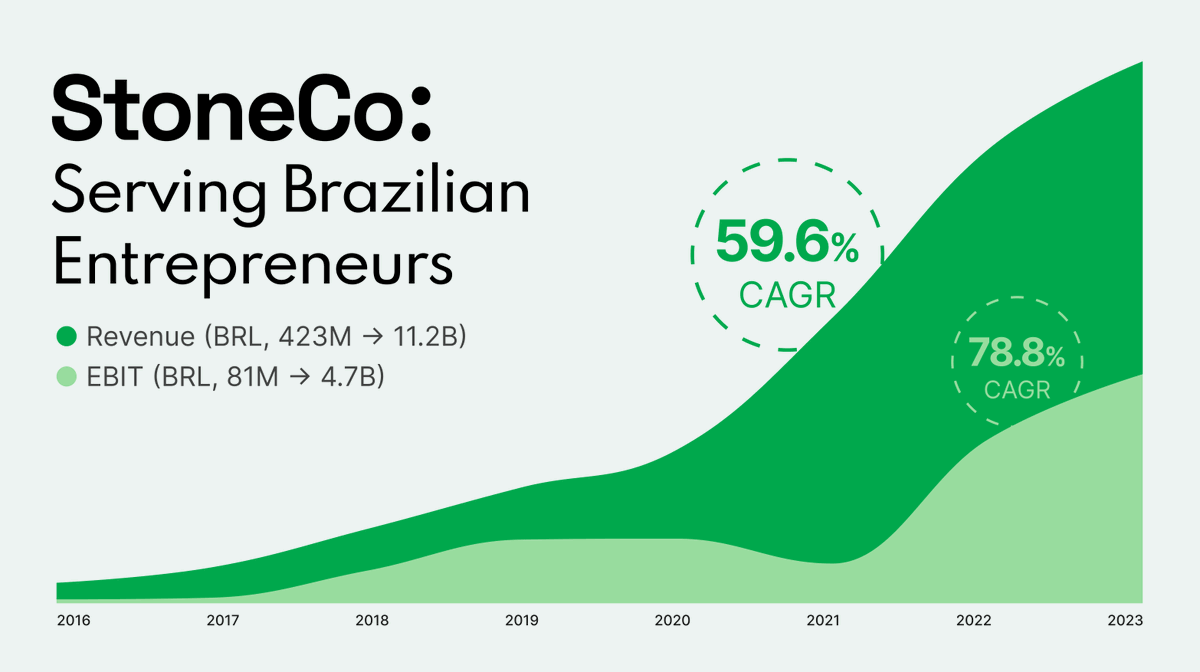
Are you familiar with $STNE? StoneCo is a fast-growing leading ~$5B Brazilian payments solution provider 🇧🇷
With a 7-year revenue CAGR of 60%, $BRK as a large shareholder, and many business similarities to other Latin America success stories such as $MELI and $NU, StoneCo is definitely a company worth having on your radar.
Founding Story
Founded in 2012 by Eduardo Pontes and André Street, StoneCo emerged in response to a significant shift within the Brazilian financial services industry. This shift was initiated in 2010 when the Brazilian Central Bank intervened to dismantle a duopoly in the sector, paving the way for new entrants like StoneCo. This was also the catalyst for Brazil to turn into a major fintech hub.
The founding duo arguably transformed the way businesses in Brazil handle payments, drawing inspiration from Jack Dorsey's Square. Their innovation attracted investors such as Berkshire Hathaway, Jack Ma, and the Walton family, leading them to become billionaires before the age of 40.
What Does StoneCo Offer?
StoneCo offers a comprehensive suite of payments solutions that empower merchants and integrated partners to conduct digital commerce seamlessly across in-store, online, and mobile channels. This includes advanced payment processing solutions, banking services, and credit facilities.
The company's rapid growth can be attributed to its focus on small- and medium-sized businesses (SMBs) in a largely underserved market. Its mission statement, "To Serve Brazilian Entrepreneurs, Transforming Their Dreams into Reality," echoes the ethos of $SHOP's renowned "Arming the Rebels".
Consistent Growth
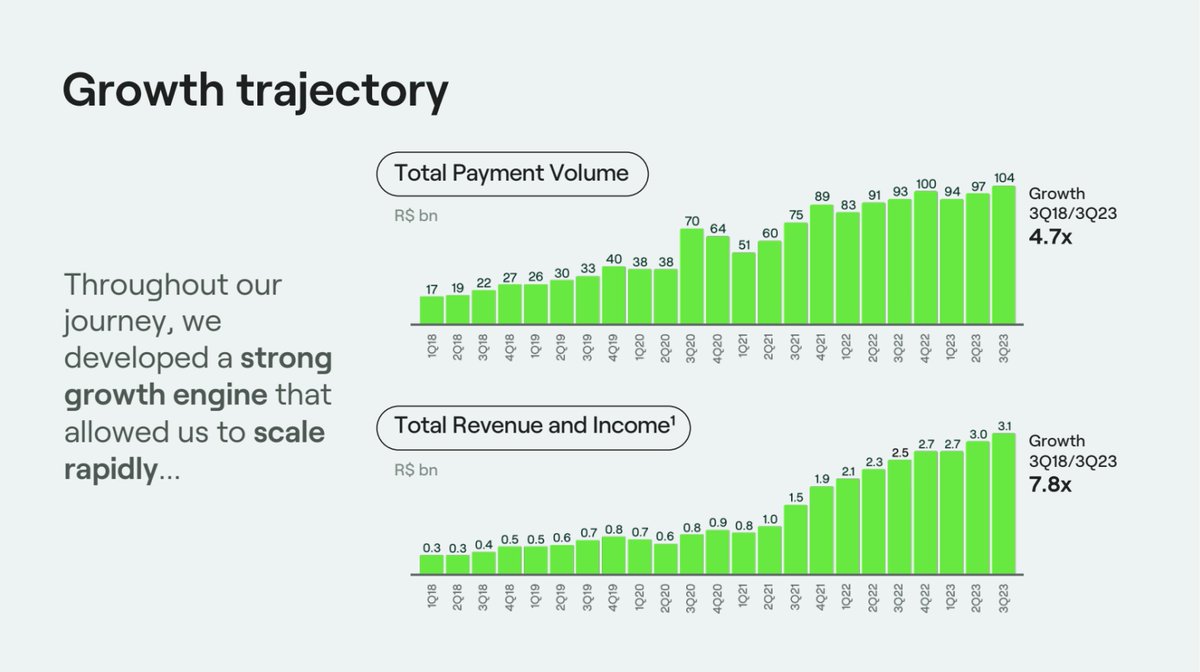
Since its IPO in 2018, StoneCo has grown its revenue by 5.5x and its EBIT by 5x on a trailing twelve-month basis. The stock, though, has interestingly enough been cut in half since its first day of trading.
So, maybe it is time to take a closer look now? To get up to speed with StoneCo, we highly recommend diving into the company's recent comprehensive Investor Day. It is, of course, available on our platform.
Harvard University is offering hands on Machine Learning course for FREE!
In this course, you build a movie recommendation system and learn the science behind data science techniques.
All this is for FREE.
Course link 🧵👇
American compassion has made a comeback.
In 2011, @SaraKonrath and colleagues found that US college student's empathy had dropped from 1979-2009.
The fall was precipitous. In some cases, 2009 students reported being less empathic than 75% of students 30 years before.
2024 will go down as one of the most revolutionary years in history.
It's only been 1 day of CES 2024
And the tech innovations are insane
Here're 10 reveals from CES 2024 that will blow your mind
1. First Transparent MICROLED TV by Samsung