What meaningful communication is there in this slide? Unfortunately, not much at all.
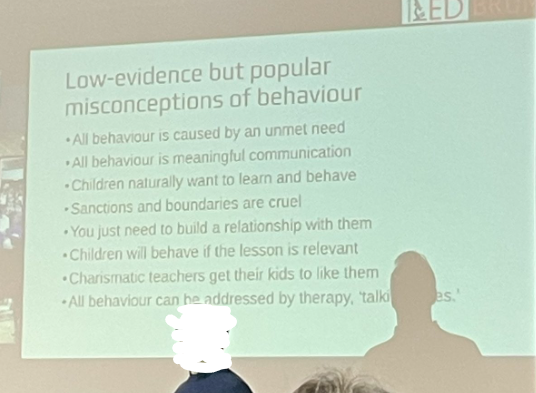
There’s a problem with the assertion that these statements are ‘low evidence misconceptions’ and it’s this. It’s not defined here what ‘behaviour’ means. To a psychologist, behaviour means the way in which a person acts or conducts themselves. All of it. The way we walk, the way we smile, the way that we talk, how we play, what we do with our time – it’s all behaviour. Behaviour is the way in which we interact with the world. It is the result of an interplay between a person and their environment.
I suspect however that on this slide, ‘behaviour’ is a stand in for what Tom sees as ‘unacceptable behaviour’. This is often how the term ‘behaviour’ is used when referring to children. However, even ‘unacceptable behaviour’ is poorly defined. One of the features of high control school environments is that something others might see as just ‘behaviour’ is defined as ‘unacceptable behaviour’. Not tucking your shirt in, for example, or forgetting your ruler. Or childish behaviours such as running instead of walking or talking out of turn.
‘Unacceptable behaviour’ is in the eye of the beholder and context dependent. What is unacceptable in a high control school (talking in the corridors, not tracking the teacher with your eyes) will be completely acceptable in another school. The behaviour is the same, it’s how the adults respond which has changed.
When ‘behaviour’ is so poorly defined, it’s not possible to test hypotheses such as ‘All behaviour is meaningful communication’, or ‘All behaviour is caused by an unmet need’. These are clearly daft when ‘behaviour’ means not tucking your shirt in or being three minutes late for school.
Another possible definition for behaviour which Tom may be using (but hasn’t told us) is ‘not doing what adults say’. This is very far from the way which psychologists would understand ‘behaviour’ and is closer to ‘compliance’. If this is what he means, then again several of his statements are clearly nonsensical. It makes no sense to say ‘all children naturally want to behave’ if by ‘behaviour’ you really mean ‘be compliant. Of course they don’t, and why should they? ‘All non-compliance is meaningful communication’ – that doesn’t make much sense either, since non-compliance can be due to a number of reasons, including forgetfulness or factors beyond a person’s control.
The problem continues as we go down the list. ‘All children will behave if the lesson is relevant’ begs the question of what definition of ‘behaviour’ is being used – and we don’t know, because it hasn’t been defined. Does he mean ‘all children will be compliant’ – in which case, again it’s clearly nonsense. Humans aren’t naturally compliant with high control systems, but that is quite different to ‘behaving’. Or does he mean that they’ll all tuck their shirts in and remember their protactors? Again, the statement is meaningless.
Last point about behaviour and therapy. Many psychologists dislike being referred a ‘badly behaved’ child and being asked to ‘fix them’ with therapy. Particularly when ‘badly behaved’ really means ‘non-compliant’. Sometimes the rules children are being asked to comply with are unreasonable and developmentally inappropriate. No ethical therapist will set out to stop children behaving like children. No therapy will stop children making mistakes or untucking their shirts. Children show their distress through behaviour, yes, but even then therapy might not be appropriate. It might be better to ask why they are distressed and see if that can be changed.
Behaviour is an interaction between a person and their environment. With children, the first step for most psychologists is to look at the systems around them and to ask why the child is behaving the way that they are. This is best practice and evidence-based. That is because we do see a lot of behaviour – defined as the way in which a child acts - as communicating something, and it’s the adult’s job to figure out what. Is this an environment within which they are thriving? If not, how could that change?
If you don’t define what you mean by ‘behaviour’ then a list of statements about behaviour means nothing at all. Of course there is no evidence. It’s not possible to generate any. The statements are untestable, because we don’t have a shared understanding of what they mean.
If you are really interested in looking at the evidence, then you need to start out by defining what exactly you are talking about when you say ‘behaviour’. Otherwise we end up with a list of provocative soundbites with no substance at all.
Good for sharing on Twitter, but ultimately meaningless.
At 16 years old, I had left the care system and was living in a bedsit. I had a single bed, an electric hob, and a second-hand kettle full of limescale. The curtains were hanging off the rail, and the carpet was covered in stains. I had to share a bathroom with 3 other people, grown men, one who had a drug problem and would fall asleep on the toilet covered in his own vomit. Fast forward 30 years, and I'm still seeing young people ( like me) leaving care and being treated like second-class citizens. Many of my friends committed suicide before the age of 21. All abandoned by the system. The mistakes of the past are still happening today. That's why we need to make care experience a protected characteristic. It's not rocket science! We can change the system once and for all and give these young people a voice and the future they deserve. #Thestateofit #changeiscoming
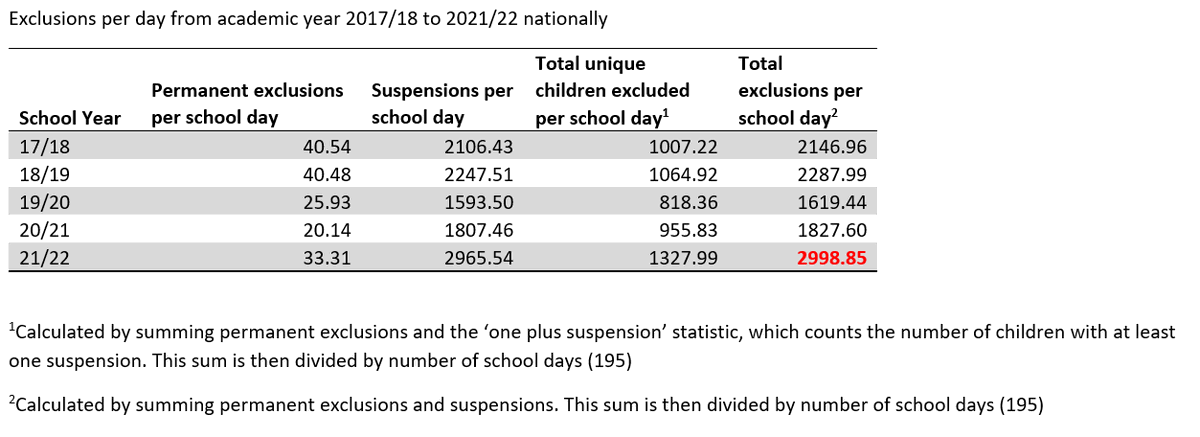
Based on DfE statistics (2022) and 195 school days the project with the pullupachair parents, me and those contributing will be 2,999 squares, crocheted together to make a very large blanket. Thank you to everyone who has shown their support @UoSResearch#crochet
Yesterday’s announcement by this Govt about winter beds was really devious and dishonest.
The message they were sending to the public was ‘we are investing in the NHS to prepare for Winter’
The reality was quite the opposite…
1/7
Punitive responses escalate the distressed behaviour they seek to eliminate. A trauma-informed, relational approach avoids exclusions by creating the psychological safety to return a child to a position of learning @EveningStandard fabulous funding! https://t.co/LmLHk3Wi54
OFSTED IS NOT A FAIR PLAYING FIELD
(A FOOTBALL ANALOGY)
A school receiving an Outstanding Judgement in an affluent area is a very different prospect and achievement to a school with very high deprivation (statistically 4x less likely).
Just like, if Man City wins the FA Cup, few people are surprised but, if my beloved Hartlepool Utd win it, the world goes crazy, we have the biggest party of our lives and Netflix probably does a documentary about it.
So, it got me thinking about various teams winning the FA Cup.....
What about the part-timers (the small school club) where the manager is also the kit man, the water boy and drives the team coach?
What about the disadvantaged club, whose players have disproportionately higher mental health issues, have lived in poverty from birth & their health is (statistically) much worse than their more affluent peers?
What about the inadequate club who nobody wants to play for, whose coaching staff are broken, who struggle with retention issues and whose morale has been zapped by a poor judgment?
What about the insolvent club (deficit budgets due to lack of funding) who can't afford to employ the back-office staff or the equipment essential to keep the club running?
What about the inclusive club who let anyone and everyone play, a broad and welcoming church, who work day and night to make sure that their players enjoy school, are well-looked after and thrive?
What about the team that gets knocked out in the semi-finals because of a bad refereeing decision that the whole world could see but VAR wasn't allowed because the referee is always right (no independent complaints process).
What about the primary team taking on the secondary team (same framework for both - different game)?
What about the team full of players who need the game adapting or additional support (no PRU or special school places) so they keep playing, risking their own mental health and development?
What about the low attendance team who, no matter what they try, can't get their players to turn up for training or who check in late to games?
What about the fact that you've trained for months and years, you've made it to the final, but you don't know when it will be and then you only get 24 hours notice before kick off?
Amazing things are happening in football, from the grassroots through to the Premier League. Just like amazing things are happening in every school, despite their own unique challenges.
It wouldn't be fair to judge all clubs by the same criteria, so why use crude, nuance-lacking, high-stakes judgements for our schools?
"They're not asylum shoppers they're asylum seekers... That's not true."
@krishgm challenges immigration minister Robert Jenrick after he claims "asylum shoppers" should seek sanctuary in the first safe country they reach under the "Refugee Convention".
Suella Braverman keeps repeating that the Rwanda scheme etc is the “will of the British people”
If, like me, you’re British, & this is not your “will” let her know by retweeting this please.
We deserve to be heard
#RwandaNotInMyName@SuellaBraverman
Trust. An underestimated word creating powerful feelings of safety, really being heard and appreciated for who you are, regardless of difference. #FlipTheNarrative 💜
Every child should live in a home with proper care and supervision.
Yet new regulations legitimise those in care aged over 15 being placed in unsafe and unsupervised accommodation such as caravan parks.
The Govt are putting these children at risk of serious harm. @article_39
Today, Rishi Sunak is focusing on how we can get more teenagers to study maths for longer.
Meanwhile:
780,000 children have been referred for mental health support. 250,000 of them have been refused.
22% of school pupils are "persistent absentees".
There's the maths crisis.
If you know people not in education who don't know what the problem is with Ofsted inspections but are open to reading something, I'm told this is handy: https://t.co/NUt6EtMHk1
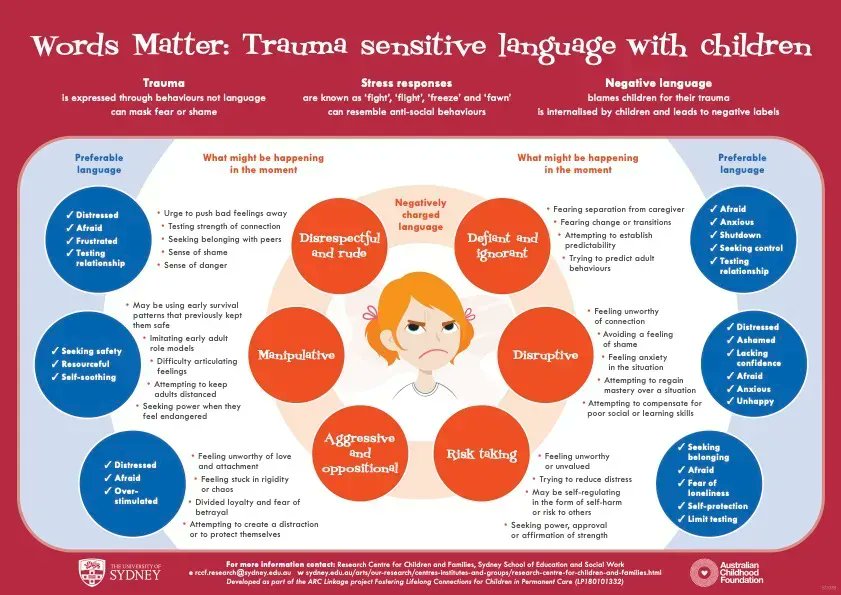
Thinking about children & their behaviour how often are they reacting to our words & language. That's not to parent blame but we need to be the ones bringing solutions and creating systems around our children that are compassionate & empathic to their needs #CCVAB#CPV#APVA#NVR