🚨 WARNING: DO NOT READ IF YOU RUN A YOUTH BASEBALL PROGRAM! ⚾
What if we stopped building youth baseball around games and started building it around DEVELOPMENT?
Somewhere along the way, we’ve prioritized winning games over developing athletes. More tournaments, more games, more competition — but are we actually building better baseball players?
What if we flipped the model?
⚾ Tee Ball / Coach Pitch: 75% Development | 25% Competition
⚾ 46’/60’ Kid Pitch: 75% Development | 25% Competition
⚾ 50’/70’ Intermediate: 67% Development | 33% Competition
⚾ 60’/90’ Big Field: 50% Development | 50% Competition
🎯 FOR WHAT IT’S WORTH…
I’m not suggesting we eliminate competition. I’m suggesting we prioritize developing fundamentals, athleticism, movement efficiency, and healthy habits BEFORE increasing the emphasis on winning.
Our goal shouldn’t be to build the best 10-year-old baseball team. It should be to develop athletes who still love the game and are prepared to succeed at 15, 18, and beyond.
💭 Coaches and parents: Would you support playing fewer games if it meant developing better athletes?
TRAIN TO DEVELOP | PLAN TO ATTACK
#ForWhatItsWorthWednesday #YouthBaseball #PlayerDevelopment #BaseballCoaching #CompleteAthleteDevelopment
@coachballgame Thoughts?
Our league does a good job communicating via email, text, SportsEngine and Facebook. Practice is usually only cancelled due to weather.
We try to make sure each team has enough coaches to be able to always hold practice, or at the very least, move that team to another field with another coach/team.
Most of our age groups have dedicated days so all teams in an age group play or practice on the same day at the same complex (2-3 fields and 4 batting cages available side by side)
⚾ FRIDAY’S FINDINGS | 90 Minutes of Practice… But How Much Actual Practice?
🚨 Here’s a statistic every youth baseball coach and parent should think about.
A study of 200 youth athletes, ages 7–14, found that just 46.1% of practice time was spent in moderate-to-vigorous physical activity. Baseball/softball players were even less active than soccer players.
That’s approximately 41 minutes of a 90-minute practice!
Now, physical activity isn’t the same as skill development, but it raises an important question:
How much time are our kids actually learning, moving, and getting meaningful repetitions?
❌ Long lines, standing around, waiting for turns.
✅ Small groups, rotating stations, purposeful repetitions, and constant engagement.
USA Baseball also recommends dedicating at least 75% of organized baseball time to practice rather than games for athletes 12 and younger.
🎯 THE TAKEAWAY
More practice time doesn’t automatically mean more development.
Don’t just count practice minutes. COUNT MEANINGFUL REPS.
💭 Coaches: If you tracked every athlete’s meaningful repetitions during your next practice, would you be happy with the results?
TRAIN TO DEVELOP | PLAN TO ATTACK
📚 Sources: Journal of Physical Activity and Health (2011); USA Baseball Youth Baseball Manual.
#FridaysFindings #YouthBaseball #PlayerDevelopment #BaseballCoaching #CompleteAthleteDevelopment
This idea is geared more towards your local recreational leagues like @calripkenbb, @wcbaberuth and @LittleLeague where the league hosts its own practices and internal schedules. So there aren’t likely to be tournaments.
Personally, I don’t believe travel ball should even start until kids have been pitching for at least a full season. I don’t see the benefit in coach pitch travel ball (harder ground balls hit at you maybe?)
Once you get into travel ball, the expectations should be set at the onset of the creation of the team or at the beginning of the season.
If parents aren’t satisfied with the approach, they’re typically the team-hoppers that are always looking for the “top” team for their kids to be on (which usually translates to finding teams that win meaningless weekend rings)
⚾ TECHNICAL TUESDAY | Passive Arm vs. Active Arm
Throw harder doesn’t always mean throw better.
One of the biggest misconceptions in pitching is that the arm needs to actively create velocity.
In an efficient delivery, the body generates momentum through coordinated movement of the lower half, pelvis, and trunk. The throwing arm should be relaxed, properly timed, and positioned to take advantage of that momentum.
✅ PASSIVE ARM
• Relaxed without being lazy
• Moves naturally with the delivery
• Allows effective sequencing and energy transfer
• Avoids unnecessary muscular tension
❌ ACTIVE ARM
• Tries to muscle the ball
• Forces acceleration prematurely
• Can disrupt timing and sequencing
• May increase unnecessary stress on the arm
🎯 THE KEY DISTINCTION
Passive doesn’t mean the arm muscles aren’t working. They absolutely are.
It means we aren’t asking the arm to manufacture velocity independently of the rest of the body.
At CAD, we focus on developing the movement, strength, and coordination that allow athletes to throw harder without simply trying to throw harder.
Let the body drive the delivery. Let the arm come through naturally.
TRAIN TO DEVELOP | PLAN TO ATTACK
#TechnicalTuesday #PitchingMechanics #PitchingDevelopment #BaseballTraining #CompleteAthleteDevelopment
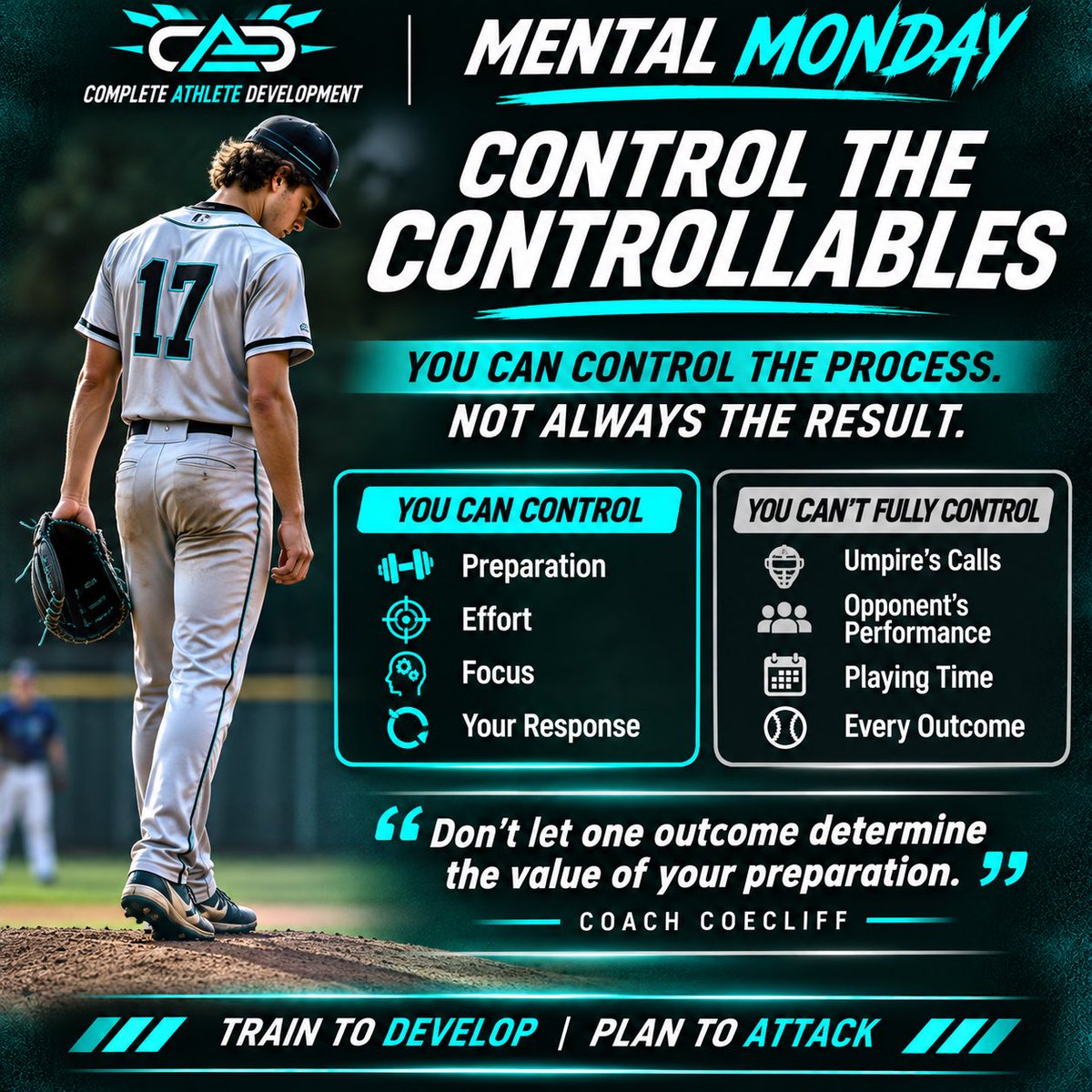
🧠 MENTAL MONDAY | Control the Controllables
You can throw a great pitch and give up a hit.
You can square up a baseball and make an out.
You can work harder than ever and still not get the opportunity you hoped for.
Doing everything right doesn’t guarantee the result you want.
That’s one of the toughest lessons in sports.
But here’s what separates athletes who continue developing from those who get discouraged:
🎯 PREPARATION — Did you put in the work?
💪 EFFORT — Did you compete with intention?
🧠 FOCUS — Were you present in the moment?
🔄 RESPONSE — How did you handle adversity?
A COACH’S PERSPECTIVE
“Don’t let one outcome determine the value of your preparation.” — Coach Coecliff
Results matter. But individual outcomes don’t always tell the whole story.
Evaluate your process, learn from the result, and focus on what you can influence next.
You can’t control every outcome. You can control how you prepare and how you respond.
💭 Athletes: Are you measuring your progress by your results alone, or by the habits you’re building?
TRAIN TO DEVELOP | PLAN TO ATTACK
#MentalMonday #BaseballMindset #MentalPerformance #PlayerDevelopment #CompleteAthleteDevelopment
⚾ SPOTLIGHT SUNDAY | Zack Guttormsen
🎓 Allentown HS | Class of 2027
📏 6’1” | 190 lbs | 1B / OF / RHP
💥 100 MPH Max Exit Velocity
⚾ 92 MPH Front-Toss Exit Velocity
🔥 82 MPH Fastball
🏃 7.4 Second 60-Yard Dash
Zack brings a strong physical presence and versatility to the field. A multisport athlete who also plays hockey, Zack is a great teammate known for his positive attitude and willingness to learn.
Keep up the great work, Zack! 💪⚾
TRAIN TO DEVELOP | PLAN TO ATTACK
#SpotlightSunday #AllentownBaseball #ClassOf2027 #BaseballDevelopment #CompleteAthleteDevelopment
🎥 FILM STUDY SATURDAY | Different Doesn’t Mean Wrong
⚾ Two unique pitchers. Two very different deliveries.
Watch the side-by-side of Japanese All-Star Rei Takahashi and two-time Cy Young Award winner Tim Lincecum.
Different arm slots. Different movement patterns. Different approaches to generating and transferring force.
Yet both found success at the professional level.
There’s no single blueprint for an effective pitching delivery.
🎯 A COACH’S PERSPECTIVE
Too often, young pitchers are taught to imitate professional athletes without considering their own strength, mobility, coordination, and physical capabilities.
Our job as coaches isn’t to make every athlete move the same way.
It’s to understand how each athlete moves and help them become the best version of themselves.
Different doesn’t automatically mean better—or worse. Mechanics should be evaluated around the individual athlete, not a universal model.
💭 Are we developing pitchers or teaching everyone to look the same?
TRAIN TO DEVELOP | PLAN TO ATTACK
#FilmStudySaturday #PitchingMechanics #PitchingDevelopment #BaseballTraining #CompleteAthleteDevelopment
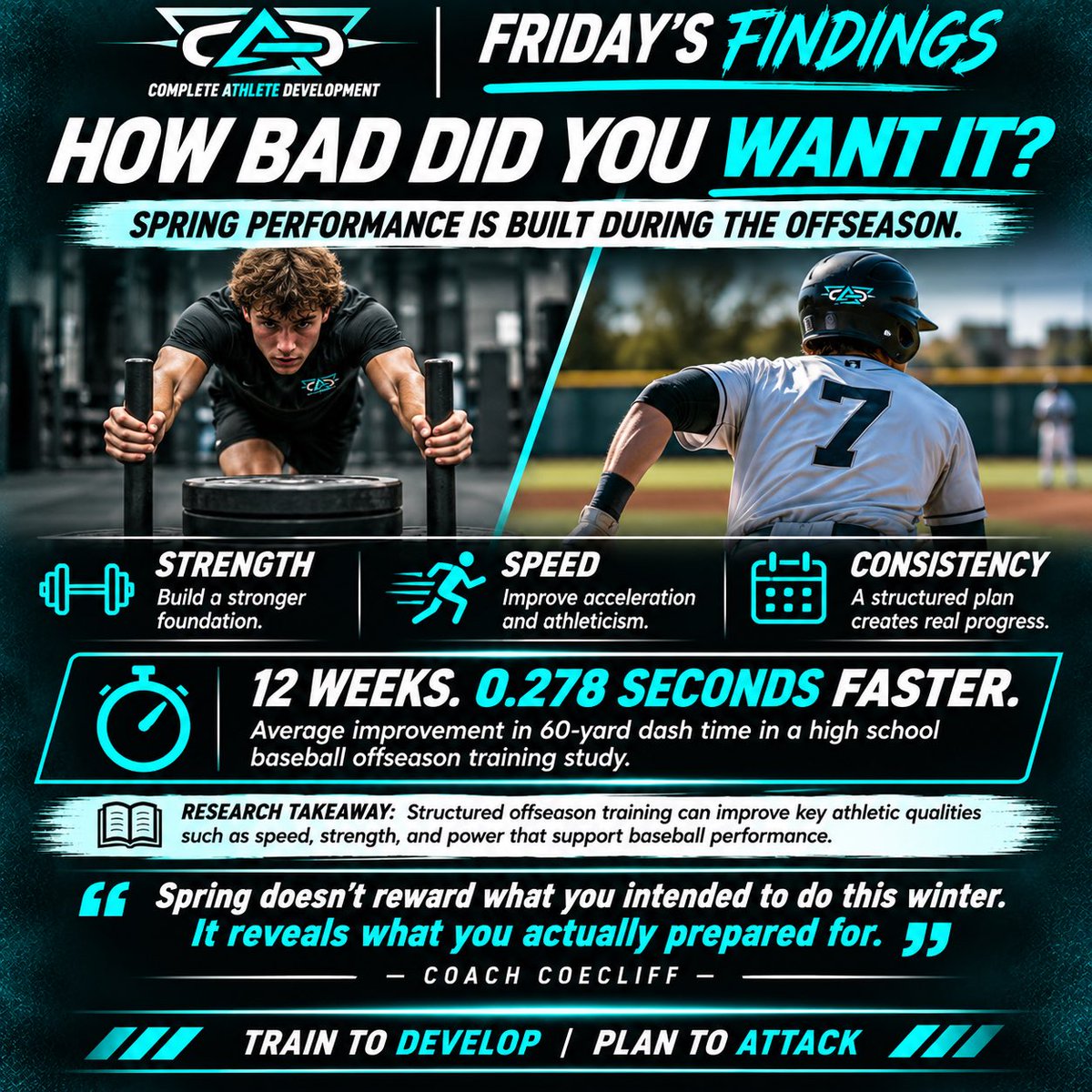
⚾ FRIDAY’S FINDINGS | How Bad Did You Want It?
Spring performance is built during the offseason.
📊 A study of high school baseball players found that a 12-week offseason strength program improved 60-yard dash times by an average of 0.278 seconds.
Doesn’t sound like much? Think again.
Remember the college recruiting benchmarks we shared?
🏆 D1: 6.6–6.9 seconds
⚾ D2: 6.8–7.1 seconds
⚾ D3: 7.0–7.4 seconds
These are illustrative recruiting guidelines, not official NCAA requirements.
Now consider an athlete running a 7.15-second 60.
Improve by 0.278 seconds, and suddenly they’re running 6.87 seconds—moving from a typical D3 range into the overlapping D1/D2 benchmark ranges!
Does that guarantee a D1 opportunity? Absolutely not.
But it demonstrates how meaningful a few months of intentional development can be.
💪 STRENGTH — Build the foundation.
⚡ SPEED — Develop athleticism.
📈 CONSISTENCY — Make progress measurable.
A COACH’S PERSPECTIVE
“Spring doesn’t reward what you intended to do this winter. It reveals what you actually prepared for.” — Coach Coecliff
The offseason isn’t about doing more just to say you worked hard. It’s about identifying what you need to improve and following a plan to get there.
You can’t guarantee spring success. But you can control how prepared you are when spring arrives.
💭 Athletes: When spring arrives, will your preparation reflect your goals?
📣 CAD assessments are now booking for November! DM to learn how we can identify your athlete’s development priorities.
TRAIN TO DEVELOP | PLAN TO ATTACK
#FridaysFindings #BaseballTraining #BaseballRecruiting #AthleteDevelopment #CompleteAthleteDevelopment
⚾ THINK ABOUT IT THURSDAY | Are We Developing Velocity or Developing Pitchers?
📈 You get what you train for. But are you developing what it takes to sustain it?
Train specifically to increase your bench press 1RM, and you’ll likely improve that number. But does that mean every supporting muscle and joint is prepared for the increased load?
Now apply that thinking to pitching.
Just because an athlete CAN throw harder doesn’t mean their body is PREPARED to handle it.
Research has linked higher throwing velocity with greater elbow and shoulder loading.
Velocity matters. But so do:
💪 Strength — Producing and controlling force
🔄 Mobility — Moving through the delivery effectively
⚖️ Stability — Controlling movement and transferring force
📊 Workload & Recovery — Managing the demands of throwing
A COACH’S PERSPECTIVE
I’m not against velocity development. I’m against chasing a number without understanding the athlete behind it.
Velocity is one measure of progress, not the definition of development.
💭 If we measure how hard an athlete throws, shouldn’t we also measure how prepared their body is to throw that hard?
📣 CAD ASSESSMENTS BEGIN IN NOVEMBER!
Assess your athlete’s shoulder strength, movement capabilities, and pitching biomechanics.
🎯 Book your child’s assessment today! DM for details.
TRAIN TO DEVELOP | PLAN TO ATTACK
#PitchingDevelopment #YouthBaseball #BaseballTraining #ArmCare #CompleteAthleteDevelopment
Precisely! Example from my first season as a hs pitching coach. I said we will do 20 min runs post throwing and one of my seniors said, “why?”
My instinct was to say, because that’s what pitchers do to recover.
His response changed my perception. He says, “What if we do tempo runs, they promote better recovery.”
I said, “Let me do some research on that and get back to you.”
Sure enough, he was right and so we changed our approach.
Not only did they recover well, but they responded to me even better. They trusted that I would hear them out and it’s true. You won’t always know everything!
⚾ FOR WHAT IT’S WORTH WEDNESDAY | A Coach’s Perspective
Are we confusing obedience with coachability?
I recently came across an interesting perspective from University of Oklahoma baseball coach Todd Butler that made me think about how we define a coachable athlete.
As coaches, we often praise players who listen, immediately make adjustments, and do exactly what they’re told.
But is that always coachability? Or are we sometimes simply rewarding obedience?
Listening to feedback doesn’t mean you have to automatically agree with it.
A truly coachable athlete should be willing to:
✅ LISTEN — Be open to feedback and different perspectives.
✅ PROCESS — Think critically, ask questions, and understand the reasoning behind the instruction.
✅ ADJUST — Apply what makes sense, evaluate the results, and continue learning.
There’s a difference between an athlete who rejects feedback because of ego and one who respectfully questions it because they want to understand.
And as coaches, we need to recognize that difference.
A COACH’S PERSPECTIVE
“Help athletes become the best version of themselves, not the best version of yourself.” — Coach Coecliff
Every athlete brings different strengths, limitations, personalities, and experiences to the field.
Our responsibility isn’t to mold every player into the athlete we were, or the athlete we think they should be.
It’s to understand what makes each player unique and help them maximize their individual potential.
Sometimes that requires challenging an athlete’s thinking.
Other times, it requires being willing to challenge our own.
For what it’s worth, great coaching shouldn’t create athletes who need us to provide every answer.
It should develop athletes who can eventually think, evaluate, adjust, and take ownership of their own development.
💭 Coaches and athletes: Where do you draw the line between being coachable and simply being obedient?
TRAIN TO DEVELOP | PLAN TO ATTACK
#CoachingPhilosophy #BaseballCoaching #PlayerDevelopment #YouthBaseball #CompleteAthleteDevelopment
⚾ TECHNICAL TUESDAY | The Lead Leg Block
It’s not about locking the knee. It’s about controlling the movement.
Watch elite pitchers and you’ll often notice how effectively they stabilize their lead leg as they rotate toward ball release.
But here’s something important for developing pitchers to understand:
A firm front leg doesn’t necessarily mean a locked front knee.
The lead leg plays an important role in transferring momentum through the pitching delivery, but effective movement involves more than simply straightening the leg.
🎯 THREE KEY FOCUS AREAS:
🔹 TIMING — When does the lead leg begin to stabilize relative to pelvis and trunk rotation?
🔹 STRENGTH — Does the athlete have the physical capacity to control the forces involved?
🔹 COORDINATION — How effectively does the lead leg work with the rest of the kinetic chain?
📊 WHAT DOES THE RESEARCH SAY?
A 2024 study comparing high school and professional pitchers found that greater lead knee extension was associated with higher ball velocity in both groups.
However, among high school pitchers, greater extension was also associated with increased elbow varus torque.
That distinction matters. More extension doesn’t automatically mean better mechanics for every athlete.
💭 A COACH’S PERSPECTIVE
“Don’t chase the position. Develop the movement that produces it.” — Coach Coecliff
Too often, we see young pitchers trying to imitate the positions of professional athletes without developing the physical capabilities necessary to achieve and control those movements.
At Complete Athlete Development, we believe mechanics should be developed around the individual athlete’s strength, mobility, coordination, and movement capabilities.
Assess the athlete. Understand the movement. Develop the solution.
📚 Research: Dowling et al. (2024), Influence of Lead Knee Extension on Ball Velocity and Elbow Varus Torque.
💬 Coaches and pitchers: Are you teaching the lead leg block as a position to achieve or a movement to develop?
TRAIN TO DEVELOP | PLAN TO ATTACK
#PitchingMechanics #BaseballBiomechanics #PitchingDevelopment #BaseballTraining #CompleteAthleteDevelopment
🧠 MENTAL MONDAY | Confidence Is Built, Not Given
Every athlete wants to feel confident when they step onto the field.
But here’s something I want young athletes to understand:
Confidence isn’t something you wait for. It’s something you build.
It doesn’t come from hoping you’ll succeed. It comes from trusting the work you’ve put in to prepare yourself.
🎯 PREPARATION — Consistent, intentional work that gives you something to believe in.
🔁 REPETITION — Building trust in your abilities through practice and experience.
📈 ADAPTATION — Learning from both success and failure, making adjustments, and continuing to improve.
A COACH’S PERSPECTIVE
“Confidence isn’t believing you’ll never fail. It’s trusting yourself to respond when you do.” — Coach Coecliff
The best athletes aren’t confident because everything always goes their way.
They’re confident because they’ve prepared for the moments when things don’t.
A pitcher gives up a home run. A hitter strikes out with runners in scoring position. A fielder makes an error.
What happens next?
That’s where confidence matters most.
You can’t always control the outcome. But you can control the preparation that gives you confidence to compete.
💭 Athletes: Are you building confidence through your daily habits, or waiting for success to give it to you?
TRAIN TO DEVELOP | PLAN TO ATTACK
#BaseballMindset #MentalPerformance #YouthBaseball #PlayerDevelopment #CompleteAthleteDevelopment
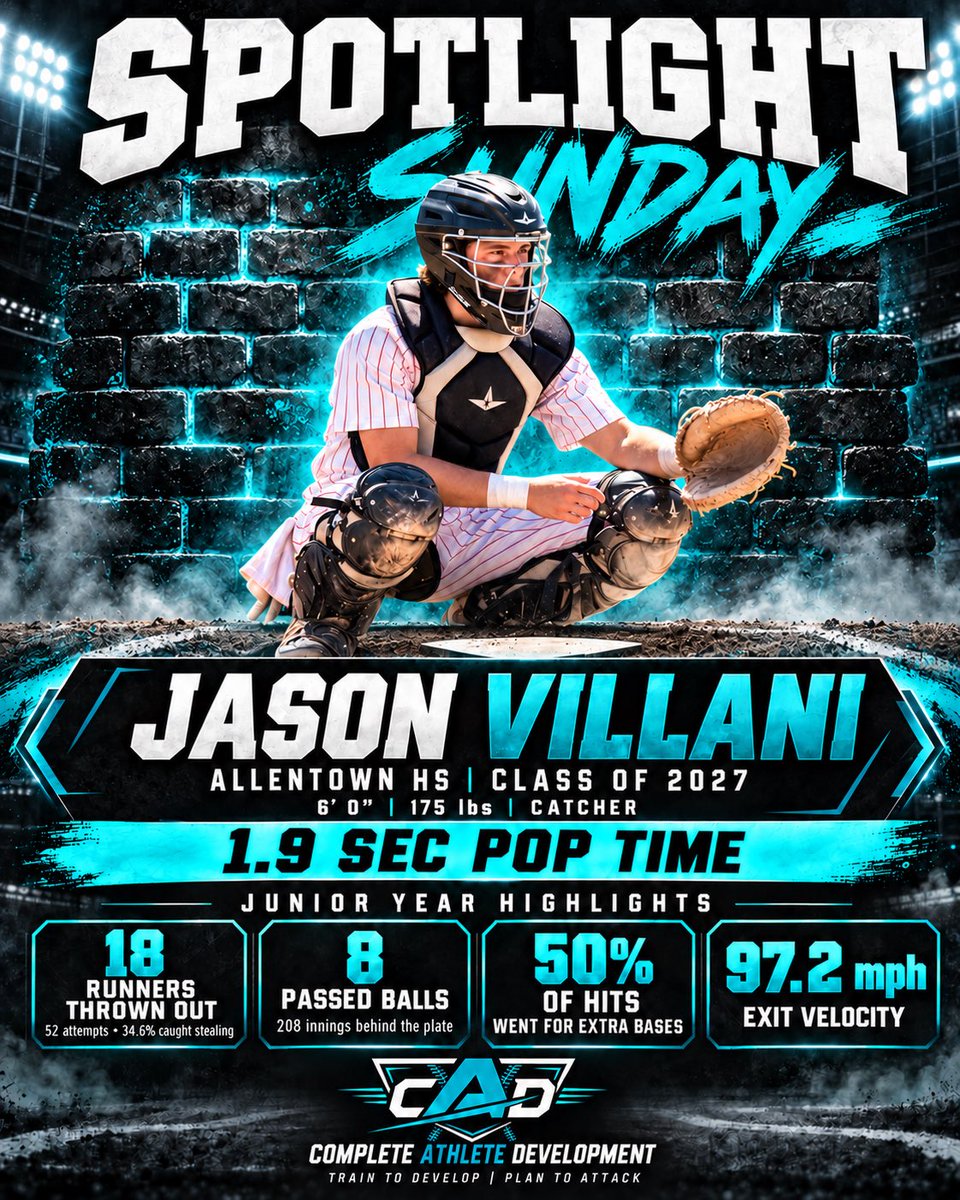
🌟 SPOTLIGHT SUNDAY 🌟
Jason Villani | Allentown HS | Class of 2027
6’ 0” | 175 lbs | Catcher
🧱 A BRICK WALL BEHIND THE PLATE.
Jason’s junior season featured:
🎯 18 runners thrown out in 52 attempts — 34.6% caught stealing
🧤 Only 8 passed balls across 208 innings behind the plate
⚡ 1.9-second pop time
And his impact extends to the batter’s box:
💥 97.2 mph exit velocity
🔥 Half of his hits went for extra bases
Controlling the running game and delivering extra-base impact—a season worth celebrating!
Show Jason some support! 👏
Who should we spotlight next? Tag a local athlete below! 👇
Train to Develop | Plan to Attack
#SpotlightSunday #CompleteAthleteDevelopment #AllentownBaseball #NJBaseball #Baseball
⚾ FILM STUDY SATURDAY | Jacob Misiorowski
�� Explosive Velocity. Controlled Movement. Efficient Sequencing.
World Series pitcher Jacob Misiorowski provides a great example of how athleticism, timing, and movement sequencing come together in a high-velocity delivery.
Watch the progression of his mechanics:
🔹 Tall & Stacked — Establishes posture and balance before initiating movement.
🔹 Controlled Drift — Begins moving down the mound while maintaining stability.
🔹 Closed Hips & Deep Drop — Creates space and positions his body to generate momentum toward home plate.
🔹 Chest Downhill — Uses forward momentum as his delivery transitions toward rotation.
🔹 Eyes Level at Release — Maintains visual orientation toward his target.
🔹 Lead Leg Block — Establishes a firm front side to help transfer momentum through rotation and release.
🎯 A COACH’S PERSPECTIVE
What makes Misiorowski interesting isn’t just his velocity. It’s how his athletic movements work together to produce it.
Young pitchers often try to replicate the positions they see from elite professionals without understanding the movements connecting them.
The lesson isn’t to pitch like Jacob Misiorowski. It’s to understand how Jacob Misiorowski pitches.
Every athlete has different physical capabilities, mobility, strength, and movement patterns.
Our job as coaches is to identify what works for each athlete and develop a delivery that maximizes their individual potential.
💭 What stands out most to you about Misiorowski’s delivery?
TRAIN TO DEVELOP | PLAN TO ATTACK
#Baseball #PitchingMechanics #PitchingDevelopment #BaseballTraining #CompleteAthleteDevelopment
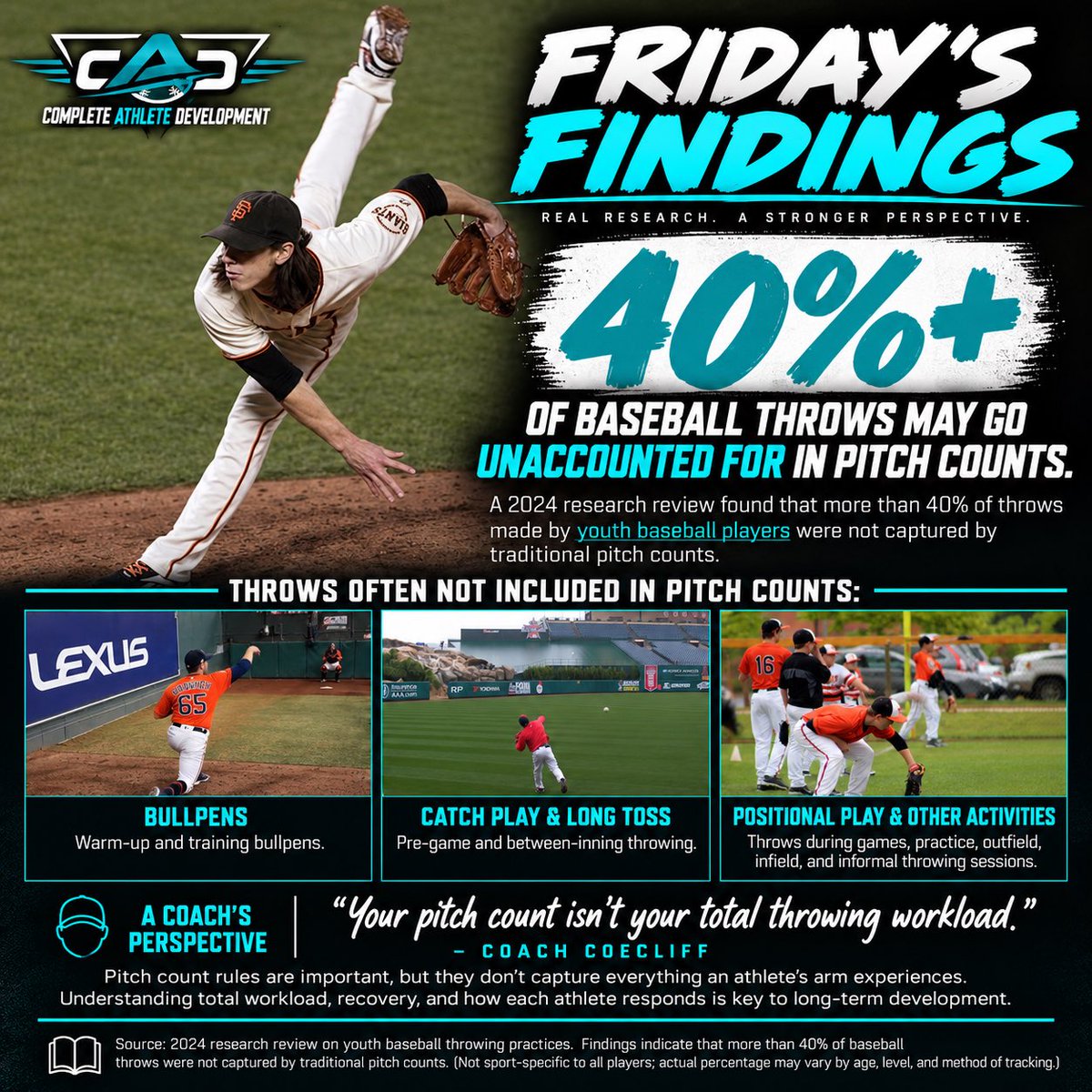
⚾ FRIDAY’S FINDINGS | The Hidden Throwing Workload
📊 40%+ of baseball throws may go unaccounted for in traditional pitch counts.
A 2024 research review highlighted findings suggesting that more than 40% of throws made by youth baseball players weren’t captured by traditional pitch counts.
Think about that.
We track pitches thrown during games, but what about everything else?
⚾ Bullpen sessions
⚾ Catch play and long toss
⚾ Positional throwing during practices and games
⚾ Pre-game and between-inning warmups
All of those throws contribute to an athlete’s total workload.
A COACH’S PERSPECTIVE
“Your pitch count isn’t your total throwing workload.” — Coach Coecliff
Pitch count regulations are important, but they only tell part of the story.
Two pitchers can finish a game with the same pitch count while experiencing very different total throwing workloads.
At Complete Athlete Development, we believe understanding an athlete’s workload, recovery, physical capacity, and individual response is essential to building a responsible development plan.
The goal isn’t simply to throw less. It’s to understand how much you’re throwing, why you’re throwing, and how your body responds.
💭 Coaches and parents: Are we doing enough to account for the throws that happen outside of games?
📚 Research note: The 40%+ figure comes from findings discussed in a 2024 review of youth baseball throwing practices. It is not a universal estimate for every athlete or program.
#FridaysFindings #CompleteAthleteDevelopment #PitchingDevelopment #ArmCare #YouthBaseball #PitchingHealth #BaseballResearch #PlayerDevelopment
⚾ THINK ABOUT IT THURSDAY
📊 Do measurables identify talent—or sometimes overlook it?
88–92 MPH fastball.
6.6–6.9 second 60-yard dash.
92–96 MPH exit velocity.
These are examples of commonly referenced Division I recruiting benchmarks. Similar guidelines exist for Division II and III programs.
But here’s something worth thinking about…
How many fundamentally sound baseball players are overlooked because they don’t meet a certain measurable?
And how many athletes with impressive measurables struggle to translate those tools into actual game performance?
Velocity matters. Speed matters. Exit velocity matters. They help coaches evaluate athletic ability and project future potential.
But so do command, consistency, baseball IQ, competitiveness, character, and the ability to perform when it matters.
Measurables tell us what an athlete CAN do. Game performance helps tell us what an athlete DOES do.
The challenge is evaluating both.
💭 What do you think? Are college programs putting too much emphasis on measurable tools, or are those numbers essential to identifying future potential?
Note: The ranges shown are illustrative recruiting guidelines, not official NCAA averages or minimum requirements. Actual expectations vary by program and position.
#ThinkAboutItThursday #CompleteAthleteDevelopment #CollegeBaseballRecruiting #BaseballDevelopment #PlayerDevelopment