“In 19 years Tim was never once late to a practice, team meal, workout, meeting, or bus. That’s a standard of discipline and reliability you tend to take for granted” - Gregg Popovich
Some Toronto condos are now selling for less than they did in 2017.
Nearly a decade of gains wiped out.
The biggest pain? Small 500–600 sq. ft. investor-style units that were once considered can't-miss investments.
Turns out location isn't everything. Layout, size and demand matter too.
In the 1990s, Canadian ecologist Suzanne Simard made a groundbreaking discovery that challenged everything we thought we knew about how forests work. While studying managed forests in British Columbia, she noticed something puzzling: when birch trees were removed to promote the growth of valuable Douglas firs, the firs did not flourish as expected, they actually struggled and grew more slowly.
Determined to understand why, Simard traced the movement of nutrients using radioactive carbon isotopes. What she found was astonishing. Trees were actively sharing resources through vast underground fungal networks known as mycorrhizae. These delicate, thread-like fungi connect the roots of different trees across the forest floor, forming a complex web that allows the exchange of carbon, water, nutrients, and even chemical signals, sometimes between entirely different species.
She discovered that older, larger trees often serve as central "hubs" or "mother trees," supporting younger saplings by redistributing vital resources and helping the entire ecosystem remain resilient. When these key trees are removed, the underground network weakens, and the health of the remaining forest declines.
Simard’s research overturned the traditional Darwinian view of forests as battlegrounds of ruthless competition. Instead, she revealed a far more sophisticated reality: forests operate as highly cooperative systems where trees communicate, support one another, and even warn neighboring trees about threats like drought, disease, or insect attacks.
What appears to the human eye as a silent, still forest is, in truth, a vibrant, interconnected living network, built not on isolation and rivalry, but on deep connection and mutual aid.
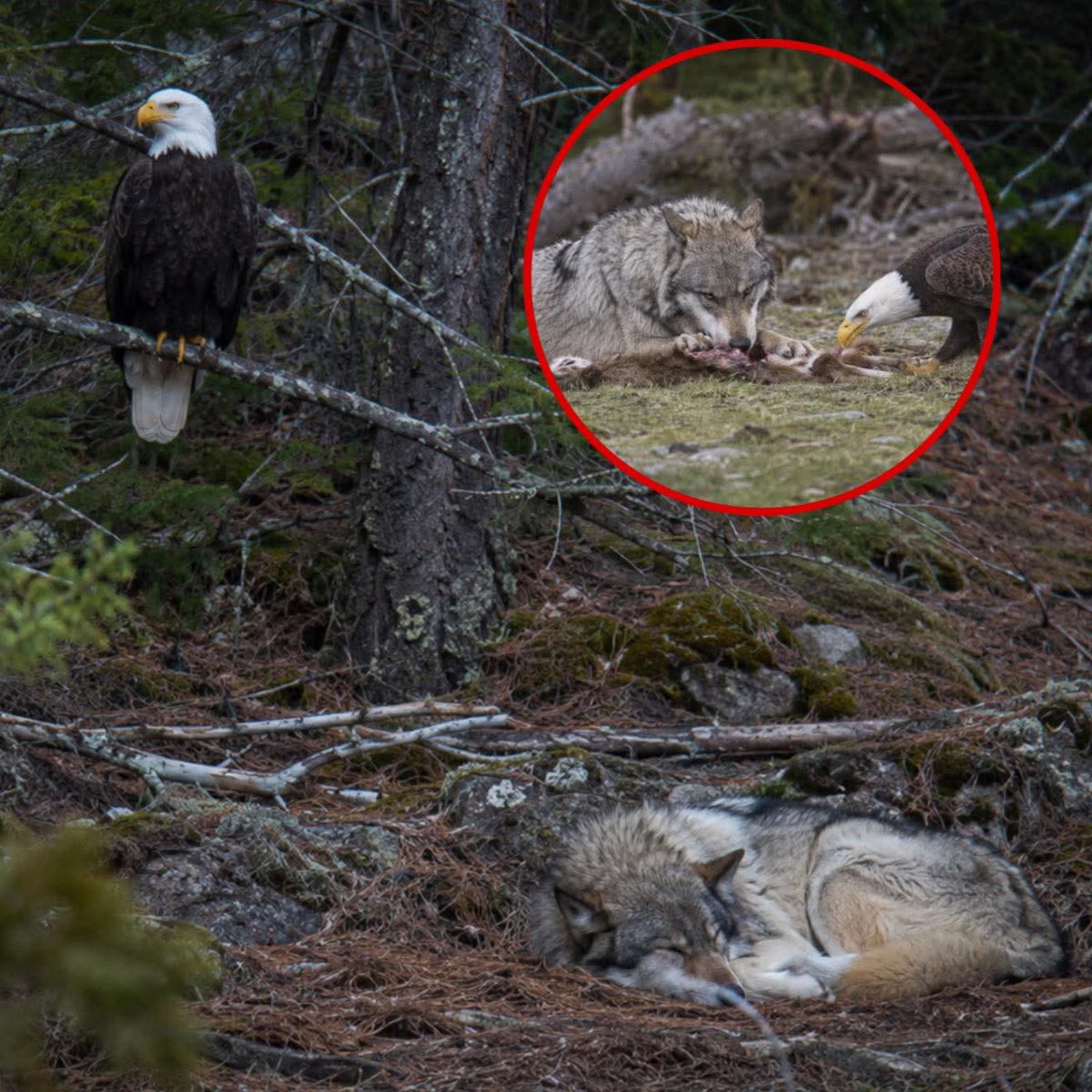
Wolf left to die until an eagle showed up. A group of researchers had been following the same wolf pack for weeks when they noticed one wolf falling farther and farther behind. It was limping badly, stopping every few steps, and by sunset, the pack had disappeared into the trees without it. One photographer stayed back, thinking he was about to capture one of the hardest parts of nature to watch: an injured animal too weak to keep up, left alone in the woods with no pack, no protection, and almost no chance. He said the wolf curled under a tree like it had already given up.
But the last photo he expected to take turned into the one nobody could explain. A bald eagle landed above the wolf and stayed there, not feeding, not circling, just watching. For days, it returned while the wolf slept, almost like it was guarding the only animal in the forest weaker than itself. Then the wolf got strong enough to move, and cameras caught something even stranger. The eagle began flying low over the brush, pushing small prey toward the wolf, and when the wolf made the catch, it let the eagle eat beside it. What started as a heartbreaking scene became something researchers never thought they would see: a wounded wolf and a wild eagle learning to survive together.
The root of the Billy Bishop Airport expansion plan is that Nieuport Aviation Infrastructure Partners (aka JP Morgan) wildly overpaid Porter ($750M) in 2015.
Without an expansion, Nieuport likely has no way to recoup its investment.
It's about the $$$$
https://t.co/sT0PMdUIjJ