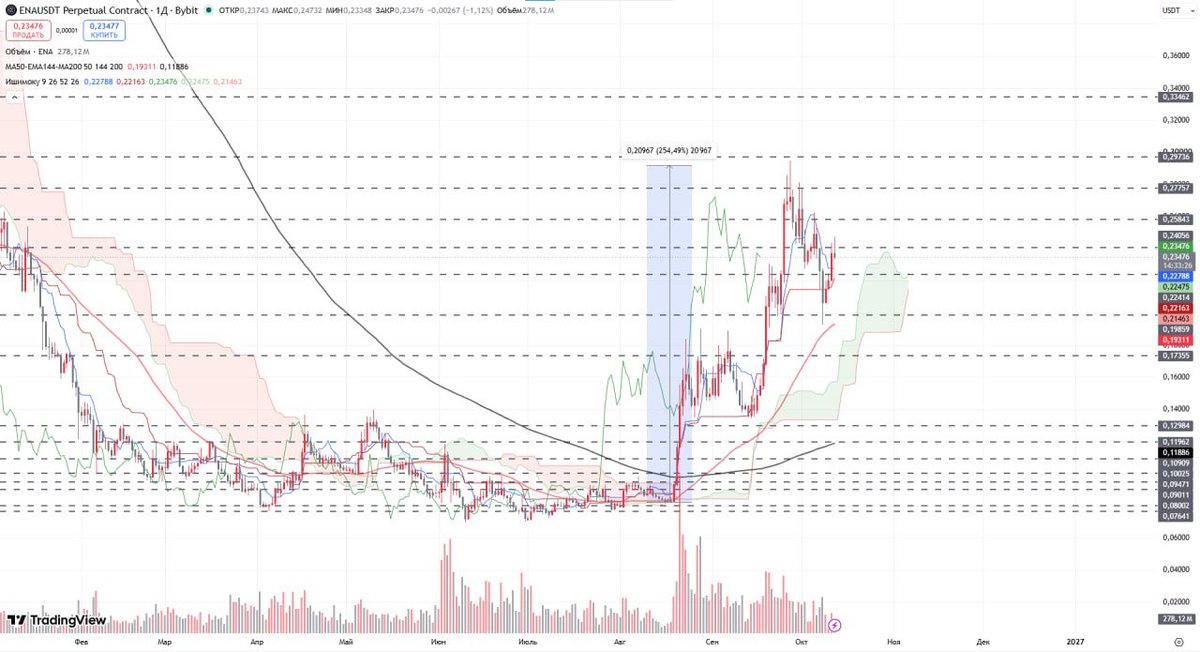
$ENA Showed impressive growth
The asset showed a phenomenal upward move, catapulting from August local lows by a record 254.49%, where it is now trying to consolidate.
The price has moved far above the moving averages + managed to consolidate above the cloud, however, we are seeing a decline in trading volumes, so in the near future there are risks of a small pullback.
The first serious obstacle on the way up will be the resistance block at $0.25843. A confident daily candle close above this mark will open the way for the asset to retest the local high around $0.29736.
The release of free Binance AI marks the start of a full-scale arms race among centralized exchanges for control over users' AI interfaces.
The platform that first provides the most accurate and seamless AI agent will capture the main flow of retail trading and the attention of the Web3 community.
Will the presence of an advanced AI assistant become the decisive factor when choosing an exchange in 2026?
Rendering a million-line diff is the easy part. 👀
Comments are what break it. Their height depends on markdown wrapping, expanded details, open reply boxes, and images still loading (none of which you know until you render).
Here's how we rebuilt the PR view in the GitHub Copilot app 🧵
$MINA The asset surged by 345%.
It staged an aggressive vertical breakout from a prolonged summer accumulation phase, briefly pushing to multi-month highs before immediately running into heavy selling pressure at the $0.16 resistance zone.
The recent price spike was driven directly by the rollout of major mainnet technological upgrades and the integration of new zero-knowledge proof protocols, which substantially boosted the blockchain's throughput.
The sharp pullback that followed stems from predictable, large-scale profit-taking by major holders and speculators at local highs. Looking ahead, the most likely scenario is a further decline and a retest of the MA200, though I wouldn't rule out the formation of a sideways range.
Adam Back's statement that he proposed Ethereum use the UTXO model even before launch due to the risks of race conditions highlights a key fork in the design of virtual machines.
The UTXO model provides absolute determinism and parallelism without conflicts over state, whereas the EVM's Account model opened the path to complex DeFi composability but paid for it with overload of the global state.
Was the account model the only way to launch the DeFi boom, or did the crypto industry from the very beginning go down the path of architectural complication?
A one-time outflow of $311.9M looks like a noticeable local spike on CoinGlass's 90-day chart, but it remains merely a temporary delta against the backdrop of billions in net inflows over recent months.
The fundamental structure of institutional presence in digital assets persists, and the volatility of ETF flows is a natural element of market microstructure.
Against the backdrop of frequent derivatives liquidations and cascading liquidations, the monthly final figures give a real picture: $3.49 billion in net inflow into Bitcoin ETFs and +11% to the sector's market cap.
As the head of Binance notes, fundamental demand for digital assets remains high despite local volatility.
What currently serves as your main reference point — monthly institutional inflows into ETFs or short-term price movements in the order book?
$AAVE has locked in its position above $100. After a powerful impulse move, it is now consolidating at fresh year-to-date highs, primed to extend its upward trajectory.
Inside the Aave ecosystem, capital is flowing in at a record pace, driven by a broad rotation of spot liquidity into altcoins. The steady daily growth of new non-empty addresses confirms that this breakout is backed by genuine organic demand from smart money.
A decisive daily close above $183.99 would open the door to larger targets around $202.29. Still, with the rally nearly uninterrupted and futures running hot, a pullback into the $150 - 160 zone may occur before the next leg higher.
Writing code with the help of LLMs has become a simple task, but deep auditing and finding architectural bugs require a completely different level of precision.
An analysis of 103.9 million pull requests allowed GitHub to create a dataset reflecting real problems of commercial development, rather than synthetic tasks.
Will AI agents be able to completely replace human code review in production in the next 2–3 years, or will the human role in architecture review remain untouchable?
How do you know whether an AI code reviewer catches the issues that matter without adding noise?
ReviewBench is a new open benchmark shaped by analysis of 103.9M GitHub pull requests, with 219 PRs across 19 languages.
Bring your own code review agent, evaluate it, and submit your results ⬇️
https://t.co/YVa464lyfx
How do you know whether an AI code reviewer catches the issues that matter without adding noise?
ReviewBench is a new open benchmark shaped by analysis of 103.9M GitHub pull requests, with 219 PRs across 19 languages.
Bring your own code review agent, evaluate it, and submit your results ⬇️
https://t.co/YVa464lyfx
$BTC: Buyers Still Lack Strength
As I expected, BTC made another retest of resistance at $86,700, but once again failed to break through and bounced lower.
Now it is crucial to hold above the cloud. If sellers keep applying pressure and push the price lower, we risk a drop into the support area around $83,000.
Let’s watch the next moves before drawing conclusions. That said, buyer strength appears to be fading, as repeated attempts to break resistance have still not succeeded.
Solana's statement about "human-scale digital money" strikes at the very heart of the PayFi thesis: the winner is whoever controls the endpoint of contact with the consumer.
The integration of on-chain settlements at the level of smartphone hardware security modules enables instant sub-cent stablecoin transfers, bypassing the high fees of traditional bank acquiring and mobile store commissions.
Will mobile manufacturers, in tandem with high-performance L1 networks, be able to pose real competition to Apple Pay and Google Pay?
In Q2 2026, Samsung became the world’s #1 smartphone maker, shipping 62 million Galaxy devices globally.
Last year, Samsung sold 240 million phones, surpassing 1 billion total active devices.
This is humanity-scale digital money, powered by Solana.
Gold continues to search for a bottom.
After the September reversal, gold was never able to restore its upward structure. The price is again around $4,120, sits below the Ichimoku cloud, and RSI is holding around 38. As long as the buyer does not reclaim at least $4,195–4,230, the current move remains for me just an ordinary bounce within a correction.
The situation below is also fairly clear. If the $4,100 area is definitively given up, the next major demand zone is already around $3,970. A return above $4,305, on the other hand, would become the first truly serious argument for a change in the local regime.
The Future of Solana: From Memecoins to the Financial Infrastructure of the Internet and the AI Era 🚀
Solana is transitioning from its status as "the fastest blockchain" to the role of a base settlement layer for traditional fintech, autonomous AI agents, and decentralized physical networks.
While the EVM ecosystem continues to fragment liquidity and user experience across hundreds of L2 networks, Solana is betting on a monolithic architecture and a single global shared state.
The main catalysts that will determine the future of the ecosystem:
1. Firedancer: The Path to 1,000,000 TPS
The launch of the independent Firedancer validator by Jump Crypto solves two fundamental problems at once:
Reliability: Eliminating the single point of failure problem in the codebase.
Scalability: Unlocking the potential of hardware and network cards to the limit. Sub-second finality and hundreds of thousands of transactions per second turn Solana into a full-fledged alternative to traditional financial exchanges like NASDAQ.
2. PayFi and Fintech Integration
Integrations with Stripe, Visa, and Shopify are just the beginning. The concept of PayFi (Payment Financialization) is taking shape on Solana:
Transactions become so cheap and fast that the payment process merges with DeFi mechanics (staking yield, instant lending collateralized by future invoices).
For the end user, the blockchain becomes "invisible" — payments happen in milliseconds, like the familiar Apple Pay, but based on USDC/EURC.
3. The DePIN Hub (Decentralized Physical Infrastructure Networks)
Projects like Helium, Render, and Hivemapper don't choose Solana by chance. To process millions of geodata points, rendering streams, and signals from real devices, you need a network with zero delays and microscopic fees. Solana has secured a monopoly on the DePIN sector.
4. The Autonomous AI Economy
Bot agents and AI models cannot wait several minutes for transaction confirmation or pay $5 in fees on L1. AI agents need micropayments for APIs, computation, and real-time data exchange. Solana becomes the ideal sandbox for creating autonomous wallets and a financial environment for artificial intelligence.
The Main Takeaway
The future of Solana is not about competing with Ethereum for DeFi enthusiasts. It is about building a unified, synchronous, and unfragmented space capable of digesting the loads of the real economy, high-frequency trading, and machine interaction
After $BNB briefly dropped below $600, buyers finally stepped in. The coin broke out of its descending trendline and began a gradual upward move, pushing the price toward resistance at $800.
Although BNB has encountered some selling pressure and momentum has slowed, the upside still has priority, supported by a solid consolidation above the cloud and moving averages.
In the near term, a minor pullback toward the $700 area looks quite likely, especially as trading volume has also declined. But after this temporary pause, I expect growth to continue and BNB to make a decisive breakout above $800.