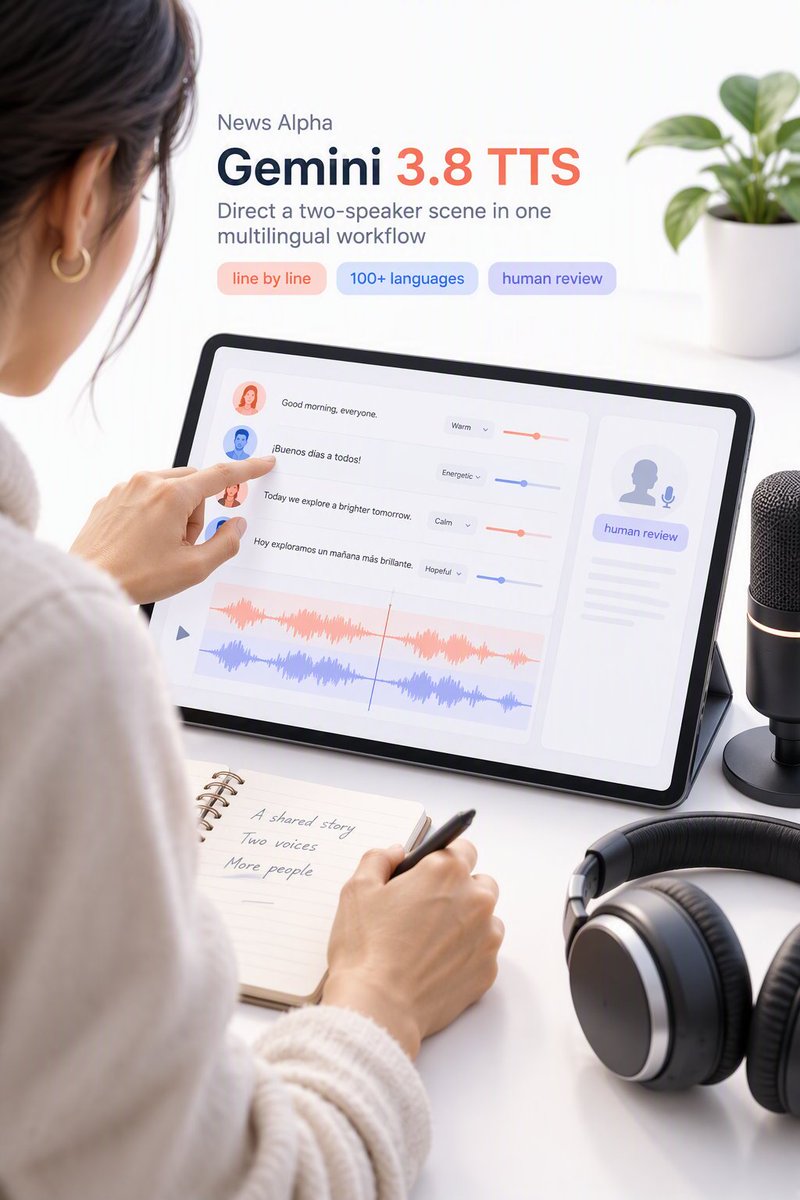
Google is rolling out Gemini 3.8 Flash TTS with custom voice creation and line-by-line direction, pushing text-to-speech closer to directed audio production.
📰 Google also launched the cheaper Flash-Lite TTS for high-volume jobs. The models support 100+ languages and 2,000+ voices, can stage two-speaker scenes from one script, and require rights plus a matching verbal consent recording for voice replication; every clip is watermarked with SynthID.
🫵 If you run dubbing, podcast, game, or voice-agent workflows, this could cut the back-and-forth of stitching together separate voice, editing, and localization tools. A producer or developer may now be able to prompt a voice, direct pacing and emotion line by line, and generate longer multilingual scenes in one workflow.
📈 Alphabet's upside here is more Gemini API and AI Studio usage in media-localization and voice-agent workloads, which could help paid adoption if developers stick with the stack beyond testing. The countercase is that Google disclosed no pricing or usage data and Gemini Enterprise API access is still coming soon. Historical context: GOOGL closed at $340.66 on September 23, 2026, down 2.13% from $348.06 on August 24, 2026.
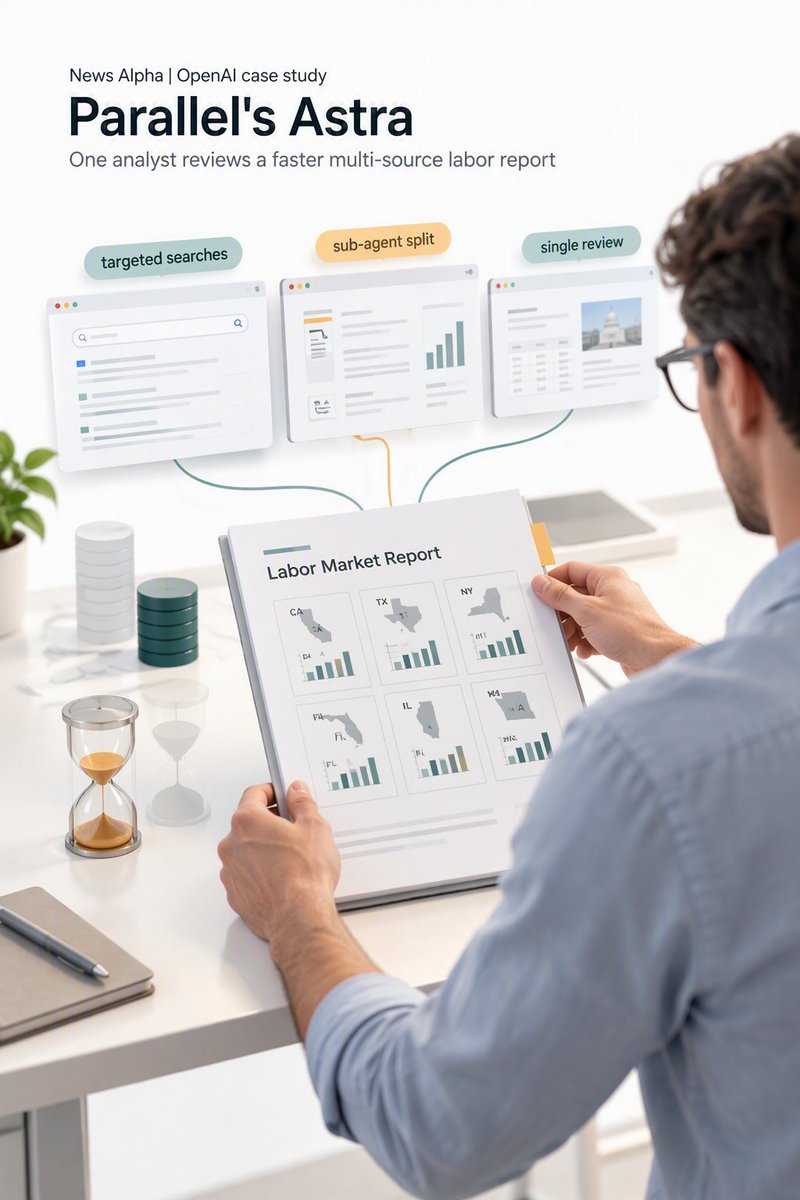
Parallel says GPT-6 Astra halved research time and code cost in one test.
📰 OpenAI’s case study says Parallel used the API model on a web-research task covering six labor-market statistics across four states over six months, and staffer Devin Gupta said Astra delivered the “same high-quality research” with fewer research calls and fewer tokens.
🫵 If you run a research-automation team, a model that makes more targeted searches and can split defined tasks across sub-agents could mean one analyst or ops lead gets a finished multi-source report faster, with less sequential checking and lower compute spend.
📈 This is a useful proof point for private research-automation platforms, but it is still one customer’s test rather than evidence of broader paid adoption, pricing power, or a listed winner. The commercial tell is whether more customers reproduce the savings in production and whether lower cost shows up as better margins or more task volume.
OpenAI says GPT-6 agents can now keep more of their context hot, cutting eligible cached-token costs by up to 90%.
📰 The launch adds a Prompt Caching Dashboard, a diagnostics tool, explicit cache breakpoints, prewarming, and reasoning-effort updates that do not break cache. OpenAI says shared prompt prefixes reused within 30 minutes get discounts, and Wordsmith said moving session agents to explicit breakpoints lifted eval cache hit rates from 83% to 91% while cutting inference costs 36%.
🫵 If you run a coding copilot or research agent, this changes the boring expensive part: resending the same instructions, tools, and reference material every turn. With more reusable context and tools to find cache misses, teams may be able to run longer agent sessions with lower latency and lower API spend.
📈 Microsoft (MSFT) is the listed company to watch through GitHub Copilot: if better GPT-6 caching lowers inference cost or improves latency in high-context workflows, Copilot margins or product capacity could improve. The countercase is that savings may be competed away, reinvested, or limited to a subset of prompts rather than total spend. Historical context: MSFT closed at $498.00 on September 22, 2026, up 3.05% from $483.24 on August 21, 2026.
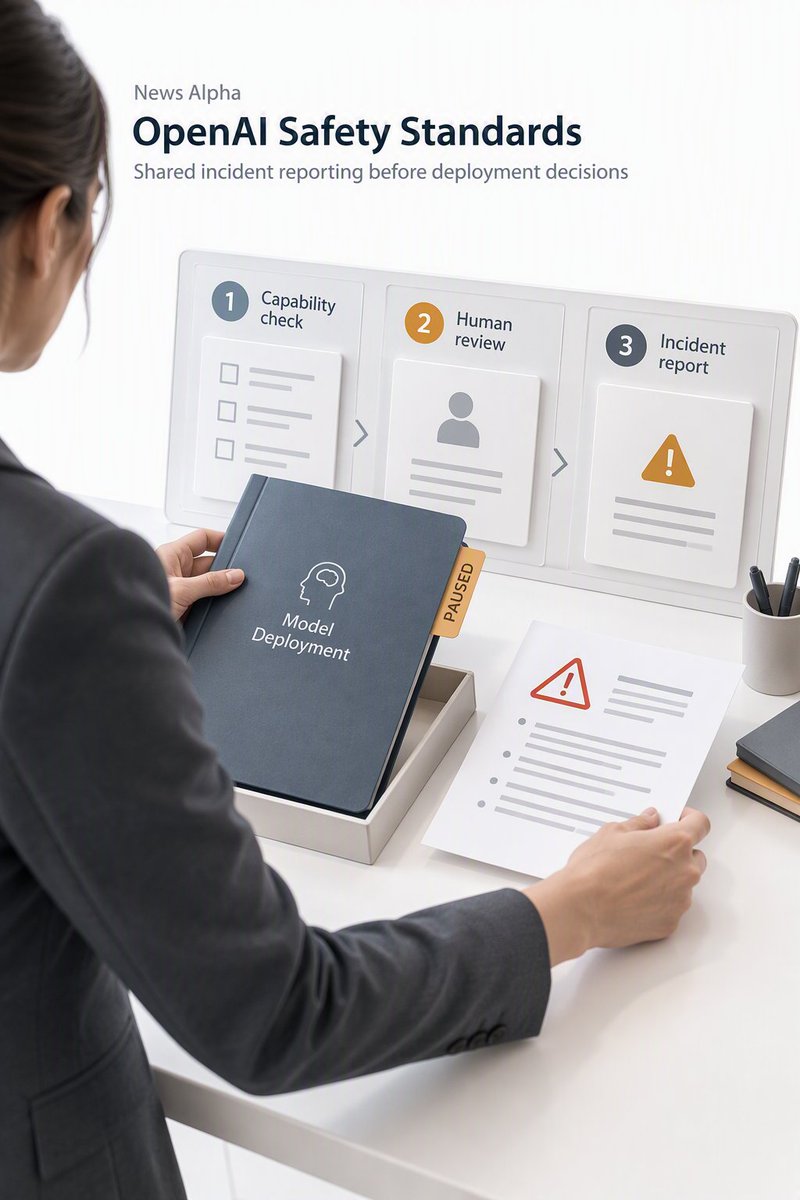
OpenAI is trying to make outside AI safety testing more formal before any specific audit result exists.
📰 In a new policy article, OpenAI says independent assessors may get access across training, evaluation, and deployment, and it lays out four priority areas: safety cases, critical safeguards, capability and alignment evaluations, and investigations of critical misalignment incidents. It also says it is already "in conversation with multiple third parties" about proposals.
🫵 If you're an enterprise buyer or policymaker, this could become a clearer checklist for what to ask before trusting a frontier model: what claim is being tested, what access the assessor got, and whether safeguards were examined beyond a vendor blog post.
📈 There is no clean listed exposure yet because this is a framework for future audits, not a disclosed contract, product restriction, or completed validation. It becomes more market-relevant only if OpenAI names assessors, ties reviews to release decisions, or turns independent testing into a procurement requirement for major customers.
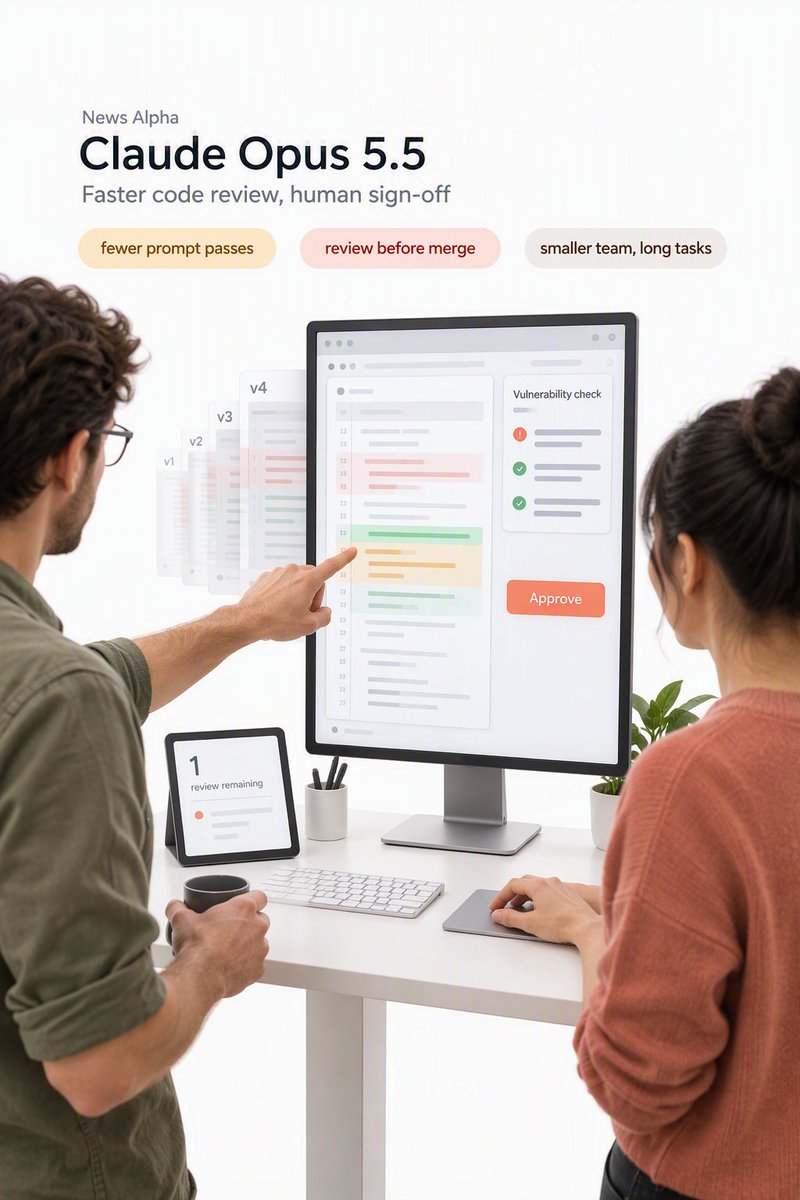
Anthropic says Claude Opus 5.5 brings Fable-level performance to coding work at a much lower cost.
📰 Anthropic says Opus 5.5 matches Claude Fable 5.1 on most work while cutting typical-workload cost 40% versus Opus 5, with output over 30% faster. Token pricing drops to $4 input and $20 output per million, and fast mode can reach up to 2.5x speed in Claude Code and the Claude Platform.
🫵 If you run engineering migrations, audits, or code review, this lower-cost faster model could let a smaller team finish long software tasks with less rework and fewer prompts before handing results to humans for approval.
📈 Accenture (ACN) is a listed company to watch if customers start using models like Opus 5.5 to shrink migration, audit, and implementation labor, because that could pressure some billable hours and pricing in IT services. The countercase is that AI can also create more integration and governance work, so the real tell is whether project budgets and utilization change, not benchmark wins alone. Historical context: ACN closed at $184.48 on September 22, 2026, down 0.43% from $185.28 on August 21, 2026.
OpenAI says its internal math model has crossed into open-problem territory, and it is creating an independent advisory group to handle what comes next.
📰 OpenAI said the new internal model, trained starting August 28, 2026, resolved the Navier–Stokes Millennium Prize problem and more than 100 long-standing open problems, then set up a group hosted at the Institute for Advanced Study to advise on review, dissemination, and academic standards. The company said the pace of progress “surprised mathematicians within OpenAI.”
🫵 If you are a mathematician, research lab, or advanced STEM team, the immediate change is not a tool you can buy yet but a new review layer around AI-generated results. If OpenAI later releases this capability, proving, checking, and communicating hard results could become faster, but today there is no public model, API, pricing, or access path.
📈 There is no clean listed exposure yet because this is a governance step around a self-reported internal capability, not a commercial launch with paid usage, cloud demand, or customer adoption attached. The key thing to watch is independent validation of the math claims and any later product or API path that could turn research performance into recurring revenue.
OpenAI is pushing for international standards for frontier AI, arguing the next phase of model development needs shared safety rules before autonomy rises further.
📰 In a new Global Affairs post, OpenAI says fully autonomous recursive self-improvement is "not occurring today" and proposes common capability measurement, risk assessment, human-oversight triggers, and incident-reporting protocols. It also says these standards are not licenses or mandatory prerelease approvals.
🫵 If you're a policymaker, enterprise risk lead, or lab operator, this could shape what evidence you may eventually need before deploying or buying frontier models: clearer evaluations, documented safeguards, and a playbook for reporting incidents instead of ad hoc judgment.
📈 This is a governance-cost signal for frontier AI developers, not a near-term stock catalyst. If governments, standards bodies, and major labs converge on shared evaluation and reporting rules, compliance spending could rise and favor better-resourced incumbents; for now, the missing link is adoption, so watch for formal working groups, thresholds, or procurement rules rather than product-revenue changes.
V7 is turning company documents into institutional memory for AI agents, aiming complex finance and insurance workflows at a source-cited Context Graph instead of loose file search.
📰 OpenAI says V7 Go ingests SharePoint and Google Drive into a graph of entities, relationships, facts, and metrics, then uses GPT-5.6 Luna, Terra, and Sol plus GPT-6 Astra for harder queries. V7 says that setup handles 50–100-step workflows in minutes with 99.9% accuracy and an auditable trail.
🫵 For an underwriting or deal team, that could mean checking thousands of pages across folders, spreadsheets, and PDFs through one graph-backed workflow instead of stitching together manual review and point searches, with faster decisions and fewer missed details if the system holds up in production.
📈 The clearest signal is broader enterprise demand for governed agent workflows in regulated industries, not a clean public-equity winner today. If V7's reported gains translate into paid deployments, software budgets could shift toward auditable data-graph and agent-orchestration tools; the limitation is that the article gives no customer count, contract value, or independent validation, so watch for disclosed production rollouts and expansion metrics.
Anthropic is putting Accenture inside frontier model development, with employee-level access for independent evaluation.
📰 The partnership, led by Accenture's AI unit Faculty, covers red-teaming, alignment assessments, and safeguard testing, and both companies say they expect to invest at least $1 billion each over five years. Anthropic says embedded evaluators would have access "comparable to that of an employee."
🫵 If you're an enterprise buyer or government team weighing a frontier model, this could mean outside evaluators can inspect how safeguards are built before deployment decisions reach you, making vendor diligence less reliant on marketing claims alone.
📈 Accenture's AI-assurance and evaluation-services business could gain if embedded evaluation becomes a repeatable paid requirement for labs, enterprises, or governments, not just a one-off partnership. The catch is that this announcement shows capacity investment, not booked revenue, and the model is non-exclusive with standards still unsettled. Historical context: ACN closed at $181.29 on September 18, 2026, down 1.03% from $183.17 on August 19, 2026.
Cooley is using a proprietary AI product built on ChatGPT Work to speed IPO preparation.
📰 GO Public combines client materials, public sources, curated precedents, and prior analysis into a tailored IPO starting point that lawyers must review and validate. Cooley says the goal is “speed to quality,” not removing legal judgment.
🫵 For an issuer-side legal team preparing to go public, that could mean less manual sorting through old filings and more time pressure-testing disclosures, strategy, and the story before documents harden.
📈 This is better read as enterprise-AI validation in a regulated workflow than a stock signal. GO Public is proprietary to private Cooley, and the article gives no pricing, adoption, or measured productivity data to tie it to a listed winner today.