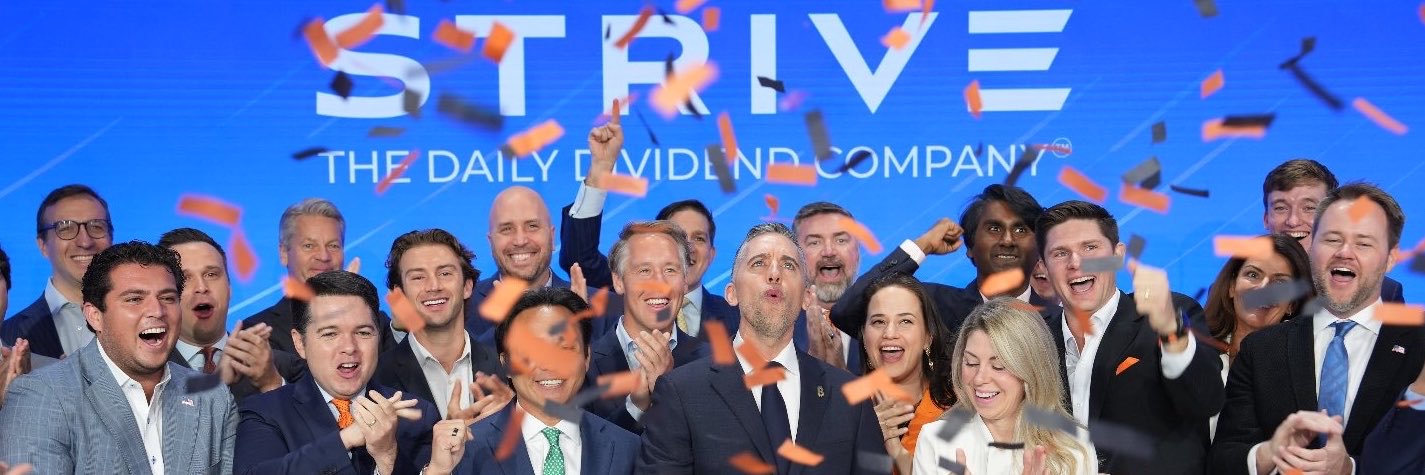
Here’s my conversation with @TheBitcoin__ covering Bitcoin, macro, Strive, digital credit, AI, and the evolution of Bitcoin treasury companies.
TIMESTAMPS
0:00 Intro
2:47 Matt’s Bitcoin Journey
7:18 Leaving CalPERS and Building Strive
9:21 The Fight Against ESG and DEI
17:04 Bitcoin’s Strongest Macro Setup
24:00 Corporate Bitcoin Treasury Strategy
26:42 AI, Abundance, and Bitcoin Scarcity
33:49 The Future of Digital Credit
36:30 SATA and Institutional Investors
38:09 Bitcoin in Pension Portfolios
45:17 Strive’s Future Plans
48:15 The Worst Argument Against Bitcoin Treasuries
50:17 Bitcoin and the Future of the United States
52:23 Bitcoin’s Next All-Time High
53:36 Closing Thoughts
Most investors forget that Strive effectively owns a 2030 LEAP tied to our own common equity. If $ASST is above ~$102 at expiry, it maxes out at approximately $40M of value to Strive.
Not our biggest asset, but IMHO our most fun forgotten one.
Strive’s OG mission was restoring shareholder primacy & meritocracy across corporate America by crushing the fiduciary breaches happening via proxy advisors & large asset managers.
Job’s not done but great to see these fiduciary breaches get punished.
Great work @SECPaulSAtkins
One of the most important lessons of every bull market is not that high valuations are dangerous. It’s that high valuations without fundamentals are dangerous. Amazon looked expensive. Apple looked expensive. Tesla looked expensive. So did https://t.co/6dAgUzu5sb.
The mistake is assuming valuation tells you whether something is overvalued. It doesn’t. Fundamentals do. The highest-valued business can be expensive for a very good reason, and refusing to own it because it “looks expensive” can turn out to be an extremely costly decision.
Bull markets have a way of punishing investors who mistake a low valuation for value.
Timely conversation on Bitcoin, $ASST, $SATA & shareholder-aligned incentives.
Bitcoin will be the fastest horse this cycle & Strive is positioned to be the fastest horse amplifying that move.
Bitcoin sentiment is likely too bearish for the 3-5 year macro setup ahead.
These are fair questions, and I agree with the core principle behind them. Compensation should be structured so that the team does well when shareholders do well, and the incentives should be tied as directly as possible to the outcomes we are trying to create. I wrote about our philosophy last September: https://t.co/MMuJLhXSnr
Our short-term incentives are driven by increasing Bitcoin per share and meeting all of our obligations. Our long-term incentives are driven primarily by outperforming Bitcoin, because Bitcoin is the hurdle rate, as well as our performance relative to the broader stock market. If we fail to pay any dividend on $SATA, bonuses do not get paid. On the long-term side, the highest payouts require us to outperform Bitcoin and perform among the top tier of publicly traded companies.
We worked with compensation consultant Mercer to build the framework. My direction was to benchmark overall compensation around the 50th percentile of the market for comparable roles, while making the incentive structure as aligned with shareholders as possible. Across our 30+ employees today, annual salaries total approximately $8 million. Aggregate short-term (annual) incentives have a target of approximately $5 million and a maximum of approximately $11 million, while long-term incentives have a target of approximately $21 million per year and a maximum of approximately $41 million. The long-term incentives are earned over a three-year period.
That means total annual compensation across the entire Strive team is approximately $34 million at target, including salaries, short-term incentives and long-term incentives. Maximum compensation under the current structure would be approximately $60 million, but getting there requires exceptional performance. At today’s roughly $2.1 billion equity value, target equity compensation represents less than 1% of the company annually, and even if we maxed out the current performance framework, the annual equity component would be approximately 1.9% of today’s equity value. Importantly, because these are three-year awards and are tied to both outperforming Bitcoin and being a top equity performer, the actual percentage of the company represented by that compensation on a forward-looking annual basis would likely be substantially lower if those maximum outcomes were actually achieved.
On the 5% incentive reserve specifically, that is simply capacity under the plan. It is not an annual grant, an annual target, or an expectation that 5% of the company will be issued every year. We have not issued 5%, and as you can see from the current structure, we are not operating at anything close to a 5% annual pace. The purpose of the reserve is to give the company enough flexibility to recruit and retain talent without repeatedly going back to shareholders simply to replenish the plan, while actual compensation remains capped and tied to performance.
There is another side of this that I think is important to be transparent about. My responsibility as Chairman & CEO is not only to recruit the best people, but to retain them. I believe we have an exceptional team that works incredibly hard, has great chemistry, and has produced results that reflect that. When I look across the industry, there are companies that offer similar or greater compensation with substantially easier performance hurdles. If Strive continues to outperform, grow Bitcoin per share and scale the company, I am much more concerned about losing great employees to competitors than I am about our team being overcompensated.
As Strive grows, I expect we will continue to reassess compensation to make sure we can recruit and retain the best talent. But the principle will not change: compensation should be competitive enough to retain exceptional people, tightly aligned with shareholder outcomes, and structured so that significant upside for employees comes from significant performance for shareholders.
Bitcoin is our hurdle rate.
$ASST has outperformed $BTC since strategy announcement in May '25, YTD 2026, & since Parker Lewis was diagnosed with Saylor Derangement Syndrome in June.
Amplified Bitcoin intentionally comes with extra risk for the potential to earn excess return.
I joined @ClaytonMorris on Redacted Invest to go deep on the macro themes I’ve been writing about: the dollar, U.S. debt, debasement, Bitcoin, where we head from here, and Strive’s victory over ESG & DEI.
Enjoyed bringing these ideas to a new audience.
TIMESTAMPS
0:00 The U.S. Dollar and Treasury Debt Crisis
4:05 Rising Yields and Treasury Intervention
6:05 Why Matt Wouldn’t Buy Treasury Bonds
9:32 Stanley Druckenmiller’s Warning
17:59 What Debasement Means for American Families
21:54 Did the 2008 Bailouts Break the System?
25:26 Opting Out of Bonds and Into Scarce Assets
31:52 Earn in Dollars, Save in Hard Assets
41:57 Could the U.S. Adopt a Bitcoin Standard?
43:22 Stablecoins, BRICS, and the Dollar
47:08 Strive’s Fight Against ESG and DEI
54:22 Economic Outlook for the Next Year
56:10 Bitcoin, Gold, and Silver Predictions
57:36 Closing Thoughts
$ASST $SATA
A lot happened at Strive over the last week, but the bigger story is the macro backdrop developing around Bitcoin.
On this week’s Hurdle Rate, we went deep on both: the recent capital markets execution at Strive and the dollar, liquidity, gold and Bitcoin framework I’ve been writing about over the past week.
If you want the full version of how we’re thinking about the environment we’re entering, this is the episode.
Another very long macro post, but I don't write these often. We are watching the most interesting macro backdrop of the last several decades take shape in real time.
One important piece of the long-term dollar view I wrote about last week is what happens at the long end of the Treasury market. Stan Druckenmiller published an excellent piece in the WSJ last night titled "Let the Bond Market Speak". The U.S. fiscal trajectory is unsustainable, running deficits near 6% of GDP at full employment with inflation still above target is reckless, the entitlement trajectory is generational theft, and attempting to suppress long-term Treasury yields does nothing to fix the underlying fiscal problem.
Druckenmiller's argument is that suppressing yields delays the fiscal reckoning that higher rates would otherwise impose on Washington. He is right about the economic logic, but I am not even sure our expectations for what ultimately happens are different. By the mid-2010s, I had come to the conclusion that there was never going to be a realistic path where sustained pressure from the bond market produced the kind of fiscal conservatism necessary to solve this problem. That realization was a major part of why I became a Bitcoiner in the first place, and Druckenmiller's own investments in Bitcoin and other hard assets suggest to me that he has come to the same underlying conclusion.
I read his piece less as a prediction of what Washington will actually do and more as a warning about what it should do before it is too late. I view it as a Hail Mary from one of the greatest macro investors of all time telling policymakers to let the market impose the discipline that the political system has been incapable of imposing on itself. I hope they listen, but unfortunately I know they won't.
Druckenmiller makes the political constraint explicit himself when he writes that neither party will run on entitlement reform. That is precisely the problem. The fiscal solution that works mathematically is not a solution that wins elections, and the people administering Treasury and other parts of the government are appointed officials operating within mandates ultimately created by elected politicians and the voters who put them there.
That distinction matters because the appointed officials can be extraordinarily intelligent, deeply patriotic and genuinely committed to making the country stronger while still being constrained by a political system with completely different incentives. Scott Bessent obviously understands the fiscal problem, and I believe he and Druckenmiller agree on the underlying diagnosis. But Bessent is running Treasury inside a political system whose mandate is set by elected officials, not by the optimal answer on a macroeconomic spreadsheet.
We just saw a version of this with DOGE. Elon Musk, the most capable private-sector operator of our generation, entered government with an explicit mandate to dramatically reduce spending. The institutional and political forces were stronger, DOGE did not change the fiscal trajectory, and the deficit continued moving in the wrong direction.
That is not an indictment of the intelligence or intentions of the people involved. It is evidence that the constraint is structural, and that is why we have to invest in the world that exists rather than the world we wish existed.
As the fiscal arithmetic continues to deteriorate and policymakers refuse to allow long-term interest rates to fully reflect it, the adjustment will not disappear. It will be expressed somewhere else, and the dollar will be the release valve.
The Treasury market is already far from an untouched free market. The Federal Reserve owns approximately $1.6 trillion of Treasuries with more than ten years remaining, roughly 28% of the entire >10-year maturity bucket. Treasury has now also doubled its planned purchases of 10-to-30-year securities after long-term yields pushed toward levels not seen in nearly two decades, while making clear that the size of those operations can increase materially further.
Those actions are important less because of their current size than because of what they reveal about the government's reaction function. Treasury has now told the market that it is sensitive to the level of long-term yields before committing enough capital to actually change their trajectory, and the market has already largely looked through the initial announcement. Druckenmiller is right that once the market believes Treasury is defending a price, every further increase in yields becomes another test of how much policymakers are actually willing to do.
I think Treasury will ultimately regret going this small this early. By showing its sensitivity without overwhelming the market, it has effectively invited the market to find out where the real line is. My expectation is that the current intervention will not be enough, long-term yields will continue higher, and the bond market will eventually force Washington to prove that it is serious.
I believe it will prove to be serious when tested. The signaling around larger Treasury purchases and the potential use of the TGA matters, but signaling will not be enough if the long end keeps selling off. At some point the market will force Treasury to move from telling investors what it could do to actually deploying capital with enough size to change the outcome.
The resistance zone on the long-term 10-year Treasury chart attached here is one I have been watching for several years. The 5.25% to 5.85% area has long stood out to me as the place where this secular move higher in rates would face its most important test, and this is not a zone I identified because of anything that happened over the last week.
It came out of a fundamental view about the U.S. debt trajectory, the natural direction of long-term yields as the fiscal problem worsened, and the level at which Treasury and/or the Fed would be forced to respond. The chart matters, but this has never been about drawing squiggles and assuming price will reverse at a line. The resistance zone mattered because I believed the underlying fiscal mechanics would eventually push yields into it while the political and financial consequences of allowing yields to move materially beyond it would become increasingly intolerable.
If the 10-year moves into the 5.25% to 5.85% range, the headlines will write themselves. Ten-year Treasury yields would be trading at levels not seen since around 2007, except this time the United States would be arriving there with a dramatically larger debt burden and a vastly more difficult fiscal position. Narrative follows price, and a large enough decline in Treasury prices will quickly become a story about the Treasury market failing, government financing becoming unstable and the world's most important bond market entering a crisis.
That narrative itself will increase the political pressure to act. Mortgage rates, government interest expense, equity valuations and broader financial conditions would all be under substantially greater pressure, while every move higher in yields would make the fiscal arithmetic worse. Treasury is already showing its sensitivity before the market has even reached the zone I have been watching.
If yields ultimately move into that area, I expect Treasury and/or the Fed to blink substantially. The response could include much larger Treasury buybacks, heavier reliance on bills, actual deployment of the TGA, renewed Fed balance-sheet expansion, some form of explicit or implicit yield management, or a combination of those tools. I would not be surprised if we ultimately see intervention in the Treasury market on a scale that looks nothing like what has been announced so far.
The path into that moment could create significant stress across financial markets. Higher long-term yields would put additional pressure on equity valuations at exactly the same time that AI is creating a growing question around the durability of many corporate moats, which could make the environment particularly difficult for traditional equities and other risk assets.
Bitcoin is more interesting because the endgame is becoming increasingly obvious. I think it is roughly a coin flip whether Bitcoin experiences meaningful weakness during the final move higher in yields or simply continues grinding higher while other risk assets struggle. If we are fortunate enough to get a meaningful Bitcoin selloff during that period, I would view it as a potentially once-in-a-lifetime opportunity to increase exposure before policymakers are ultimately forced to respond with size.
But I would not build a portfolio around the hope that opportunity appears. The macro backdrop is already bullish enough that, in my view, the time to be positioned is now if you are not already positioned. A dip would be an extraordinary gift, but the market may simply look through the short-term stress because the eventual policy response is becoming increasingly obvious.
From a traditional fixed-income mandate, the 5.25% to 5.85% zone has always looked interesting to me as an area where I would want to get very long duration. If Treasury and/or the Fed respond the way I expect, long-term Treasury bonds could perform extremely well as policymakers push yields back down. But at Strive we do not run a fixed-income mandate. We run a Bitcoin mandate, and this is the kind of setup that calls for responsibly maximizing Bitcoin amplification.
Treasuries would be a beneficiary of the intervention, but I want to be long risk, long scarcity and, above all, long the fastest horse. Bitcoin is the fastest horse, and the ability for Strive to amplify Bitcoin into this kind of macro environment is far more attractive to us than owning an asset whose yield policymakers are explicitly trying to suppress.
That brings this directly back to the dollar thesis I wrote about last week. Druckenmiller is right that governments defending prices against fundamentals ultimately lose, but that does not mean they cannot suppress the specific price they are targeting for a meaningful period of time. If Washington refuses to meaningfully reduce spending, then suppressing long-term yields and allowing the dollar to weaken may actually be the least damaging of the politically available alternatives.
The correct solution is obviously fiscal conservatism. But because that solution is politically unavailable, allowing an uncontrolled rise in long-term yields against today's debt burden risks creating a much more immediate Treasury-market crisis. Financial repression and a weaker dollar are deeply imperfect outcomes, but they are preferable to simply allowing the financing structure of the U.S. government to break in real time.
That is why the dollar becomes the release valve. Treasury and the Fed can suppress long-term yields, but they cannot make the underlying fiscal imbalance disappear. The cost gets transferred somewhere else, and a weaker currency is the most politically tolerable place for a meaningful portion of that adjustment to occur.
This is also why I don't view a DXY move into the high-60s or low-70s as some extreme end-state for the dollar. It would take the dollar to the weakest levels we have experienced in the modern era, but not by an historically extraordinary margin. Bitcoin has repeatedly benefited from weakening-dollar environments throughout its history, but it has never existed through a secular move in the dollar to these kinds of lows. Bitcoin was created after the 2008 dollar low and has spent its entire history with the dollar either recovering from those lows or operating materially above them.
A secular move to new lows in the dollar would therefore represent something genuinely new for Bitcoin, and this Treasury dynamic adds another fundamental layer to the framework I have been writing about. Dollar debasement increases the pool of capital seeking scarcity. Bitcoin's continued monetization allows it to capture a growing share of that expanding pool. AI abundance simultaneously increases the uncertainty around the long-term value of traditional corporate moats, strengthening the relative appeal of an asset whose scarcity cannot be competed away.
The explosive scenario is when these forces begin aligning at the same time: a growing pool of global capital seeking scarcity, Bitcoin capturing a growing share of that pool as it continues to outperform other scarce monetary assets, and Strive amplifying Bitcoin on top of both. Those are not independent tailwinds. They compound.
That is the grand slam scenario I continue to see forming. The dollar declines, policymakers increasingly suppress the long end of the Treasury market, AI continues to debase traditional corporate scarcity, Bitcoin reasserts itself as the fastest horse among scarce monetary assets, and Strive is positioned to maximally amplify Bitcoin through that environment. If the bond market gives us a temporary Bitcoin selloff on the way there, I want to buy it aggressively. If Bitcoin sees through the endgame and never gives us the dip, I want to already be positioned.
Druckenmiller ends his piece by urging Washington to let the bond market speak. I agree with the warning and share his frustration with the generational consequences of refusing to address the underlying problem. The bond market is going to have to speak much louder before policymakers respond with the size ultimately required, and when it does, they are far more likely to suppress the message than undertake the fiscal restructuring necessary to eliminate it.
The path I have been watching for years is increasingly coming into view: the 10-year moves into that 5.25% to 5.85% resistance zone, the Treasury-market narrative turns into a crisis narrative, Washington is forced to respond with real size, and the secular dollar decline accelerates as pressure that would otherwise have been expressed through long-term yields is redirected elsewhere.
TLDR: YOU ARE NOT BULLISH ENOUGH^3
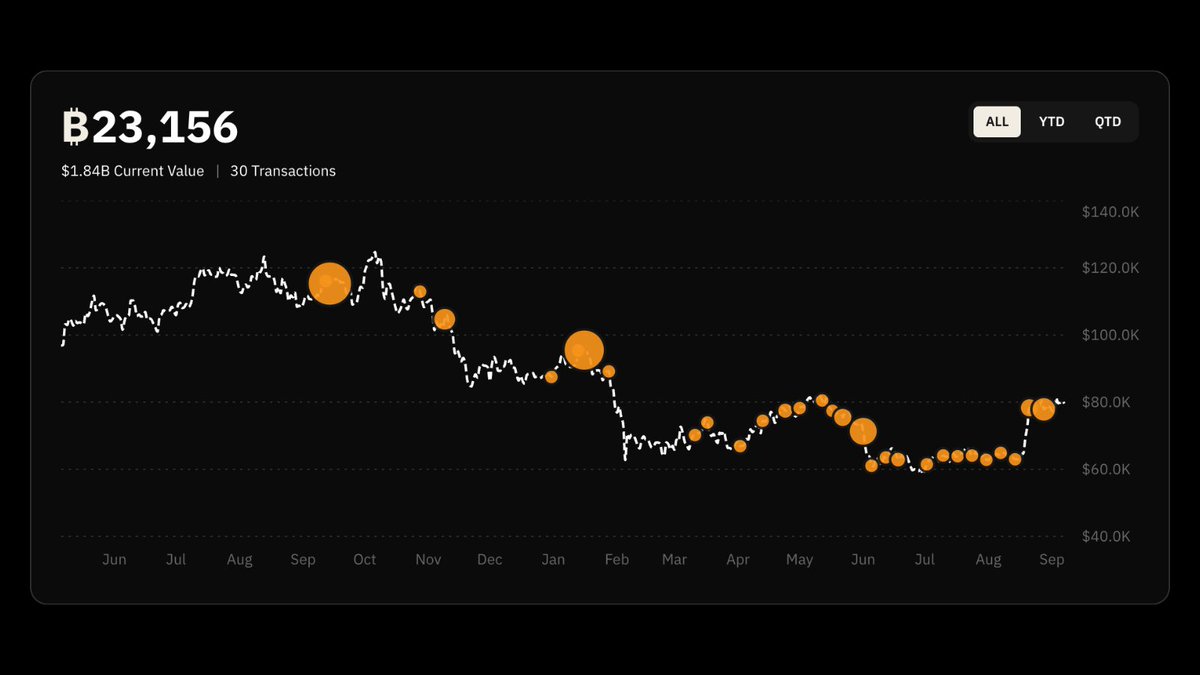
One year ago, Strive held zero Bitcoin.
Today, we own more than 1 out of every 1,000 Bitcoin that will ever exist.
With Strive firing on all cylinders, it’ll be fun to see how big the stack is one year from now.
February 19 was the bottom of the bear market in $ASST. It's fun to look back at this post now because through both the pessimism then and the excitement today, our conviction in what we are building has never wavered. We understood the long-term opportunity then, we understand it now, and neither the stock price nor the prevailing sentiment changes that.
We knew what we owned in Bitcoin. We knew the amplification structure we had built around it and how secure it was. We knew the team we had assembled and the chemistry we had together. Even as the vibes around Strive were about as bad as they could get, inside Strive they were incredibly high. Executives and directors were buying the stock with their own money, directors were stepping off the board to go all-in as full-time members of the company, and we had a deep conviction that we were going to win. That combination of long-term conviction, talent and chemistry is incredibly rare, and the execution that followed over the next six months came directly from that foundation.
Looking back through the replies, what also stands out is that even with so much negativity around Strive in the broader ecosystem, there was a strong and dedicated group of shareholders who believed in what we were building when it was hard to do so. We won't forget who was riding with us when it was hardest. Today $ASST is ripping and the broader vibes are high, but our focus hasn't changed. Bitcoin's bull market is just getting started, we have the amplification structure built to capitalize on it, and Strive is firing on all cylinders.
Still all-in.