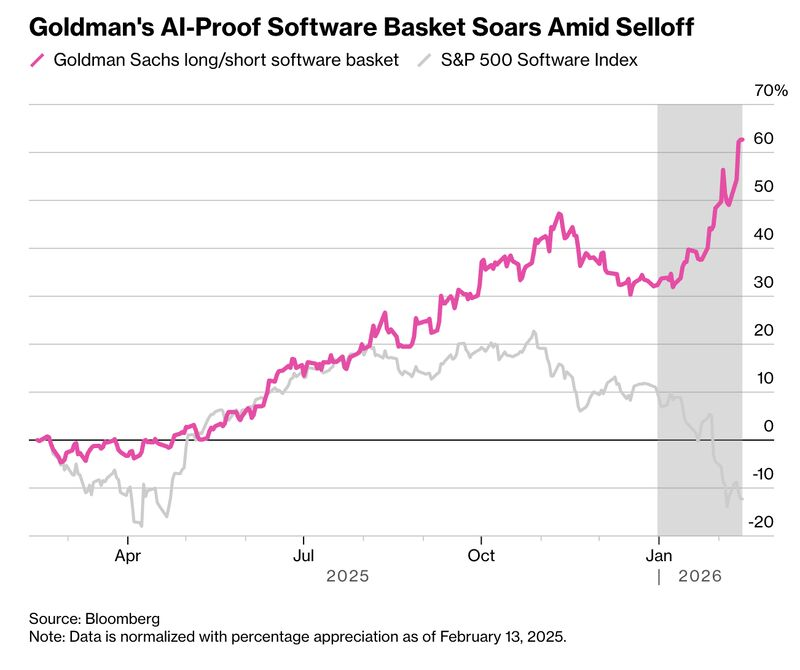
The Goldman Sachs list of AI winners & losers:
Supposed winners:
- Cloudflare
- CrowdStrike
- Palo Alto Networks
- Oracle
- Microsoft
- Amazon
- Alphabet
- Nvidia
- TSMC
- Micron
- Arista Networks
- Palantir
- Zoom
- Vertiv
- Eaton
- NextEra Energy
Supposed losers:
- https://t.co/yZK0mvfWhp
- Salesforce
- DocuSign
- Accenture
- Duolingo
- Workday
- SAP
- Atlassian
- UiPath
- Cognizant
- Gartner
- SAP
- Unity Software
They seem to think that providers of physical hardware and infrastructure will be relative winners. Cyber security companies, too.
Meanwhile, Goldman argues that if AI agents become the primary interface, traditional software becomes commoditised, simple passive data stores. And consulting/IT services names like Accenture will be hurt as AI compresses billable work hours.
Curt Cignetti took over the worst program in college football history and then proceeded to win the school’s first-ever national championship within just two years. It's the most remarkable coaching job in the history of sports.
Finland's underground data centers heat entire city blocks using server waste heat
In Finland, several data-centres now feed their waste heat into municipal district-heating networks instead of simply dumping it into the air. For example, waste heat generated by data-centre cooling is captured and transferred into the district-heating grid, providing carbon-neutral heat to thousands of homes and public buildings. This reuse of thermal energy helps reduce reliance on fossil-fuel heating, cuts emissions, and turns the by-product heat from digital infrastructure into a genuine resource rather than waste.
This is Amazon’s new $11 billion dollar massive Data Center Campus in St. Joseph County, Indiana
It will be primarily dedicated to training and running AI models
It will use 2.2 gigawatts of power, equivalent to the electricity needed to power roughly 1 million homes and approximately 300 million gallons of water per year
This is Amazon’s new $11 billion dollar massive Data Center Campus in St. Joseph County, Indiana
It will be primarily dedicated to training and running AI models
It will use 2.2 gigawatts of power, equivalent to the electricity needed to power roughly 1 million homes and approximately 300 million gallons of water per year