We’re nearing the end of a brutal crypto winter. If you’re positioned for Kaspa you’re in an excellent spot.
Locked and loaded this is the time to ensure you’re ready for maximum gains.
Accumulate while you can.
$KAS
Valour, which managed $640.2M in ETPs as of September 25 and is owned by Nasdaq-listed DeFi Technologies, offers a Kaspa ETP on Sweden's Spotlight Stock Market. Investors can buy it through Avanza, Nordnet, Montrose and SAVR.
@kaspaunchained
Valour, which managed $640.2M in ETPs as of September 25 and is owned by Nasdaq-listed DeFi Technologies, offers a Kaspa ETP on Sweden's Spotlight Stock Market. Investors can buy it through Avanza, Nordnet, Montrose and SAVR.
@kaspaunchained
Trillions of AI agents are going to choose $KAS
KASPA is the *only* Crypto rail on the market capable of processing transactions at the “speed of light”
Not having exposure to $KAS is a massive risk you’re taking
CRYPTO COMMUNITY SHOWDOWN 🥊
Bitcoin. XRP. Solana. Kaspa.
Which community can actually show up and dominate?
Vote. Repost. Bring your army.
$BTC $XRP $SOL kaspa:native
60+ Enterprise Markets to Be Disrupted by #Kaspa Tech
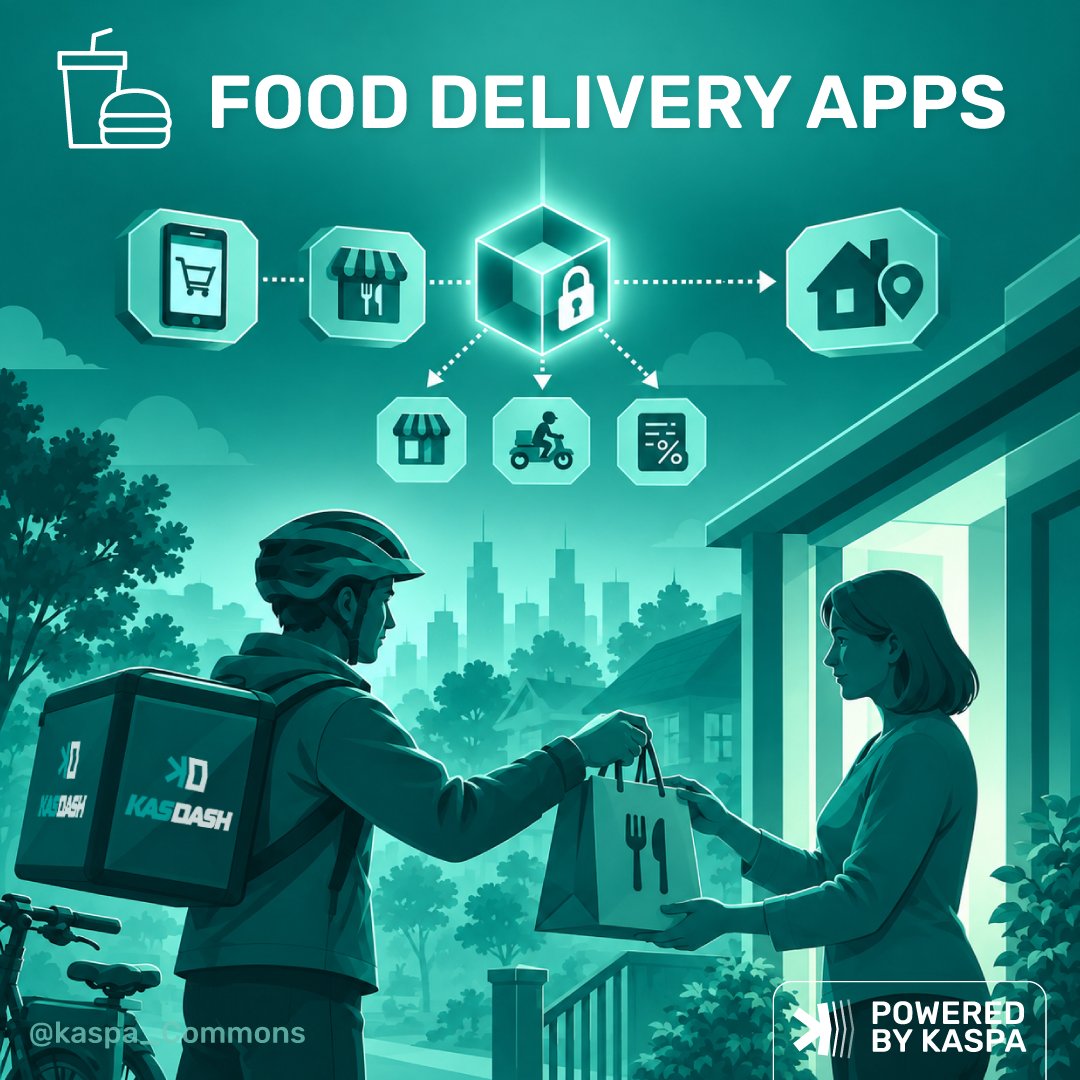
#33 Food Delivery Apps
Food delivery apps connect customers, restaurants and couriers, but the platform sits in the middle of almost every part of the transaction.
It receives the order, handles payment, tracks delivery, calculates fees, pays restaurants and couriers, manages disputes and keeps the transaction history.
Legacy Platforms & Systems
• DoorDash, Uber Eats, Skip and Deliveroo
• Centralized restaurant and courier marketplaces
• Credit and debit card payment networks
• GPS and mapping APIs
• Restaurant POS integrations
• Proprietary courier matching and dispatch
• Platform-controlled ratings and reputation
• Scheduled restaurant and courier payouts
These platforms provide useful services including discovery, logistics and support. There is still plenty of room to rethink how the order, payment and settlement underneath those services work.
What’s Broken / Innovation Gaps
❌ Restaurants and couriers depend on a central platform for settlement
❌ Customer payment, restaurant payment and courier payment are separate processes
❌ Payments can settle long after the food is delivered
❌ Order status and disputes depend on platform-controlled records
❌ Refunds and cancellations require the platform to determine where the money goes
❌ Ratings and work history are trapped inside individual apps
❌ Restaurants have limited control over marketplace customer relationships
❌ More automated commerce will require programmable payment and settlement
Where Food Delivery Can Still Innovate and Where Kaspa Tech Could Help
❌ The platform controls the money from checkout to payout
✅ Payment could be locked at checkout with the conditions for spending it established from the beginning.
Kaspa Covenants can enforce how a UTXO may be spent and validate its next state. Covenant IDs provide continuity as that state changes. An order could move through accepted, prepared, picked up, delivered, cancelled or refunded states while retaining a verifiable lineage.
❌ Developers have to build that logic close to Kaspa Script
✅ SilverScript now provides a higher-level way to write it.
SilverScript v1.0.0 is officially released and compiles to Kaspa Script. Developers can define state and transition policies while the compiler handles much of the lower-level Covenant plumbing, state validation and transaction structure.
For a delivery application, that could mean writing rules for when funds remain locked, when an order can advance, which outputs are valid and what conditions allow settlement or refund.
❌ One customer payment eventually has to become several payments
✅ The transaction itself can enforce the agreed outputs.
Kaspa’s transaction introspection allows a Covenant to inspect and validate transaction outputs. A delivery contract could require the correct amounts and destinations before allowing locked funds to move.
That opens the door to settling the restaurant, courier, taxes and other predefined recipients as part of the completed transaction rather than sending everything through a platform account first.
❌ Delivery confirmation and payment are separate events
✅ Delivery confirmation could become an input to the settlement process.
A restaurant scan could verify pickup. A customer QR code, signature or another authenticated action could confirm delivery. The Covenant rules determine what constitutes a valid transition and whether the corresponding payment outputs are allowed.
❌ Restaurants and couriers wait for platform payouts
✅ Settlement could occur as part of the completed order transaction.
Once the required conditions are satisfied, Kaspa can settle the valid transaction directly rather than leaving balances inside a platform for later reconciliation.
❌ Cancellations and refunds require someone in the middle to control the funds
✅ Valid refund paths can be written into the contract.
A Covenant could allow one transition if an order is cancelled before pickup and another once delivery has been verified. More complicated disputes may still require arbitration or another agreed process. The basic settlement rules do not have to be decided after the fact.
❌ A full delivery marketplace involves more than one contract
✅ This is where Argent becomes interesting.
Argent is being developed as an actor-based language and compiler for atomic, multi-contract applications on Kaspa. Argent programs compile to SilverScript and its runtime can construct transactions coordinating multiple actors.
A future delivery application could potentially model the customer, restaurant, courier and other participants as separate actors whose contracts participate in one coordinated transaction.
Argent is still under active development and needs further auditing and hardening before general production use.
❌ Private customer information should not be exposed publicly
✅ Kaspa’s native ZK verification provides another building block for applications that need to prove something without exposing all of the underlying information.
This could eventually be useful for identity, eligibility, delivery or other private verification requirements while keeping unnecessary personal information outside the public transaction history.
What could that look like?
A customer places an order and the payment is locked according to predefined rules. The restaurant accepts it, the courier verifies pickup, and delivery is confirmed at the door.
That final confirmation can trigger a transaction distributing payment to the restaurant, courier, taxes and any other agreed recipients.
The delivery app can still handle menus, maps, courier matching, notifications, customer service and logistics. It doesn’t necessarily need to hold the funds and manage settlement between everyone involved.
Toccata provides the L1 capabilities. SilverScript gives developers a practical language for writing Covenant logic. Argent is exploring how more complex multi-actor applications can be built above that foundation.
Got inspired? Start Building!
See links in thread
PS - Shout out to @KasperoLabs for demoing their KASDASH app! We're hungry for more!
Just messing with covenants on $KAS and I did not fully grasp that what is happening is an address is being created that is owned by no one. It simply an address that is created with hard coded rules of what occurs with the balance that exists in the address.
This address has no private key or seed phrase. (P2SH addresses) Really cool stuff that truly understanding doesn't come around until you start messing with it yourself!
Do not blindly follow crypto influencers. Too many can't be trusted. There will always be a right way and wrong way to do anything in life. It's too risky to try and find one's who put morals over profits. We all want to make money in crypto. But, right over wrong. Always!
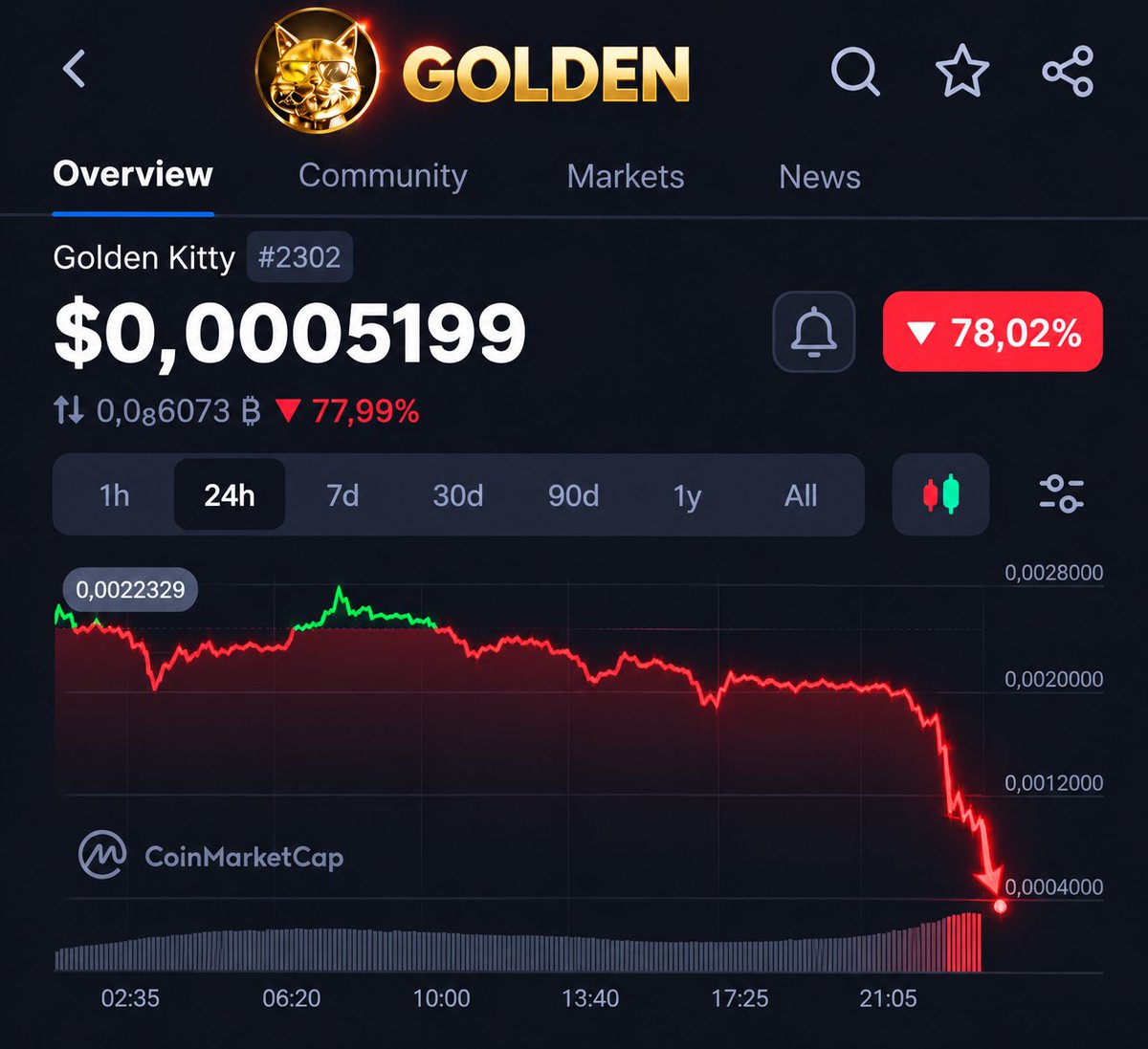
Damn -77,99% down on robinhood:0x92e4b008161ac64a7d0c5e540f453f8e6b8bd8d7 Kitty!!!
What the hell happened here? That is not a normal dip, that is a complete collapse.
Friendly reminder $20 $KAS is still a sub $1T market cap network...
With greater adoption, it's not THAT aggressive of a mid-long term target
The major risks I see are related to the network surviving its infancy
If #Kaspa continues shipping and attracting talent to the network, there's a reasonable chance to achieve $20 $KAS
$KAS could be one of the most interesting setups in crypto if Toccata delivers.
Kaspa spent years being valued mainly as a fast PoW payment network.
Now it has programmable UTXOs, covenants and ZK verification on L1.
That changes the potential market completely.
If developers start building DeFi, stablecoins and other applications on Kaspa while ~96% of KAS is already mined and issuance keeps falling…
I think the market could eventually value $KAS very differently from a “PoW coin”.
Kaspa is real-time bitcoin, solving scalability is great but not the core value prop.
Real-time bitcoin means achieving in a few seconds the same security guarantees that nakamoto consensus / bitcoin achieves after an hour; decentralizing each consensus round rather than chain quality achieved through a coarse aggregate of rounds.
A clean definition anchor for real-time decentralization (RTD): The ability to sample the honest majority in real-time.
(Note that even fast leaderless VRF-based proof-of-stake cant sample honestly bc the selected nodes get to choose the content of their blocks after they've been selected; pos=select then write, pow=write then select)
--
RTD affects: txn confirmation, censorship resistance, secure oracle finality, MEV resistance.
Eg censorship resistance, bitcoin is the most censorship resistant chain, but if 60% of the miners are censoring you (point in reference: OFAC abiding tornado censoring eth miners), your txn will pend for 30-40 minutes. For shady business payments that's not prohibitive, but for a real economy, for an asset aspiring to be at least a king of collateral even if not an MoE, this is unacceptable, esp under economic stress.
Beyond censorship, all things finance benefit tremendously from pow density, from sampling the majority in real-time in a secure and honest manner.
I wont get into MEV resistance now, but having a "conscious" stream of oracle attestations (not price oracles) finalized in real-time qualitatively upgrades the ability to encode informed risk, collateral, liquidity management, which is the lifeblood of defi.
In context of conf times, increasing from 1 to 10bps saturates the latency optimization. But for pow density we need dozens of blocks per second, with the endgame of 100 bps: Under 10bps a 37% attacker can fake the majority signal with probability 12%. With 100bps this drops to 0.3%. Today Kaspa can't accelerate to >10bps w/o harming conf times, but DAGKNIGHT will be implemented hopefully by Q3 at least on testnet, by which we will push for 25-40bps.
The cherry on top: RTD also implies netsplit resistance, as per the partial synchrony framework.
WWIII cyberwar resistance. Hypothetically speaking ofc.
(elaborated- https://t.co/o8vKa7gBwm)
Wallet #1, the clock is up.⏱️
The protocol is ready.
From here, adoption is the only thing that separates a winner from a ghost chain.
Tell us who you are.
Tell us why you stacked.
$KAS
There is so much that can be built and still needs to get built that is fully reliant on $KAS L1 itself. Nothing else.
Focusing on projects that reintroduces a new token or nfts etc... which drive away liquidity from $KAS itself is short sided trying to get quick wins.
Build for the long game. Build and Use Kaspa alone.