Computational Machinery of Cognition (CMC) lab focuses on computational and neural machinery of goal-driven behavior |
PI: @neuroprinciples | @tudresden_de
Some incredibly exciting news that still feels a bit surreal: I am starting my research group @MPICybernetics!
The best part? We are hiring at all levels!
Curious about the science we plan to tackle, read along :)
If these research directions resonate with you and you're interested in joining our team, we now have 2 open PhD positions!
More information about the positions: https://t.co/S9JbR23Sat
More information about our research: https://t.co/om4PcNeRr6
Of course, tackling these interdisciplinary questions requires a village! And we are incredibly lucky to have a fantastic network of collaborators to make this vision a reality, including Peter Dayan, @neuroprinciples, @XindiPoo, @lndriscoll, RoLi Lab & more!
To do this, we develop data-driven, species-specific models by integrating:
💻 🤖 computational methods (RL, dynamical systems, AI)
&
🪱🐟🐀🐒👤 behavioral & neural data (from nematodes to primates)
to uncover shared or species-specific mechanisms of adaptive decisions.
Our main goal is to understand how animals learn the dynamics of their environment across timescales to adapt their decisions. We study this in the context of foraging behavior, which allows us to link neural, behavioral, and environmental dynamics in naturalistic settings.
I also owe a very special thanks to
@neuroprinciples who has helped me navigate every single step, discussing science, mapping out the hidden rules of academia, and teaching me when and how to pivot!
Before talking science, there is no doubt that none of this would be possible without the immense support and trust of my mentors @SelfOrgAnna, @EngelTatiana & Peter Dayan, and all my labmates! I'm so grateful for their endless support and for inspiring me every day!
Wanna compare dynamics across different systems? See our fast and furious method developed by us (@ArmanBehrad, @TheSTraveller, @neuroprinciples) together with our wonderful collaborators! You can already use our code: https://t.co/boG5Rw8J1e...
Wanna compare dynamics across neural data, RNNs, or dynamical systems? We got a fast and furious method🏎️
The 1st preprint of my PhD 🥳 fast dynamical similarity analysis (fastDSA):
📜: https://t.co/jTVENLHfiV
💻: https://t.co/9SOMlwRkzj
I’ll be @CosyneMeeting - happy to chat 😉
Thrilled to see the first preprint of the lab out 🤩 Check it out if you need to compare dynamics in your data and RNN (or any other combinations of dynamical systems)! Code is also already available if you want to try it on your data/RNN/...: https://t.co/qzGQgL9pdf
Wanna compare dynamics across neural data, RNNs, or dynamical systems? We got a fast and furious method🏎️
The 1st preprint of my PhD 🥳 fast dynamical similarity analysis (fastDSA):
📜: https://t.co/jTVENLHfiV
💻: https://t.co/9SOMlwRkzj
I’ll be @CosyneMeeting - happy to chat 😉
@StphTphsn1@taherehtoosi Let me (mis)use @taherehtoosi's tweet on her great study, to also draw attention to our approach to bistable perception based on reinforcement learning and decision-making models (which I think brings a complementary perspective): https://t.co/Qq3ABjTwen
Happy to share my first post-doc paper with Peter Dayan just published at @NeuroCellPress
"Multistability, Perceptual Value, and Internal Foraging"
Paper (free access before Oct 18th): https://t.co/h0Z3RGtO0H
No access? Email me at [email protected]
🧵👇
In our Learning Club @CompNeuro_lab today (Sep 25, Thu, 2pm CET), @DengPan18 will tell us about his recent paper (👇) [joint work w/ Rushworth lab]. Want to attend, send an empty email to [email protected] to get the link!
In our Learning Club @CompNeuro_lab today (Sep 25, Thu, 2pm CET), @DengPan18 will tell us about his recent paper (👇) [joint work w/ Rushworth lab]. Want to attend, send an empty email to [email protected] to get the link!
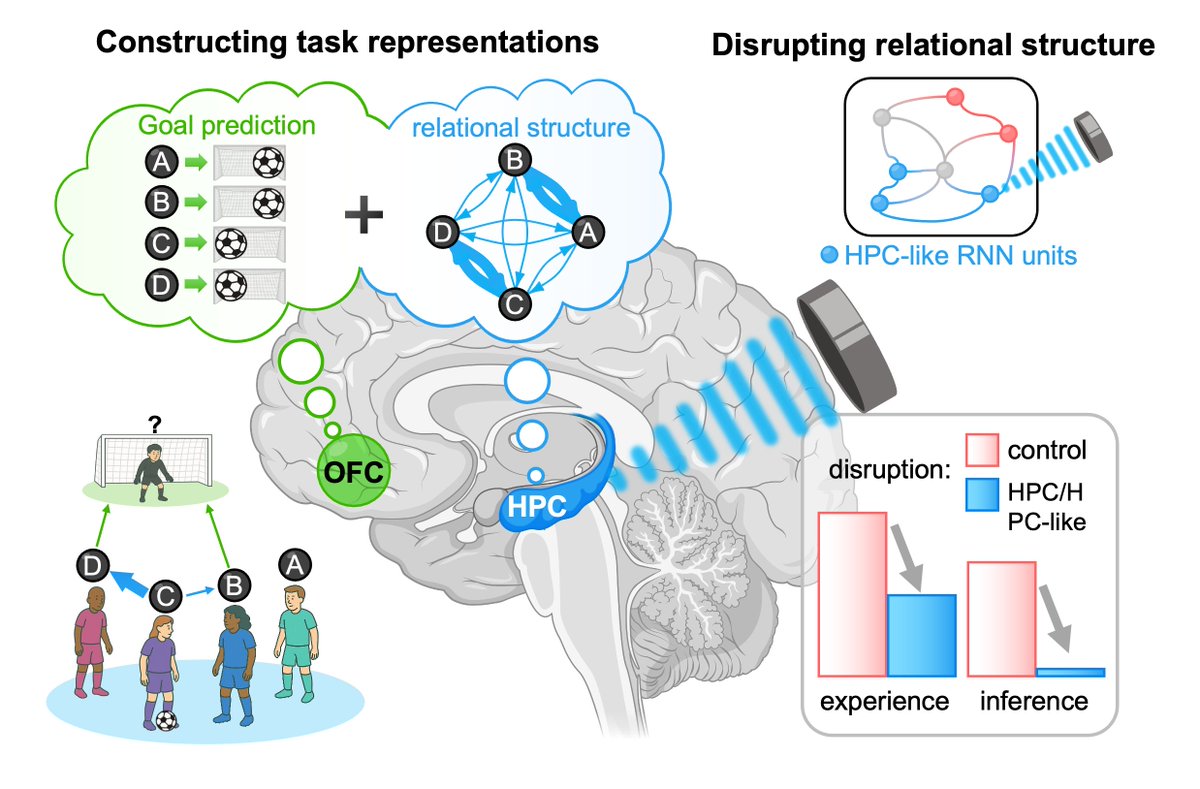
🚨We believe this is a major step forward in how we study hippocampus function in healthy humans.
Using novel behavioral tasks, fMRI, RL & RNN modeling, and transcranial ultrasound stimulation (TUS), we demonstrate the causal role of hippocampus in relational structure learning.
🚨We believe this is a major step forward in how we study hippocampus function in healthy humans.
Using novel behavioral tasks, fMRI, RL & RNN modeling, and transcranial ultrasound stimulation (TUS), we demonstrate the causal role of hippocampus in relational structure learning.
In our Learning Club @CompNeuro_lab today (Aug 18, Thursday, 2pm CET), @LiebanaSamuel will tell us about his paper (https://t.co/HCg6GfmN5H) [joint work w/ @SaxeLab & @ArminLak ]. Want to attend, send an empty email to [email protected] to get the link!