だめだもう最強の2人の冒頭で泣いてるわ
https://t.co/Wp2pMGXFgB
https://t.co/pjOOiJlkIS
September聴いて泣いてるわ、なんか、誰に言われてるかわかんないけど、ずっと陽気な親友に、お前との日々は曇りなんてねえよなあって語りかけられてる感じがして、ダメだ首から下麻痺してる白人の人に感情移入してもう号泣してる
ーーー
“Never Was a Cloudy Day” は、アメリカのソウルグループ The Sylvers の曲名です。
直訳すると、
「一度も曇った日はなかった」
ですが、英語では「曇り」は天気だけでなく、気分や人生の比喩としても使われま���。
そのため、この曲では
「君といる限り、悲しい日なんてなかった」
「君のおかげで人生はいつも���れ渡っていた」
というニュアンスになります。
『最強のふたり』で使われたことで有名になりましたが、曲自体は恋人への幸福感を歌った甘いソウル・ナンバーです。
タイトルの文法も少し面白く、本来なら
There was never a cloudy day.
と言うところを、歌詞らしく
Never was a cloudy day.
と倒置しています。
つまり意味としては、
「曇りの日なんて一日もなかった」→「ずっと幸せだった」
という感じです。🎵
ちなみに映画の冒頭で流れると、ドリスの奔放さとフィリップが久々に生を実感している感じが重なって、単なるラブソング以上の意味を帯びて聞こえます。
“Modern mathematics was born with Archimedes and died with him for all of two thousand years. It came to life again with René Descartes and Isaac Newton.”
— Eric Temple Bell
The supreme task of the physicist is to arrive at those universal elementary laws from which the cosmos can be built up by pure deduction. There is no logical path to these laws; only intuition, resting on sympathetic understanding of experience, can reach them. In this methodological uncertainty, one might suppose that there were any number of possible systems of theoretical physics all equally well justified; and this opinion is no doubt correct, theoretically. But the development of physics has shown that at any given moment, out of all conceivable constructions, a single one has always proved itself decidedly superior to all the rest.
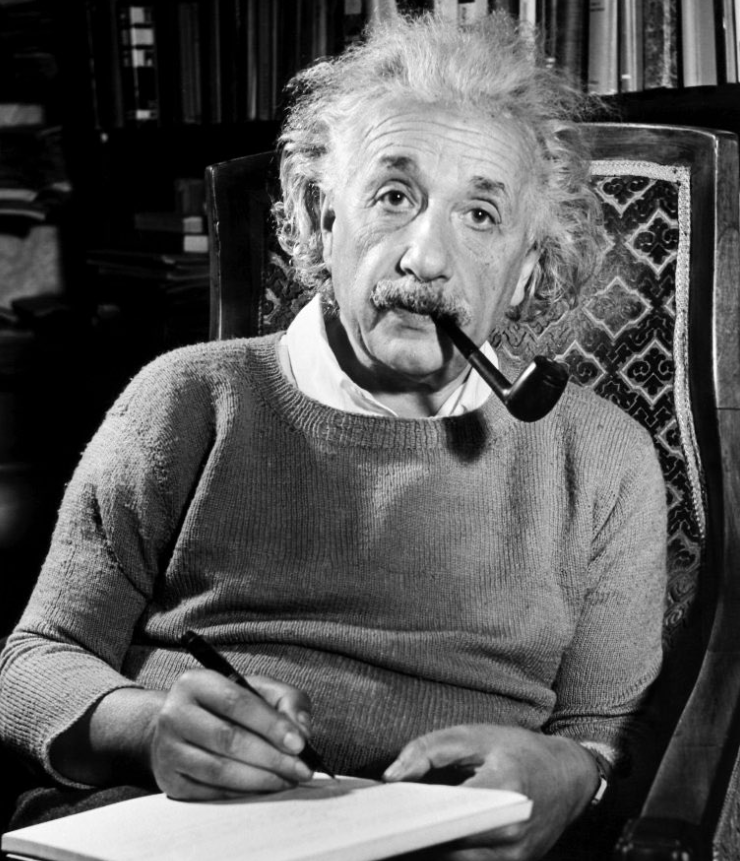
📷 A. Einstein working in his office. Portrait photograph by Herman Landshoff, Princeton, c. 1950.
Albert Einstein once remarked, “You know, Henri, I began by studying mathematics, but eventually turned to physics.”
Henri Poincaré asked, “Why was that?”
Einstein replied, “Because although I could distinguish true statements from false ones, I couldn’t determine which were truly important.”
Poincaré smiled and responded, “That’s quite interesting, Albert. I began with physics, but ultimately chose mathematics.”
Einstein, intrigued, asked, “And why did you make that change?”
Poincaré answered, “Because I couldn’t tell which of the important facts were actually true.”
The exchange captures, with subtle wit, the contrasting philosophies of two of the greatest scientific minds.