One unified platform to comply with the latest data privacy, security, & AI regulations, including GDPR, CCPA/CPRA, LGPD, SOC2, the EU AI Act, and many more.
Privacy regulation is often viewed as a compliance burden but leading organizations are turning it into a competitive advantage.
According to a recent Harvard Business Review article, companies that invest in strong privacy programs can build greater customer trust, strengthen brand loyalty, and create long-term business value. Rather than focusing solely on the short-term costs of compliance, organizations should recognize the benefits of responsible data practices, including improved customer relationships, reduced risk, and greater resilience in an increasingly regulated environment.
Data privacy isn't just about avoiding fines, it's about earning trust and differentiating your business.
Read more: https://t.co/Mumjf69CMJ
Learn how Concord can help your organization operationalize privacy compliance, automate consent management, and build trust: https://t.co/wyU2fggQnF
#Privacy #DataPrivacy #GDPR #CCPA #CPRA #PrivacyFirst #PrivacyMatters #Trust #DataCompliance
Vermont lawmakers are advancing stronger consumer privacy protections.
The Vermont Legislature has moved forward with S.71, a comprehensive privacy bill aimed at giving consumers greater control over their personal data. The legislation would require greater transparency around data collection and sharing, strengthen protections for sensitive information, limit excessive data collection, and provide consumers with rights to access, correct, delete, and opt out of certain data practices.
The bill also targets manipulative data practices and online surveillance, signaling Vermont’s continued focus on consumer privacy and data accountability.
Read more about the legislation here: https://t.co/yh0pxwFRZO
As privacy regulations continue to evolve across the U.S., organizations should proactively assess their compliance programs and consent management strategies.
Learn how to get compliant: https://t.co/woWGRupjTR
#Privacy #DataPrivacy #ConsumerPrivacy #Compliance #DataGovernance #ConsentManagement #PrivacyLaw #Vermont #GDPR #CCPA #CPRA #PrivacyFirst #PrivacyMatters
The SECURE Data Act is the latest push for a federal privacy standard, but if it feels familiar, that’s because it is.
We’ve seen multiple proposals gain traction in recent years, only to stall before becoming law. While this bill signals continued momentum, its path forward remains uncertain.
What’s not uncertain: Businesses can’t afford to wait.
State regulations are expanding. Enforcement expectations are rising. And even if a federal law passes, operational readiness (not policy awareness) will determine success.
In our latest newsletter, we break down:
- Why federal privacy efforts keep falling short
- What’s different (and what isn’t) about the SECURE Data Act
- What organizations should be doing right now to stay ahead
Read more: https://t.co/gWAang6bYN
#Compliance #DataGovernance #RiskManagement #AIGovernance #Privacy #DataPrivacy #GDPR #CCPA #CPRA #PrivacyFirst #PrivacyMatters #PrivacyNews
Colorado’s updated AI law (SB 26-189) significantly reshapes compliance requirements for businesses using AI in hiring, lending, housing, healthcare, and more.
Key changes include:
• Broader focus on AI-driven decision-making tools using personal data
• Removal of prior exemptions for some regulated entities
• New consumer rights around disclosure, corrections, and human review
• No private right of action, but discrimination liability still applies
• Mandatory AG rulemaking by 2027
• Temporary 60-day cure period through 2030
Read more: https://t.co/ouZolwOajG
#Privacy #DataPrivacy #GDPR #CCPA #CPRA #PrivacyFirst #PrivacyMatters #AI #Colorado
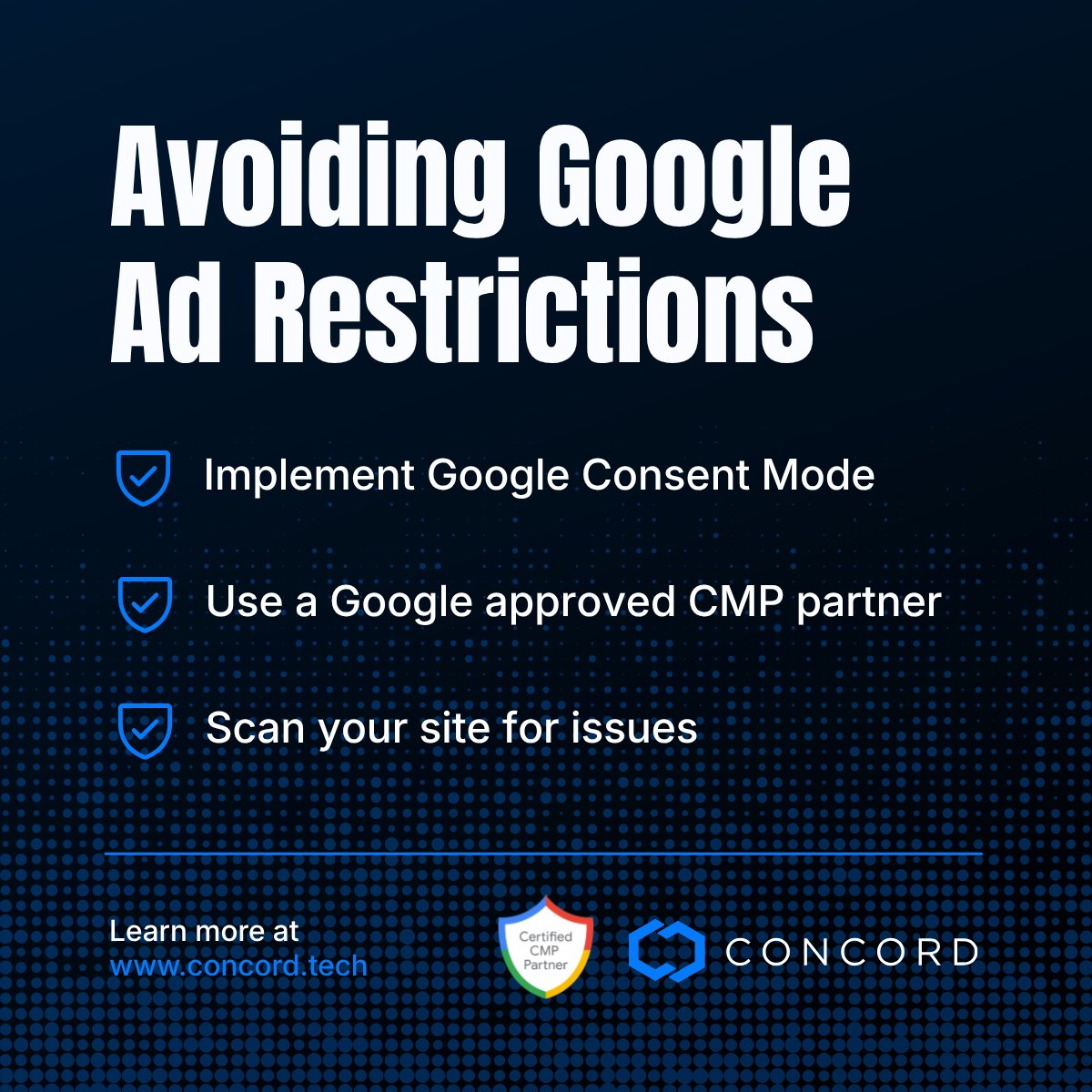
Google requires Consent Mode v2 for ads in the EEA and UK.
Missing or misconfigured signals can block campaigns, break conversion tracking, and create compliance gaps, often without warning.
Concord is a Gold-certified Google CMP partner. Our free scanner validates your consent signals instantly and reports any issues.
Run a free scan now → https://t.co/mtbWoevk9H
#Privacy #DataPrivacy #GDPR #CCPA #CPRA #PrivacyFirst #PrivacyMatters #GoogleCMP #CMP #GoogleConsentMode
Ensure your website meets GDPR, CCPA, and other regulations from day one with real-time scanning, automated blocking, and advanced compliance features.
Learn how to get compliant: https://t.co/UvvVuDHwOM
#Privacy#DataPrivacy#GDPR#CCPA#CPRA#PrivacyFirst#PrivacyMatters
🗞️🗞️ Concord Privacy News: Alabama and Oklahoma enact comprehensive privacy laws; Maine data privacy bill fails in final vote; NASCIO report highlights progress and gaps in state privacy programs.
Read more: https://t.co/ZjS5X1ayux
#Privacy#DataPrivacy#GDPR#CCPA#CPRA #PrivacyFirst #PrivacyMatters #PrivacyNews
Think GDPR doesn't apply to your small business? Or that it's only a European problem? Think again.
Two of the most common misconceptions about GDPR are that it only affects large organizations and that US-based businesses are off the hook. In reality, if your business handles any personal data, even something as simple as emails, invoices, or contact lists, GDPR may apply to you. Yes, even if you're a small business and if you're a US-based business.
What this means:
There's no small business exemption from GDPR. If you're a US company with EU customers, clients, or partners, you are not off the hook. Even basic tools like your inbox or CRM count as data processing. Customers have the right to access, correct, or delete their data. Security and organization aren't just compliance requirements, they're critical to building trust.
While some smaller companies may have lighter record-keeping obligations, the responsibility to protect personal data remains the same, regardless of where your business is headquartered.
The takeaway: GDPR isn't about company size or location. It's about how you handle data. If you do business in the EU, GDPR applies to you.
Read more: https://t.co/Udb3ByR7lr
At Concord, our next generation data privacy and compliance platform helps companies, including US businesses operating in the EU, build trust with people, drive company growth, and comply with the latest privacy regulations like GDPR.
#Privacy #DataPrivacy #GDPR #CCPA #CPRA #PrivacyFirst #PrivacyMatters
New guidance from the European Data Protection Board (EDPB) is clarifying how personal data can be used for scientific research under GDPR.
Key updates:
• Broader definition of scientific research (including commercial use)
• Clearer guidance on legal bases (consent vs. legitimate interest)
• Emphasis on data minimization and safeguards
• More flexibility for secondary data use
Read more: https://t.co/sgw6OZk6hL
#Privacy #DataPrivacy #GDPR #CCPA #CPRA #PrivacyFirst #PrivacyMatters #EDPB #PrivacyCompliance #DataGovernance #ConcordTech
India’s Digital Personal Data Protection Act vs. GDPR: A Comparison. Digital Personal Data Protection Act (DPDPA) replaced India’s existing patchwork of data protection rules and triggered changes in how companies subject to Indian data protection laws process personal data. Read more: https://t.co/eqLyrhEkqk #Privacy #DataPrivacy #GDPR #CCPA #CPRA #PrivacyFirst #PrivacyMatters #DPDPA
On April 7, the Alabama legislature enacted a comprehensive data privacy bill, positioning Alabama as the 21st state to pass such a bill. This bill will take effect on May 1, 2027. Learn more: https://t.co/1FZI513lYN #Privacy#DataPrivacy#GDPR#CCPA#CPRA#PrivacyFirst #PrivacyMatters #Alabama
The future of financial data privacy in the U.S. may be shifting—again.
A recent House Financial Services Committee hearing put a spotlight on a growing challenge: while most state privacy laws still include exemptions tied to the Gramm-Leach-Bliley Act (GLBA), those exemptions are evolving.
👉 Many states are moving away from broad, entity-level exemptions
👉 More are adopting narrower, data-level exemptions
👉 And that means GLBA compliance alone may no longer be enough
For privacy teams, this creates a more complex reality—where the same organization may be both exempt and regulated, depending on the data and jurisdiction.
At the same time, lawmakers are signaling potential updates to GLBA itself, raising the stakes for organizations managing financial data.
We break down what this means—and what to do next.
🔗 Read more: https://t.co/taxcJq3rCT
#Privacy #DataPrivacy #GDPR #CCPA #CPRA #PrivacyFirst #PrivacyMatters #GLBA #Compliance
CIPA is quickly becoming one of the most important, and misunderstood, sources of privacy risk.
A law from 1967 is now being used to challenge modern website technologies, from analytics to tracking pixels.
The takeaway: Privacy risk isn’t just about new regulations anymore — it’s also about how existing laws are being reinterpreted.
We broke down the key implications for businesses 👇
https://t.co/3SoV7REoHv
#DataPrivacy #PrivacyCompliance #CIPA #WebsitePrivacy #DataProtection #Privacy #PrivacyMatters #PrivacyFirst