The CDL26 programme is now live!
Two days of real-world deployments, Business Value, Developer Evolution, Scale & Governance, Ontology Engineering & Practice, Rapid Insights.
Clinical trial protocols turned into knowledge graphs, Norway's railway mapped as one, and Siemens using graphs to power its industrial AI agents.
AstraZeneca, Mercedes-Benz, Bloomberg, Google, ServiceNow, and Scania are among those sharing what's working with knowledge graphs, ontologies, and AI right now.
William Tunstall-Pedoe opens with a keynote on neurosymbolic AI, and there are tracks for everyone, from beginners to advanced.
⭐ Take a look at the full programme and book your tickets now: https://t.co/O5Y9IDVv6Z ⭐
📍11-12 November | London Tower Bridge
Keynotes from distinguished speakers
Presentations with leaders and innovators
Panel discussions exploring diverse views
Masterclasses with expert instructors
Lightning Talks to get you up to speed
#KnowledgeGraph #GraphRAG #Ontology #Graph #AI #DataScience #GraphDB #SemTech
Swisscom runs more than 100 inventory systems, and each one holds only a fragment of the truth. Working out how customers, services, resources, vendors, contracts and owners connect across all of them used to be slow, costly and risky.
At CDL26, Florian Kammermann, Intelligence Management Enterprise Architect at Swisscom, will explain how his team turned those silos into a connected enterprise knowledge graph without taking ownership away from the teams that run each system.
Data stays with its source domains and is published as data products. A central correlation capability then links everything into one knowledge graph, using the Swisscom Data Model as the ontology. It’s Data Mesh and connected-data principles working together in production. Data quality is enforced at the source, domains stay autonomous, and the business gets an AI-ready view of the whole estate.
The graph now supports vendor compliance, vulnerability management, incident management and change impact analysis. If you’re trying to show measurable value from a large-scale data correlation project, or you’re wondering whether Data Mesh and knowledge graphs can coexist, this is a good one to catch.
From 100+ Inventory Silos to a Connected Enterprise Knowledge Graph
🎤 Florian Kammermann, Intelligence Management Enterprise Architect, Swisscom
📅 Wednesday 11 November 2026, 12:55 PM - 1:15 PM, Rapid Insights Track (Ludgate Suite)
📍 Leonardo Royal Hotel London Tower Bridge
⭐ Discover more about this session & book your CDL26 pass: https://t.co/zboAPZN1y6
#CDL26 #KnowledgeGraphs #DataMesh #EnterpriseArchitecture #DataProducts
Most graph queries start with something you can name: a known entity or an explicit pattern. Real investigations often start with much less. You might only have a few clues about an entity or a pattern of events, and nothing that matches exactly.
In this two-hour CDL26 masterclass, Prashanth Rao and David Hughes of HDC Labs introduce hyperdimensional computing (HDC) as a way to handle exactly that. HDC represents information as hypervectors, long lists of numbers, often thousands of elements long. A simple algebra combines them to represent properties, relationships and collections of facts. You can then compare a partial query against those representations and surface relevant records, even when you only know some of the details.
The session treats HDC as a modelling technique that works alongside graphs, not as a replacement for them. The graph stays in place for exact relationships, constraints and supporting evidence. After a short introduction, you’ll spend most of the time in guided Python notebooks, building representations from a connected dataset, querying them with incomplete clues and following graph relationships from what you retrieve. You’ll also look honestly at when ordinary embedding search is already good enough.
You’ll leave with:
- Worked notebooks you can rerun on your own data
- A modelling worksheet for deciding what to retrieve, what distinctions to preserve and how to encode partial queries
- A clear sense of where HDC adds value and where it doesn’t
No previous knowledge of HDC is needed.
Modeling Connected Data with Graphs and Hypervectors
🎤 Prashanth Rao & David Hughes, HDC Labs
📅 Wednesday 11 November 2026, 03:30 PM - 05:30 PM, Developer Evolution Track (Harpley Suite)
💻 Bring a laptop set up to run Python notebooks
📍 Leonardo Royal Hotel London Tower Bridge
⭐ Learn more about this session & book your pass: https://t.co/DNLvy11L5x
#CDL26 #KnowledgeGraphs #HyperdimensionalComputing #GraphDatabases #Python #DataScience
Vibe coding has made building an application easier than ever. The hard part now is the data underneath it. Conversational, adaptive apps need a connected data layer that captures context, relationships and domain knowledge in a form AI can reason over.
Cybersecurity is a good test case. Knowledge about threat actors, malware, vulnerabilities and infrastructure is deeply interconnected, but it’s usually scattered across reports, analyst notes and disconnected datasets. Knowledge graphs can bring it together, but expert-built ontologies are slow to scale and can reflect narrow or contested definitions.
This CDL26 session tackles that problem from two directions.
The research: four AI agents analyse a domain using different reasoning strategies. A coordinating agent called Organon then weighs their outputs to produce a richer ontology. That ontology becomes a graph database schema that users can query in plain English.
The real-world build: lessons from creating a canonical threat-actor data product inside a global financial institution. That work covered the data model and dictionary, alignment with the enterprise ontology, field-level quality controls, and a single source of truth for threat-actor identities, aliases and scoring.
You’ll come away understanding how AI agents can generate ontologies, how those ontologies become usable knowledge graphs, and why high-quality connected data is what makes context-aware AI reliable. No cybersecurity background is needed, so this is a good fit for both business and technical attendees.
From Natural Language to Connected Intelligence: AI Agents and Knowledge Graphs in Cybersecurity
🎤 Symeon S. Vasileiadis, AI & Data Lead, J.P. Morgan
📅 12 November 2026, 4:25 PM - 4:55 PM, Educational Track
📍 Leonardo Royal Hotel London Tower Bridge
⭐ Discover more about this session & book your pass: https://t.co/Tlad6uC8wt
#CDL26 #KnowledgeGraphs #Cybersecurity #AIAgents #Ontology #ThreatIntelligence
Ten years in, the questions this community asks have changed.
It used to be "should we build a knowledge graph?" Now it's how to ground an agent in one, how to tell whether an AI-generated ontology is any good and how to prove the value before anyone signs off on the budget.
Here are six things you'll learn at #CDL26:
01 How to build your own knowledge graph-powered MCP server, in Neo4j's hands-on masterclass
02 How to prove the value of a graph before you build it, with Value from Data & AI
03 Which of 11 RDF frameworks actually performs, from Data Treehouse's honest benchmark
04 How to spot an LLM-built ontology that only looks complete, from Scania's ontology architect
05 How to ground AI agents in your data without copying it into yet another store, from the founder of Google's Spanner Graph
06 Why neurosymbolic AI can make answers fully auditable, in the opening keynote from William Tunstall-Pedoe
That's six of 50+ sessions across nine tracks, so ensure to plan your session schedule ahead of event day.
🌟Build your schedule: https://t.co/O5Y9IDVv6Z
#CDL26 #KnowledgeGraphs #Ontology #GraphRAG #AgenticAI #SemanticWeb
The Ontology Buyer’s Dilemma: The Governance Layer No Platform Sells
The fact travels. The rule doesn’t.
Take a payment above a set threshold. A compliance hold is placed on it. Release requires sign-off from someone with legal authority.
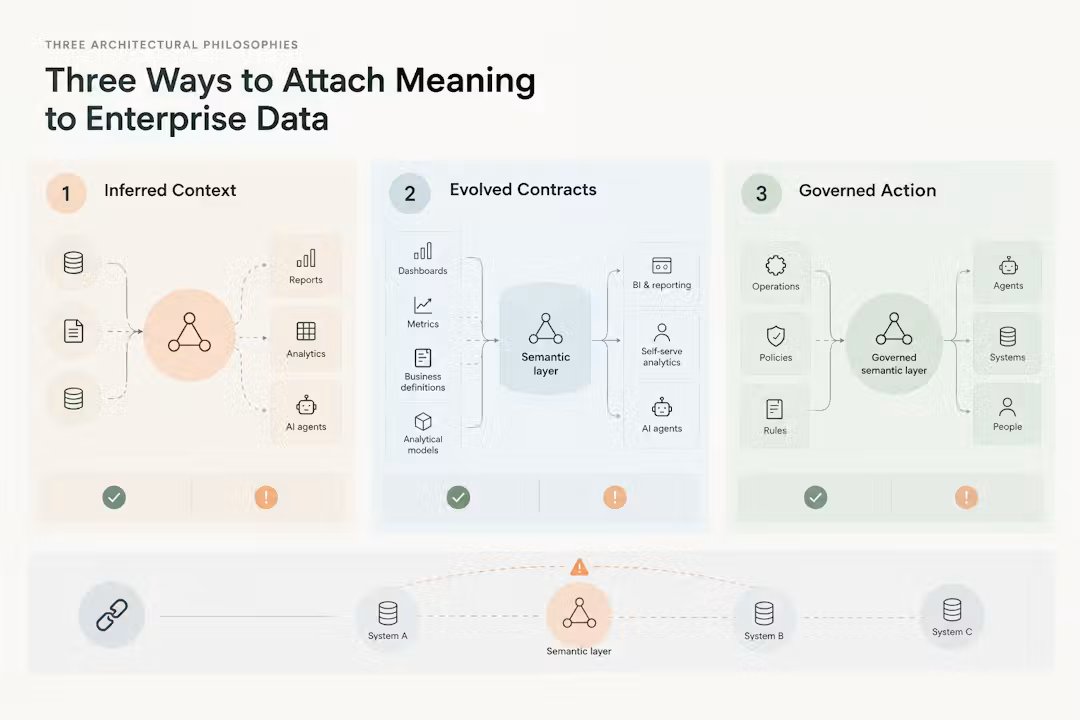
Inside the platform where the rule was defined, it holds. Whether a system infers context, evolves a data contract or models governed actions, each can represent that rule within its own boundary.
Then an agent hands the payment to a system outside that boundary.
The hold status arrives. The approval requirement does not.
That seam sits at the centre of a piece on how enterprises choose semantic layers for AI agents. Three architectural philosophies compete for the same budget: inferred context, evolved contracts and governed action. Standard procurement matrices score openness, ease of adoption, integration and lock-in. One criterion is missing: whether a rule is enforced once work crosses into a second system.
The distinction drawn:
Grounding: what a system tells an agent an entity means
Governance: what a system lets an agent do about it, everywhere the agent operates
The platforms surveyed demonstrate strong grounding. None demonstrates governance that survives a boundary it did not build. The authors call the result semantic theatre: a rule that looks enforced because it is visible, but only holds inside the platform built to see it.
Why the gap survives procurement, with no bad faith required from vendors:
A cross-boundary lapse cannot be staged in a sales demo
Formal constraint modeling is a scarce skill
RFP scoring rewards feature checklists over architectural completeness
Choosing among the three philosophies is the tractable seventy per cent. The remaining thirty per cent has no commercial sponsor, and every added agent and platform boundary adds another seam.
Before signing: ask vendors to demonstrate rule enforcement across two integration points rather than one, and name who internally owns the risk of a rule failing at a handoff. 🔍
By Travis Thompson and Muskan Purohit
https://t.co/EPA1vGgVFB
#AIAgents #DataGovernance #SemanticLayer #EnterpriseArchitecture #DataEngineering
--
Connected Data London 2026 | 11–12 November | Leonardo Royal Hotel London Tower Bridge
🎟 Tickets on sale now - 🔔 Full programme announced
https://t.co/vx5EQB5CXb
📺 Sponsorship opportunities available. Contact [email protected] for details.
#KnowledgeGraph #GraphRAG #Ontology #Graph #AI #DataScience #GraphDB #SemTech
The Post Office Horizon scandal wasn’t caused by a lack of data. It happened because the system’s version of reality was trusted over the real world, and nobody had the means or the ownership to challenge it.
Knowledge graphs and ontologies carry the same risk; they’re built to be a single source of truth, but the business they describe keeps moving. Terminology shifts, priorities change, and source systems multiply, often faster than the formal model can keep up. The harder question is how you keep business meaning aligned over time, and who owns it.
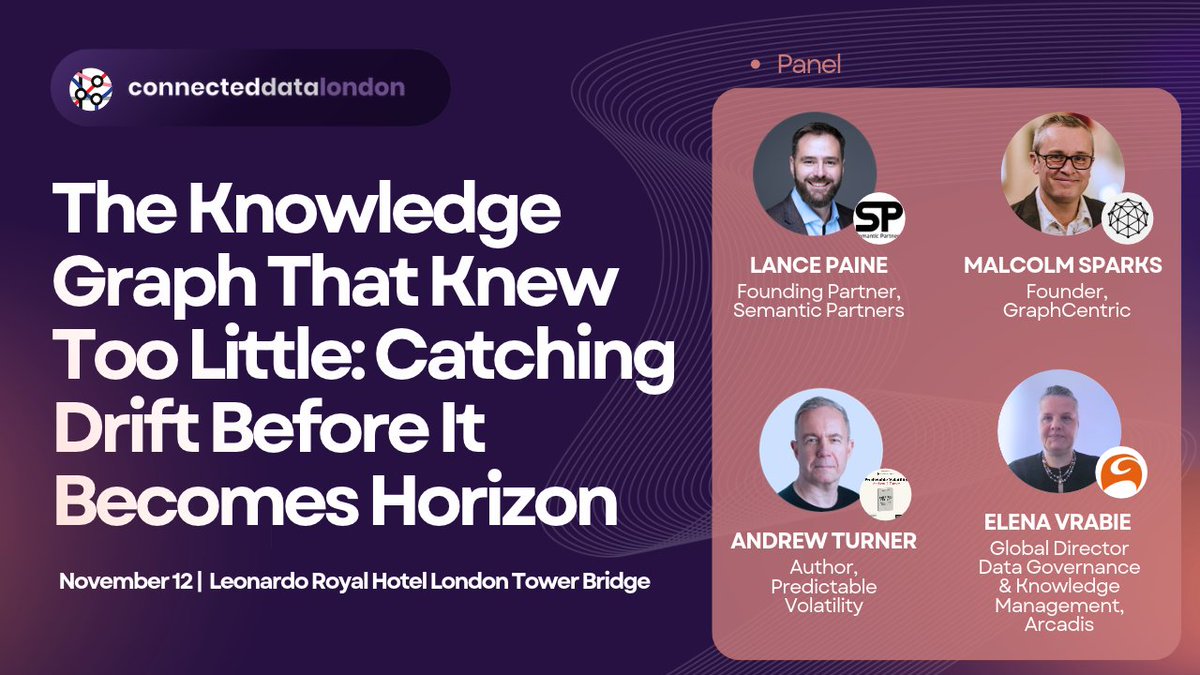
This fast-paced CDL26 panel brings together four leading speakers who tackle that question from different angles:
🎤 Lance Paine, Founding Partner - Semantic Partners
🎤 Malcolm Sparks, Founder - GraphCentric
🎤 Elena Vrabie, Global Director, Data Governance & Knowledge Management - Arcadis
🎤 Andrew Turner, Author - Predictable Volatility
Expect agreement on the problem and honest debate on the answers. The panel will cover layered ontologies that change at different speeds, the difference between detecting drift and deciding what should change and how to reframe governance for colleagues as change-impact tracking rather than red tape. You’ll leave with a few practical principles for your own programmes and a clear sense of where experienced practitioners still disagree.
The Knowledge Graph That Knew Too Little: Catching Drift Before It Becomes Horizon
📅 Thursday 12 November 2026, 11:35 AM - 12:05 PM, Educational Track (Bartholomew/Harpley Suite)
📍Leonardo Royal Hotel London Tower Bridge
⭐ Read more about this panel and register to attend CDL26: https://t.co/GVGwOL2bi2
#CDL26 #KnowledgeGraphs #Ontology #DataGovernance #SemanticWeb
Join GraphGeeks for our Connected Data London wrap-up mixer - an evening to unwind after the conference, catch up with familiar faces, meet new people and keep the conversations flowing around all things graphs, knowledge graphs and AI.
Come along to share ideas, hear what others are working on, and meet more people in the graph community!
📍 London, near Tower Bridge
🗓️ Friday, November 12 | 5:30 PM onwards
🍹 Drinks and light refreshments provided
You don’t need to attend Connected Data London to join this mixer - if you’re passionate about graphs or just graph-curious, you are welcome.
🌟 Space is limited, so register ahead and connect with us: https://t.co/A7evivZDZv
#GraphGeeks #ConnectedDataLondon #KnowledgeGraphs #GraphTechnology #AI #DataCommunity
Creating Customer 360s Using Entity Resolution
This talk will cover how teams are creating customer 360s using entity resolution. Combining data from different systems or databases to create a customer 360 presents various difficulties. For example, not every system will have a shared ID or key that allows you to uniquely identify a person. Using entity resolution, we can use the various pieces of data to identify a person.
Main Takeaways:
- Entity resolution is essential for creating accurate customer 360s.
- Understanding the challenges of data quality, multiple identifiers, data silos, and data privacy is crucial for successful implementation.
- Entity resolution techniques can help identify and match customer records, resolve data inconsistencies, integrate data from multiple sources, and address data privacy concerns.
- Real-world examples provide valuable insights into the practical application of entity resolution in building customer 360s.
https://t.co/szhhKZaZqm
--
Jesse Anderson. Data Engineer, Creative Engineer, Managing Director, Big Data Institute
Jesse Anderson is a Data Engineer, Creative Engineer, and Managing Director of Big Data Institute. He mentors companies all over the world ranging from startups to Fortune 100 companies on Big Data. This includes projects using cutting-edge technologies like Apache Kafka, Apache Hadoop, and Spark
--
Welcome to Connected Data London's #ThrowbackThursday
Every Thursday at 3pm GMT, we are releasing gems from our vault on #YouTube
Tune in and learn from leaders and innovators; subscribe to our channel and watch premieres as they are released!
#knowledgegraph #graphdatabase #graph #AI #datascience #analytics #semtech #ontology
What did ontology ever do for us?
Ontology is hard to do well. Experts argue over points that decision makers have little reason to care about, which makes the “ology” a tough sell to management.
So the useful question is a practical one: where does it deliver real benefit?
Three answers stand out.
1. Data integration
Decisions need accurate, relevant and timely information. In large organisations, that information is smeared across databases of varying vintage and quality, built to different rules with few common standards.
A taxonomy tags terminology. A proper ontology provides common business patterns that standardise the meaning of data (the semantics) as well as the terms. It’s how Telicent CORE and other ontology-driven systems work.
2. Data sharing
Words are dangerous. It’s hard to know whether another person, or system, understands a term exactly as you do.
A good ontology pushes meaning into the structure of the data rather than relying on terms. Identifying something by what it’s part of is often more reliable than a name or key. It can also accommodate ambiguity, letting data owners be specific about how they’re being vague.
For safety-critical data shared with partners, better to embrace the complexity than pretend everything is clear cut.
3. A fresh analytical perspective 🔍
The strongest formal ontologies rest on foundations that formalise high-level concepts: space and time, causality, classification, uncertainty. Philosophers and logicians call these “metaphysical choices”. In practice, they amount to a reusable, scalable approach to recurring problems.
Getting those foundations both correct and useful is no small task. Existing standard upper ontologies are the best place to start:
Much of the hard work is already done
Others use them, so hiring is easier
They bring interoperability with like-minded partners
There are more uses for ontologies, but data integration, data sharing and a new lens on complex data problems are where the benefit is clearest.
By Ian Bailey
https://t.co/SPDG7mFF4v
#DataIntegration #DataSharing #Semantics #UpperOntology #EnterpriseData
--
Meet Ian Bailey and Telicent at Connected Data London 2026 | 11–12 November | Leonardo Royal Hotel London Tower Bridge
🎟 Tickets on sale now - 🔔 Full programme announced
https://t.co/cgRWidLVZ2
📺 Sponsorship opportunities available. Contact [email protected] for details.
#KnowledgeGraph #GraphRAG #Ontology #Graph #AI #DataScience #GraphDB #SemTech
What connects football, royalty and schadenfreude? More than you might think!
At Connected Data London, Oxford Semantic Technologies’ CEO joins Aedín Guyot, Semantic Expert at Reach, to explore how one of the UK’s largest news publishers combines LLMs, knowledge graphs and rule-based reasoning to make sense of more than 4,000 news articles every day.
Discover how reasoning uncovers new facts and hidden relationships in existing data, enriching Reach’s knowledge graph by 30% without manual overhead. The result? Richer insights that help editorial teams understand the stories, subjects and connections that resonate with their audiences.
Drawing on years of real-world experience, this session explores how knowledge-based AI complements LLMs, how reasoning scales with constantly changing data, and what other organisations can learn from putting these technologies into production.
🎤 Aedín Guyot, Reach - Taxonomy Business Analyst & Peter Crocker, Oxford Semantic Technologies - CEO
📅 12 November | Educational Track, 12:10 PM - 12:40 PM
⭐ Discover more about the session and secure your CDL26 pass today: https://t.co/T7rEbkoOwB
#CDL26 #KnowledgeGraphs #SemanticAI #LLMs #AI #ConnectedData
An LLM will build you an ontology in minutes if you ask it to. What it won’t do is make the decisions that separate an ontology from a schema. Dean Allemang, Senior Staff Applied Research Scientist at ServiceNow, calls this “no-how dressed up as know-how”. Choosing an upper ontology, reusing domain models like FIBO, applying patterns such as “things not strings”, and knowing when OWL should give way to SHACL is hard-won expertise. It’s what keeps an ontology reasoning correctly and integrating cleanly as new use cases arrive.
At #CDL26, Dean will show how to make that expertise explicit and enforceable inside a vibe-ontology workflow, using an MCP service, an assistant skill or standing guidance in a system prompt. He’ll walk through his own deliberately opinionated policies, explain where a human still needs to step in, and share how subject matter experts achieved in a week what a team of ontologists would once have needed months for.
You’ll leave with a concrete pattern for letting the LLM handle the heavy lifting while the ontologist’s judgment stays in charge. You’ll also see competency questions reframed in a way every developer will recognise: as unit tests for meaning.
Know-How Beats No-How: Steering Vibe Ontologies with Ontologist Judgment
🎤 Dean Allemang, Senior Staff Applied Research Scientist, ServiceNow
📅 Thursday 12 November 2026, 02:15 PM - 02:45 PM, Edges Track (Salisbury Suite)
📍 Leonardo Royal Hotel, London Tower Bridge
⭐ Discover more about this session and book your pass now: https://t.co/SRiUkxzhCF
#Ontology #KnowledgeGraphs #GenAI #SemanticWeb #AIEngineering
Some of the most meaningful conversations at CDL26 will happen away from the stages. Our Gold Sponsors are bringing teams who have solved, at serious scale, the problems many attendees are still wrestling with.
- If you’re trying to get buy-in for a knowledge graph inside a large organisation, talk to Bloomberg. Their Enterprise Knowledge Graph makes data findable, accessible, interoperable and reusable across every domain of the business, and they build it for their own use rather than to sell. Few teams can tell you more honestly what it takes to make semantic metadata work across a whole company.
- If your knowledge graph, analytics and AI agents live in separate places, find the Google team at Stand 6, then go to their session on unifying knowledge graphs, semantics and AI agents on Google Data Cloud. It’s a chance to see how BigQuery fits into a connected data architecture and to put your own questions to the people building it.
- If you need reasoning over your data, not just storage, spend some time with Oxford Semantic Technologies, the team behind RDFox. Spun out of the University of Oxford and now part of Samsung, they work on applications such as financial crime detection and medical diagnosis, and they can show you what rules-based inference looks like in production.
- If your AI agents keep tripping over duplicate or conflicting records, Senzing is the conversation to have. They created Agentic Entity Resolution, which helps agents recognise the same real-world person or organisation across messy data in real time, without the data leaving your own infrastructure.
Come with your problem, and leave with the insights to solve it.
📅 11-12 November 2026
📍 Leonardo Royal Hotel London Tower Bridge
⭐ Book your pass and discover more of our 2026 sponsors: https://t.co/yv9ro7TdeW
#CDL26 #KnowledgeGraphs #EntityResolution #AIAgents #DataArchitecture
Plant Memory: SAP PM work orders as verified, agent-accessible failure knowledge 🏭
A work order short text reads “Parb.- Dryer elevator brg chng”. The remarks field mixes English and Hindi. The root-cause column is mostly empty.
Maintenance records are the largest written account of how industrial equipment fails. The diagnostic knowledge behind them often stays with senior technicians.
Plant Memory turns SAP PM exports into an ISO 14224-aligned maintenance ontology. Every extracted statement is a reified fact carrying:
a confidence score
the exact evidence it was read from
a verification state: proposed, verified or rejected
How it works:
Rule-first technical language processing expands abbreviations, resolves assets and extracts component, failure mode, root cause and action
An LLM acts as a second reader. Its disagreements raise a fact’s review priority instead of overwriting it
Technicians work through a review queue, answer knowledge-gap questions where failures repeat without a recorded cause, and approve or reject ontology drift proposals
One graph serves a web app for people and an MCP server for AI agents, and every answer cites the work orders behind it. The only write tool creates proposals
Results on a synthetic 12-month export of 400 work orders from a parboiled-rice plant:
96.2% component accuracy and 88.9% failure-mode accuracy
100% root-cause precision at 62% coverage
82.1% top-1 root-cause accuracy on 28 diagnostic questions, against 53.6% for the raw SAP root-cause column
An LLM used as an independent extractor reached 55.4% on failure mode, against 88.9% for the rules. That comparison shaped the merge policy.
The paper notes that synthetic ground truth favors the system, and names evaluation on real plant data with technicians as the next step.
By Akash Raj
https://t.co/H8V0uqsdTw
#MCP #Industry #Manufacturing #ISO14224 #Neo4j #Maintenance
--
Connected Data London 2026 | 11–12 November | Leonardo Royal Hotel London Tower Bridge
🎟 Tickets on sale now - 🔔 Full programme announced
https://t.co/2c3xIpiuEt
📺 Sponsorship opportunities available. Contact [email protected] for details.
#KnowledgeGraph #GraphRAG #Ontology #Graph #AI #DataScience #GraphDB #SemTech
The most dangerous AI answer isn't the obviously wrong one. It's the one that sounds completely right and isn't.
Malcolm Hawker, CDO of Profisee, former Gartner analyst and author of The Data Hero Playbook, thinks the industry is building exactly that problem into GenAI.
He argues that trustworthy AI needs two things. The first is meaning: a shared understanding of what your data represents. The second is truth: whether the specific records behind an answer are actually real. Most of the market's energy is going into meaning, through semantic layers, knowledge graphs and retrieval, while truth gets quietly left behind.
At #CDL26 he'll explain:
- Why adding more context will never close that gap on its own
- Where trusted truth actually comes from, and the role master data plays
- A simple test for knowing when an AI use case needs master data and when it doesn't
- Why agentic AI raises the cost of getting this wrong
It's a useful challenge for a room full of knowledge graph practitioners, and that's exactly why it's a great fit for the programme.
🗓️ 12 November, 11:35 | Nodes Track, Warwick Suite
⭐ Learn more about this session and book your pass today: https://t.co/3Fmu7YaC4L
#CDL26 #TrustworthyAI #MasterData #KnowledgeGraphs #DataGovernance
What if AI agents didn't just know what to do, but also understood what they're allowed to do?
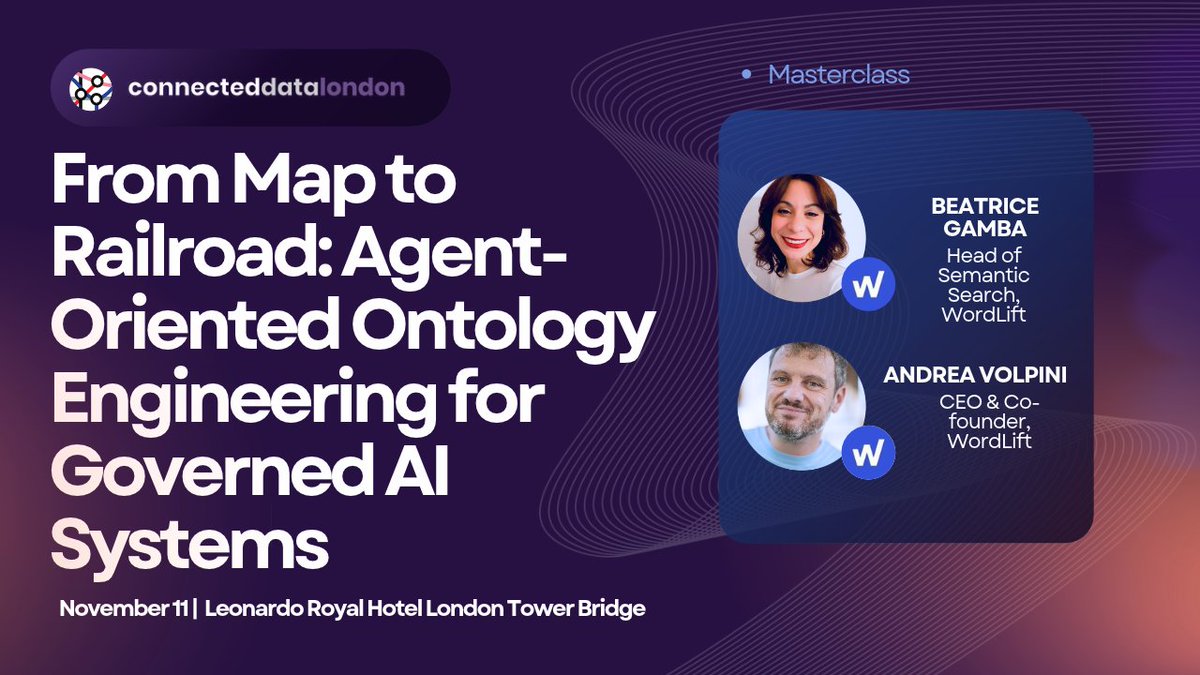
That's the challenge behind From Map to Railroad, a hands-on masterclass coming to Connected Data London 2026. Beatrice Gamba and Andrea Volpini of WordLift are exploring how ontology engineering can help make agentic AI more predictable, governed and ready for real-world enterprise use.
The idea is to move beyond ontologies that simply describe a domain. By connecting semantic models with executable constraints and defined states, teams can give AI agents clearer boundaries for the actions they take - rather than leaving business rules and permissions entirely to an LLM's interpretation.
During this practical session, attendees will work through Python exercises exploring how OWL and SHACL can support constraint enforcement, traceable decisions and more reliable tool execution. They'll also look at how this approach can generate useful data for training and improving specialised AI models.
You will leave this session knowing how to turn organisational knowledge into something AI agents can actually operate within - with governance built into the architecture.
If you're working on agentic AI, enterprise knowledge graphs or the challenge of making autonomous systems accountable, bring your curiosity (and your Python skills) to this session.
From Map to Railroad: Agent-Oriented Ontology Engineering for Governed AI Systems
🎤 Beatrice Gamba & Andrea Volpini - WordLift
🗓️ Wednesday 11 November 2026, 3:30-5:30 PM
📍 Ontology Engineering & Practice Track, Salisbury Suite
⭐ Explore the session further and secure your CDL26 pass: https://t.co/n4vziM2trf
#CDL26 #AgenticAI #KnowledgeGraphs #Ontology #AI #DataGovernance #SemanticWeb
Bloomberg's data underpins decisions across global financial markets, and keeping that data connected, consistent and trustworthy is what their metadata and knowledge graph teams work towards every day.
That's why their presence at Connected Data London 2026 matters. When an organisation at that scale backs this community as a Gold Sponsor, it shows knowledge graphs have moved past the experimental stage and into the infrastructure that large businesses depend on.
They aren't just sponsoring. Tara Raafat, Head of Metadata Strategy at Bloomberg, sits on our Programme Committee and helped shape this year's agenda. She returns to the stage on 12 November with a question many teams are only starting to face: what happens to knowledge graph governance once AI agents start editing the graph?
If you're building a business case for knowledge graphs in your own organisation, this is the room where you'll hear how one of the most data-intensive companies in the world actually does it.
🗓️ 12 November, 12:10 | Nodes Track, Warwick Suite
⭐ Book your pass: https://t.co/yv9ro7TdeW
#CDL26 #KnowledgeGraphs #Metadata #FinancialData #DataGovernance
The Quality Inheritance Principle: Why AI Is Only as Good as Your Vocabulary
MIT NANDA reviewed more than 300 publicly disclosed AI initiatives. 95% of the pilots produced no measurable impact on the P&L.
The usual suspects sit at the model level: hallucination, domain tuning, context windows. In health systems, the break tends to sit one layer lower, in the vocabulary an organization uses to describe its own world.
Take a routine research question: how many patients had this condition, took this medication, and fell in this age range?
It reads as one question. It is three category definitions stacked together:
- Condition → a set of diagnosis codes
- Medication → drug identifiers across brands, generics, and dosages
- Age range → a date of birth, measured against a reference date someone has to choose
Billing, the lab system, and the research registry each define these differently. None is wrong. They were simply never reconciled.
i2b2, the open-source cohort-discovery platform born in academic medicine, shows what changes when they are. Cohort queries that took weeks (approvals, analyst interpretation, rewrites) took minutes. The interface was not the breakthrough. Billing and lab codes had been mapped into shared concept hierarchies, so the interpretation an analyst repeated on every request was done once and made reusable.
The speed came from agreement.
An ontology, in this framing, is the organization's vocabulary written down, with the disagreements resolved before anyone builds on top of it. It can live in a knowledge graph, a semantic layer, governed data products, or a well-kept spreadsheet. The format matters less than whether the agreements are real.
AI raises the stakes. An analyst who meets an ambiguous field asks a colleague or flags the result. A model reasons fluently on an argument the organization never settled, and the output arrives looking authoritative.
Five questions to ask before building:
1. Problem-value fit
2. Data readiness
3. Explainability and trust
4. Workflow fit
5. Sustainability
Over all five sits governance: who owns each decision?
Data readiness is the one most often skipped, because "ready" gets mistaken for "clean." Readiness asks:
- Consistent definitions: does "admission date" mean the same thing in every system?
- Preserved variance: what is lost when different conditions share one bucket?
- The right level: encounter, patient, unit, or population?
Each is an ontology question. No data quality tool settles them.
The organizations in the remaining 5% tend to differ less in model quality than in how firmly they agree on what their words mean. 🧩
By Riyaz Mohammed
https://t.co/kgn0oxAHKD
#HealthcareAI #DataGovernance #SemanticLayer #DataQuality #ClinicalData
--
Connected Data London 2026 | 11–12 November | Leonardo Royal Hotel London Tower Bridge
🎟 Tickets on sale now - 🔔 Full programme announced
https://t.co/oBCyIjAgUb
📺 Sponsorship opportunities available. Contact [email protected] for details.
#KnowledgeGraph #GraphRAG #Ontology #Graph #AI #DataScience #GraphDB #SemTech
Knowledge graphs and ontologies are having their moment in the AI spotlight. But for some people, this work started long before the hype. At CDL26, one of those people is sharing 20 years of hard-won lessons on what it really takes to turn data into shared understanding.
Since 2005, Juan Sequeda has been working on knowledge graphs and ontologies, starting with research-backed approaches to deriving knowledge graphs from relational databases. Since then, that work has moved beyond academia into startups, products, and enterprises wrestling with the same fundamental challenge: how to make data meaningful, connected, and useful. Two decades later, the questions remain surprisingly familiar. Why do these projects succeed or fail? Why do teams underestimate the work involved? And why is building a solid semantic foundation still so difficult?
This session isn't a nostalgic trip through the history of the semantic web. It's a practical guide built on experience, covering the technical, organisational, and cultural lessons that come from doing this work for real. Expect honest insights into the patterns that keep repeating, architectural approaches that work, and advice on how to build semantic foundations without trying to boil the ocean.
If you're building, buying, or betting on knowledge graphs in the age of AI, this is a chance to learn from 20 years of experience, avoid some expensive mistakes, and understand what it takes to make knowledge work in practice.
Scar Tissue: 20 Lessons from 20 Years of Building Ontologies and Knowledge Graphs
🎤 Juan Sequeda
📅 12 November, 1:40 PM- 2:10 PM, Nodes Track | Warwick Suite
📍 Leonardo Royal Hotel London Tower Bridge
⭐ Discover more about this session and secure your CDL26 pass: https://t.co/x8cEznM9Uu
#CDL26 #KnowledgeGraphs #Ontology #SemanticWeb #AI #DataArchitecture
Context = Knowledge + Expertise + Norms
Context = Knowledge + Expertise + Norms, Prukalpa argues. The enterprise context layer turns all three into machine-usable context for agents. It has two halves.
A core substrate with three tightly integrated parts: AI-ready data and a knowledge graph, semantics and ontology (the shared meaning layer), and skills (reusable, versionable, testable units of procedural knowledge).
Plus five capabilities that run on top: context mining, a development lifecycle for context itself, compounding learning loops, activation and retrieval across many interfaces, and governance and observability.
Florence Benezit notes the data architectures agents access are excellent at storing what’s true right now, but they were not designed to keep how it got that way. The fix she proposes is similar – three layers stacked together: knowledge graphs, ontologies, and context graphs.
When agents become the primary consumers of your data, your data architecture becomes your AI architecture, Pramod Sadalage and Prem Chandrasekaran add. To make data ready for agentic AI, they introduce the AI-ready data stack.
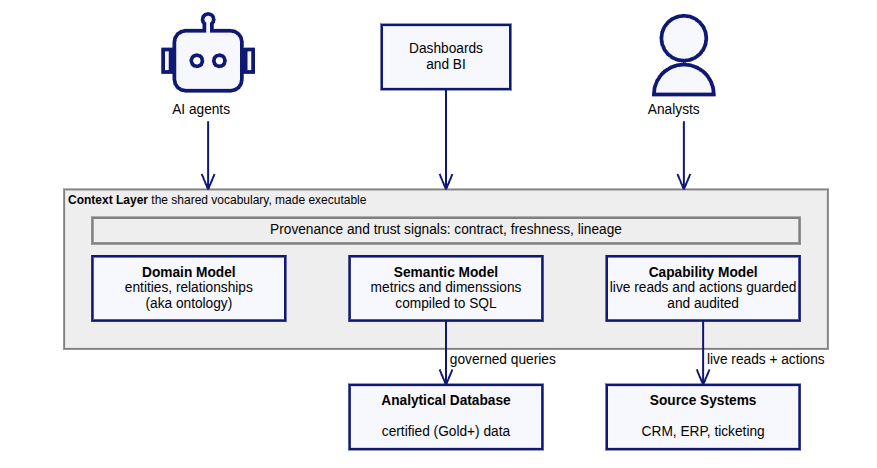
Data contracts and quality to make data trusted. Then traceability and governance to records why an agent acted and bounds what it can reach, making data traceable and governed. The context layer encodes what metrics and entities mean, making data contextual.
The context layer includes a domain model of entities and relationships, a semantic model of metrics compiled to SQL against the analytical store, and a capability model of guarded reads and actions against live systems, with provenance signals across all three.
Building on this, agents can query live systems and write back, making data operational.
--
📩 Excerpt from The Year of the Graph Autumn 2026 newsletter
Read "# Meaning, Traversal, Reasoning, Action: The Graph Stack for Agentic AI" with more sections, references and attribution here 👇
https://t.co/YfrPw2nFzS
All things #KnowledgeGraph, #GraphDB, Graph #Analytics / #DataScience / #AI and #SemTech.
Hands-on knowledge graph sessions usually shut out the people who decide whether a programme goes ahead. Adam Rendek’s masterclass at CDL26 is different, because the only prerequisite is that you can write markdown.
Adam, Data Centre Design Optimisation Manager at AWS, co-invented DOT-LD with Dr Ora Lassila. It’s an open-source syntax that lets domain experts build ontologies directly inside everyday documentation, without Protégé, OWL or an engineer interpreting what they meant.
In two hours you’ll author a working knowledge graph, validate it in VS Code, and see a small language model answer a multi-hop question correctly only once the ontology is behind it. It all runs offline, with no code or database. Directors and engineers complete the same exercises side by side, so practitioners leave able to run the method and decision makers leave able to judge it.
Ontologies Without Ontologists: Shifting Semantics Left into Engineering Documentation
🎤 Adam Rendek, Data Centre Design Optimisation Manager, Amazon Web Services
📅 Wednesday 11 November 2026, 12:30 PM - 02:30 PM, Ontology Engineering & Practice Track (Salisbury Suite)
💻 Bring a laptop with Visual Studio Code installed
📍 Leonardo Royal Hotel London Tower Bridge
⭐ Read more about this masterclass and grab your CDL26 pass: https://t.co/rRjvHAi9b5
#CDL26 #KnowledgeGraphs #Ontology #DataLeadership #SemanticWeb #AI