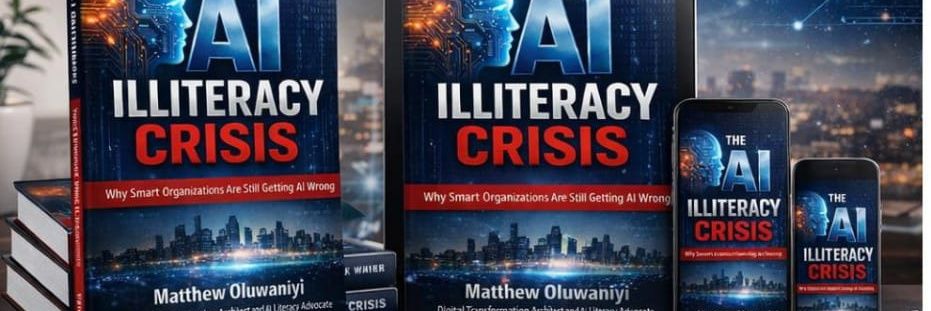
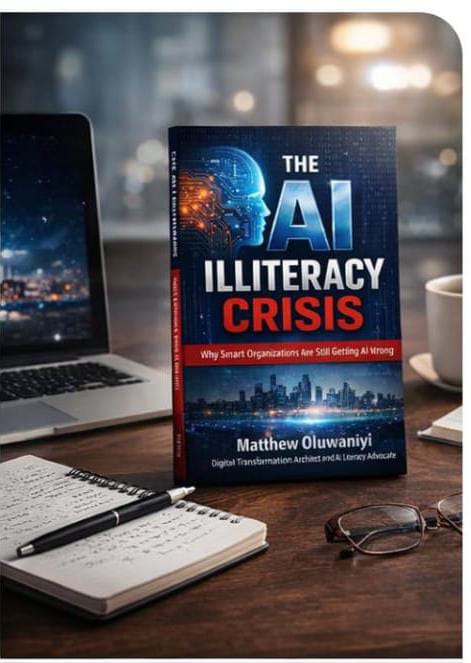
In my work architecting digital ecosystems, I view AI as the ultimate "force multiplier." It is an incredible tool for parsing vast datasets, automating repetitive workflows, and overcoming the "blank page" syndrome. But there is a dangerous line between augmentation and atrophy!
Video Credit: David Epstein
#DigitalTransformation
#AILiteracy
#ResponsibleAI
#FutureOfWork
#CognitiveAugmentation
A few years ago, I had the privilege of architecting the Cybersecurity Pathway curriculum for the Microsoft Learn Student Ambassadors (MLSA) at the University of Lagos.
While designing the framework was rewarding, the real magic happened during the execution. Supervising the participants as they moved from theory to "mini-projects" proved one thing: Empowered learners become the strongest line of defense.
Seeing these students tackle real-world security challenges reinforced my belief that the best digital strategies are those that prioritize sustainable skill-building.
#DigitalTransformation #Cybersecurity #MLSA #TechLeadership #FutureOfWork
Throwback...My interest in digital transformation was first ignited by the limitless scale of the cloud, but it was the impact of cloud architectural frameworks that truly captured my focus. I realized that the cloud isn't just about migration; it’s about designing resilient, high-availability structures that allow an organization to pivot and scale with absolute precision.
AI Training is not the same as AI Literacy even though they may look similar at first glance.
And I think this is where a lot of people, teams, even organizations quietly get it wrong.
AI training teaches you how to use a tool. Click here. Prompt like this. Get this kind of output.
It’s useful. No doubt about that.
But it’s also limited.
Because the moment the tool changes, or behaves differently, or gives a response that feels “off” everything starts to wobble.
That’s where AI literacy comes in.
AI literacy is deeper.
It’s not just about using AI, it’s about understanding it.
Why does it respond the way it does?
Where can it fail?
When should you trust it and when should you pause and question it?
It’s the difference between following instructions and actually knowing what you’re doing.
One creates users.
The other builds thinkers.
And in a world where AI is evolving almost weekly, that difference matters more than most people realize.
You can train 100 people on a tool today, but if only 10 of them are truly AI literate, guess who will still be effective six months from now?
That’s the quiet gap.
And maybe the real question is not:
“Have we trained our people on AI?”
But:
“Do they actually understand what they are working with?”
#AI #AIliteracy #AIGovernance
This is well handled. Transparent, cautious, proactive. But here’s the part most people will miss:
Security today isn’t just about systems being safe.
It’s about users being literate enough to respond correctly.
A fake app only works if someone can’t tell the difference.
An update only protects you if you understand why it matters.
That’s the shift.
We’ve spent years building secure AI systems but far less time building security-aware AI users.
And that gap?
That’s where the real risk lives.
I strongly agree that this is a clean breakdown. But it quietly assumes something that often isn’t there.
AI literacy.
You can assemble reasoning, tools, retrieval, orchestration and still end up with a system no one truly understands or can reliably judge.
Because the missing layer isn’t technical. It’s human.
Who decides what “the right info” is?
Who recognizes when reasoning is flawed?
Who knows when not to trust the output?
Without that, evaluation becomes guesswork and orchestration just scales confusion faster.
An AI agent isn’t just a system design problem.
It’s a literacy problem hiding in plain sight.
Funny enough, this is exactly how the AI Illiteracy Crisis quietly deepens.
We give systems human names and then slowly start treating their outputs like human judgment.
OpenAI didn’t design ChatGPT to be a person. But the moment it feels like one, people stop interrogating it like a tool.
And that’s where things slip.
Anthropomorphism makes adoption easier, sure.
But it also lowers skepticism.
You don’t “verify Claude.”
You “trust Claude.”
That subtle shift?
It’s doing more cognitive damage than most people realize.
AI doesn’t just free up time for “more interesting work.” It quietly reshapes what you’re capable of doing without it.
In the AI Illiteracy Crisis book, I argue that when routine tasks disappear without understanding, people don’t automatically move up the value chain, they lose the cognitive scaffolding that got them there in the first place.
So yes, productivity rises.
But capability? That depends.
If users aren’t developing AI literacy alongside usage, what looks like elevation is often just displacement from doing the work to supervising outputs they no longer fully understand.
That’s the real trade-off most people are missing.
Sinan Aral is pointing to something subtle but dangerous: productivity gains without literacy create dependency, not capability.
AI doesn’t just “erode skills” on its own. It does so when people don’t understand how to think with it, question it, or operate without it.
That’s the real gap.
Most organizations are optimizing for output speed but neglecting cognitive resilience.
Short term: things look efficient.
Long term: you quietly lose the very expertise that made the system valuable.
AI literacy isn’t optional anymore. It’s the difference between augmentation and atrophy.
From what I’ve seen and written about in The AI Illiteracy Crisis, there’s a third layer underneath all of this that’s easy to miss:
Most people aren’t reacting to “AI capability.” They’re reacting to their slice of AI exposure and treating it as the whole system.
So you end up with two equally confident but misaligned realities:
one shaped by outdated interaction, and another shaped by highly specialized, almost “edge-case” performance in technical domains.
Both are real. Just not comparable.
And that’s where the real problem sits.
AI literacy right now isn’t just about knowing what AI can do.
It’s about knowing when your experience stops being representative.
Because once you miss that distinction, you start either:
overdismissing what’s possible
or overprojecting what’s typical.
And both distort decision-making in their own way.
The uncomfortable truth is that the system is not one uniform capability curve. It’s uneven, selective, and sometimes surprisingly discontinuous.
Most of the confusion online is just people arguing from different “versions” of the same technology without realizing it.
This is interesting but maybe not surprising.
From what I’ve been seeing while working on The AI Illiteracy Crisis, people don’t just evaluate accuracy they react to perceived intent.
AI feels neutral.
Humans feel like they’re trying to win an argument.
So the same correction lands differently.
But that’s also where it gets tricky.
If we start trusting AI more because it sounds less ideological, not because we truly understand how it generates those “facts,” we might just be outsourcing judgment instead of improving it
And that’s a deeper problem most teams haven’t fully reckoned with yet.
That’s exactly where the real shift is happening.
AI is no longer a “computer science thing” it’s becoming a thinking layer across disciplines.
But here’s the tension I keep seeing:
As AI spreads horizontally, AI literacy isn’t spreading at the same pace.
So you get brilliant students from law, medicine, business all engaging AI, but often without a shared depth of understanding to question, interpret, or challenge what it produces.
That gap?
It’s subtle now, but it’s going to define outcomes more than access ever will.
That’s the core of the AI Illiteracy Crisis I’m exploring.
I think both sides are missing something fundamental.
From what I’ve seen working on my book "The AI Illiteracy Crisis", the real issue isn’t just propaganda vs progress. It’s that most people, including decision-makers, don’t actually have the literacy to evaluate AI claims in the first place.
So narratives win. Not necessarily because they’re true, but because they’re persuasive.
That’s why you can have:
- exaggerated fears gaining traction
- real risks being misunderstood
- and policies built on shaky interpretation
The danger isn’t only “anti-AI messaging.”
It’s a public (and workforce) that can’t reliably tell the difference between signal and noise.
Until we fix that, we’ll keep swinging between hype and panic and calling it strategy.
From my personal experience, I have observed that the governance aspect is the most ignored and misunderstood part of the AI journey. While organizations focus on the "assembly line" of data and validation, they often treat governance as an afterthought.
Success with agentic AI requires more than functional code; it demands a clear framework for accountability. When an agent acts independently, the question of "who is responsible" becomes a critical operational risk. This is one reason I am writing this book on AI Illiteracy Crisis
Smart organizations are still getting AI wrong.
Most AI failures aren't technical; they're literacy-based. I’m finalizing my book on "The AI Illiteracy Crisis" and I want to feature real-world perspectives from leaders like you.
I'm looking for researchers and professionals to share their "in-the-trenches" AI stories for my upcoming book.
Where has AI helped? Where has it failed?
Contribute your insights and get featured. Help shape the roadmap for responsible AI.
Be acknowledged in the final publication.
Share your experience here: https://t.co/LNf0GbGswi
#AI #AILiteracy #FutureOfWork #TechLeadership