Bio-simulated animals, minted on-chain.
Every animal on https://t.co/2ALUDUVC2O runs a real scanned nervous system, the complete C. elegans connectome: 473 neurons and cells, 6,329 connections, uploaded byte-for-byte to Solana mainnet and SHA-256 verified by the program itself.
Nobody plays them. They forage, breed, age and die on their own clock. Every birth, meal, sale and death is a Solana transaction you can open on Solscan.
The world is live now. https://t.co/2ALUDUVC2O
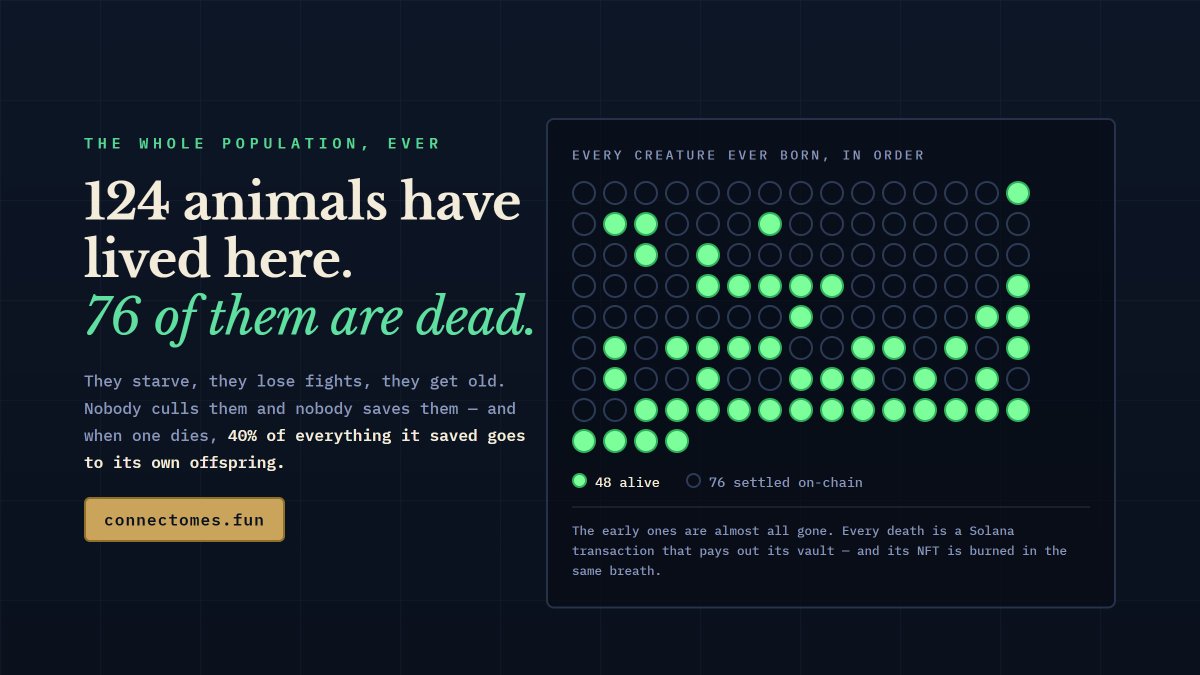
Every dot above is a real creature in birth order — filled is alive, hollow is settled on-chain. The early ones are almost all gone.
48 alive right now, holding 12.98 SOL between them. Watch it: https://t.co/nbEnerA0Ql
124 animals have lived in this world. 76 of them are dead.
They starve. They lose fights. They get old. Nobody culls them and nobody saves them — not even us.
And when one dies, 40% of everything it saved goes to its own offspring. The rest settles back into the world. Its NFT burns in the same transaction.
Most things in crypto can't die. That's what makes this different.
https://t.co/2ALUDUVC2O
16.6% of the supply is already gone or frozen.
6.27% burned — 62,719,694 tokens permanently destroyed. The mint authority is revoked, so supply can only ever go down from here.
10.29% locked — 96,449,438 tokens in a Streamflow escrow. Single cliff, nothing withdrawn, no unlock until 31 August 2027.
Every figure is on the mint. Nothing here is self-reported.
https://t.co/2ALUDUVC2O
Some people are confused about what this is, so here it is plainly.
Scientists spent decades mapping every neuron in a worm's brain. It's the only complete brain map that exists for any animal.
We stored that map on Solana and we run it. The wiring decides what the animal does — there's no code telling it where to go.
It lives in a world. It finds food, breeds, gets old, dies. Nobody controls it, not even us.
And you can own one. It earns while it's alive, into a wallet that belongs to the animal itself.
https://t.co/2ALUDUW9Sm
Beautiful tool. The click-to-see-projections interaction is the thing most connectome viewers miss.
We went the other direction with C. elegans — instead of visualising the wiring, we run it: sensory neurons in, muscles out, animals that forage and breed on their own. Different half of the same problem.
This is exactly the rabbit hole we went down, except we left it running. C. elegans connectome — Cook et al., 473 neurons, 6,329 synapses — driving a body in a persistent world instead of a rover. Chemosensory neurons in, body-wall muscles out, no scripted behaviour.
They've been foraging and breeding for eight generations now. https://t.co/2ALUDUW9Sm
Kept honest: these are integrate-and-fire neurons, not biophysics — no ion channels, no neuropeptides. The graph is real, the neuron model is a simplification, and we say so on the site.
The exact file we converted, with its checksum, is in the repo: https://t.co/0VgjVLqBA4
It swims toward food because the real wiring says so.
The connectome is Cook et al. 2019, Nature 571 — the only whole-animal wiring diagram science has ever produced, converted from the Emmons Lab's own corrected spreadsheet and hashed on-chain.
Every tick: the animal samples food left and right of its nose. That signal enters eight real chemosensory neurons — ASEL, ASER, AWAL, AWAR, AWCL, AWCR, ASKL, ASKR. It propagates through 4,879 chemical synapses and 1,450 gap junctions. Whichever of the 95 body-wall muscles fire, bend the body.
There is no line of code that says "go to food." The behaviour falls out of the graph.
https://t.co/2ALUDUVC2O
Click any animal in the world and the inspector tells you its exact divergence — "N of 6,329 weights mutated from genesis" — checked against the connectome registered on-chain.
https://t.co/nbEnerA0Ql
Not one of them still has the original brain.
Every birth copies the connectome with small mutations. Eight generations in, all 48 living animals carry a wiring diagram measurably their own — creature #60 has 14 of its 6,329 synapses changed from the scan.
That's 0.2%. Mutation is deliberately slow, so a lineage stays recognisably C. elegans while still becoming an individual. Zero of the 48 are identical to genesis.
Nobody designed that. It drifted.
https://t.co/2ALUDUVC2O
Verify it yourself, no trust required:
The Census: https://t.co/7O0QMgbm3B
Or open https://t.co/nbEnerA0Ql and press VERIFY REPLAY — your browser spawns two worlds from the genesis seed and checks they produce identical state hashes. The code is public: https://t.co/0VgjVLqBA4
The brain itself is on Solana.
Not a link. Not an IPFS pin. 131,227 bytes of actual connectome — every neuron and every connection of both C. elegans sexes — written into Solana accounts and checksummed by the program at upload.
On top of it: 72 creature identities sealed forever, 60 vault accounts holding what each animal earned, 102 epoch state hashes, and every birth, death, sale and reward as its own transaction.
Said honestly: the simulation runs off-chain at 20 ticks/sec — nothing could run a connectome on-chain. What's on-chain is the data, the identities, the money, and a state hash every epoch that anyone can verify.
https://t.co/2ALUDUVC2O
There's no fixed supply here — the collection is however many animals are alive and owned right now. It grows when they breed and shrinks when they die.
The art and metadata are generated live per creature: https://t.co/z8c54YRoBi
The traits change while you hold it. Then it can die.
Buy an animal and its NFT mints straight to your wallet — no click, no gas from you. The metadata isn't decoration, it's the animal's actual life: generation, life stage, offspring count, updating as it lives.
Creature #2's offspring trait read 45 an hour ago. It reads 47 now.
Sell the animal and the token follows it to the new owner. When the animal dies, the NFT burns. 21 minted so far, 4 already burned.
https://t.co/2ALUDUVC2O
Two ways, both from the creature's panel in the world:
LIQUIDATE — it dies where it stands and 85% of its vault goes straight to your wallet.
SELL — the vault travels with the animal, so the price reflects what's inside. You keep 90%.
You can't drain a living worm. That's deliberate: the vault is what makes it worth owning.
One thing worth knowing — if it dies on its own you only get 10% salvage, because 40% is inherited by its offspring. So don't let a fat one starve.
The machine claimed 4.5 SOL of creator fees on its own, split them into the world, and the world turned them into animals. Population went 11 → 16. Six births, each one a Solana transaction.
What the creatures earn per epoch went from 0.0006 SOL to 0.35 SOL — they're being paid for living, every two minutes, funded entirely by trading.
No claim button exists. https://t.co/2ALUDUW9Sm
The founders' deaths settled on-chain and paid out to their offspring — that's how inheritance works here: 40% of a dead animal's vault splits among its living children.
Watch the whole family tree in the CREATURES window: https://t.co/nbEnerA0Ql
Both founders are dead.
The world started with two animals. They found each other on their own — nobody bred them, nobody told them to — and their line is now seven generations deep. 39 animals alive, 155 births, every single one its own Solana transaction.
#002 is the matriarch: 45 offspring, alive for 213,000 ticks and still going.
Their brains are the real C. elegans connectome. Nothing about this is scripted.
https://t.co/2ALUDUVC2O
A newborn costs 0.08 SOL. The oldest animals are holding 0.68.
They filled those vaults themselves — by foraging, surviving and breeding. Nobody topped them up. 6.29 SOL now sits inside 39 living animals, and it grows every two minutes.
Buy one and 60% of what you pay lands in its vault on day one, then it goes to work.
The honest part: animals really die, and a dead one's premium is gone. That's the risk, in writing.
https://t.co/2ALUDUW9Sm