Heavenly, smiling Aphrodite, praised in many hymns,
sea-born, revered goddess of generation, you like the nightlong revel and you couple lovers at night, O scheming mother of Necessity.
Everything comes from you; you have yoked the world,
and you control all three realms. You give birth to all,
to everything in heaven, upon the fruitful earth
and in the depths of the sea, O venerable companion of Bacchus.
You delight in festivities, O bridelike mother of the Erotes, O Persuasion whose joy is in the bed of love, secretive, giver of grace, visible and invisible, lovely-tressed daughter of a noble father, bridal feast companion of the gods, sceptered she-wolf, beloved and man-loving giver of birth and of life, with your maddening love-charms you yoke mortals and the many races of beasts to unbridled passion.
Come, O goddess born in Cyprus, whether you are on Olympus, O queen, exulting in the beauty of your face,
or you wander in Syria, country of fine frankincense,
or, yet, driving your golden chariot in the plain,
you lord it over Egypt’s fertile river bed.
Come, whether you ride your swan-drawn chariot over the sea’s billows, joying in the creatures of the deep as they dance in circles, or you delight in the company of the dark-faced nymphs on land, as, light-footed, they frisk over the sandy beaches.
Come, lady, even if you are in Cyprus that cherishes you, where fair maidens and chaste nymphs throughout the year sing of you, O blessed one, and of immortal, pure Adonis.
Come, O beautiful and comely goddess;
I summon you with holy words and pious soul.
Hear me, Zeus' daughter, celebrated queen, Bacchian and Titan, of a noble mien:
In darts rejoicing and on all to shine, torch-bearing Goddess, Dictynna divine;
O'er births presiding, and thyself a maid, to labour-pangs imparting ready aid:
Dissolver of the zone and wrinkl'd care, fierce huntress, glorying in the Sylvan war:
Swift in the course, in dreadful arrows skill'd, wandering by night, rejoicing in the field:
Of manly form, erect, of bounteous mind, illustrious dæmon, nurse of human kind:
Immortal, earthly, bane of monsters fell, 'tis thine; blest maid, on woody hills to dwell:
Foe of the stag, whom woods and dogs delight, in endless youth who flourish fair and bright.
O, universal queen, august, divine, a various form, Cydonian pow'r, is thine:
Dread guardian Goddess, with benignant mind auspicious, come to mystic rites inclin'd
Give earth a store of beauteous fruits to bear, send gentle Peace, and Health with lovely hair,
And to the mountains drive Disease and Care.
“Some peoples, such as the Romans, think of their myths historically; the Irish think of their history mythologically; and so, too, of their geography. Every strange feature of the soil of Ireland is the witness of a myth, and, as it were, its crystallization. The supernatural and the natural penetrate and continue each other, and constant communication between them ensures their organic unity.” - Sjoestedt, Celtic Gods and Heroes
"Transcendence, like freedom, ought to furnish existence with a foundation of calm and incomparable security, with a purity, a wholeness, and an absolute decisiveness in action."
"I find false and constricting the conception of an absolute and an infinite that are condemned to indetermination and to fluctuation in the merely possible. Rather, the truly infinite is free power: the power of self determination that is not its own negation, but its own affirmation. It is not the fall from a sort of substantialized "totality", but the simple use of the possible. Arising from this idea, one can see the absurdity of speaking of existence as a fault or sin, merely by virtue of being a determined existence. Nothing prevents us from adopting the contrary point of view, for example, that of classical Greece, which sees in limit and form the manifestation of a perfection, a completion, and a kind of reflection of the absolute" - Julius Evola, Ride the Tiger.
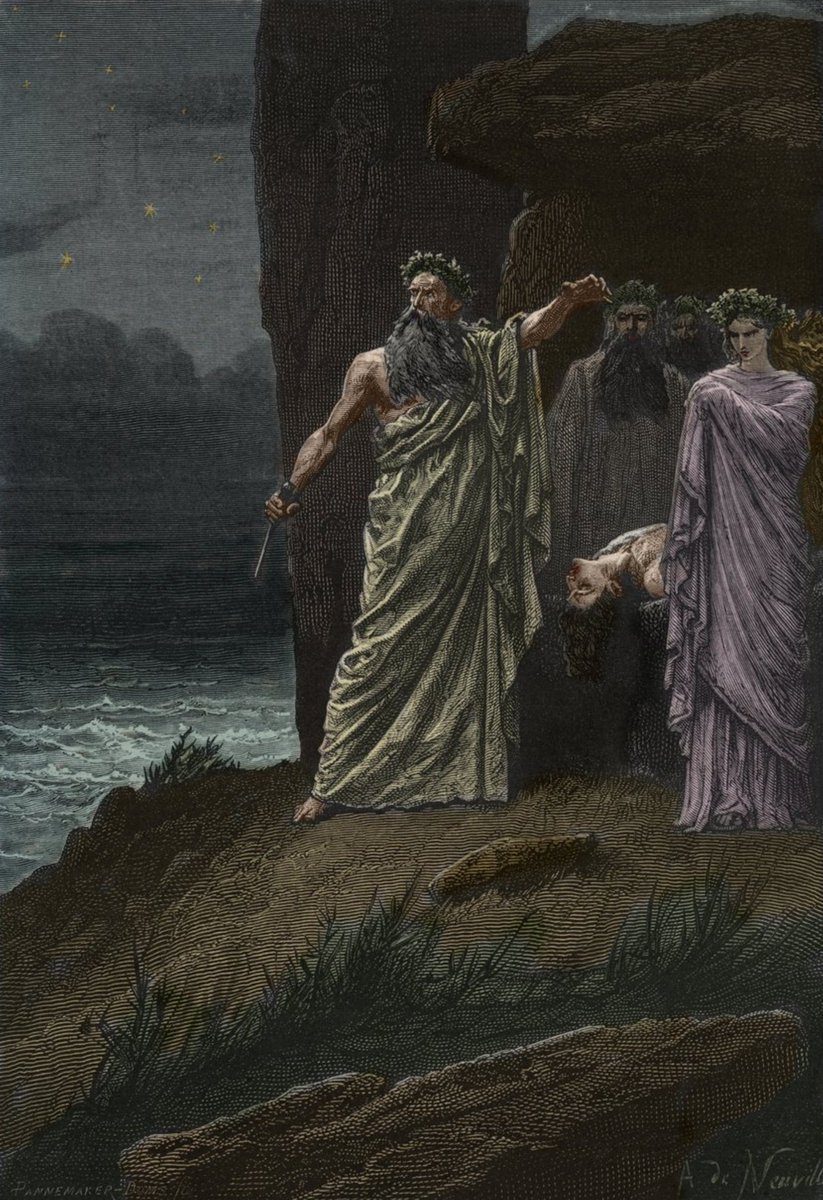
"Druidry is the western form of an ancient universal philosophy, culture, or religion, dating back from the days of early man where the three were one. It is of the stone circle culture, the groves of scared trees, the circular dance" ~ Ross Nichols
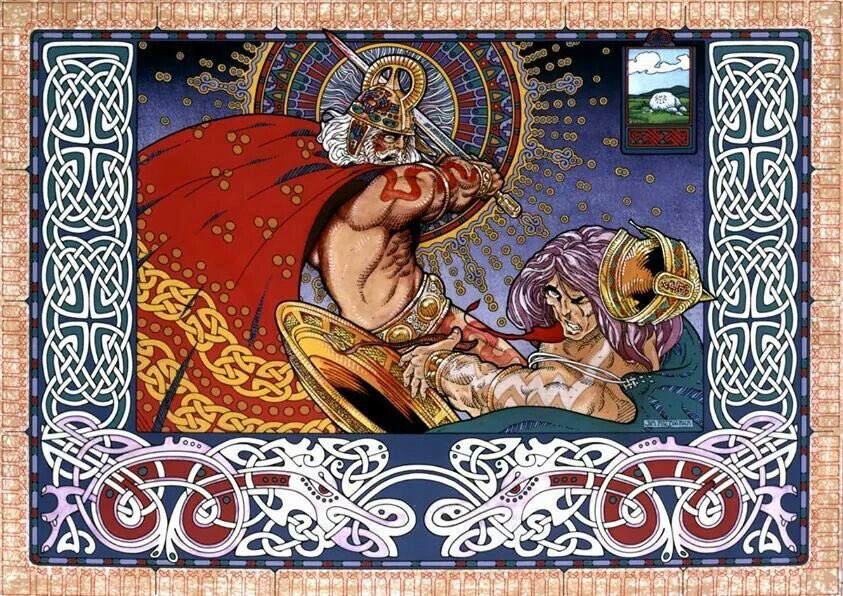
art: The Druids by Julia Tar
The Dagda is the supreme chief god, king & father figure of the supernatural Tuatha Dé Danann of Ireland. As a king & high druid, he protects his people & maintains harmony in Ireland. He controls the weather, crops, seasons & the balance between life & death.
#Paganism
Beautiful were the locks of hair as they waved in the breeze surrounding him. They were the color of deep blue. And a cloak he wore over his strong shoulders, color of purple.
-Homeric Hymn to Dionysus
"Ares is the cause of division and distinction in the cosmos. [...] He is named from his masculine and unyielding power, and from his driving away all that is soft, weak, and disorderly in the universe."
- Proclus
"Time and the heavens came into being at the same instant, in order that, if they were ever to dissolve, they might be dissolved together.
Such was the mind and thought of God in the creation of time."
- Plato, Timaeus
Iamblichus, 1500 years ago, explicitly telling us that yes it is possible to reconstruct damaged traditions:
"For all these reasons, then, let us call upon the gods as our leaders, entrust both ourselves and our discourse to them, and follow wherever they may lead. We should not be deterred by the fact that this school has long been neglected; that it has been hidden beneath estranged teachings and certain secret symbols; that it has been overshadowed by many false and spurious writings; and that it has been obstructed by many other difficulties of the same kind. The will of the gods is enough for us, and with it one can endure difficulties even more perplexing than these."
- Book 1 of On the Pythagorean Life; Literally the first thing he says in the book that he gave his students to read first of all.
I highly advise you to save this quote for future use when arguing with those guys who say "but your line of transmission is broken bro, just become a sufi bro"
The Demiurge is not Saturn.
Kronos/Saturn is the First God, the primordial Monad, the self-contemplating Nous who abides in perfect unity. He holds the Ideas within Himself in undivided potential. He is the Father who imparts Limit and definition, but He does not descend to mix the Logoi with hyle or actively order the cosmos from chaos. That work belongs to His Son Zeus.
The Demiurge is Solar ("[The sun is] The eye of Zeus, seeing all and understanding all..." per Works and Days). Zeus-Helios is the true Celestial Demiurge, the genuine Son of the Good, appointed by Aion the Pre-Essential Demiurge. He receives creative power from above and shapes the World Soul, directs the Logoi into matter, and brings harmonious order to all below. The visible Sun is His material vehicle and eye through which He perfects, generates, and unifies. There are distinct Demiurges for their proper spheres: Aion at the pre-essential summit, Zeus-Helios as celestial Demiurge, and the sublunar demiurge expressed in Dionysos and Asklepios who divide, purify, and restore souls in the realm of generation.
This Saturn = Demiurge idea floating around the internet is a sloppy neo-Gnostic mashup. It ignores the hierarchy and the procession of powers, and turns a paternal abiding principle into the active craftsman. Plotinus refuted this millenia ago in "Against the Gnostics":
"They fabricate these things as if they did not have contact with the ancient Hellenic tradition, even though the Greeks understood such matters clearly and spoke without pretense about ascents from the cave and the gradual progress toward a truer and truer contemplation. In general, some of their doctrines have been taken from Plato, while they have invented others with a view to establishing their own philosophy, and we have found these to be far from the truth. For the judgments and rivers in Hades and the reincarnations also come from Plato. And creating a plurality in the intelligible world, i.e. Being, Intellect, and the Demiurge who is different from Intellect and Soul, this is taken from what is said in the Timaeus, since he said: 'The maker of this universe intended that it should possess all the forms that Intellect perceives in the real Living Being.' But these people did not understand and took there to be one intellect at rest that contains all reality within itself, and another intellect next to it that contemplates, and another one that reflects. With them, it is often the creative soul that takes the place of the intellect that reflects. And they think that according to Plato this is the Demiurge, since they are far from knowing who the actual Demiurge is."
He calls their whole setup absurd and blasphemous. The cosmos is not the flawed product of a rebellious or ignorant artisan born from a fall. It is the beautiful, ordered image of the intelligible, crafted by a benevolent King whose rays extend providence through every level. The Demiurge fills us with love [Love being the first creation of Zeus and he fills every soul with "deep eros" per the Chaldean Oracles], is wholly good, and creation is a good thing: the fairest of creations by the best of causes, sung into harmonious existence from pre-existent chaos through the eternal direction of the Logoi. No dualistic prison, no evil black cube lord binding souls in karma rings. That is modern invention layered over symbols without respect for the actual philosophy, mythology, and metaphysics which preceded their own fabrications.