Ethena Pay has been a year in the making and represents Ethena's first time going direct to consumer
We've been using it for months now and we couldn't be more excited to bring this product to market
The neobank model has been crying out for an asset issuer to own the full stack. Adding a card to USDC and USDT spending leaks value to external stablecoin issuers which can be internalized within the product
Ethena issues the underlying asset of Ethena Pay, so every balance in app is an Ethena owned asset and Ethena owns 100% of the rewards on the backing
That is the core offering, and it is what allows @EthenaPay to offer the highest, and most sustainable savings rate in the market
From a user perspective, earning is the default state of money within Ethena Pay, with crypto complexity abstracted away and no action required to earn
6% on balances, 5% cashback, borderless, free, instant global money transfers. Send, spend and save powered by USDe
Excited is an understatement
https://t.co/khRgNkKo1X
Ethena recap on one of the crazier weeks:
- Bybit hack vindicated off exchange custody design of USDe and answered one of the biggest questions of Ethena's resilience during a CEX incident
- Ethena process $120m of redemptions in the aftermath of the hack with zero issues
- Counterparty risk to Bybit was limited to $30m of unrealized profit, equal to half of the Reserve Fund.
- $30m exposure was reduced to zero within 90 minutes
- Despite the stress test, sUSDe APY still came in at 9% this week
- USDe launched on Aptos
- Proof of Reserves announced with @chaoslabs
- @etherealdex passing $450m in TVL, with 15% of their future token supply committed to sENA holders
- USDe launched on MEXC as a rewarding asset
- ENA listed on @BithumbOfficial
- @EchelonMarket committed 5% of token supply to sENA
- Season 4 of Ethena points campaign announced and two new Pendle pools launched
Average Ethena week
345 days
376 marathons
£380,995 raised for charity
Deserts✅
Rainforest✅
Savannahs✅
Mountains✅
Jungle✅
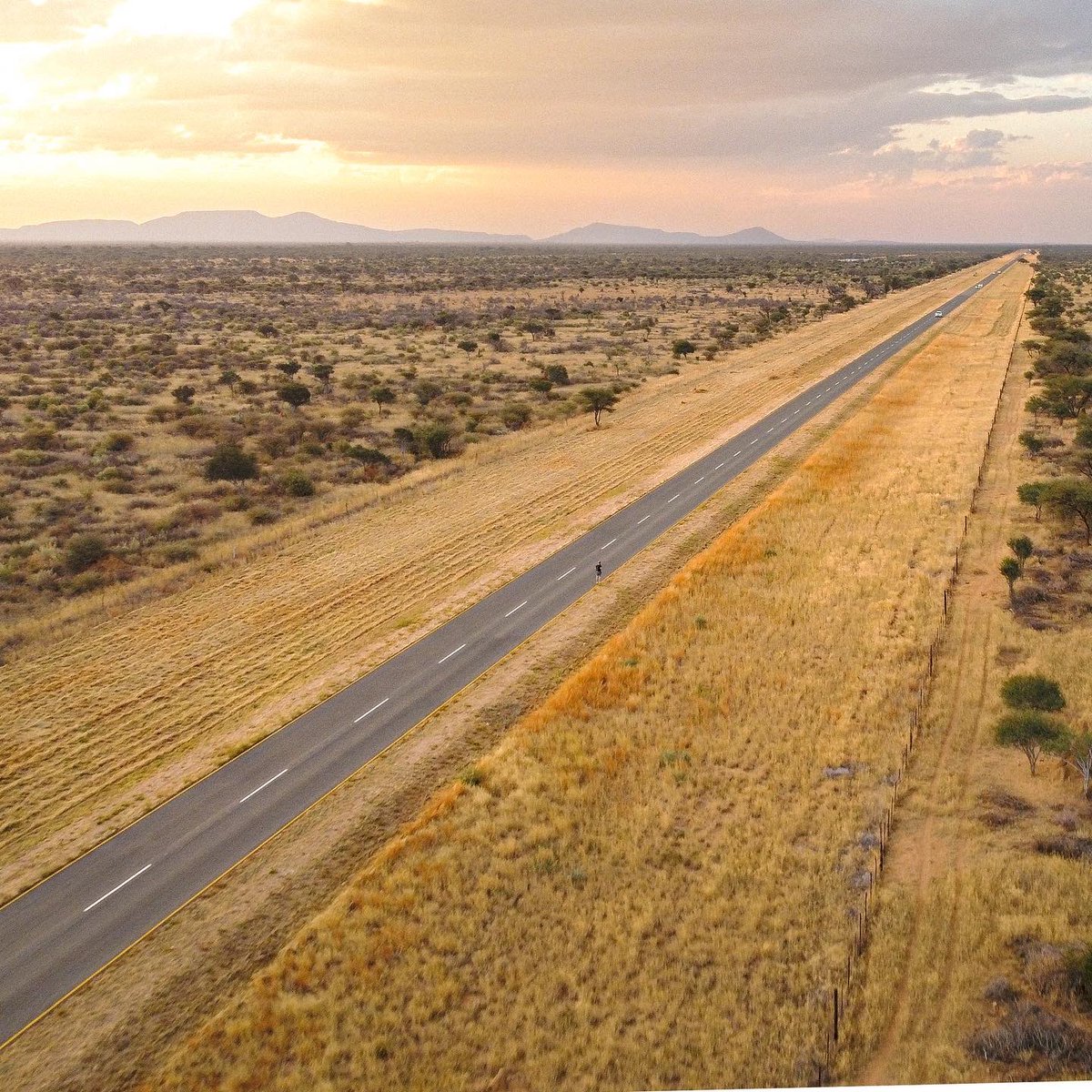
7 days out from being the first person ever to run the entire length of Africa🫡
A lot of new eyes on Ethena today and people are right to point out the risks involved
I wanted to take a sec to highlight some of the extensive work we've done surrounding the risks of the design, and specifically addressing funding risk
Before I get into the meat and veg here, we are trying something new, making a lot of tradeoffs in order to deliver what we think is an actually useful product.
We could have brought out another overcollateralized DeFi fork with RWA's backing - but imo the stablecoin space has been crying out for some innovation for a couple years now.
To be clear, USDe isn't safer or better than any other projects - we are simply offering something with an uncorrelated risk profile to the rest of DeFi. No ties to the traditional banking system. A real yield that isn't plucked from thin air. Bringing a CeFi cashflow to DeFi.
With that in mind, a new design means new risks, so let's take a look at a common first question people have:
What happens when funding goes negative?
Always like to answer this question by diving into the data so bear with me
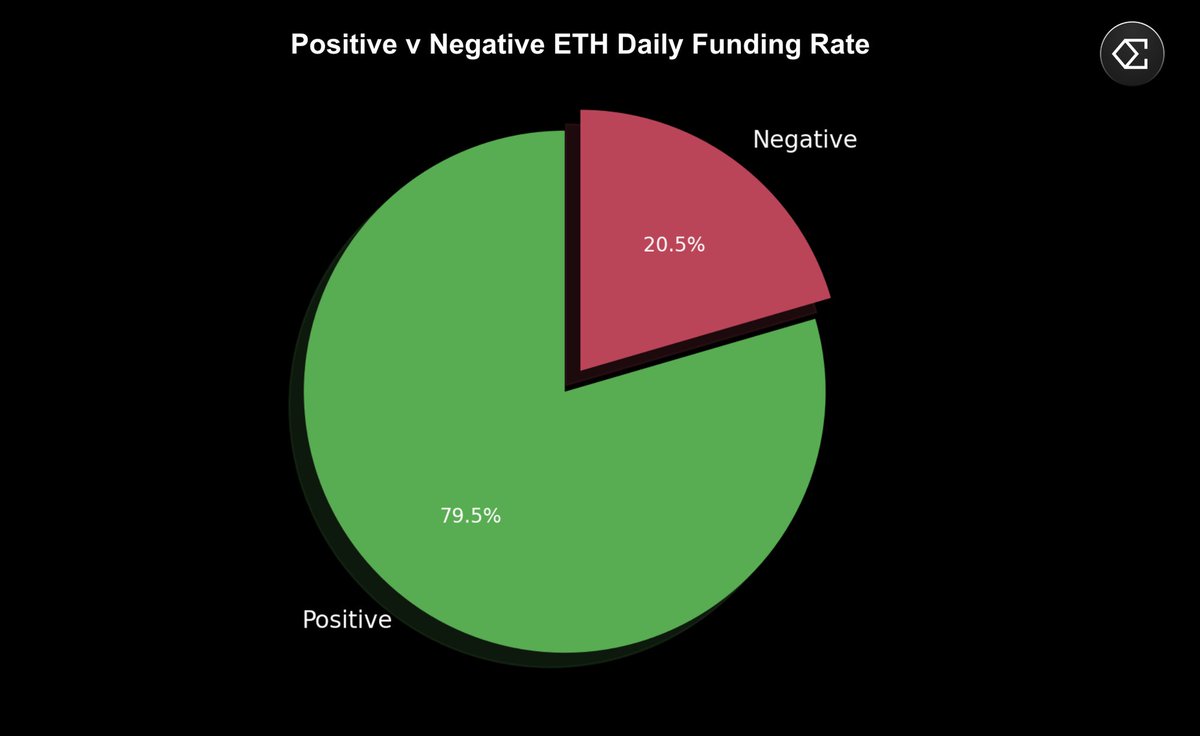
ETH funding was only negative on 20% of days over the last 3 years, including the bear market of '22.
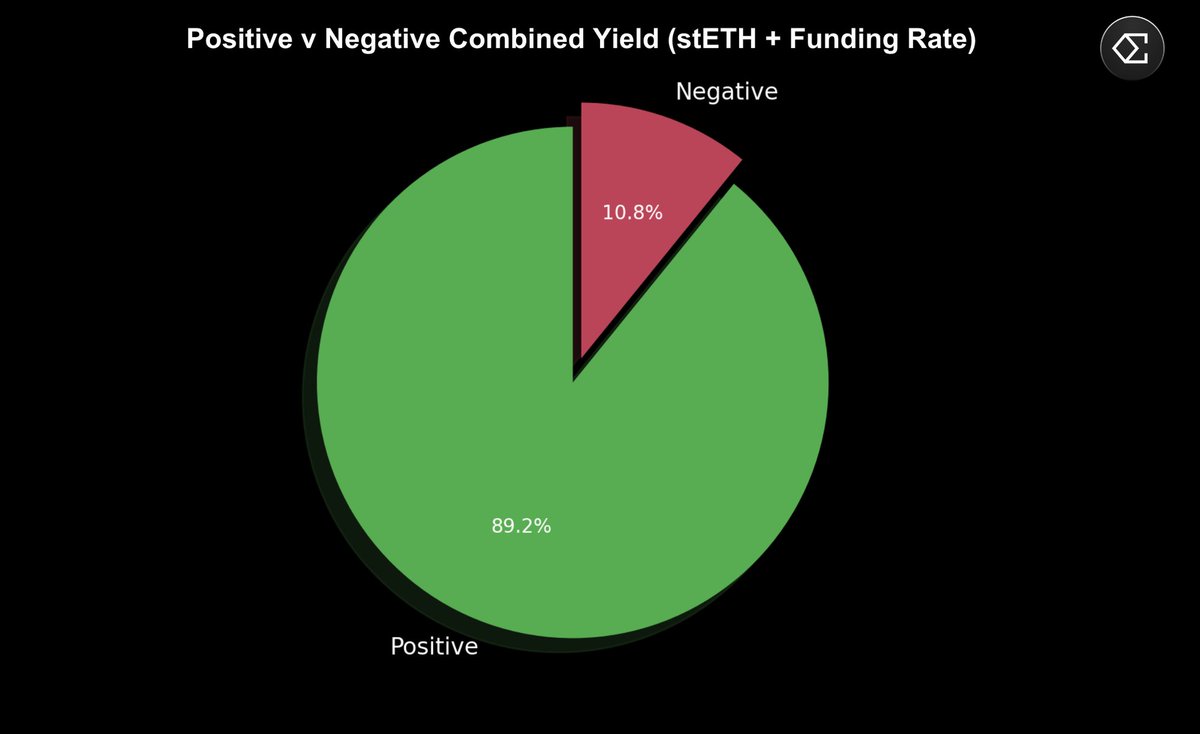
Using stETH as collateral provides a margin of safety over negative rates. That means we are only concerned with days when ETH funding is more negative than stETH yields.
That brings the number of negative yielding days down to just 11%.
Looking at consecutive days funding we can see how positive days tend to persist while negative days rarely do. Longest streak of positive days 110 days set this year, longest negative 13 days.
Quarter by quarter we can see only one quarter in 2022 had a combined yield (stETH+short ETH funding) that was negative. That included an outlier event when ETH funding rates dipped as low as -300% thanks to an arb opportunity via ETH's transition to Proof of Stake.
To start 2024, the yield has hovered around 20% 🫠
There are a couple main reasons why funding rates skew positive:
- There is clear demand in crypto to go long with leverage. Deep pools of capital are unwilling to lend the capital on the short side of that long leverage.
- Some exchanges (Binance, Bybit) have positive baseline funding rates of 11% annualized, meaning if funding is within a certain range it snaps back to 11% by default. Those exchanges make up over 50% of open interest. We can see below the impact positive baseline funding has to the distribution of funding on Binance and Bybit in particular
But enough about averages, what do we expect to happen when funding goes negative?
1. Users redeem. USDe supply shrinks and we lift some of our shorts. At a large enough size, lifting our shorts will help funding rates improve, helping USDe supply find an equilibrium level where it sets to its natural size. At that point, we will look to onboard other collateral like BTC etc with untapped derivative market of $20bn+
2. Intra-day movements in funding rates do not pose much risk to Ethena’s solvency as their effect is a capped, slow erosion of collateral. The maximum negative rate on Binance of -100%, for example, implies a maximum loss of 0.091% of notional in any single 8-hour period (when funding is due). This wouldn't be a death spiral type scenario, we're talking about a slow, prolonged bleed out over the course of weeks or months, if negative funding were to persist
3. An insurance fund sits alongside the protocol, protecting the collateral from periods of negative funding. We've put extensive research into recommending a size for the insurance fund which you can find here https://t.co/8pjmdpaH8H
tldr is we found $20m per $1bn of USDe would survive almost all bearish forecasts of funding rates.
@chaoslabs also did their own modelling, and recommended an fund size of $33m per $1bn USDe. The majority of our recent funding round of $14m will be going to the insurance fund. https://t.co/nVY4Z9SSVT
The insurance fund will be capitalized with a take rate on positive yielding days, ensuring it grows along with the supply of USDe.
In summary, negative funding rates are a feature, rather than a bug of the system. USDe has been built with negative funding in mind.
Hopefully not too dense a post, but want to show we are serious about these risks. If you disagree with anything I've said, fire away lmk.
And we've got plenty more on funding risk in our docs that I haven't covered https://t.co/oBR4Fucggy