Publisher of Coolcat Report investment newsletters, 1997-2016; journalist for more than 35 years. Interested in stocks, sports, politics, life and love.
Market Wizard Linda Reschke's 12 Technical Trading Rules:
1. Buy the first pullback after a new high. Sell the first rally after a new low.
2. Afternoon strength or weakness should have follow through the next day.
3. The best trading reversals occur in the morning, not the afternoon.
4. The larger the market gaps, the greater the odds of continuation and a trend.
5. The way the market trades around the previous day’s high or low is a good indicator of the market’s technical strength or weakness.
6. The previous day’s high and low are two very important “pivot” points, for this was the definitive point where buyers or sellers came in the day before. Look for the market to either test and reverse off these points, or push through and show signs of continuation.
7. The last hour often tells the truth about how strong a trend truly is. “Smart” money shows their hand in the last hour, continuing to mark positions in their favor. As long as a market is having consecutive strong closes, look for up-trend to continue. The up trend is most likely to end when there is a morning rally first, followed by a weak close.
8. High volume on the close implies continuity the next morning in the direction of the last half-hour. In a strongly trending market, look for resumption of the trend in the last hour.
9. The first hour’s range establishes the framework for the rest of the trading day.
10. A greater percentage of the day’s range occurs in the first hour then was the case in the past, and thus it has become increasingly important to trade aggressively if there are early signs of a strong trend for the day.
11. There are four basic principles of price behavior which have held up over time. Confidence that a type of price action is a true principle is what allows a trader to develop a systematic approach.
The following four principles can be modeled and quantified and hold true for all time frames, all markets. The majority of patterns or systems that have a demonstrable edge are based on one of these four enduring principles of price behavior.
Charles Dow was one of the first to touch on them in his writings. Principle One:
A Trend Has a Higher Probability of Continuation than Reversal Principle Two:
Momentum Precedes Price Principle Three:
Trends End in a Climax Principle Four:
The Market Alternates between Range Expansion and Range Contraction!
12. In the world of money, which is a world shaped by human behavior, nobody has the foggiest notion of what will happen in the future. Mark that word –
Nobody! Thus the successful trader does not base moves on what supposedly will happen but reacts instead to what does happen.
I will try to play it soon, but my focus is just on solving Wordle and I don't care if it takes me 6 tries. I use the same three words every day unless I can solve it in three. Every once in a while I get a 2. SHARE is my starter word, and I got a 1 the day it was the word.
I created a new Wordle style game. I loved Wordle, but thought that there should be a time component. Check out Speedle. 3 games every day. Easy gives you 4 minutes to complete, medium 2 minutes, and hard 1 minute. More points for the faster you solve and the fewer guesses you take. You can play it here: https://t.co/jw75gEFl2X**
Subway lost its way. I remember eating at a Subway back when I worked in SF in the mid-90s. The sandwiches were delicious. The beginning of the end came for Subway in 2008 when they rolled out $5 footlongs. They lowered the quality of their meats so that their franchises could earn a profit on the low priced sandwiches. No more real ham and turkey, instead they opted for chipped up ham and turkey held together in some gelatinous goo.
Now a footlong sub is $16, more than triple what it was. Did they go back to higher quality meats with the price increase? Nope. Why would consumers opt for an inferior product when they can go to a local deli and get a sub with high end cold-cuts for around the same price?
They have completely destroyed the brand, and I suspect that over half of the Subway locations will go under over the next 3 years.
They need to have a come to Jesus moment, like when Domino's Pizza hired a new CEO and he asked why are we performing so poorly. His answer: our pizza sucks! And he set about fixing it. The result of this was a 3000% increase in the company's share price over the next decade.
It might already be too late to rescue this former iconic brand, but doing nothing guarantees an epic downfall.
$TSLA down 14% on shitty earnings.
Nasdaq down 2.15% and undercuts June low of 24,980.38. The Nas closed more the 7.5% off its early June high of 27,190.21.
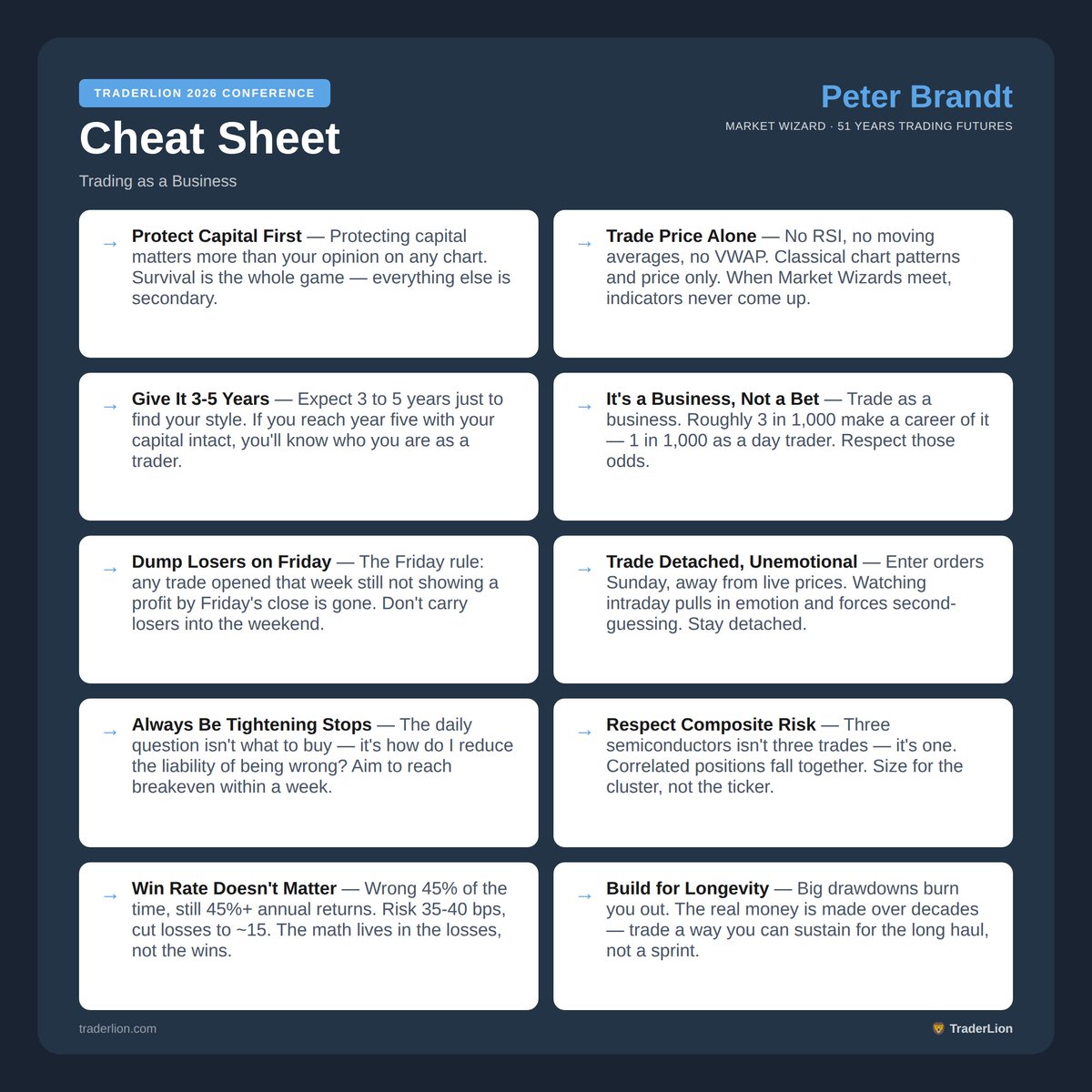
Market Wizard. 51 years trading futures. One of the most respected chartists alive.
Peter Brandt (@PeterLBrandt) broke down how he's traded profitably across six decades — risk, process, and treating trading as
a business.
10 lessons in one cheat sheet 👇
$ASTS at $66. A lot of you are wondering the same thing: what actually stops this fall? Here's the honest answer and no hopium.
First, what's happening. This isn't fundamental selling. It's a mechanical hedge. CNBC laid out the mechanism directly: institutions holding SpaceX equity have to hedge, but there's nothing directly comparable to short - so they "create a basket of things that simulate the price action." That basket is the liquid space names: $ASTS , $RKLB , and peers. ASTS gets sold as a component, not a company. Same playbook desks used to hedge the 2004 Google IPO.
The data backs it: S3 Partners flags ASTS as one of the sector's clearest directional shorts - a +41% short build, ~78% of it genuine directional/hedge shorting, not arbitrage. This is a crowded hedge. That's why good news (BB8-10, Rakuten JV) hasn't mattered. The price is being set by a hedge against a different company.
Because it's mechanical, "it's cheap" won't stop it.
Only things that remove or overwhelm the hedge will:
1) The hedge unwinding - starts late July, builds through fall. SpaceX trades on a tiny 4-5% float. That scarcity is what forces the basket-short workaround. Unlock schedule: float doubles late July/early August (first tranche, post-Q2 earnings), expands ~6x by late September, ~⅓ public by Halloween. As SPCX becomes directly shortable (borrow already down to 1-3%), insiders no longer need ASTS as a proxy hedge - they cover. Relief comes in waves, not one day.
2) A catalyst amplified by the crowded short. J-LEO or a defense award brings fundamental buyers who don't care about the SpaceX hedge and forces shorts to cover. Crowded short + catalyst = violent. Not guaranteed to land, may be absorbed at first, but it's the fastest path up.
3) SPCX stabilizing. Since ASTS trades as a SpaceX proxy hedge, pressure eases when $SPCX settles - even at a lower level.
So: the pressure can run until the unwind plays out - realistically now through late summer, possibly shortened by J-LEO. Anyone calling an exact bottom is guessing.
What I'm holding onto: this is a borrowed-shares hedge with an expiry schedule, not a broken thesis. The business is executing. Mechanics have a clock.
$ASTS 🛰️
Currently in $MU $INTC $DELL $MRVL $ARM $NBIS with decent size and strong gains.
Traded $SNDK $BE $STX $TTMI with too small of a position and sold most with relatively small gains and then lost the positions.
Never held $SIMO.
Live and learn.
The Winners keep Winning
$SNDK $BE $MU $STX $INTC $SIMO $DELL $MRVL $ARM $TTMI $NBIS
I rarely scan, as I am more of a "watchlist" person. I keep and monitor stocks on my watchlists which are grouped by theme, instead of trying to find new opportunities from performing daily scan. And I already have some long term winners which I am happy with just monitoring their positions, instead of trying to be cute with new opportunities which I am not familiar with.
If you are new to scanning, and/or as lazy as I am, perhaps you can do some auto scan like what I did on TradingView and rank them by YTD performance, study them and monitor them. Some of the search parameters are easily changed to suit your appetite (e.g. market cap) or suit the market situation.
The latest auto scan from TV reveals that not only the YTD winners keep winning, they keep winning big (c.f. a similar scan result conducted 3 months ago), especially if they have been a consistent winner in the past 12 months (i.e. not just a benefiary of a temporary disruption/ market situation).
Interesting mention is that these top 11 performers are all at above +200% YTD. Of which $SIMO just passed my personal risk management rule of over $10 bn cap, and $BE which recently washed me out (at a profit) but is as usual not easy to hold with its inherent volatility.
Sometimes you don't have to look too far outside for a new leader. The market is a voting machine and they have been consistently helping you to pick the best stocks. Study them, monitor them, and maybe make money trading some of them.
Personally long six of these.
$SNDK $MU $INTC $MRVL $ARM $NBIS
The downside of such a scan is that since it is on the existing winners, it run a risk of not picking up new emerging opportunities in time, but should not be too big issue an issue with re-ranking on shorter term performance, or generally having a market awareness from reading, or picking it up from social media.
$BE was losing $200,000,000 every year before spiking 3200% from $10.
Right now, there's 4 stocks setting up exactly the same:
1. $TE target $110+
AI power buildout burning cash now, margins inflect once Austin G2 scales output
2. $KEEL target $70+
pivoting bitcoin power into AI compute leases, re-rating from miner to infrastructure play
3. $POET target $50+
near-zero revenue today, but $500M+ optical AI supply deal could flip that fast
4. $APLD target $400+
AI data center buildout burning cash now, contracted leases could flip it profitable
♻️ RESHARE this post and write 1 comment, I'll DM you right now my favorite 1000% call option to get for $TE.
Very well said. Sometimes you have to endure some lumps along the way while navigating the markets.
For me it’s better to play the intermediate weeks-to-months game then to fold my tent because the market has a couple of bad days.
The Timeframe Mismatch
One thing I've learned over the years is that a lot of trading behavior comes down to choices.
Being positive is a choice. Staying aligned with the longer-term trend is a choice. Focusing on what the market is doing instead of what you think it should do is a choice. Just like flipping bearish after two red days is a choice.
Now, if your timeframe is a few hours or a couple of days, that's perfectly fine. Different styles exist for a reason. But if your goal is to participate in the multi-week and multi-month moves that can make a year, then you need a mindset that can survive normal pullbacks, rotations, and periods of uncertainty.
The tricky part is that sometimes those emotional flips will be right. Sometimes the market will roll over, the correction will become something bigger, and the traders who turned bearish after a few rough days will look smart. Those moments tend to stand out because they're memorable.
What gets overlooked is the cost of making that same decision over and over again during the 90% of the time when a normal pullback is just that: a normal pullback within a healthy trend.
When you're constantly reacting to every red day, scary headline, or uncomfortable pullback, you end up fighting the very trends you're trying to capture. Exposure gets reduced when it feels uncomfortable, only to be added back when things feel comfortable again.
The market rarely rewards comfort.
The irony is that the biggest moves often feel the hardest to hold. If they were easy, everyone would capture them. Most traders say they want the multi-week and multi-month trend, but many abandon the position the moment the market stops going straight up.
That's why I try to spend less time predicting and more time observing. As long as the evidence remains constructive, my job is to stay aligned with it. When the evidence changes, I'll change with it.
Until then, I don't see much value in turning every pullback into a new bear market thesis.
Sometimes the biggest edge is simply having the discipline to stay with a trend longer than most people are emotionally capable of. That's where a lot of the real money is made. 🐼📈
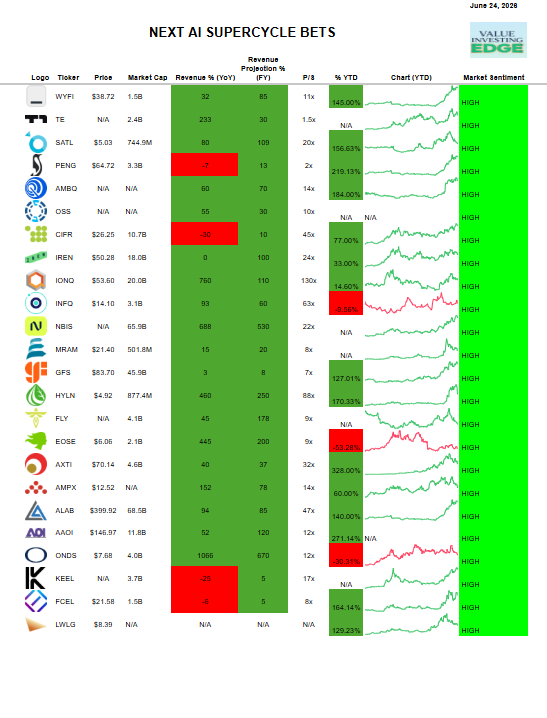
The next wave of market winners potential to dominate entire market in 2026 and beyond:
AI Infrastructure /Data Centers
$WYFI - Small-Cap AI Infrastructure Bet
$NBIS - NVIDIA-Powered AI Cloud Leader
$IREN - AI Data Center and Compute Infrastructure
$CIFR - Bitcoin Miner to AI/HPC Infrastructure
$KEEL - Digital Infrastructure
Drones / Robotics / Defense
$ONDS - Aerial and Ground Defense Lead
$OSS - Rugged AI Compute for Defense
Space
$FLY - Launch and Space Systems Pure Play
$SATL - Earth Observation Satellite Data
Semiconductors
$PENG - AI Factory and HPC Infrastructure
$ALAB - AI Data Center Connectivity Leader
$GFS - U.S. Semiconductor Foundry Play
$AMBQ - Ultra-Low-Power Edge AI Chips
$MRAM - Specialty Memory
$VECO - Semiconductor Equipment Supplier
Photonics / Optics
$AAOI - AI Data Center Optical Networking
$AXTI - Compound Semiconductor Substrate Play
$LWLG - Next-Gen Electro-Optic Polymer Platform
Quantum / Advanced Computing
$IONQ - Trapped-Ion Quantum Computing Leader
$INFQ - Quantum Sensors and Neutral-Atom Computing
Energy
$TE - Domestic Solar Manufacturing Growth Play
$EOSE - Long-Duration Zinc Battery Storage
$AMPX - High-Density Silicon-Anode Battery Leader
$HYLN - Distributed Power / KARNO Generator
$FCEL - Fuel Cell Power + Data Center Energy