If you earn £75,000 per year you personally pay £3,634 on national debt interest alone.
Not for hospitals.
Not for kids.
Not for building a better country for all of us.
At CORGI, we have built a tool based on open-source government data that shows you in detail how your personal tax money is spent.
If you earn £75,000 a year, based on national averages you are personally spending:
£7,003 on the NHS
£10,904 on Welfare
£3,280 on Education
£1,950 on Defence
£2,881 on Devolved Governments
£3,634 on National Debt Interest
Want to know your own numbers?
👉 Use the calculator here: https://t.co/xsAPHzL9no
You’ll get a full breakdown of how much you pay — and exactly where it goes.
The tax calculator also lets you see your total tax contribution in detail. All numbers are open source and come from either the Office for National Statistics or the Office for Budget Responsibility.
When you are using the tool, you have the option to toggle off lifestyle taxes such as alcohol tax, gaming tax or tobacco tax which may not be relevant to you.
We are also looking at an individual’s total tax contribution; to that end we have included both Employers National Insurance and Corporation Tax.
Employer’s National Insurance is a direct tax on your job. You don’t see it on your payslip, but your employer pays it because you exist. It reduces how much you can be paid, and directly affects job growth across the UK. Every UK employer factors this liability in the individuals overall pay calculation.
Furthermore, when you spend money, you are not only paying VAT, but you are also helping companies be viable by making a profit and those profits get taxed. If you strongly disagree with the logic here, we have included the option in the calculator to opt out of having this included in your own tax analysis.
Tax is the biggest bill you’ll ever pay.
And the least transparent.
But it doesn’t have to stay that way.
We built this CORGI tool to change that — one receipt at a time.
Because when people know where their money goes, they start asking better questions.
And better questions change everything.
💬 What surprised you most about how your tax is spent?
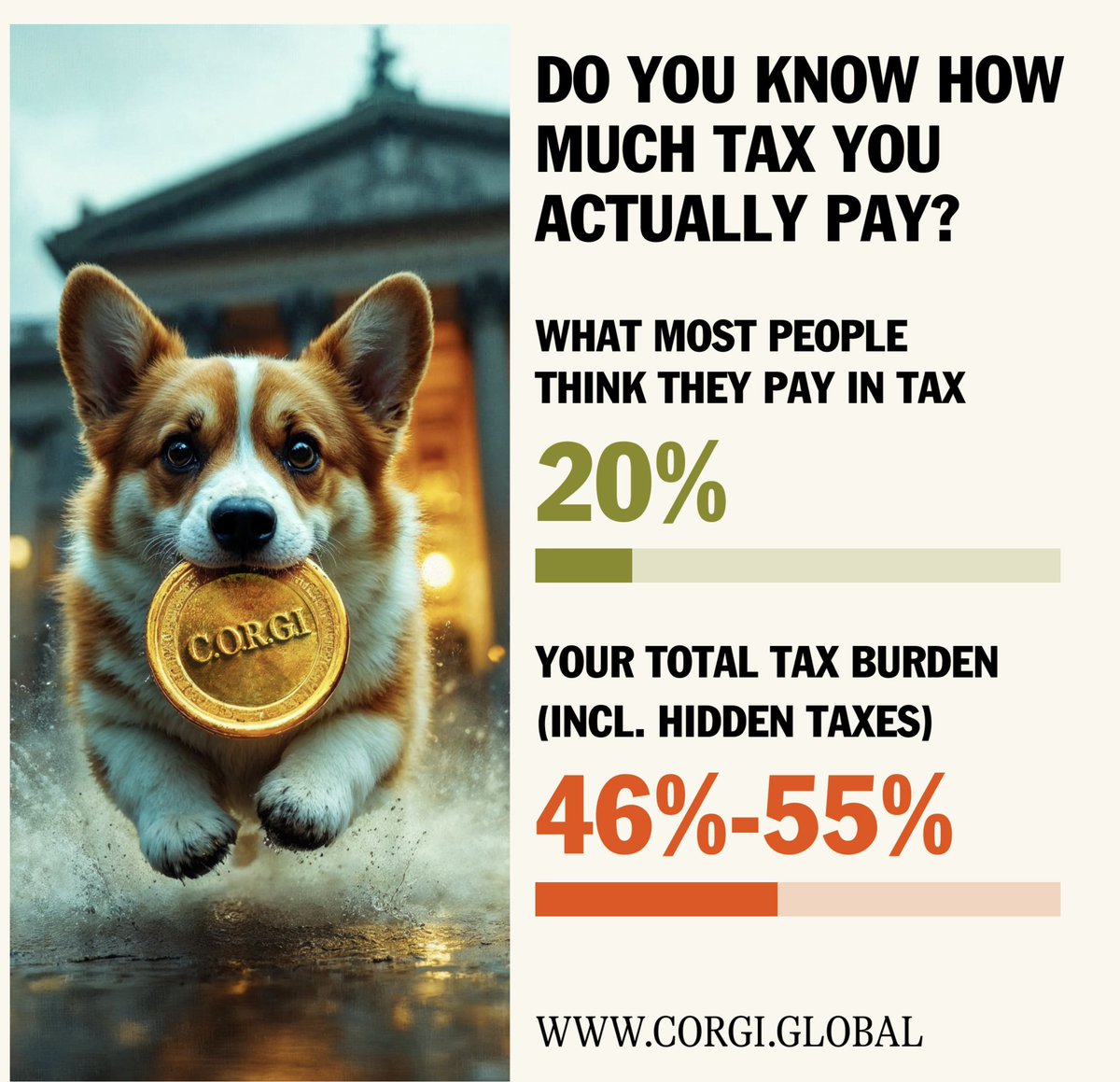
Think you pay 20% tax?
Try 48%-52% — and most of it’s hidden.
We built a tool that shows your real UK tax rate — and where every pound goes.
👉 https://t.co/DQqv93Ehdc
Try it. it takes 60 seconds.
👉 https://t.co/DQqv93Ehdc
Then post your result and tag it with #Corgi 📷
This is the tax transparency we all deserve. No politics. No spin. Just open source data.
🚨 Earning £50K in the UK?
You’re probably paying over £27,000 in tax.
That's half of your income — gone.
We built a tool to show you what you’re actually paying — and where it goes. Thread👇
For a £50K earner, here’s where that tax goes:
£6,704 → Welfare
£4,306 → NHS
£2,235 → National Debt interest
£2,017 → Education
£1,853 → Local Government
The rest? Defence, net zero, pensions, prisons...
I'm not in favour of the sweeping tariffs just imposed by the United States.
But and I had to implement tariffs — here’s how I’d do it differently:
1️⃣ Give the world 12 months’ notice.
Rewiring global trade doesn’t happen overnight.
Businesses need time to rebuild supply chains, rework contracts, and open new facilities.
Imposing tariffs without warning doesn’t punish rivals — it punishes your own citizens.
No time to adjust means price hikes, empty shelves, and a global recession on the cards.
2️⃣ Phase tariffs over 5 years.
If you’re aiming for a 20% tariff like Trump has imposed on the EU — build to it gradually. 5% a year.
Businesses need time to adjust to this seismic shock, and to completely rework their supply chains, build new production facilities and employ new workforces.
Without a transition period, you’re not reshaping trade — you’re detonating it.
3️⃣ Protect the most vulnerable.
These tariffs will crush Western consumers.
But they’ll obliterate developing economies who rely on trade to lift people out of poverty.
Trade has done more to raise global living standards than any aid programme in history. Strip it away without a plan, and you create a tinderbox of global instability.
Smart trade reform must exempt essential goods like food and medicine — and support fragile economies through the transition.
4️⃣ Be strategic, and collaborative.
Right now America's long term allies the EU are being treated like enemies - spoken about in similar terms to the US's long-term rivals China.
There’s no logic. No cohesion. Just chaos.
If you want to use tariffs as a tool — use them wisely. Build alliances. Reward fair trade. Leverage cooperation. Right now the there are 0 collaborative conversations around trade, only combative ones.
5️⃣ Pull, don’t just push.
Tariffs alone won’t bring production back home.
You need to pair them with real domestic investment:
- Tax breaks for reshoring
- Infrastructure for advanced manufacturing
- Skills and R&D support for critical sectors
If you're serious about rebuilding industry, make things easier to build in your country — not just harder to import.
-------
We’re entering a new economic era. As UK Chief Secretary to the Treasury Darren Jones said this week:
“The era of globalisation has ended.”
My feeling on this is that, though this may make some people richer, overall the world is going to suffer.
Let’s not pretend that destroying global trade will somehow lead us to progress.
What do you think?
How much are entrepreneurs taxed in the UK?
According to a recent independent research paper by the Tax Payer’s Alliance, it is over 85%.
This is because when entrepreneurs earn, they often exceed numerous tax thresholds, save and invest their earnings, and ultimately pass them on to their family.
As a result, the same money is taxed repeatedly before it is ever spent, leading to an exceptionally high marginal tax rate.
The tax burden on entrepreneurs and their family because much higher when Labour reduced business relief from inheritance tax from 100% to 50%.
The TPA research reveals just how brutally the system is stacked against those trying to build something and create jobs in the UK — and the numbers are staggering.
If you’re an entrepreneur in the UK, you could end up paying up to 93% in taxes on what you build 😳.
Which means:
➡️If your business earns £100, your family could be left with as little as £10 after taxes.
Here's where it all goes:
💰Income Tax
💰National Insurance
💰Corporation Tax
💰Capital Gains Tax
💰Inheritance Tax
💰VAT
The TaxPayers' Alliance highlighted that post-budget, these numbers have increased to eye-watering numbers:
🔺Best-case scenario (with smart tax planning): 83.5% tax
🔺Worst-case scenario: 93.1% tax
That means after putting everything on the line — the long hours, the sleepless nights, the personal sacrifices — you and your family are left with barely 10p for every pound you generate.
The TaxPayers' Alliance report lays out the devastating impact this is having on our economy:
➡️New firms — responsible for most net new job creation — are disappearing at an alarming rate.
➡️The number of UK businesses has dropped by 11% since 2020.
➡️The fear of failure among entrepreneurs has risen by 60% in the past two decades. Meaning more and more would-be founders are being put off from even starting.
The message is clear: Founders are giving up.
And honestly — seeing the numbers it's hard to blame them when you’re expected to put your home, your savings, and your family’s future on the line — only to keep 10% of what you’ve built.
If the UK wants to rebuild its economy, we need to create an environment where entrepreneurs can thrive.
That means:
✅Tax stability: Entrepreneurs need certainty. A long-term commitment to stable tax rates would encourage investment and risk-taking.
✅Growth-focused reforms: Expanding business rates relief and improving capital gains incentives would give founders the breathing room they need to grow.
✅A reduction in the overall tax burden: Entrepreneurs need to know that their efforts will be rewarded — not swallowed by endless taxes.
We need to fix this.
Massive credit to the TaxPayers' Alliance for compiling such an important report — if you want to dig deeper, you can read the full report here:
https://t.co/edROKpjfqK
The UK economy is still on life support.
The Chancellor’s Spring Budget speech was little more than an exercise in make believe. The government's position is built on forecasts which are pure fantasy. Indeed:
- The Office for Budget Responsibility has downgraded growth to just 1% this year.
- Inflation’s forecast is worse than expected.
- And while there’s talk of a slight “recovery” in the next few years — let’s be honest:
1.8% growth in 2027 isn’t a comeback...
It’s a crawl.
And to make matters worse, everything is based on OBR numbers, and even in their own words ‘The OBR has tended to overestimate real GDP growth and underestimate government borrowing.’
Indeed, Over the past two decades, the OBR the average forecasting error was a colossal 15% of GDP. Yet we are gambling the future of our country on forecasts from perhaps the most incompetent forecaster in history.
Even with these crazily optimistic numbers, the government has just over a 50% chance of meeting its own debt rules by the end of the decade.
So, they've stacked the rules in their own favour...
And still might miss?!
This isn’t a plan.
It’s goalpost shifting dressed up as progress.
And if even a light breeze from across the Atlantic (say, a Trump-led trade war) hits us, the entire thing comes crashing down.
Even though I've been told by the media I have no business talking about politics, I don't see how I can stay out when I see how this will affect the people of the UK.
And naturally, I always empathise with the entrepreneurs, small business owners and risk-takers who are feeling the squeeze massively right now.
Without economic growth, how can businesses thrive?
The reality is:
We need a budget that fuels ambition, not one that stifles it.
We need policies that support the builders, the innovators, the job creators.
Because without them, there is no recovery.
There is no growth.
There is no future.
It's time for bold action. I truly believe we can turn this around as long as we are able to look after each other - and the government is able to look after the entrepreneurs who build this economy.
This is why I am so passionate about funding UK businesses - and doing what I can to help make the government more efficient.
What would you like to see the government doing to help support your industry or sector?
The UK’s ‘Office for Value for Money’ is breathtakingly unambitious in its aims.
Their target is a 1% saving on government spending.
1% is nothing more than a sticking plaster on a system that’s fundamentally broken given our government spends £1.27 trillion a year.
Instead of bringing in experts from the private sector — people who know how to control costs and drive efficiency ��� they recruited from within the public sector.
The same system they’re supposed to be fixing.
Their supposedly independent chair even has glaring conflicts of interest that mean he can’t even investigate major projects like HS2, one of the UK’s biggest financial disasters in recent memory.
So, what’s their first major focus?
Cutting accommodation costs — including spending on hotels for asylum seekers, veterans, care leavers.
Meanwhile, billions in wasted spending on bloated projects, red tape, and mismanaged budgets continue to fly under the radar.
This is bureaucracy at its finest: ineffective, conflicted, and unambitious.
To drive meaningful change, we need:
→ Experts from the private sector who know how to control costs
→ Incentives that reward results, not just reports
→ Ambitious targets that actually move the needle
Reading this reminds me why we launched Corgi: The Coalition for Organisational Reform and Government Improvement.
Because it's never been more important to call out waste, highlight better solutions, and help get our country back on track.
If the government can’t get its act together — it’s up to us to hold them accountable.
The total national debt stands at £2.8 trillion, and rising interest rates mean the cost of servicing it keeps climbing.
The UK's debt interest payments are now higher than the entire police, defence, and schools budgets combined.
The current welfare system is an affront to the values of our country and Labour’s history.
That’s what Keir Starmer wrote in The Times yesterday.
I’ve been critical of Starmer since he took office, but credit where it’s due — his article resonated.
If he has the courage to follow through on what he outlined, this could be a step in the right direction for a government that’s been in disarray since day one.
By 2030, UK welfare spending is projected to hit £100 billion. That’s devastating for an economy already in crisis.
And the impact is not just economic — as Starmer said, it’s having a “terrible human cost.”
The system actively encourages people not to work.
Young people are being shut out of the labour market.
And people who want to return to work can’t get the support they need.
Meanwhile, benefits fraud has hit unprecedented levels. In 2023-24 alone, £10 billion was lost to fraud and error — 6.7% of total benefit spending.
If nothing changes, the cost of sickness and disability benefits will be 50% higher by 2030.
We are not 50% sicker as a society.
We are not 50% less able as a society
And with the increase in the prevalence of home working we are definitely not 50% less flexible as employers.
Every other G7 economy now has a higher employment rate than before the pandemic. In the UK, it’s lower.
We’re facing:
→ An economic crisis
→ A national debt crisis
→ A productivity crisis
Starmer’s pledge to reform welfare is encouraging — but without fixing the wider economic mess, it’s pointless.
If there are no jobs to return to, the plan fails.
Labour plans to get people back to work will only be successful if there are indeed jobs to get them back into.
October budget wiped out hundreds of thousands of jobs. Unemployment has soared, and we’re teetering on the edge of recession.
Talk of getting people back to work is meaningless unless we first have an economy that can actually employ them.
Reforming benefits without taking the actions we need to fix our economy is like trying to get healthy by exercising constantly but then only eating marshmallows.
As things stand, whilst Sir Keir is pounding away on his treadmill, but it seems like Rachel Reeves is chocking him to death with marshmallows.
-------
Keen to hear what you guys think about this - drop your comments below.
Of course our economy shrank in January.
This morning's headlines just confirm what has been blindingly obvious to all of those at the coal face of business and commerce for months.
The fact they didn't see this coming raises yet another question of doubt on Rachel Reeves' ability to fix this situation.
Unless something changes, things are about to get much worse when the National Insurance hike hits on the 6th of April.
Business experts estimate that at least 300,000 people will lose their jobs next month when this tax increase takes its strangle hold on our already struggling business sector.
On top of that:
→ Businesses are already collapsing at record rates. The UK lost 37 shops a day in 2024.
→ Jobs are already vanishing. 169,395 job losses in the retail sector alone during 2024.
→ Our standard of living is plummeting. Real GDP per capita dropped significantly over the 2nd half of 2025 and continues to decline rapidly.
→ Almost half of the entrepreneurs - the job creators of this country - I speak to are considering leaving the UK because it's no longer viable to build a business here.
The Bank of England’s Report highlighted weaker activity, lower productivity, higher inflation and skyrocketing unemployment.
My solution, and my ask of our government is incredibly simple:
I am urgently calling on our leaders to reverse the devastating increase in NI before it is too late, before too many people lose their jobs and before irreparable damage is done to our economy and to our future as a nation.
On the 6th of April, the NI increase is going to do so much more harm than good to the UK economy and will result in signifincanlty lower tax revenue for the government overall:
• The NI increase will damage the economy with negative growth, the government will get less tax overall.
• With almost 20% of adults in the UK employed by the government, the government will actually be paying a huge amount of this additional tax themselves.
• The unemployment benefits as well as all the additional costs to society of increased unemployment will dwarf any increase in tax revenue.
• The UK will see significantly less investment over the next 24 months as businesses shrink down to save costs, further damaging our economy.
Rt Hon Rachel Reeves & Keir Starmer – more than 300,000 people are set to lose their jobs unless you reverse your crazy tax hike – is this really something you want to have happen on your watch?
January was yet another warning sign but it's not too late to fix it.
Our country, and our people deserve significantly better.
I’m not a politician.
As much as I admire Elon Musk - I don’t care about taking sides for political gain.
The only thing I care about is trying to make this amazing country a haven for UK businesses once again.
Because the reality is:
📉 2024 saw the highest number of UK business closures on record—over 330,000 businesses shut down.
🏭 We lost 37 shops a day on the high street last year.
🔻 Job losses in retail alone hit 169,395.
🚨 And that was before the new National Insurance hike kicks in.
Every business owner I know is saying the same thing: 2025 will be brutal.
So, I’m using the skills I’ve built over the last 17 years scaling BrewDog from a two-man startup to a billion-dollar global brand to do something about it.
That’s why I launched Corgi—the Coalition for Organisational Reform and Government Improvement.
🔎 We’re tracking down billions in wasted taxpayer money.
📊 We’re putting together politically neutral reports on exactly where government spending is broken.
🛠️ We’re using experts, not politicians, to propose cost-effective solutions.
And here’s what’s happened already:
✅ 350+ experts have stepped up to help—public sector insiders, financial analysts, data scientists.
✅ We’re building a whistleblower network so people inside the system can finally speak out.
✅ Our first report is already in progress.
Some people are calling this a "publicity stunt". Or that I have no business playing politics.
Honestly? Let them call it whatever they want.
Because if this “stunt” helps stop businesses from going under, stops people from losing their jobs, and stops billions of taxpayer money from being wasted—
does it really matter what people call it?
If we can help the UK become 10 or 15 per cent more efficient on how we spend the £1.27 trillion of taxes we deploy each year, then it makes a game-changing difference to the UK economy.
I know business.
I love helping businesses.
It's what gets me out of bed every morning with a smile on my face.
And I know how to build high-performance teams that cut inefficiencies. And I want to use that knowledge to help the UK economy recover - that's it.
If you want to help, start here: https://t.co/njhFVypOsn
Me: "I'm spending my own time and money to assemble a team of brilliant volunteer experts to help show how the government can reduce waste with the aim of protecting jobs and stopping living standards from tanking even further in the UK."
Newspapers:
If we ran our businesses like this, we would be bankrupt.
If any business person gets their numbers wrong, they lose money. If they get them really wrong, they go bust.
Now imagine running a business where you consistently miscalculate by billions.
Enter The Office for Budgetary Responsibility (OBR). And it's failing Britain.
The OBR was set up in 2010 to provide independent economic forecasts to guide government policy.
The problem? Their forecasts are consistently wrong—and not by small margins.
Let me explain:
→ The OBR has repeatedly overestimated GDP growth and underestimated borrowing. That means the government spends money it doesn’t have, thinking the economy will grow faster than it actually does.
In one of their own recent reports, the OBR states:
‘The OBR has tended to overestimate real GDP growth and underestimate government borrowing.’
→ In January, they projected a tax surplus of £20.5bn. The real number? £15.4bn—a staggering 25% miss, leaving a £5.1bn hole in public finances.
→ In November 2024, an OBR forecasting error wiped £18bn of financial headroom from the UK’s balance sheet.
→ Over the past two decades, between the Treasury and the OBR the average forecasting error, in other words, the difference between the projection for the national debt five years hence and what actually happened - was just over 15% of GDP.
Let's put that into context. It's about £415bn, more than double the NHS budget.
And yet, the government continues to base its economic strategy on these wildly optimistic and inaccurate projections.
Rachel Reeves’ disastrous 2024 budget was built on OBR numbers.
The result? Skyrocketing taxes, zero economic growth, and national debt spiralling out of control.
Too many businesses are closing down.
Too many people are losing their jobs.
And yet the people responsible for these forecasts face zero consequences.
Here is my solution:
In the private sector, high-level roles are bonused based on performance. If you don’t hit your targets, you don’t get paid. If you consistently fail, you get fired.
But I read the appointment letter of Richard Hughes, Chair of the OBR, and guess what? It explicitly states:
“You will not be eligible for any bonus.”
That needs to change.
I am under no illusions that forecasting is a tough business. But the people in charge should be rewarded for doing it well - and face consequences for doing it poorly?
I’d introduce performance-based incentives for Hughes and his senior team—bonuses tied directly to the accuracy of their forecasts, particularly when it comes to national debt.
Because right now, they have zero skin in the game. No accountability. No consequences for failure.
We can fix this mess, we can start by making sure the people responsible for our economic future are held to the same standards as anyone running a real business.
The stakes are too high to get this wrong.
What do you think?
I love this country.
I built my business in this country.
I’m raising my family in this country.
But I refuse to stand by and watch this country fall apart...
→ Businesses are collapsing at record rates. The UK lost 37 shops a day in 2024.
→ Jobs are vanishing. 169,395 job losses in the retail sector alone during 2024.
We haven't even had the new National Insurance rate kick in yet. I expect that number to increase, dramatically come April.
→ Our standard of living is plummeting. Real GDP per capita dropped significantly over the 2nd half of 2025 and continues to decline.
And while this is happening, our government is burning through taxpayer money and consistently hiking taxes while delivering less and less in return.
That's why last week, we launched Shadow Doge to highlight government waste.
Today, it evolves into Corgi: The Coalition for Organisational Reform & Government Improvement.
Here’s what we vow to do:
✅ Uncover billions in wasted taxpayer money.
✅ Publish reports exposing exactly where the system is broken.
✅ Work with ex-civil servants, data scientists, and AI engineers to propose real solutions.
Already, over 200 amazing experts have volunteered to help—working for free—to hold the government accountable.
I just want to say a massive thank you to everyone who is helping!
Nobody understands inefficiencies in the public sector better than the people working inside it. Corgi will amplify their voices and bring real solutions to light.
I’ve spoken to CEOs, founders, and business leaders across the UK. They all say the same thing: 2025 will be brutal.
- More layoffs.
- More businesses shutting their doors.
- More families struggling to keep up.
I'm done just talking about this stuff; I want to take action.
And if you're sick of watching this country sink— get involved.
It's not a silver bullet, but it's a start.
👉 Link in our bio.
♻️ Please share to help amplify the message and impact.