$GRO | Mayo Schmidt, Executive Chairman of Brazil Potash , is making the case for local potash supply.
Brazil imports >95% of its potash.
GRO’s Autazes Project is designed to help reduce that exposure with up to 2.4M tons/year planned production and 91% committed under long-term offtakes.
View the full interview: https://t.co/Ze5B9ifafn
$GROP31
$GRO | Brazil Potash has awarded the second and final FEED contract for the Autazes Project’s mine shafts and underground development to WSP UK Ltd., with Redpath Deilmann as subconsultants.
This completes full-project FEED coverage across Autazes and supports the path toward bankability.
Read the full news release: https://t.co/7kW1TUYRjs
#Potash #Fertilizer #Mining #Brazil #FoodSecurity #Engineering
$GRO | Brazil’s equity proxy leads the chart at +22.9% YTD.
That is 14.4 percentage points ahead of the S&P 500 and 13.2 percentage points ahead of MSCI ACWI.
For $GRO, the message is clear: Brazil’s real-asset and domestic supply-chain story continues to stand out.
https://t.co/s08o95J57u
$GRO | Brazil is prioritizing fertilizer security.
The lower house approved PROFERT, a proposed framework to support domestic fertilizer production and infrastructure. It now returns to the Senate.
For GRO, the direction is clear: more local potash, shorter logistics and less reliance on imports.
https://t.co/q3sX2Dhrld
$GRO | The Autazes Project continues to advance in Brazil.
Last week:
• Site visits with international investors
• Meetings with state leadership
• Engagement with Mura communities
Ongoing dialogue and local collaboration remain central to project development.
#Brazil #Potash
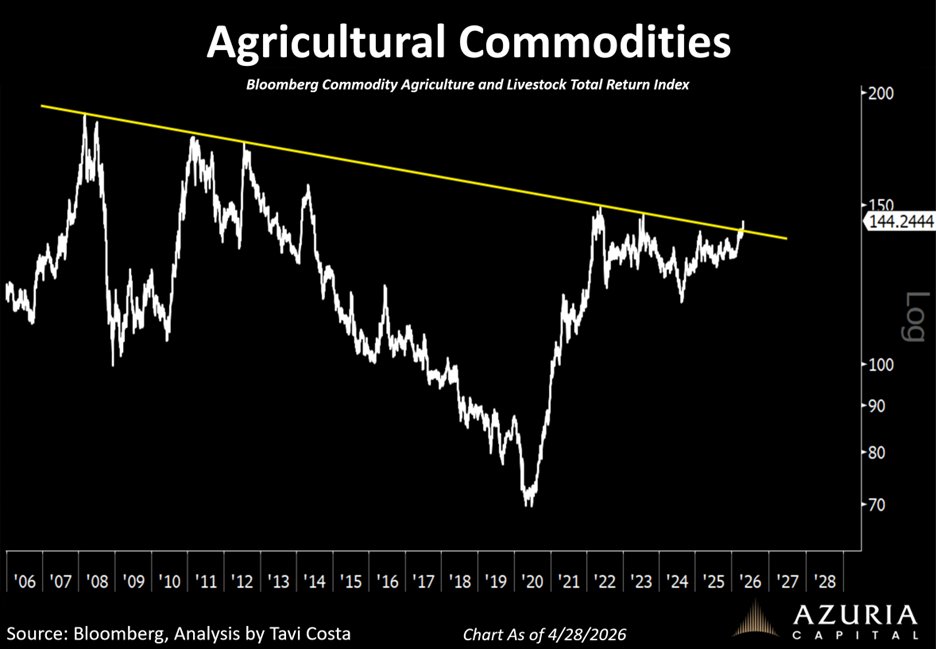
$GRO | When grains move, fertilizer matters.
@TaviCosta notes corn, wheat, cotton, sugar and rice prices are beginning to turn higher — a reminder that food security starts with reliable crop inputs including fertilizer.
Brazil imports over 95% of its potash. $GRO is advancing domestic supply closer to Brazilian farmers.
Agricultural commodities are now breaking out decisively from nearly 20-year resistance.
Just as expected:
When energy moves, food prices tend to follow.
This is deeply concerning for society, yet it aligns with the broader macro trend.
People will point to isolated narratives like droughts, but that misses the bigger picture.
This is a second-order effect of the energy issue.
https://t.co/II9JJhU4ql
Brazil is sitting on some of the largest fresh water reserves on Earth.
And almost nobody prices it in.
The Guarani Aquifer holds close to 40,000 cubic kilometers of water under southern Brazil.
That is enough to give the whole world drinking water for around 200 years at today's use.
It is one of the largest aquifer systems ever found on the planet.
About two-thirds of it sits under Brazilian soil.
Then scientists looked under the Amazon and found something even greater.
They call it the Great Amazon Aquifer System.
Early estimates put it near 162,000 cubic kilometers, roughly four times the Guarani.
Even the conservative numbers are enormous.
The Urucuia Aquifer feeds the farms of western Bahia and the MATOPIBA region.
It also keeps the São Francisco River flowing through the dry season.
That same aquifer lost about 31 cubic kilometers of water in just two decades.
Groundwater is the reason farmers there can grow crops on the same land year round.
Global markets still price Brazil on its politics.
They forget what is sitting under the ground.
A Brazilian soybean farmer ordering potash from Saskatchewan today waits 107 days for delivery.
A farm 60 kilometers from a mine inside Brazil could get the same product in 2.5 days.
That is 104 days saved.
It is also $357 per ton saved on every load that arrives.
Spread that gap across 2.4 million tons of annual production and the number gets serious.
Brazil currently leaks roughly $857 million per year to Saskatchewan, Russia, and Belarus on this one input.
The country that feeds nearly 1 in 10 people on Earth pays a 73% markup to import the mineral that grows the food.
Last month I spent three days on the ground in the Amazon examining the Brazil Potash ($GRO) project structurally positioned to close that gap.
The asset is not what Wall Street thinks it is.
The mine is the cover story. The real position underneath is a 15-year exclusive logistics contract on empty river barges that already run upriver.
Read the Full thesis here:
https://t.co/gEMYt2OiTo
----------------------------------------------------
Disclosure: Austral Continental is a paid content and advisory partner of Brazil Potash Corp (NYSE-A: GRO). This thread is sponsored research and contains forward-looking statements. Full disclosure: https://t.co/F2ZfLW9mdr.
-----------------------------------------------------
$GRO | #ICYMI Tariffs. Trade shifts. Fertilizer supply.
In this interview with Departure Capital, Brazil Potash CEO Matt Simpson breaks down:
• Why potash markets are tightening
• How global trade is reshaping supply
• Why Brazil is at the center of it all
Watch the full conversation 👇
https://t.co/oxo3JmqZ1x
#Potash #FoodSecurity
$GRO | Energy markets move fast.
Potash doesn’t — and that’s the risk.
By the time fertilizer prices react, farmers have already adjusted:
→ Delayed purchases
→ Lower application
→ Crop shifts
Brazil sits at the center — heavily reliant on imports.
Domestic supply matters.
#Potash #FoodSecurity
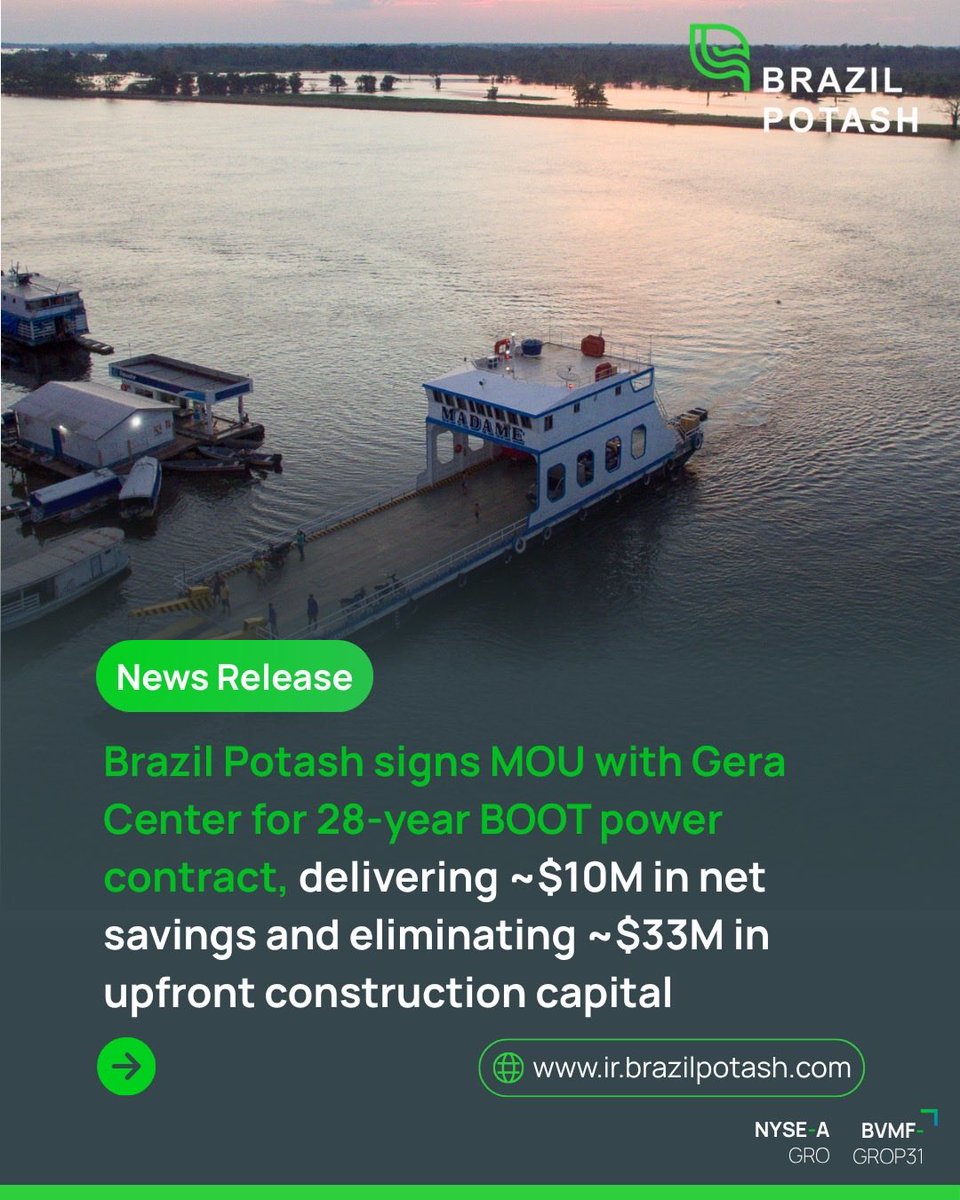
$GRO | Brazil Potash signs MOU with Gera Center for a 28-year BOOT power agreement supporting construction and operations at the Autazes Project.
Key highlights: ⚡ ~$33M removed from upfront construction capital ⚡ ~$10M estimated net savings vs. PFS ⚡ 20MW modular power system ⚡ 120-day mobilization timeline ⚡ 98% contractual backup availability
The agreement supports GRO’s broader strategy of using BOOT structures to reduce upfront capex while advancing critical infrastructure for construction in the Amazon region.
The MOU is non-binding. Read the full news: for important cautionary information regarding forward-looking statements: https://t.co/1uC6ics0AH
#Potash #Brazil #Mining #Infrastructure
$GRO | As @drewcrawford_ highlights, the global conversation is shifting from “when things stabilize” to who controls the resources the world cannot function without.
Brazil sits at the center of that discussion: 🌎 Global agricultural powerhouse 💧 One of the world’s largest fresh water reserves ⚡ One of the cleanest major power grids globally ⛏ Critical mineral and fertilizer supply chain relevance
Potash is part of that equation.
Most capital allocators are still waiting for the world to settle down.
It won’t.
The better question is where the world’s must-have resources sit, and who controls them.
Brazil is the only large democracy that does all five at once.
It is the top global exporter of soy, beef, coffee, sugar, orange juice, and chicken.
Its fresh water is enough to keep feeding the world through every UN climate scenario on paper.
The grid runs on ~88% clean power, nearly four times the share of the United States.
Brazil controls ~90% of the world’s niobium, supplied almost entirely from one mountain in Minas Gerais (the metal that hardens jet engines, pipelines, and high-grade steel).
Add iron ore, rare earths, graphite, nickel, manganese, and bauxite and Brazil ranks top four globally in every one.
And the Amazon stores 200 billion tonnes of carbon, more than every allowance Europe’s carbon market has ever priced.
No other major economy has this stack.
The mispricing is the opportunity.
——————
Clip from Brazilian Regional Markets | Brazil Week at The Harvard Club of New York
#brazil #investing #finance #emergingmarkets #brasil
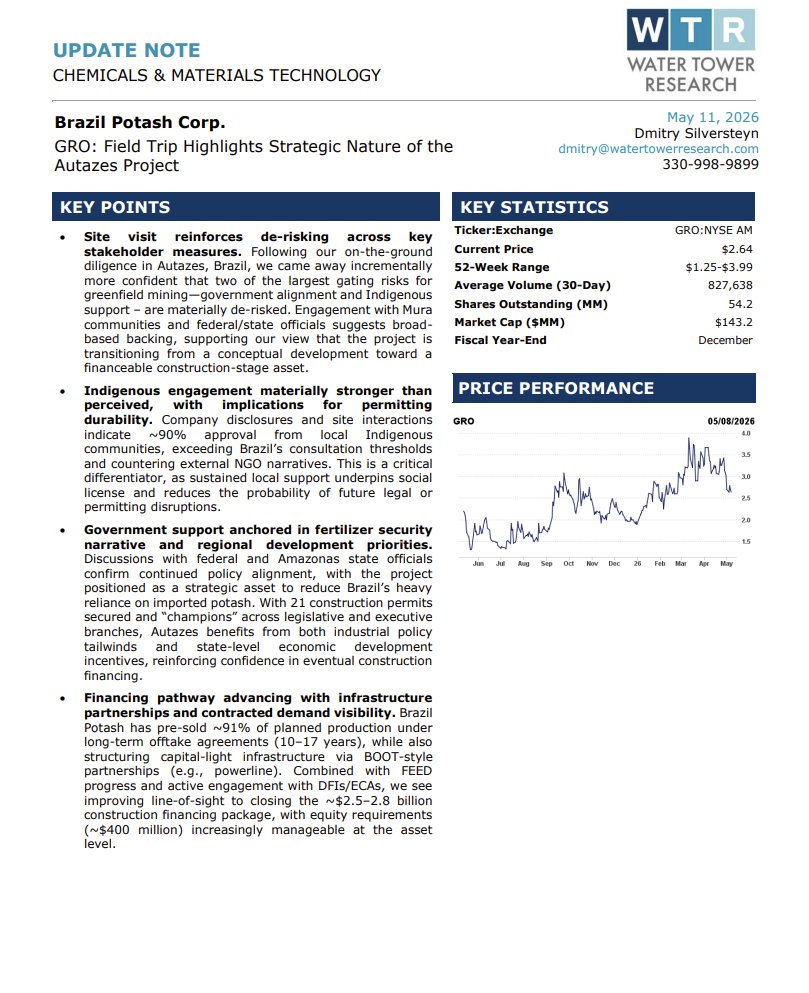
Recent site visits to Autazes, Brazil reinforce improving confidence in Brazil Potash Corp's project execution and long-term viability.
🔹 Key risks de-risking. Government alignment and Indigenous support appear materially stronger following on-the-ground diligence.
🔹 Community engagement. Local Indigenous backing remains well above consultation thresholds, supporting permitting durability.
🔹 Strategic importance. Project positioned as a key asset in Brazil’s fertilizer security and regional development strategy.
🔹 Financing progress. Long-term offtake agreements, infrastructure partnerships, and financing discussions continue advancing toward construction-stage readiness.
Read Dmitry Silversteyn's full report for additional detail on project development, permitting, and financing outlook.
https://t.co/RbSUUVPZqp
$GRO #Mining #Potash #Fertilizer #CriticalMaterials #Infrastructure #EmergingMarkets #Investing #SmallCaps #WaterTowerResearch @CorpPotash
$GRO | Potash is being redefined as a “future-facing commodity.”
New supply is coming — including projects in Brazil.
The shift is clear:
→ More demand
→ Concentrated supply
→ Need for diversification
Brazil is a key part of that story.
@globeandmail
https://t.co/lOhJtFdASA
#Potash #FoodSecurity
NYSE: $GRO | BVMF: $GROP31
$GRO | Brazil Potash has awarded the FEED contract for key surface facilities and infrastructure at the Autazes Project to Wood and Promon Engenharia.
The scope includes the processing plant, tailings facility, river barge port, and ~13 km road upgrade connecting plant to port.
A key step toward bankability and construction financing readiness.
Read the full news release: https://t.co/ED68bHBlck
NYSE: $GRO | BVMF: $GROP31
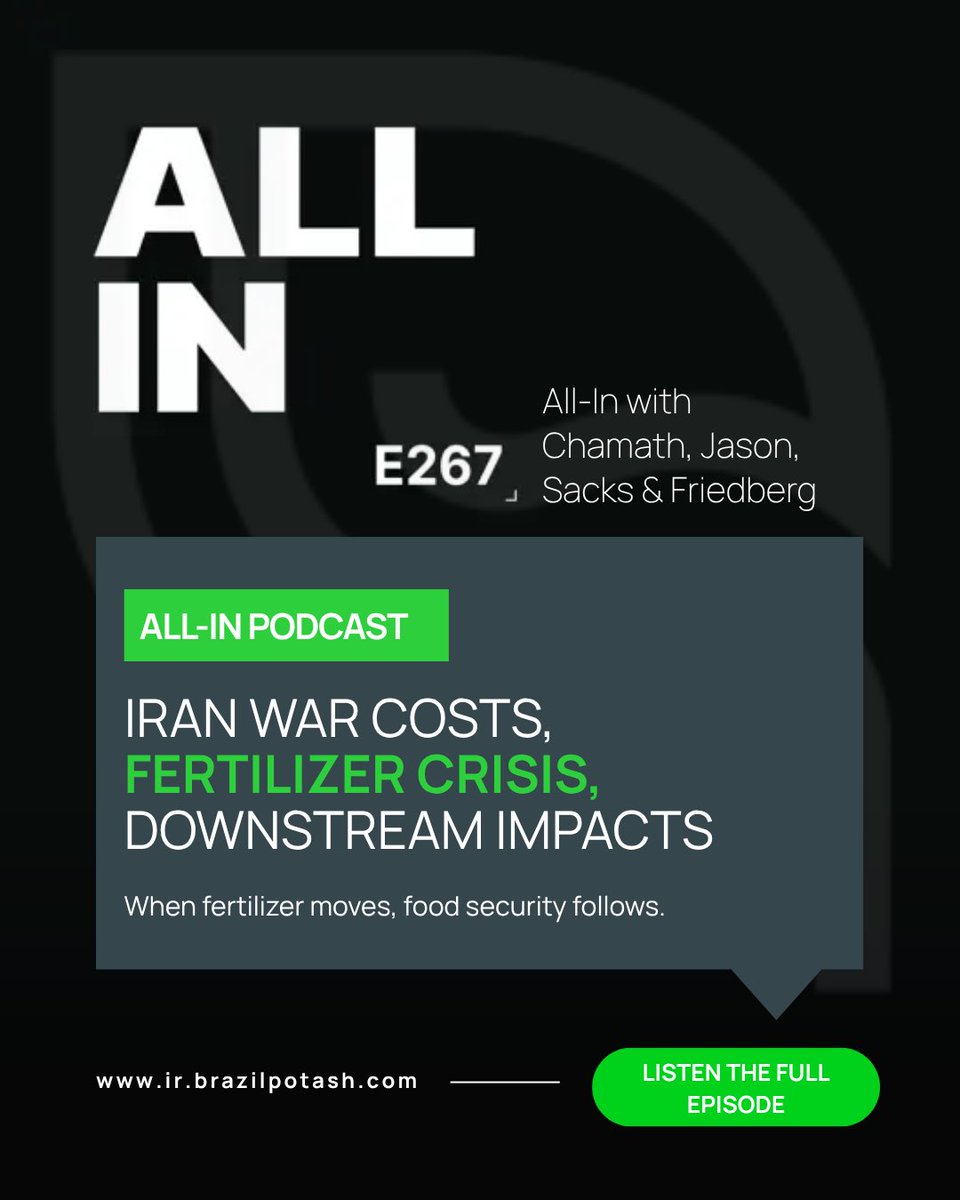
$GRO | One of latest @theallinpod episodes made a key point: fertilizer is not a side story. It is a core part of food security.
The conversation focused on nitrogen and global shipping chokepoints, but the broader lesson applies across agriculture: when supply chains tighten, farmers feel it fast.
For Brazil, that is exactly why domestic potash matters. More local supply means more reliability, better logistics, and less exposure to external shocks.
https://t.co/eG3BkF2OQw
#BrazilPotash #Potash #Fertilizer #FoodSecurity
NYSE: $GRO | BVMF: $GROP31