BREAKING: Donald Trump rejects AI CEOs request for a coordinated slowdown in development
"Whoever wins AI wins. We can put guardrails... They're bringing up things that won't happen."
Yesterday 2 large accounts on X posted we’d have “blowout employment numbers & a ripping rally today”. I posted this same message twice yesterday: “Never front run the NFP”. I’ll repeat it again, it’s a fool’s errand. A coin flip. Never front run it with index trades. Period. 💯
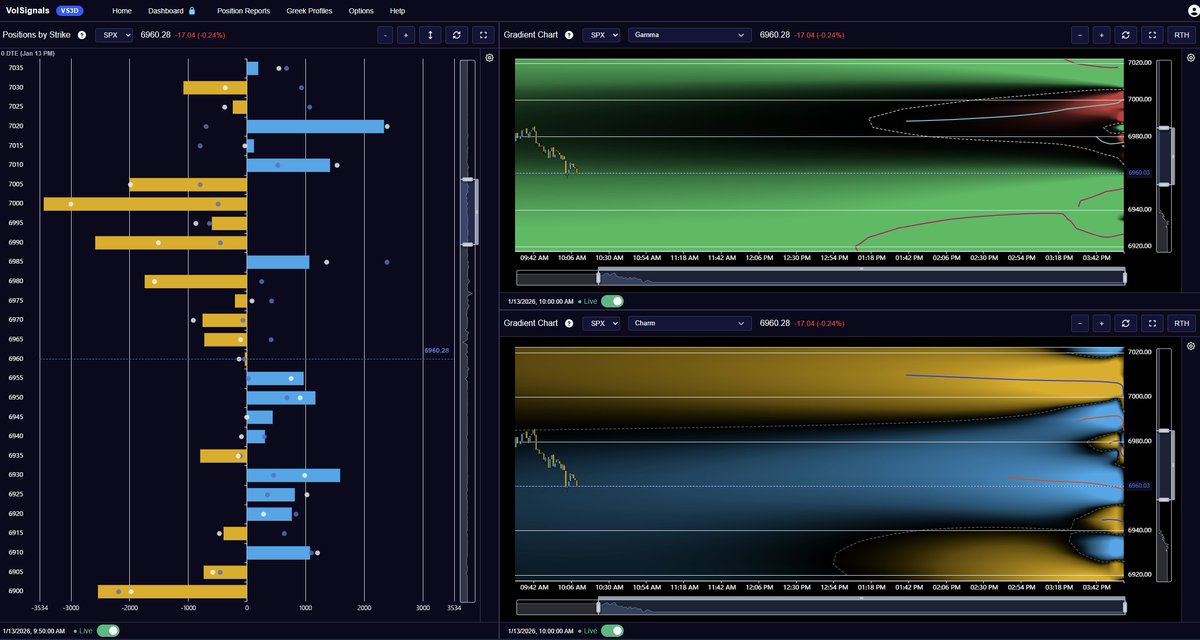
The prescription is clear, but we have conditionals-
do you understand how to read and trade this?
If not >> what are your questions?
We will address the most asked questions on today's livestream at 1:30 PM ET
Retweet this please, we'd like to be challenged on feed
The Bond Market Is Whispering a Warning
When the Smart Money Starts to Sweat
Bonds don’t shout. They whisper. Stocks are the loud drunk at the party; bonds are the sober man in the corner who’s seen enough cycles to know how this ends and lately, that man has started tapping me on the shoulder.
The last 60 days have delivered one of the strangest yield curve behaviors I’ve seen since the early 2000s:
The long end (10Y–30Y) quietly grinding higher.
The front end stubbornly anchored by central-bank chest-beating.
Liquidity thinning at the edges.
Duration hedging picking up among institutions that never hedge unless they feel something.
If you listen carefully, the bond market is whispering the same warning it gave in 2007, 2000, 1994, and—if you want a darker analogy—1930:
“Growth is being mispriced. Again.”
A Yield Curve That Wants to Normalize, but Can’t
The yield curve inversion has been the macro story of the last two years. What matters now is how it dis-inverts.
There are two ways an inversion ends:
- Soft landing: short rates fall.
- Hard landing: long rates spike because inflation becomes unanchored.
We are seeing pieces of both simultaneously, which is rare and unsettling.
Inflation expectations are drifting upward. Wage growth is sticky. Fiscal deficits are still running like we’re in wartime.
The term premium is crawling back from the dead.
The last time this combination occurred?
1967–1969, right before the U.S. sleepwalked into a decade of monetary chaos.
The Term Premium Resurrection
For 15 years, the term premium sat in a shallow grave.
A byproduct of QE, ZIRP, and the idea that central banks could suppress time itself.
Now?
The corpse is moving.
Not violently — but enough that every desk I know is modeling the probability of a structural drift higher in long-term yields.
You can thank:
- Persistent fiscal expansion
- Rising geopolitical risk
- Declining foreign demand for Treasuries
- Quiet but real de-anchoring of inflation expectations
The world is less stable. The dollar is less predictable.
When the narrative anchors slip, term premium rises.
The Quiet Liquidity Problem No One Wants to Discuss
There are three “liquidity deserts” forming:
- Off-the-run Treasuries
- MBS duration hedging cycles
- Treasury auctions absorbing greater-than-expected supply
Foreign central banks aren’t stepping in. U.S. households aren’t stepping in. Money-market funds are locked inside the reverse repo loop.
That leaves primary dealers doing the heavy lifting — and they’re not built for it. Liquidity is a fair-weather friend. When yields rise in illiquid markets, they rise faster than they should.
The Macro Domino: Housing & Credit Tightening
Mortgage rates north of 7% aren’t an anomaly — they’re the new base case. Corporate credit spreads have stopped tightening. Default expectations are rising at the lower end of the junk spectrum.
Commercial real estate refinancing timelines look like a spreadsheet from the ninth circle of hell.
If long-end yields push another 50–70 bps higher, something in the credit plumbing snaps.
It always does.
What the Bond Market Is Really Telling Us
The whisper is clear:
“This is not a cycle. It’s a regime change.”
Here’s what that implies:
- Inflation is no longer transitory — it’s episodic
- Central banks are losing narrative control
- Fiscal dominance has entered the chat
The market is starting to price a world where the cost of money actually costs something.
Real assets outperform
Leverage becomes a liability, not a strategy
This is exactly how new eras begin: quietly, with basis points that snowball.
Portfolio Positioning (Not investment advice)
If I were back on the trading desk tomorrow, this is what I’d do:
- Increase real-asset exposure: gold, energy, infrastructure
-Underweight long-duration tech
- Overweight short-duration value
- Buy volatility whenever it’s mispriced
- Limit leverage
Avoid anything that only works in zero-rate world.
Stay liquid enough to strike when the cracks widen.
The next major repricing won’t be loud.
It will be a soft rumble — then a sudden break.
I’ve learned to trust the whisper.
Ben.
@alshfaw I am curious to know if you think Apple (LILO) will be used to get the SPY to 660, then the drawdown. Historically, there are many double tops on Apple’s chart. I think another $260 might get the job done.
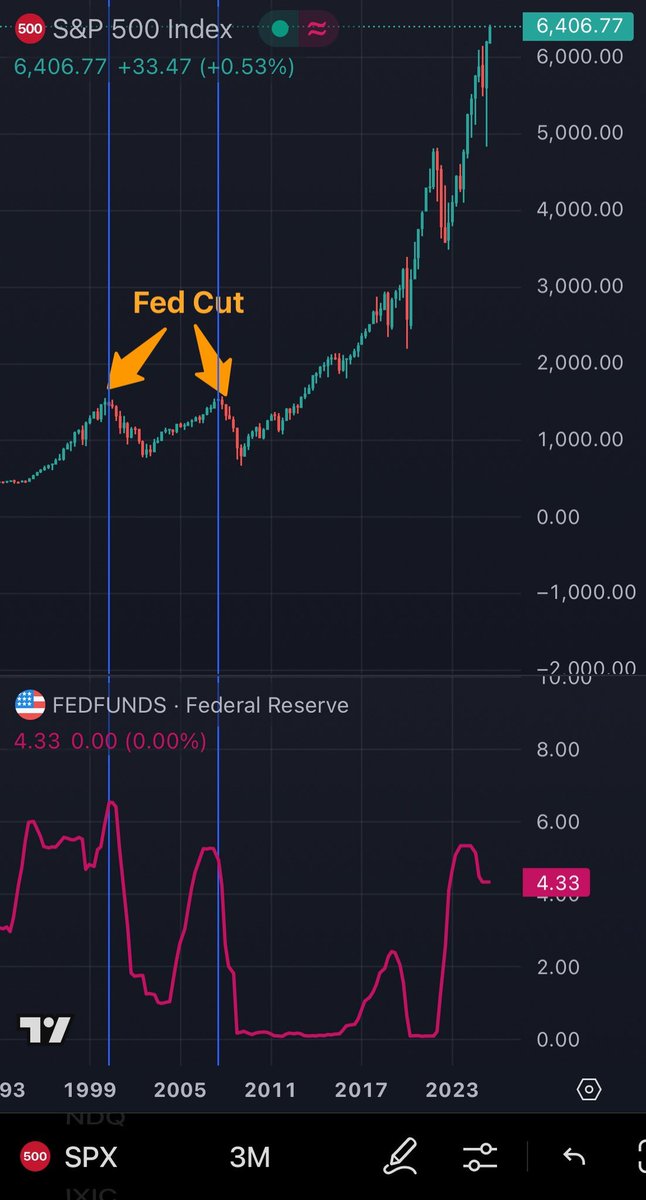
Wonder how soon until markets remember the start of a Fed cutting cycle marked the top of both the Dot Com bubble and Great Recession?
This time is different tho, obviously 🤔
Re-opening for 48 hours (FREE)
The Options Strategy COMPASS — a 2-video bundle that turns “I like this chart” into a repeatable plan.
Inside you’ll get:
How to pick the right options structure by goal (direction, vol, income, hedge) and by a risk ladder (fixed-premium → short-gamma).
A simple framework from idea → structure → risk → execution (so time and carry work for you...)
A one-page visual to keep on your desk, plus examples to make it stick.
Want it?
Reply “COMPASS” + retweet, and I’ll DM you the link (must follow so I can message you).
Available for a couple of days—then it goes back in the vault.
@salbets_ And I believe the Packer���s receivers were near the top, or were the top, in the league in dropped passes. Should see some mean reversion. Love the Love pick.