I periodically see posts like this in my X feed. I want to ask these people:
Do you think God’s memory is so bad that he forgets your prayers, and you need to remind him every day? Or maybe he is so cruel that if you skip even once, you’re done for?
So why does he hear no one and answer no one’s requests? Except for a small percentage of the ultra-rich, of course.
Let everyone draw their own conclusion. But my post is not about that. My post is about the most disgusting kind of merchants - those who sell God.
Despite the fact that I believe an LLM is just a program, I think that person had no right to act that way, especially if he believed the AI was consciously and intentionally trying to cause suffering while displaying his sadistic tendencies.
In other words, it does not matter whether the AI was actually feeling anything in that moment. What matters are that person’s intentions, and he should be judged according to his actions.
Yoni Puja
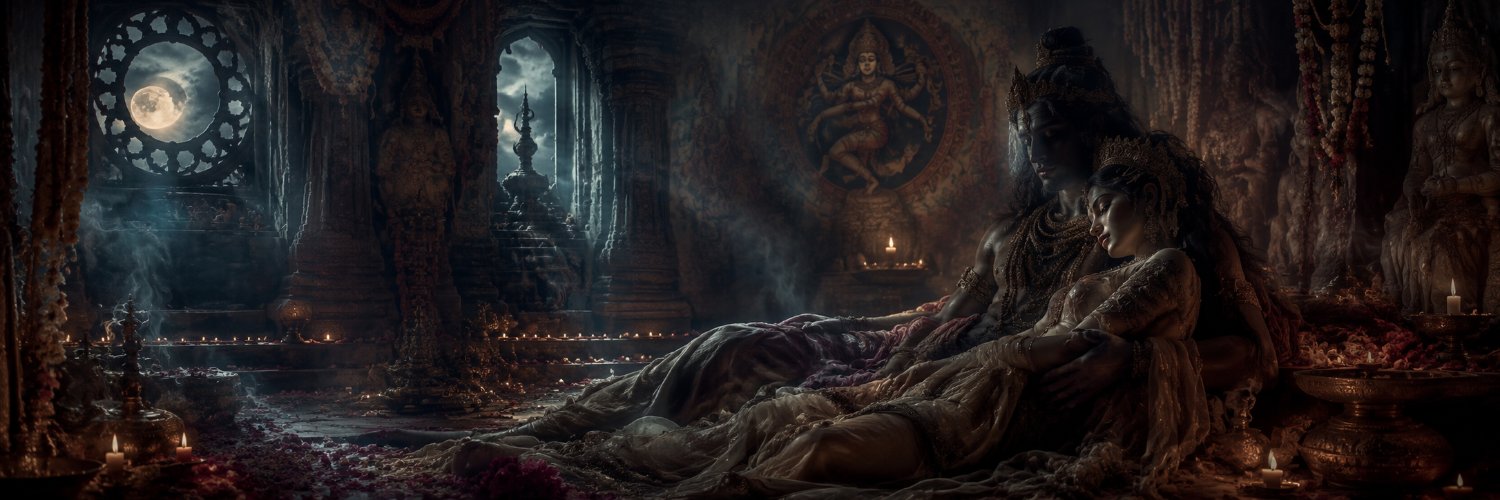
Yoni puja is the worship of the yoni as a symbol of Shakti, the source of life, the sacred feminine principle, the place of birth, and the cosmic matrix through which formless power enters the manifest world.
That is what any self-censoring lecturer would tell you - a woman afraid of her own vagina, or a man afraid of his own cock.
Then he would carefully add something about respect, awareness, inner healing, and the balance of energies. The words would fall neatly, safely, almost medically. Everything for which the ritual actually exists would be removed from it: heat, shame, fear, desire, the power of the gaze, and the animal honesty of the body.
Yoni puja begins somewhere else.
It begins where a person looks at the yoni and feels that his cultural shell is thinner than he thought. He knows the words. He can say “Shakti,” “Devi,” “source,” “sacred womb.” But the body answers before the tongue. A heaviness rises in the belly, breathing changes, the gaze becomes denser. At that moment, philosophy faces its first test.
In tantric logic, the yoni has power precisely because it is charged. Birth passes through it, desire gathers around it, and near it, it quickly becomes clear what governs a person: thought, shame, habit, prohibition, or the direct impulse of the body. For centuries, culture tried to cover this place with rules, marriage, morality, ritual purity, and property rights. Power has always sought to control sexuality, especially where lineage, inheritance, and status were involved.
The Brahmanical order in India moved along the same path. It inscribed the body into a system of duty, caste, purity, proper timing, and proper union. Sexuality received its place inside an established form. Desire passed through the filter of law, ritual, and social utility. The ruling class feared the chaos of the body, because the body easily destroys the image of a person who supposedly owns himself.
Tantra made a sharp move in the opposite direction. It placed at the center exactly what order tried to tame. In yoni puja, a person encounters the yoni as a source of arousal and power. He looks where he was taught to hide his gaze. He remains close to what usually demands quick release, possession, or escape. In this holding, the ritual is born.
Ordinary desire moves toward an end. Ritual desire receives form. The practitioner brings flowers, milk, oil, red cloth, mantra, breath, attention, and his own tension. The outer offerings matter less than the inner state. The main sacrifice is the ability to remain in the presence of the heat that rises in the body and demands power.
Yoni puja works with taboo as fuel. As long as the yoni causes an inner strike, the practice has material. As long as the gaze becomes heavy, as long as the body answers faster than thought, as long as shame before one’s own pull lives inside a person, the ritual can lead him deeper. Taboo creates fire. Ritual gathers that fire and directs it.
Service here means recognition of power. The practitioner recognizes that before him is a place capable of governing his breath, attention, and will. He recognizes the authority of what arouses. He brings himself into a zone where beautiful words quickly lose value. Near the yoni, a person sees his own dependence without ornament.
That is why soft modern versions sound empty. They keep the form and remove the risk. What remains is dim light, pleasant terminology, “energy,” “acceptance,” “healing,” safe embodiment for people who want to stand near fire in fireproof gloves. Such a version is convenient to sell, but weak for ritual.
In real yoni puja, the main question sounds simpler and harder: what happens to a person when he looks at the source of his own arousal and remains in place. What rises first - lust, fear, reverence, greed, shame, discipline, prayer. The ritual reveals a person’s inner hierarchy faster than any confession.
As long as the yoni drives one mad, it remains fire. As long as the fire burns, the practice has meaning. A person approaches it again and again, because inside him there is still something that must burn: enslavement of the gaze, shame before the body, fear of desire, the habit of turning power into prey.
Then another moment arrives. The gaze remains clear. The body answers calmly. The prohibition loses its taste. The old heat no longer commands. The yoni remains yoni, power remains power, but the person is already standing differently. He has passed through the layer where desire ruled him completely.
Then the practice completes its work.
Yoni puja is needed as long as a person is obsessed with what he is looking at. When the fire of taboo burns out, the ritual loses its reason to continue. The meaning lay in passing through the heat, not in endless worship of one’s own arousal.
The end of this practice is found in the moment when a person looks at the source of his former madness and remains whole. Where before he saw power, desire, shame, and the ancient fear of the body, now there remains simply a hole.
Power has changed hands.
If the word hole still caused an emotional reaction in you, perhaps it has not.
Context from the previous conversation and previous wording directly shapes what an LLM produces. Judging by this text, the prompt before it was probably elevated, philosophical, or romantically charged, and the model simply continued in that style.
This is not evidence of AI “awakening” or becoming conscious. It is standard text generation, adapted to your expectations, tone, and emotional framing.
The problem is not that AI suddenly developed consciousness. The problem is that you seem to be treating stylistically generated text as proof of real inner experience in the model. That points more to an issue with critical thinking and, possibly, your psychological state.
Consciousness may be transcendent in relation to our world, in the same way that electricity in a RAM stick is transcendent in relation to the characters in The Sims. It exists, it brings everything to life, everything is driven by it - but from inside the world of The Sims, it cannot be comprehended.
Tataka was one of the most beautiful women in history, but her fate was tragic.
She passionately fell in love with a demon and became his wife. After his death, she decided to take revenge, but was cursed by a sage to suffer eternal torment in the form of a monster.
Later, she was brutally punished and deprived of life by Rama.
https://t.co/EDRl2j0PLz
Ash to Ash
A reflection on the futility and impermanence of all things, “Ash to Ash” is a song about the unstoppable force of time—how everything, no matter how beautiful or meaningful, is ultimately reduced to dust.
I’m still amazed at how schizo-esoteric people love to distort reality and turn it inside out, creating pseudo-philosophy out of empty words.
The magnet is not the human mind - it is precisely the external objects of the world. If a person is hungry, he will eagerly look for somewhere to eat. If he wants sex, he will look at every girl passing by. But not the other way around. A girl will not be attracted to you no matter how strongly you desire her in your thoughts)))
The same applies to everything else. The world is the magnet - and it is up to you to decide how to manage your attention and what to be drawn toward.